Obsidian: True Value, Fair Pricing & Buying Guide
Why does one obsidian bracelet cost $25 and another $70? Here's my honest answer as a creator: where the price really comes from, how to spot true quality, and how not to get taken.
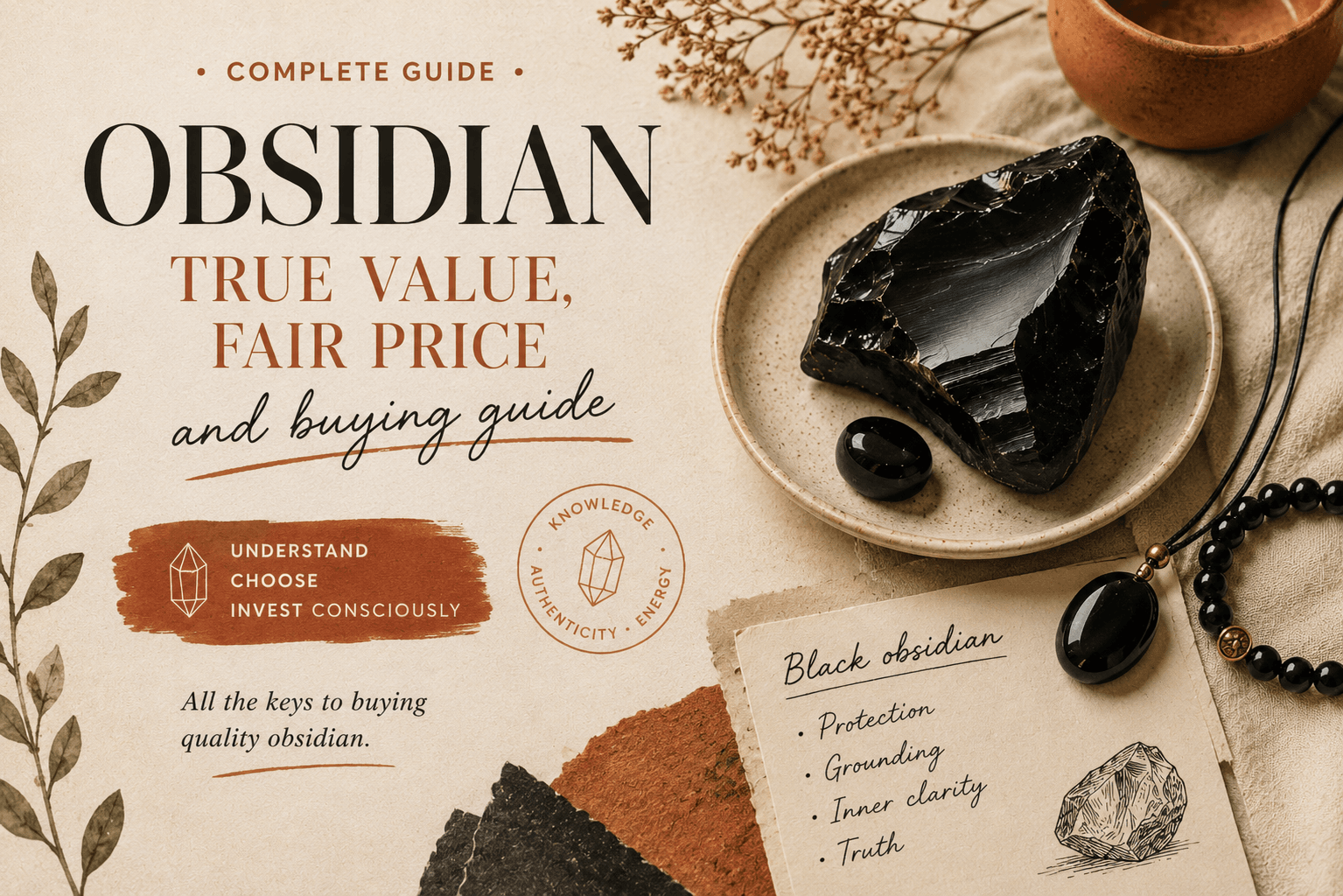
Obsidian captivates with its raw beauty and reputation as a protective stone. But the moment price enters the conversation, answers scatter everywhere. Same-looking piece, triple the cost. It's the question I get asked most since opening my studio in 2024.
I'm going to give you my honest answer, no corporate speak. Just where real value in obsidian comes from, and how to know if you're paying fair.
The real cost of raw stone
Start with a truth that surprises people: obsidian is not a rare stone. It's volcanic glass that forms wherever silica-rich lava cools fast, Mexico, Iceland, the US, Armenia, New Zealand. Nothing like a diamond or emerald.
Direct consequence: raw material costs almost nothing. For a kilogram of good-quality black obsidian (no visible cracks, properly dense), a wholesale supplier charges between $12 and $35 per kilogram. And one kilogram makes a lot of beads.
Remember this: if someone sells you obsidian as "premium-priced because the stone is rare," be wary. The stone alone never justifies a high price. Everything else does.
Where your money actually goes
Here's what matters. When you buy a $40 obsidian bracelet, here's roughly where each dollar goes:
Secondary materials are waxed cord, quality elastic thread, stainless steel, clasps, spacer beads. Business overhead covers packaging, the website, shipping fees, taxes, a modest margin. Craftsmanship: stone selection, assembly, finishing, quality control.
In short: you're not paying for the pebble, you're paying for the hands that shaped it. It's exactly like bread. The flour costs nothing; it's the baker's skill that makes the difference.
Real prices in 2026
Let's be concrete. Here's what to expect for authentic, handmade obsidian in the US market:
8-10mm beads, careful assembly, black obsidian
Calibrated beads, details, variety or stone pairings
Depends on shape, size, and stone variety
Quality chain or cord + mounted pendant or beads
Delicate setting, spherical bead, hand-finished
Bracelet + necklace + pendant + ring, coordinated
Watch out for rock-bottom prices: an obsidian bracelet for $3, $5 on a mass marketplace almost always hides something, tinted glass sold as obsidian, or mass production with zero oversight. I'm not judging, but know what you're buying.
Rare varieties and the price markup
Black obsidian is most common, those are the prices above. But certain varieties are genuinely rarer, and that shows in the price:
| Variety | Rarity | Price impact |
|---|---|---|
| Black obsidian | Common | Baseline |
| Gold sheen obsidian | Rare | + 20-40% |
| Rainbow obsidian | Very rare | + 40-60% |
| Mahogany obsidian | Uncommon | + 15-35% |
| Snowflake obsidian | Very rare | + 50-70% |
Why do gold sheen and rainbow cost more? Because their reflections, golden for one, blue-iridescent for the other, come from fine natural inclusions found only in certain deposits, in small quantities. Beautiful, properly oriented beads are scarce, so they cost more at source. That's a justified markup, not inflated margins.
Spotting true quality
You know the prices now. The question is whether you're paying for real quality. Here are five signs I always look for:
1. Regular, calibrated beads
Beads of uniform size and shape signal careful sorting and quality craftsmanship. Irregular, poorly polished beads point to rushed work.
2. A true glass-like shine
Hold the stone to light. Real obsidian has a deep, almost liquid polish, like black glass. If it's dull, gray, or covered in micro-scratches, the polishing was skipped, or it's not obsidian.
3. Clean finishing
No fraying cord, no cracked beads, no rusting clasps. These details speak volumes about care taken throughout.
4. Clear provenance
Obsidian doesn't need official certification (none exists). But the creator should be able to explain where their stone comes from and how it was worked. If it's vague, that's a red flag.
5. A reachable creator
My favorite test: email the seller. "Why this obsidian? How do you work it?" A personal, prompt reply shows someone who truly knows their craft. Silence or a template message? Move on.
Pitfalls to avoid
To not get fooled, watch for these red flags:
"Certified obsidian by a gemologist"
There's no standardized certification for obsidian. If someone claims it's "certified," ask for proof, it rarely exists.
"Guaranteed health benefits"
No stone can guarantee health or energy effects. In the US, claiming it violates FTC standards. Honest sellers always phrase properties conditionally, not as promises.
"Insane price drop, 90% off"
An obsidian piece slashed to a few dollars isn't a deal, it's a sign corners were cut. Questionable materials, fragile assembly, or outright counterfeits. You'll have something that falls apart in months.
Weak or generic photos
Tiny, blurry images, or photos recycled everywhere online? Be suspicious. A true artisan showcases their own work, from multiple angles.
Why I price the way I do
For full transparency: my bracelets, pendants, necklaces, and rings in obsidian range from around $32 to $65. Here's my thinking:
- I hand-select every stone, not bulk buying with eyes closed. Time-intensive, but it changes everything.
- I assemble each piece myself, every bead passes through my hands, every knot is checked.
- I use lasting materials, waxed cord, stainless steel, never cheap alloys that darken skin.
- I package with care, each order ships with a care guide, not just a plastic bag.
- I make no magic claims, just a beautiful, honest piece you'll wear for years without apology.
"I'd rather sell less but look every customer in the eye. My price is the actual time I spent on your piece, nothing added, nothing missing."
Smart buying without breaking the bank
To wrap up, my tips for a wise, confident purchase:
- Get clear on what you want. A daily bracelet? A piece for a special moment? Budget shifts accordingly.
- Set a range. $30, $50, $100? Pick your target zone, this stops endless second-guessing.
- Compare makers, not just prices. A $35 bracelet done right beats a $15 one that breaks fast.
- Ask questions before buying. Stone source, craftsmanship, care, quality answers tell you as much as the product.
- Read thoughtful reviews. Skip the five-star parade; nuanced feedback is often most helpful.
- Catch seasonal drops. Many artisans offer limited-time discounts. Wait a bit, get better value without cutting quality.
And if you want deeper stone knowledge, my complete obsidian guide covers everything: varieties, properties, care, and meaning.
My obsidian pieces
If you're hunting for fair pricing and handmade quality, here are some of my creations. Each is personally selected, assembled, and checked:
Frequently asked questions
Does gold sheen obsidian really cost more than black?
How can I be sure I'm paying for real handmade work?
Is a $5 obsidian bracelet ever honest?
Does a pricey obsidian have more power than a cheap one?
Where can I check fair pricing for obsidian in 2026?
Find your obsidian piece
A bracelet for everyday wear, a gold sheen set, or a rare rainbow obsidian piece, all handmade, fairly priced.