Every God Associated With Obsidian
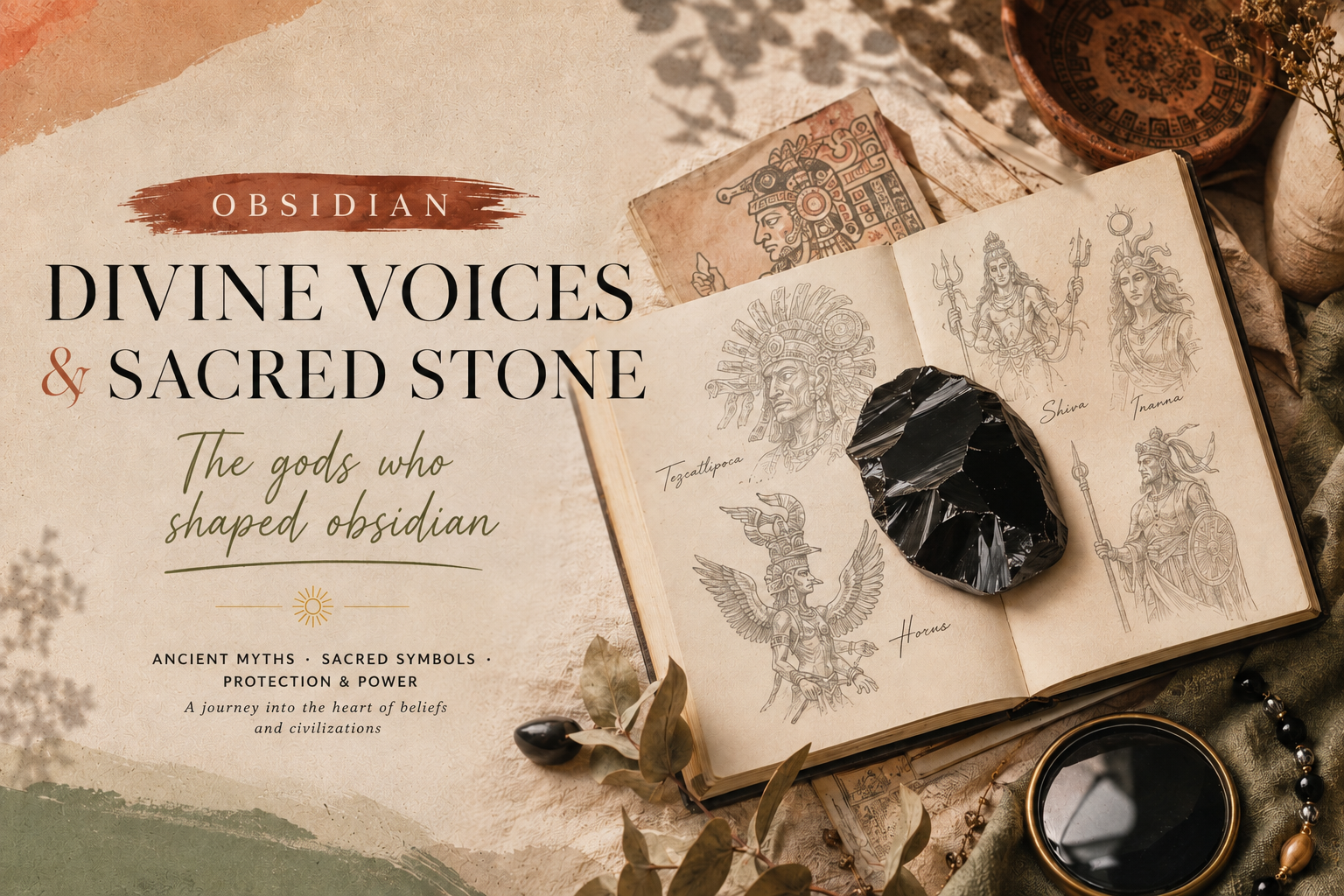
For the Aztecs, obsidian wasn't just another stone: it had its own deities, with names that describe it directly. Smoking Mirror, Obsidian Knife, Curved Point, Obsidian Butterfly. Here are the historically documented obsidian gods, and, just as useful, the ones attributed to it today with no real basis at all.
Why does a stone end up with its own gods?
Not every stone gets its own deity. Obsidian did, for a very concrete reason: in Mesoamerica, it was the single most important material in the civilization's material culture.
Without iron metallurgy, a freshly flaked obsidian blade offered the sharpest edge available. It was used for everything: cutting, hunting, ritual sacrifice, shaving, surgery. It was also a form of currency, an object of long-distance trade, and a source of political leverage between city-states.
A material that central always ends up divine. What stands out in the Aztec case is that several deities carry its name within their own, itztli meaning "obsidian" in Nahuatl.
When I found out the Nahuatl word for obsidian shows up inside the names of three different deities, I understood why this stone obsessed me so much. It isn't just a pretty rock: it's a material that organized the lives of millions of people.
Tezcatlipoca, the Smoking Mirror
The central figure, and one of the major deities of the Aztec pantheon. His name, in Nahuatl, literally means "Smoking Mirror", tezcatl, mirror, poca, that which smokes.
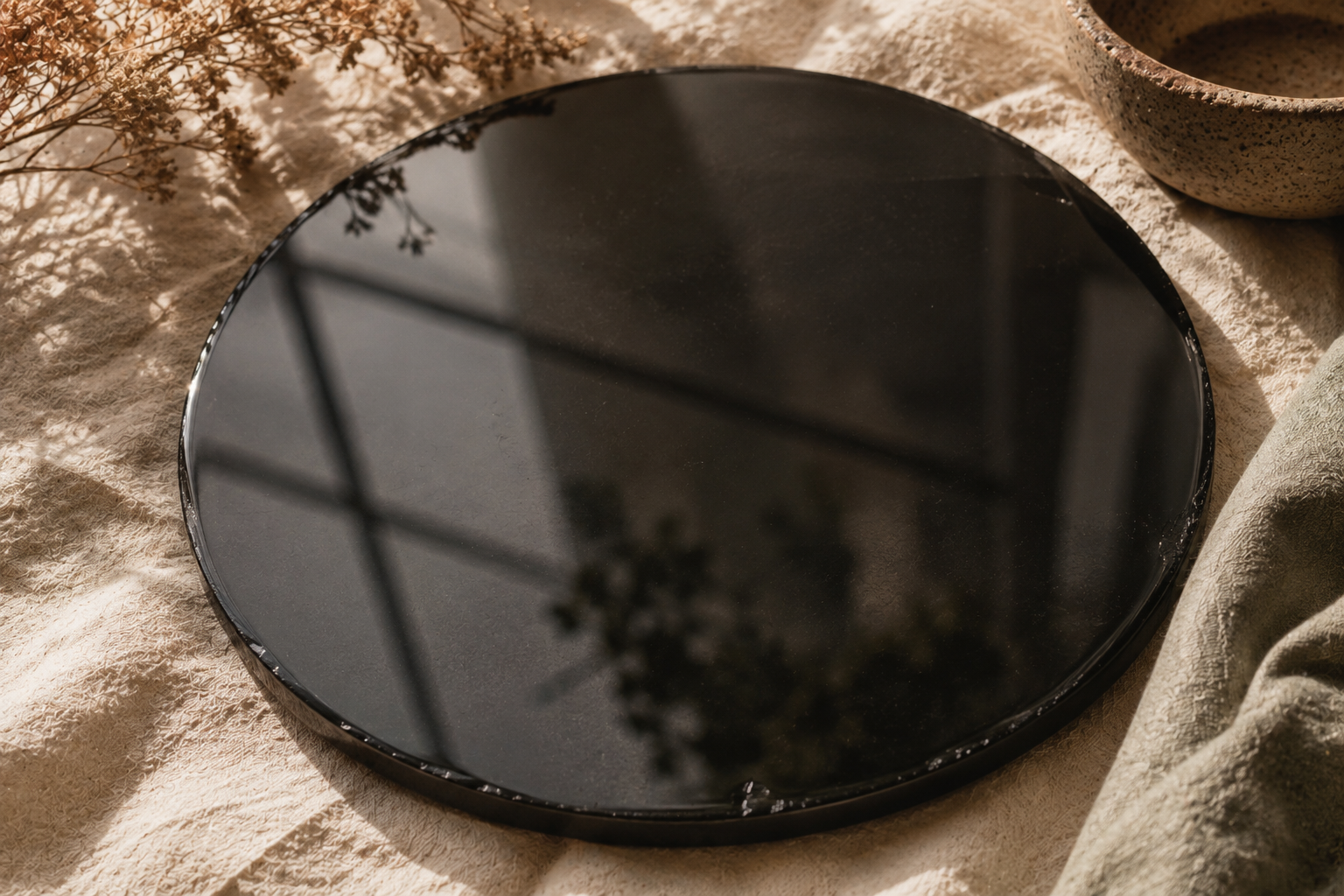
This mirror isn't a metaphor. The Aztecs polished obsidian disks into genuine mirrors, dark, deep, in which the reflection appears veiled as if by smoke. These objects were used for divination: priests searched them for visions, read fate in them, and looked for what was hidden.
- Name
- Tezcatlipoca, "Smoking Mirror"
- Culture
- Aztec (Nahua), Postclassic Mesoamerica
- Domains
- Night, fate, sorcery, discord, kingship
- Link to obsidian
- The scrying mirror is his attribute; several obsidian deities are his variants
Tezcatlipoca is an ambivalent god: neither good nor evil, but unpredictable. He sees everything, including what people hide from themselves. This figure is the direct source of obsidian's reputation as a "stone of truth" and a mirror of the soul, an idea that survives intact in modern crystal healing.
A thread that crosses the centuries, when obsidian is described today as a stone that "shows back what needs to be seen," it unknowingly continues an Aztec symbolism more than five centuries old. It's one of the rare modern correspondences with a genuine historical root.
Itztli, the Obsidian Knife
The most literal of them all: itztli is simply the Nahuatl word for obsidian. The god is the stone, personified in its sharpest form, the sacrificial blade.
- Name
- Itztli (or Itzli), "Obsidian," "Obsidian Knife"
- Culture
- Aztec (Nahua)
- Rank
- Second of the nine Lords of the Night
- Domains
- Stone, sacrifice, night
- Relation
- A variant of Tezcatlipoca
The Lords of the Night form a cycle of nine deities, each governing one night, within the Aztec calendar system. Itztli holds second place in that cycle. His function is tied to sacrifice: the obsidian blade was the instrument through which blood was offered, within a cosmology where the order of the world demanded that debt.
It has to be said plainly, without dressing it up or softening it: human sacrifice was part of Aztec religion, and obsidian held a central role in it. This dimension belongs to the stone's history just as much as its everyday uses.
Itztlacoliuhqui, the Curved Obsidian Point
His full name, Itztlacoliuhqui-Ixquimilli, translates to "Curved Obsidian Point" and "Blindfolded One." He is the god of frost, cold, and winter, but also of sin, punishment, and human misery.
- Name
- Itztlacoliuhqui-Ixquimilli, "Curved Obsidian Point"
- Culture
- Aztec (Nahua)
- Domains
- Frost, cold, winter, punishment, blind justice
- Relation
- A variant of Tezcatlipoca; associated with the north and night
His myth is striking. He was first Tlahuizcalpantecuhtli, Lord of the Dawn, Venus as the morning star. During the creation of the Fifth Sun, he challenged the sun Tonatiuh to a duel of projectiles. He lost, and Tonatiuh, as punishment, pierced his head and transformed him into the god of stone and cold.
From the light of dawn to frozen stone: it's a myth of fall and petrification. His blindfolded eyes also make him a figure of blind justice, the kind that strikes without regard for who it hits.
This one moves me in particular. A deity of light turned to black stone for missing his target, there's something very human in that, and a poetic explanation for why obsidian feels so cold to the touch.
Itzpapalotl, the Obsidian Butterfly
The most beautiful name of the group, and the most fearsome figure. Itzpapalotl means "Obsidian Butterfly": a skeletal warrior goddess, her wings edged with stone blades.
- Name
- Itzpapalotl, "Obsidian Butterfly"
- Culture
- Aztec, of Chichimec origin
- Domains
- War, sacrifice, fate, the paradise of Tamoanchan
- Attribute
- Butterfly wings edged with obsidian blades
The image carries rare power: the lightness of a butterfly armed with the stone's edge. She rules over Tamoanchan, a mythical paradise, and embodies both beauty and danger at once, exactly what obsidian represents materially, a splendid material whose edge can cut flesh.
This duality illuminates an intuition that survives in modern practice: obsidian is described as a powerful but blunt stone, one best approached gradually. I cover this in my guide to obsidian safety and precautions.
Among the Maya: the mirror, more than the god
Maya civilization used obsidian extensively, ritual blades, flakes for bloodletting self-sacrifice, trade goods. And yet it never produced an obsidian deity as clearly identified as the Aztec ones.
What you do find, instead, is the importance of the mirror motif in divine iconography. Several deities carry a reflective attribute on their forehead or body, a marker of their supernatural nature. The logic is the same, the mirror as a threshold between worlds, but it never crystallized into a single god carrying the stone's name.
A word of caution, many sites attribute specific "obsidian gods" to the Maya. This is generally a mix-up with the Aztec pantheon, or an extrapolation. The two civilizations are distinct, separated by centuries and hundreds of miles.
Pele, goddess of fire, and a distinction that matters
You often come across Pele, the Hawaiian goddess of volcanoes and fire, in lists of deities linked to obsidian. That's partly justified, partly inaccurate, and the distinction is worth spelling out.
Pele rules over volcanic fire, and two formations carry her name: "Pele's hair," glass filaments stretched by the wind, and "Pele's tears," teardrop-shaped droplets of solidified glass.
The detail almost everyone leaves out, these formations are indeed volcanic glass, but they are not obsidian. They're basaltic in composition, low in silica, whereas obsidian forms from lavas rich in silica, and much more viscous.
That viscosity is what lets obsidian form compact masses, while fluid basalt scatters into filaments and droplets. Two volcanic glasses, two chemistries, two behaviors.
Pele is therefore a deity of volcanic glass in general, not of obsidian in the strict sense. The distinction isn't a purist's footnote: it explains why Hawaii, despite intense volcanic activity, produces very little obsidian. To understand the mechanism, see my article on how obsidian is formed.
Modern claims: what has no basis
A quick search will turn up obsidian linked to Hecate, Kali, Anubis, Hades, Lilith, the Morrigan, or Saturn. Let's be clear: none of these associations have any historical basis.
They come from crystal healing and neo-paganism over the last few decades, working by thematic analogy: obsidian is black, these deities are linked to night, the underworld, or death, so the two get paired.
| Deity | Link to obsidian | Status |
|---|---|---|
| Tezcatlipoca | Obsidian mirror, his attribute | Historically documented |
| Itztli | His name means "obsidian" | Historically documented |
| Itztlacoliuhqui | "Curved Obsidian Point" | Historically documented |
| Itzpapalotl | "Obsidian Butterfly" | Historically documented |
| Pele | Basaltic volcanic glass | Real link, but not obsidian |
| Hecate, Kali, Anubis… | Analogy with black and night | Modern claim |
This doesn't make these associations worthless for those who work with them, a symbolic correspondence functions through the intention behind it. But presenting Hecate as "the Greek goddess of obsidian" is simply false: ancient Greece knew this stone without attributing a deity of its own to it.
The name itself, "obsidian" doesn't come from a god, but from a man. Pliny the Elder, in the 1st century AD, records that the stone was named after a man called Obsius, who supposedly brought it back from Ethiopia. A mundane origin for a stone so laden with the sacred.
What this changes when you wear obsidian
Nothing, materially. But perhaps something in terms of attention.
What this history reveals is that the qualities attributed to obsidian today, truth, the mirror, blunt protection, an intensity that needs taming, aren't recent inventions. They have a documented root, more than five hundred years old, in a civilization that knew this stone better than anyone.
That's rare enough in the world of crystals to be worth noting. Many crystal-healing correspondences were formulated in the 20th century; this one traces back to Tezcatlipoca.
If you'd like to explore this dimension further, rainbow obsidian naturally extends the theme of reflection and inner sight. For practice, see my guide to meditating with obsidian, and for the energetic mapping, obsidian and chakras.
Worth knowing, this article covers religious traditions and historical facts. The properties attributed to stones in crystal healing belong to beliefs; they are not a medical claim and never replace the advice of a health professional.
Frequently asked questions
What is the god of obsidian?
What does "Tezcatlipoca" mean?
Did the Maya have a god of obsidian?
Is Hecate linked to obsidian?
Are Pele's tears obsidian?
Where does the word "obsidian" come from?
Why was obsidian so important in Mesoamerica?
Wear the stone of Tezcatlipoca
Bracelets, necklaces, pendants, and rings in natural obsidian, handmade in my studio in France.