Types of Obsidian: Every Variety, Explained
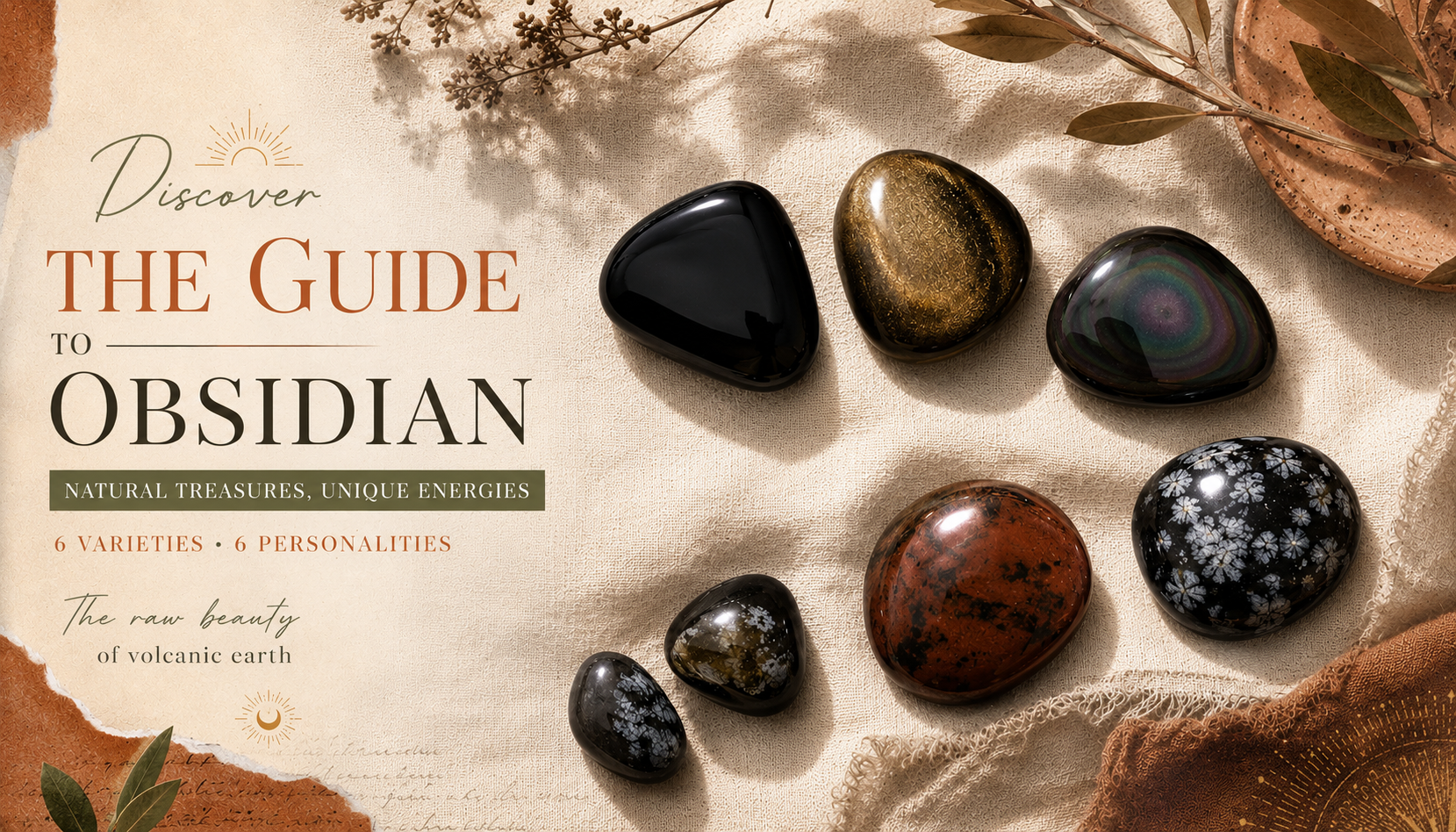
Most people picture obsidian as one thing: a black stone. It's actually a whole family, deep blacks, gold sheens, blue-purple flashes, white speckles, and a handful of varieties so rare that collectors chase single deposits for them. Here are all the types of obsidian, what causes each look, and which ones are really just glass.
Where the different types of obsidian come from
To understand the varieties, you have to start with what obsidian actually is: a natural volcanic glass, born when silica-rich lava cools so fast that its minerals never get the chance to crystallize. I walk through that whole process in my article on how obsidian is formed.
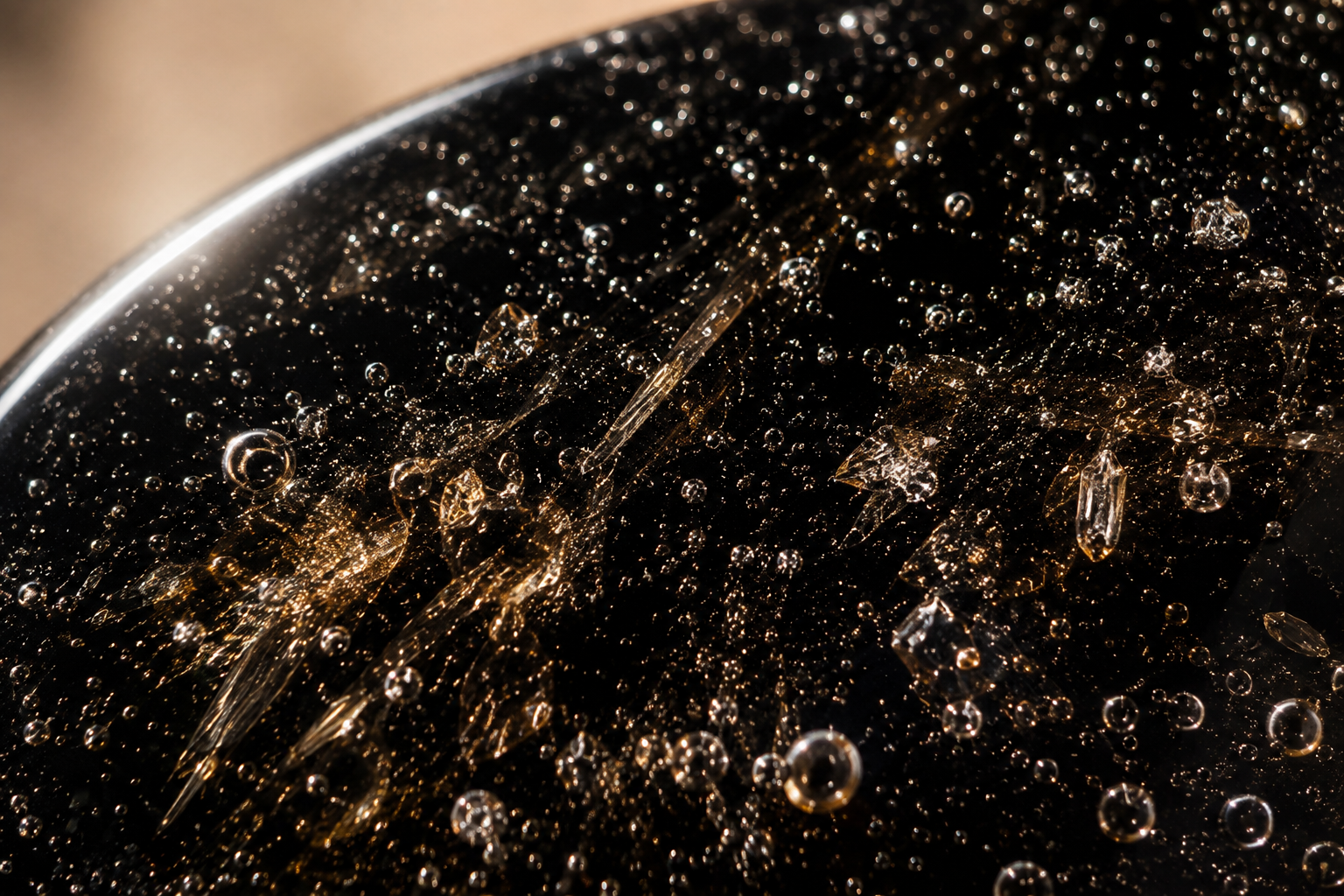
That origin has one big consequence: obsidian is almost always dark. Its "colors" and patterns don't come from pigment. They come from tiny inclusions that play with light, white cristobalite crystals, aligned gas bubbles, magnetite nanoparticles, traces of iron and hematite. That internal signature is what separates one type of obsidian from another, and it's why a single block can carry several effects at once, and why no two stones are ever quite alike.
In the US you're standing on some of the best obsidian country in the world: Glass Buttes in central Oregon, Obsidian Cliff in Yellowstone (a National Historic Landmark, and a source traded across half the continent in prehistory), the Newberry Volcano flows in Oregon, Glass Mountain in northern California, and the volcanic fields of New Mexico and Arizona. For everything about the stone itself, origins, symbolism, properties, start with my complete black obsidian guide.
The 7 most common types of obsidian
Let's start with the varieties you'll actually run into, in jewelry and in crystal shops alike.
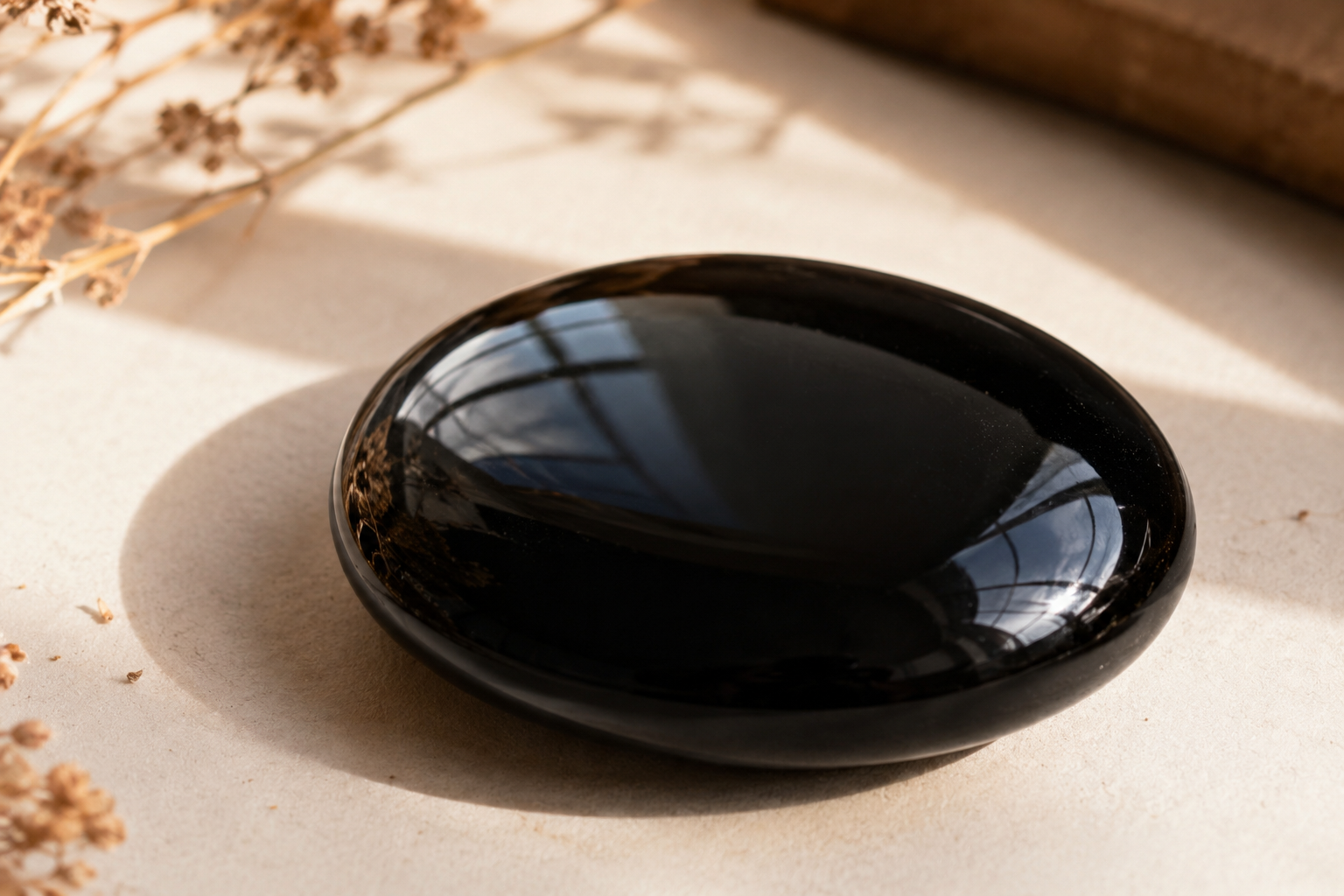
Black obsidian
Pure black, smooth, glassy. Protection and grounding.
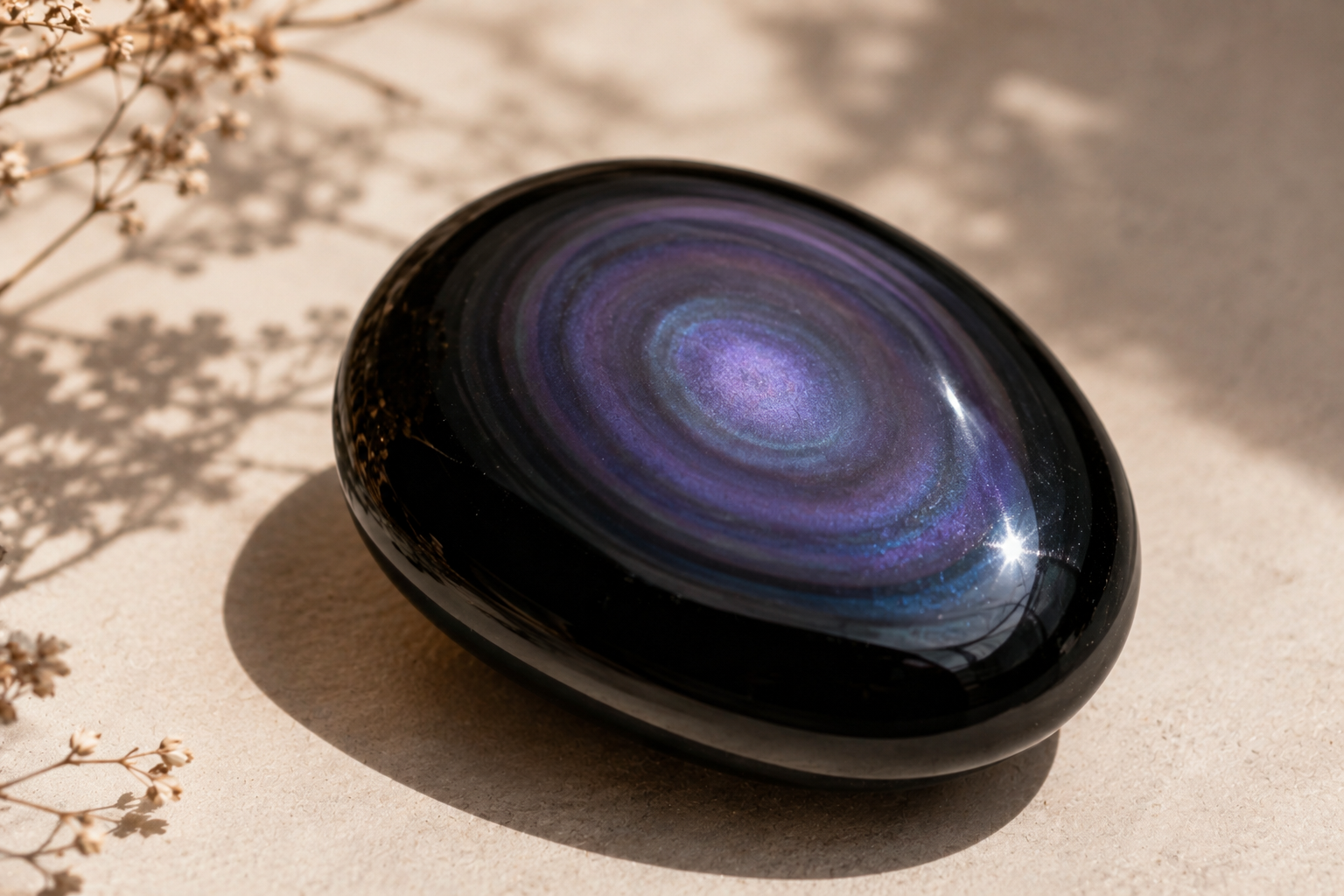
Rainbow obsidian
Blue-violet flashes at the right angle. Softness, intuition.
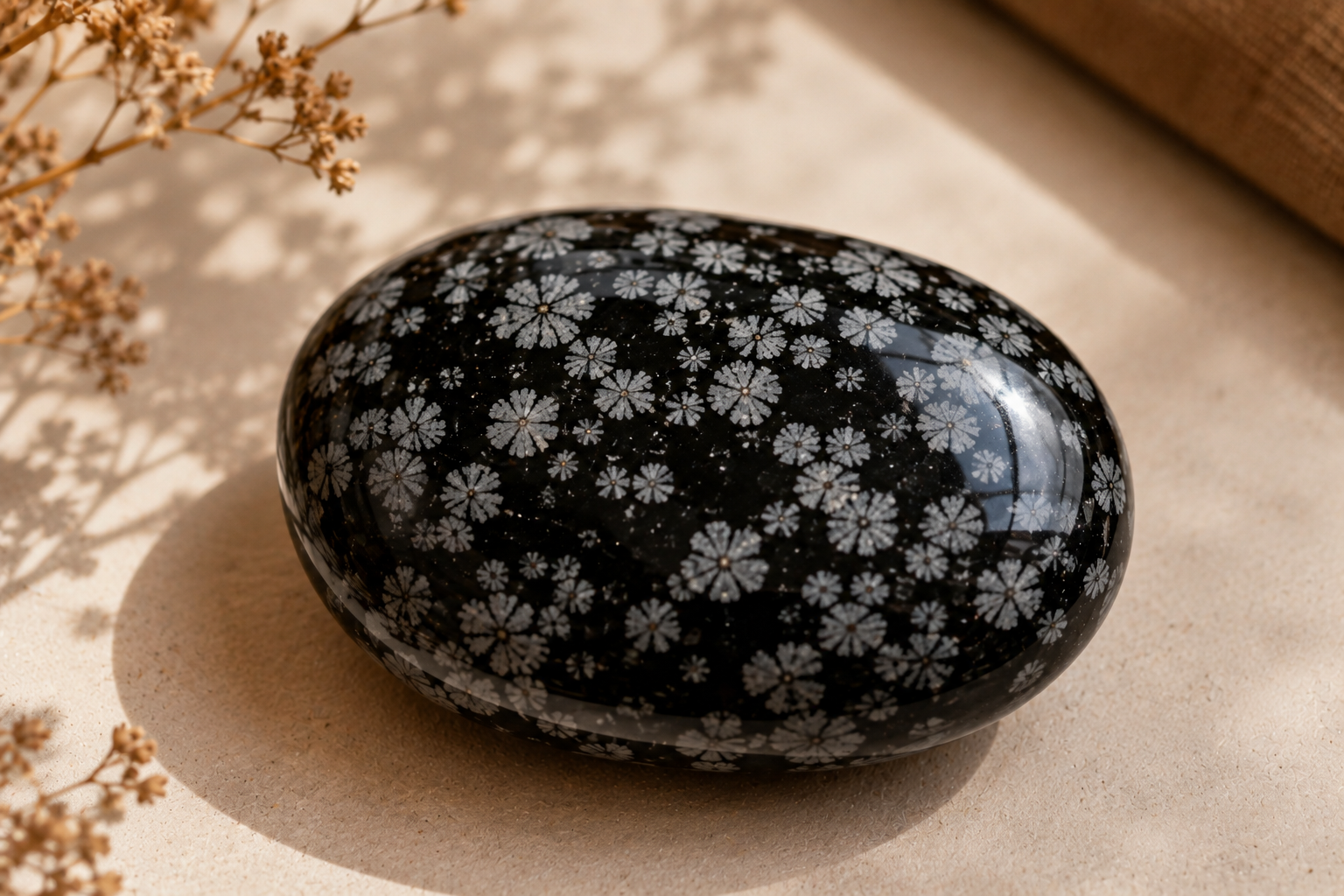
Snowflake obsidian
Black flecked with white. Balance, letting go.
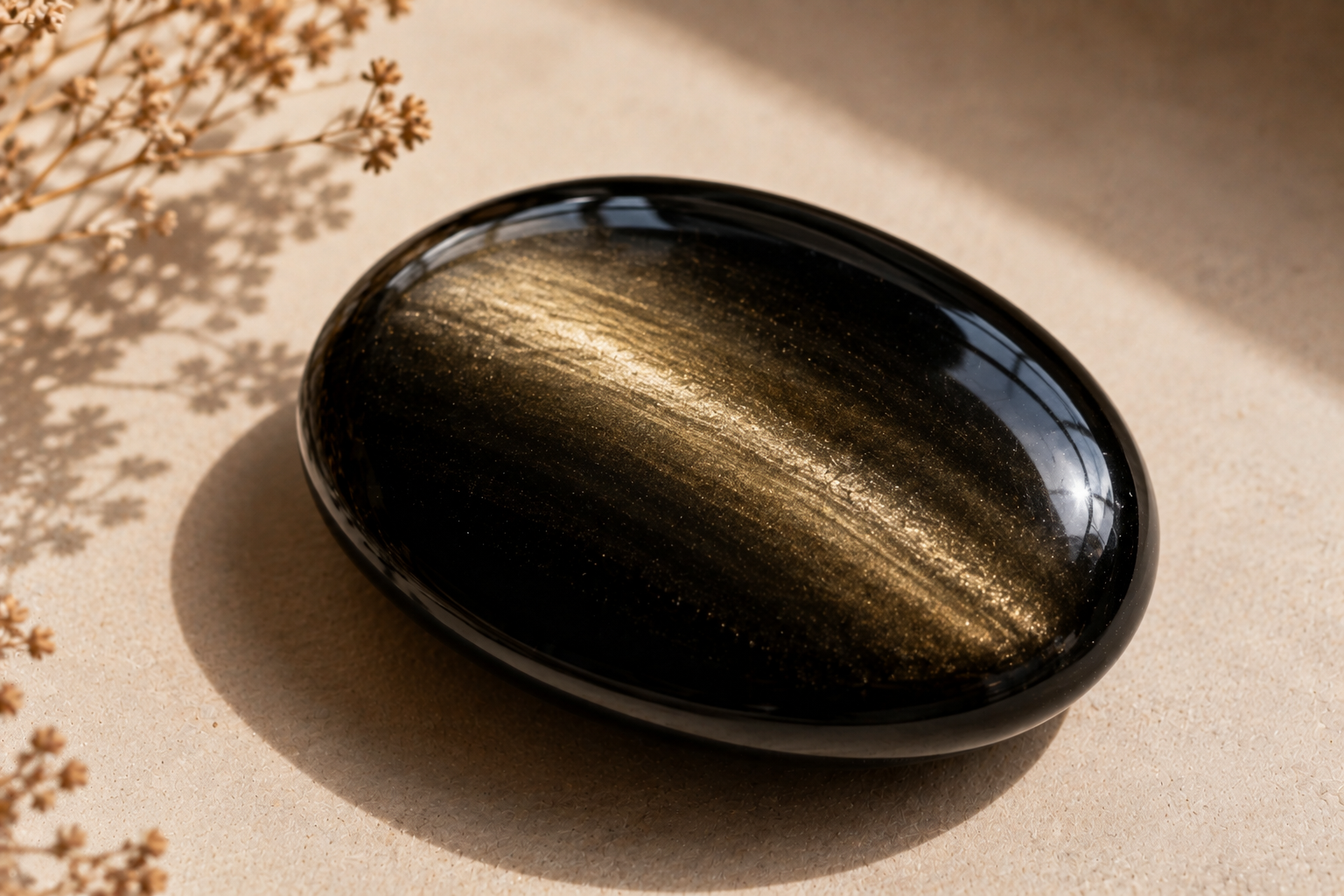
Gold sheen obsidian
A golden veil moves across it. Confidence, abundance.
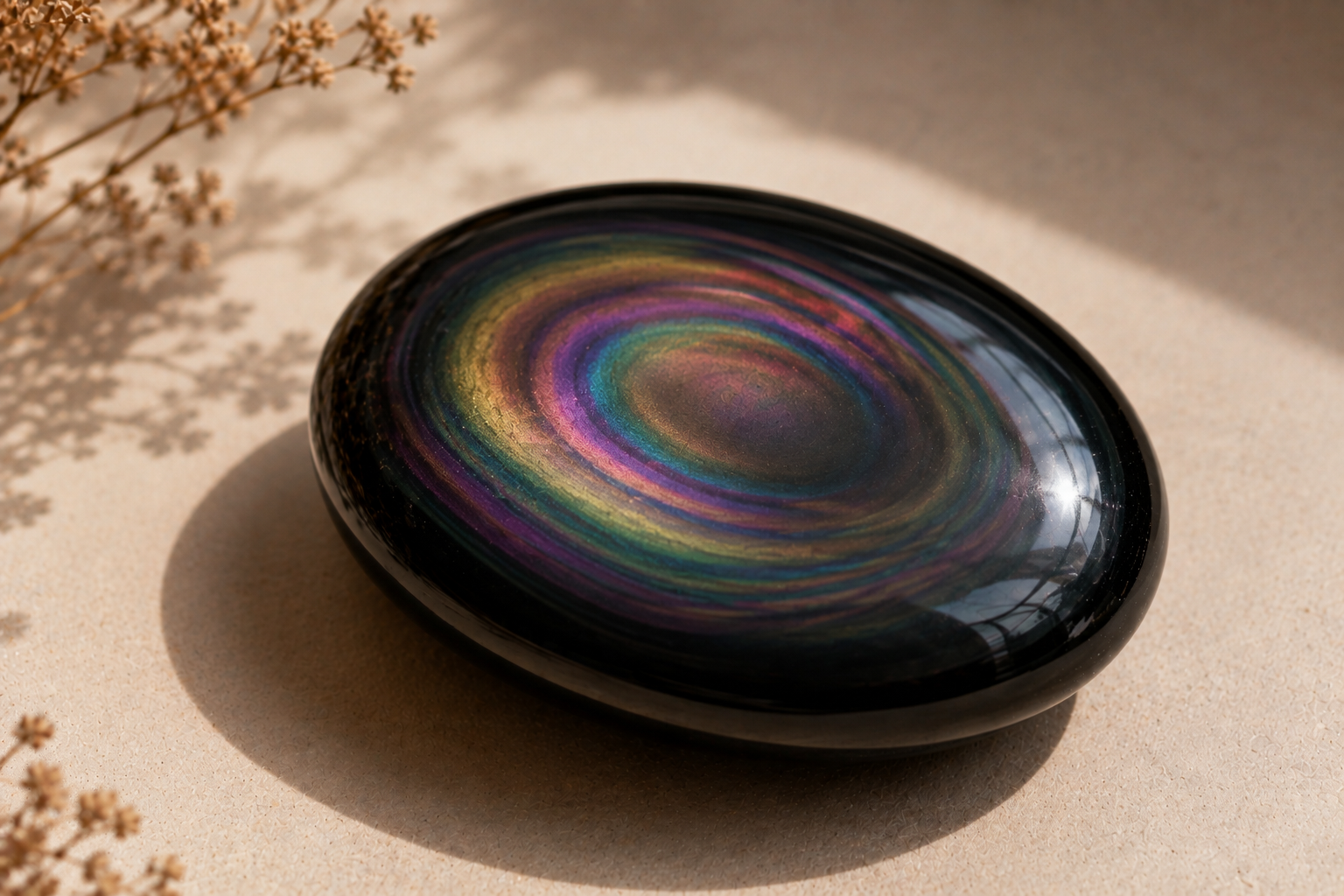
Silver sheen obsidian
The same effect, cooler and moonlit. Clarity.
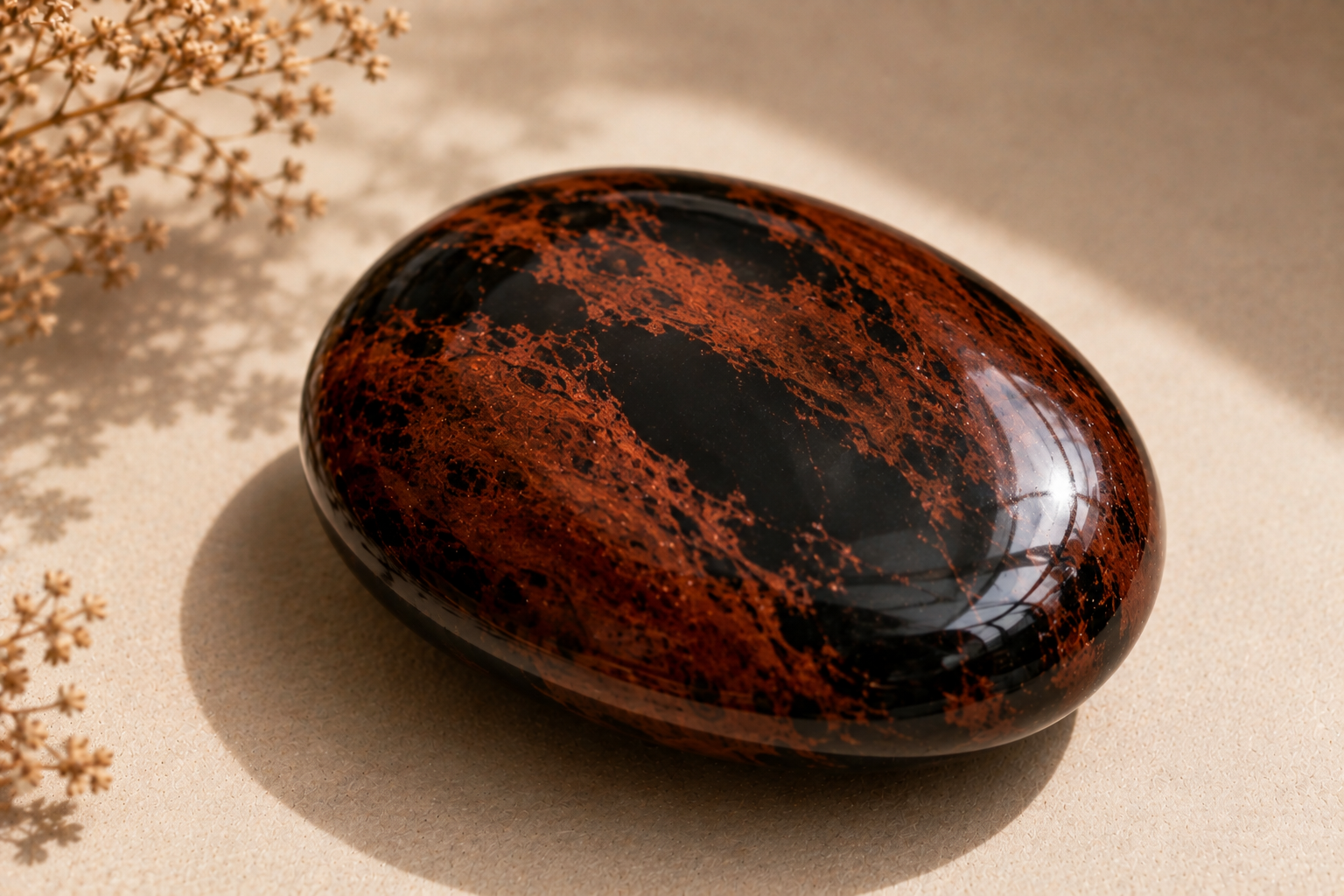
Mahogany obsidian
Black marbled with red-brown iron. Grounding, vitality.
Apache tears
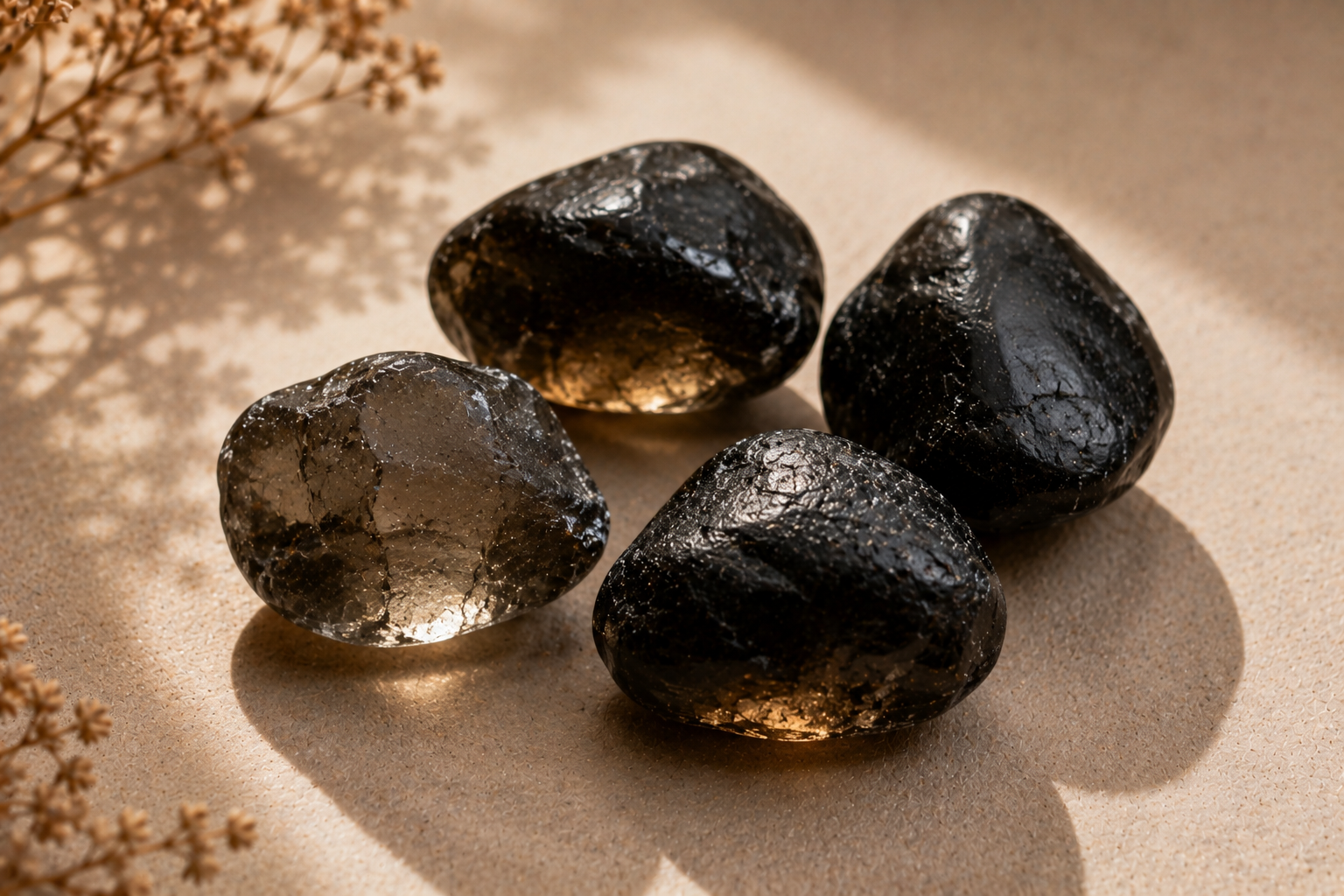
Small translucent nodules. Comfort in grief.
Black obsidian, the protection stone
The one everyone pictures: black, smooth, almost a mirror once polished. That depth comes from iron and magnesium. It's the protection and grounding stone of the family, traditionally tied to the root chakra, and it's where I'd tell any beginner to start. I've given it its own article on its protective and grounding properties. In jewelry, a plain black obsidian bracelet is still the most versatile piece you can own.
Rainbow obsidian, the gentlest one
Tilt it and a blue or violet veil rises to the surface, like an eye opening. The effect comes from vanishingly thin layers of nanoparticles suspended in the glass, which split the light the way an oil film does on water. Tradition links it to softness, intuition and a quieter mind, which makes it the usual pick for people who find black obsidian a little too blunt. See the full range on my rainbow obsidian page.
Good to know, "rainbow obsidian" gets used for two slightly different stones: the subtle blue-violet sheen, and a showier multicolored version with green and gold in the banding. Same phenomenon, different intensity. If a listing promises fireworks, look closely at the photos before you buy, and see the FAQ below on how it differs from fire obsidian.
Snowflake obsidian, the balanced one
Black, dusted with small white blooms. Those "snowflakes" are cristobalite crystals that grew inside the glass as it cooled, which makes this variety a rare case of obsidian caught mid-crystallization. Symbolically it's read as balance and letting go, shadow and light reconciled in one stone. Everything about it is on my snowflake obsidian page.
Gold sheen and silver sheen, the shimmer effect
Turn these and a golden or silvery veil sweeps across the stone. It comes from microscopic gas bubbles stretched and aligned as the lava flowed, then frozen in place, reflecting light like a field of tiny mirrors. Gold sheen is associated with confidence, drive and abundance; silver sheen with clarity and a cooler, more lunar quality. Gold sheen is a favorite of mine to work with, and it has its own gold sheen obsidian page.
Mahogany obsidian, the earthy one
A marbling of black and red-brown, veined like fine hardwood, caused by iron oxide and hematite spreading through the glass. Tradition gives it grounding, vitality and steady strength. It's the warmest of the family, which is why it works so well as a bracelet.
Apache tears, the comforting one
Small dark nodules, weathered naturally out of their volcanic ash bed and slightly translucent against the light. The name comes from a story told at Apache Leap near Superior, Arizona: after a group of Apache warriors rode off the cliff rather than surrender, the tears their families wept were said to have turned to stone. A softer, gentler black obsidian, and the one most often suggested during grief.
My own favorite is rainbow obsidian. The first time I tilted one toward the workshop window and that blue-violet shimmer appeared, I honestly thought the stone had winked at me. I haven't gotten over it since.
If one of these varieties is already calling to you, here are the ones I keep on the bench, made by hand, one bead at a time.
Rare and collector varieties
Past the classics there's a second tier: obsidians that rarely reach jewelry counters, prized by collectors and lapidaries.
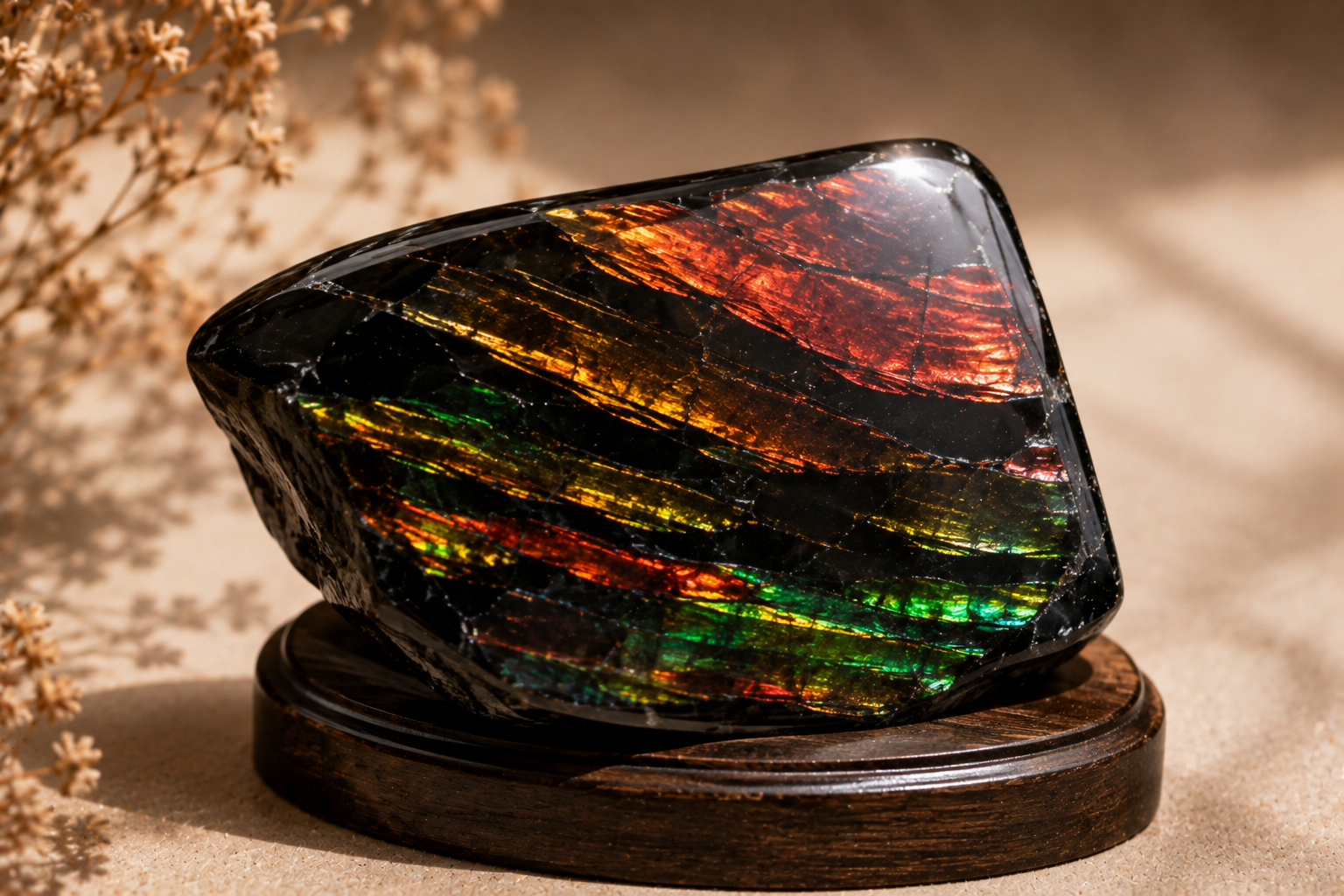
- Fire obsidian, the prize. Extremely thin layers of magnetite create an opal-like, butterfly-wing iridescence in reds, golds and greens. It comes almost exclusively from Glass Buttes, Oregon, and it takes a skilled cutter to reach the layer without polishing straight through it.
- Midnight lace obsidian, fine black ribbons folded back on themselves, drawing lacework through the stone.
- Spiderweb obsidian, a network of pale veins crossing the surface like a web. Every block is a one-off drawing.
- Peacock or blue pearl obsidian, polished, it reveals lavender, green and violet waves, like a peacock feather. Mexican in origin.
- Pumpkin and peanut obsidian, two spherulitic varieties: the first leans orange, the second shows pale shell-like patches.
- Tri-flow obsidian, three tones blended in one block (black, red-brown, translucent), the record of separate lava flows folded together.
Rarity here means found in few places, not more powerful. A collector-grade fire obsidian and a plain black bead came out of the same kind of volcano; one is simply harder to source and harder to cut.
I don't work with all of these. Some are too fragile for a bracelet, others I can't source reliably enough to promise you anything. But I love knowing them, and when a customer shows me a fire obsidian they found on a road trip, I melt a little.
The fake colored obsidians
This is the most useful section of the guide. Those transparent, brightly colored "obsidians", electric blue, apple green, ruby red, aqua, sold all over online marketplaces, are almost always manufactured glass. Not stone. Not volcanic. Often slag glass or offcuts, tumbled and relabeled.
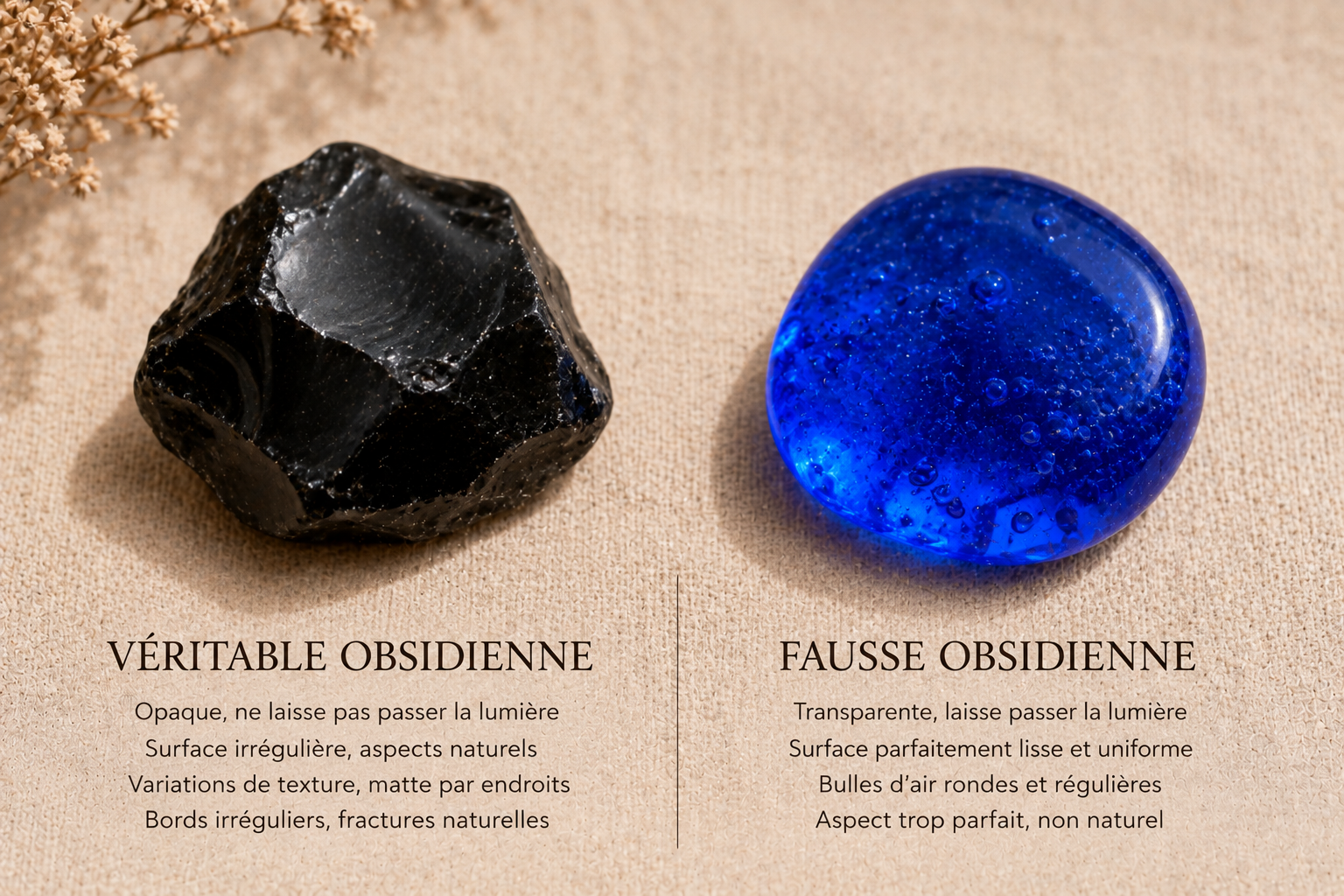
A few things that tell you a stone is genuine obsidian:
- it usually shows tiny bubbles, inclusions or faint irregularities under a loupe;
- it feels cool to the touch and warms up slowly in your hand;
- its fracture is conchoidal, curved and shell-like, never a clean straight break;
- manufactured glass is too perfect: even color, uniform transparency, evenly spaced round bubbles, and it often feels suspiciously light.
In short, if an "obsidian" is see-through and a vivid blue or green, it's almost certainly glass. Real obsidian stays deeply dark. The genuinely colored varieties that do exist, a matte green from Mexico for instance, are opaque and understated, never candy-bright.
If a price looks too good to be true, it usually is. I break down what fair pricing actually looks like in my obsidian pricing and value guide. And because this stone breaks to a razor edge, it's worth reading my notes on obsidian safety and precautions before handling rough pieces.
Early on I got caught by a "blue obsidian" I found online. Gorgeous color, completely fake. That was the day I decided to only work with stones whose source I can actually name.
Quick reference chart
The whole family at a glance, with what I'd actually tell you if you asked me across the workbench.
| Variety | What it looks like | Traditionally linked to | My take |
|---|---|---|---|
| Black | Deep black, glassy | Protection, grounding | Start here. Most versatile, hardest to get wrong. |
| Rainbow | Blue-violet sheen | Softness, intuition | The one I'd pick if black feels too blunt. |
| Snowflake | Black flecked white | Balance, letting go | Lovely stone. I don't make it, and I'll say so. |
| Gold sheen | Moving golden veil | Confidence, abundance | Underrated. Needs good light to show off. |
| Silver sheen | Cool metallic shimmer | Clarity, calm | Same effect as gold, quieter. Harder to find. |
| Mahogany | Black and red-brown | Vitality, rootedness | Warmest of the family. Great on darker skin tones. |
| Apache tears | Small translucent nodules | Comfort, consolation | Better as a pocket stone than as jewelry. |
| Fire (rare) | Opal-like iridescence | Passion, energy | Collector territory. Expect to pay for it. |
Keep in mind, what this chart can't show you is the thing that matters most: no two pieces of obsidian look the same, even from the same block. The associations in column three come from tradition, not from anything measurable in the stone.
Which type of obsidian should you choose?
It depends on what you're after, an intention, or simply a reflection that stops you.
- for everyday protection: black obsidian, the safest first choice;
- for softness and intuition: rainbow obsidian;
- for balance and letting go: snowflake obsidian;
- for confidence and abundance: gold sheen obsidian;
- for vitality and rootedness: mahogany obsidian;
- for the sheer play of light: rainbow, or fire obsidian if you're collecting.
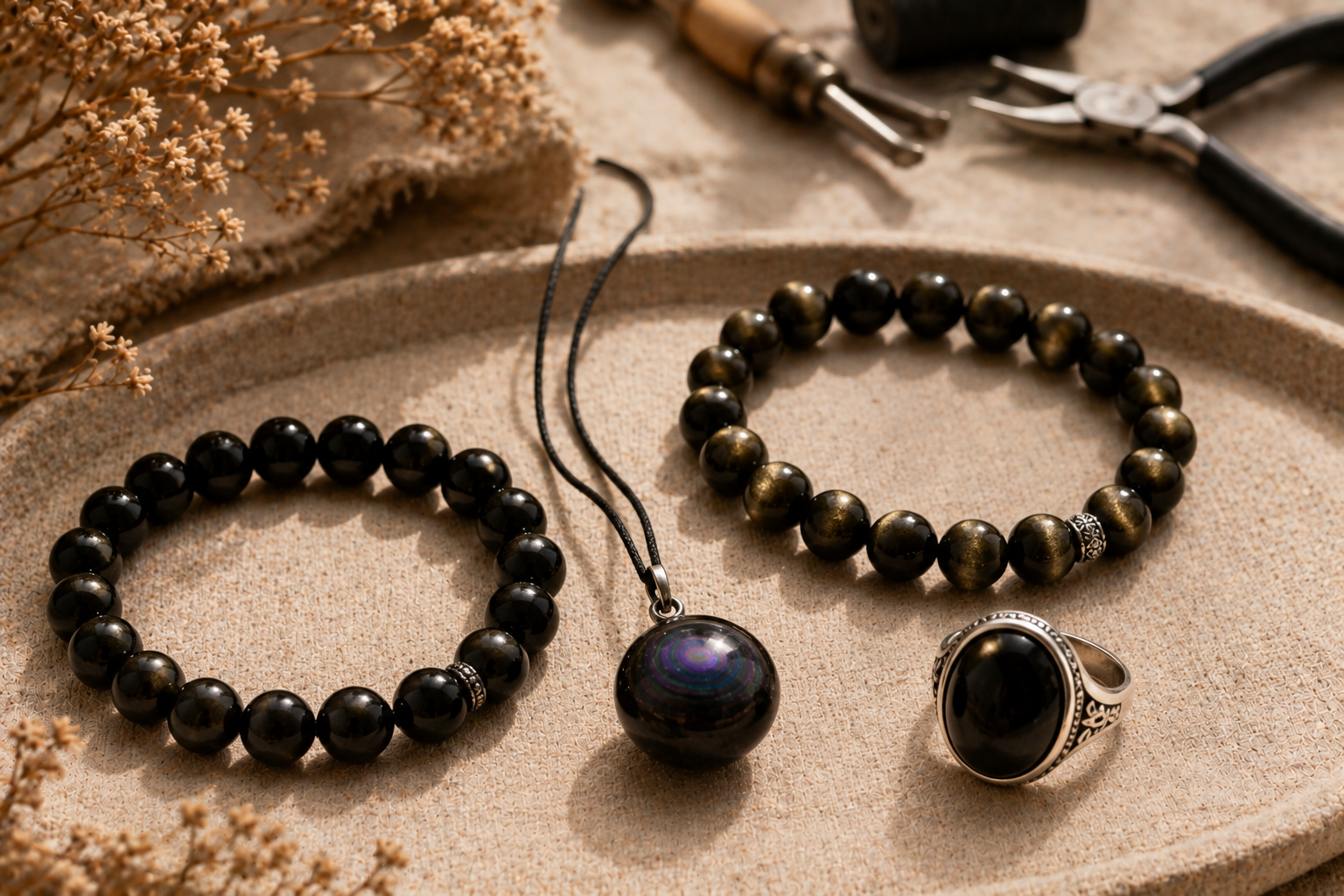
Then pick the format that fits your day: a bracelet for quiet all-day contact, a pendant or necklace to keep the stone near your heart, a ring to have it in your line of sight. Men will find pieces made with them in mind on my obsidian for men page, and the jewelry size guide lists US ring and wrist sizes in inches.
Nothing stops you from mixing varieties, or pairing obsidian with other stones. I go through the combinations that actually work in my guide to crystal pairings with obsidian, including the excellent obsidian and tiger's eye duo. And if you meditate, any of these varieties makes a good anchor for root chakra work.
One honest caveat before you buy on intention alone: if you're choosing a stone because you're going through something heavy, anxiety, grief, a health scare, please treat the stone as company, not as care. It sits alongside a conversation with a doctor or a therapist; it doesn't stand in for one.
Care, cleansing & cautions
Whatever variety you end up with, looking after it works the same way.
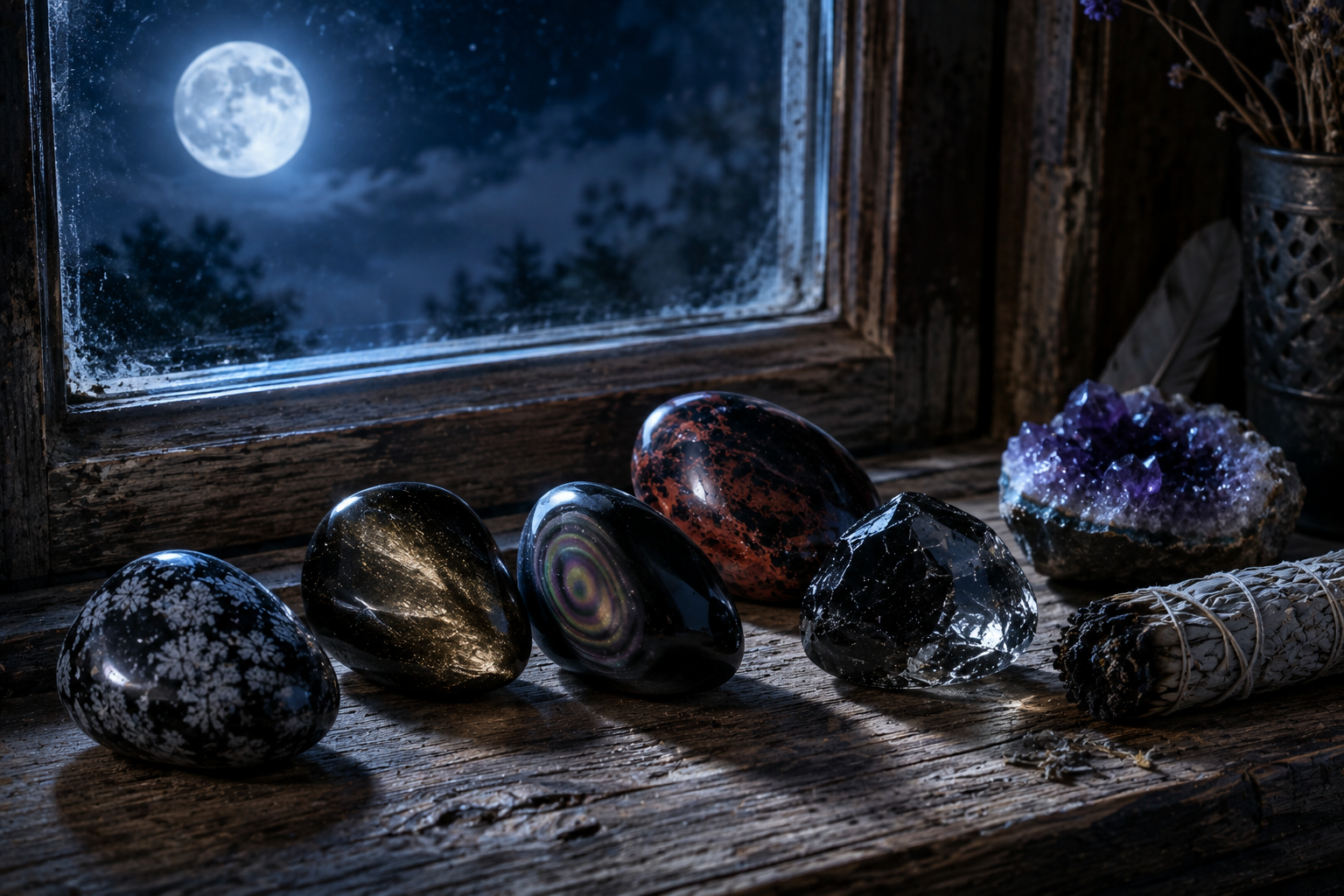
Physical care
Obsidian sits at 5 to 5.5 on the Mohs scale, softer than quartz, so it scratches and chips more easily than people expect. A soft cloth is all it needs. Keep it away from knocks, and take a bracelet off before showering, swimming or working out, on beaded pieces the elastic cord always fails long before the stone does. Full details in my guide to cleaning obsidian. And handle rough or broken pieces carefully: a fresh obsidian edge is genuinely sharp.
Cleansing and charging
Smoke (sage, palo santo), a brief rinse under cool running water, or a rest on a quartz cluster. Skip the salt and saltwater, which dull the surface over time. To charge, moonlight is the classic choice, a full moon if you're being traditional, or contact with soil. Avoid long stretches in direct sun. Every step is laid out in my guide to cleansing and charging obsidian.
Keep in mind, the properties described here come from spiritual tradition and crystal healing, a wellness approach based on belief. They are not medical claims, they cure no disease, and they never replace the advice of a healthcare professional. If something in your body or your mind worries you, talk to a doctor. More on this in our medical disclaimer.
Frequently asked questions
How many types of obsidian are there?
What is the rarest type of obsidian?
Is rainbow obsidian the same as fire obsidian?
Which type of obsidian is the most powerful?
Is blue or green obsidian real?
What's the difference between gold sheen and silver sheen obsidian?
Which type of obsidian should a beginner start with?
Do all types of obsidian get cleansed the same way?
Find your type of obsidian
Bracelets, necklaces, pendants and rings across the obsidian family, handmade in France from natural stones chosen one by one.