Obsidian in Meditation: Grounding & Root Chakra
Born from fire and frozen by cold, obsidian is one of the most powerful allies for grounding. In meditation, its density and darkness make it a solid anchor that gently brings you back into the body and the present moment. Here's how to use it for meditation, practice grounding, and work with the root chakra, complete with a guided step-by-step meditation.
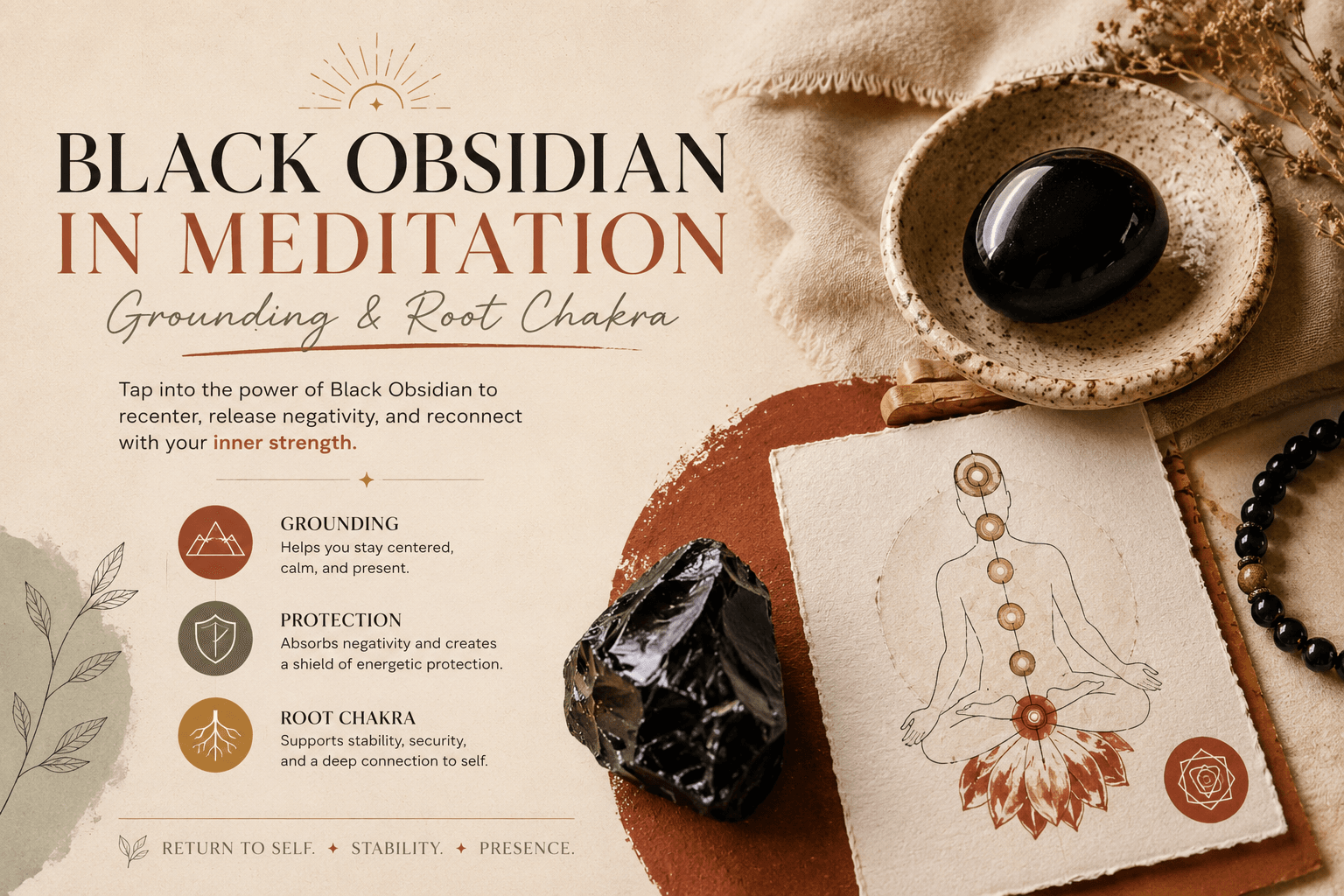
Why obsidian for meditation
In crystal healing, black obsidian is considered a deeply grounding and protective stone. Born from lava cooled so quickly it had no time to crystallize, it's a dense, smooth, dark volcanic glass, and it's precisely that darkness that makes it such a treasured stone for meditation.
Black absorbs, calms, stabilizes. When you feel scattered, "in your head," a bit disconnected from your body, obsidian acts like a quiet weight that draws you downward: toward the ground, toward the present moment. That's why it's so often used in grounding practices. For more on this dimension, see my article on obsidian as protection and grounding.
When I feel scattered, I sit for five minutes with an obsidian pebble in the palm of my hand. Nothing else. Just the weight of the stone and the breath, it's often enough to settle me.
Obsidian and the root chakra
The root chakra, Muladhara in Sanskrit, is the first of the seven main chakras. Located at the base of the spine, it's associated with the color red and the element Earth. It's the chakra of grounding: it governs the feeling of security, stability, connection to the body and the physical world, and the confidence that you belong and can stand firm.
When it's out of balance, you might feel restless, anxious, like you're floating outside yourself, or always on edge. In contrast, a calm root chakra brings that rare sense of being settled, present, and safe in your body.
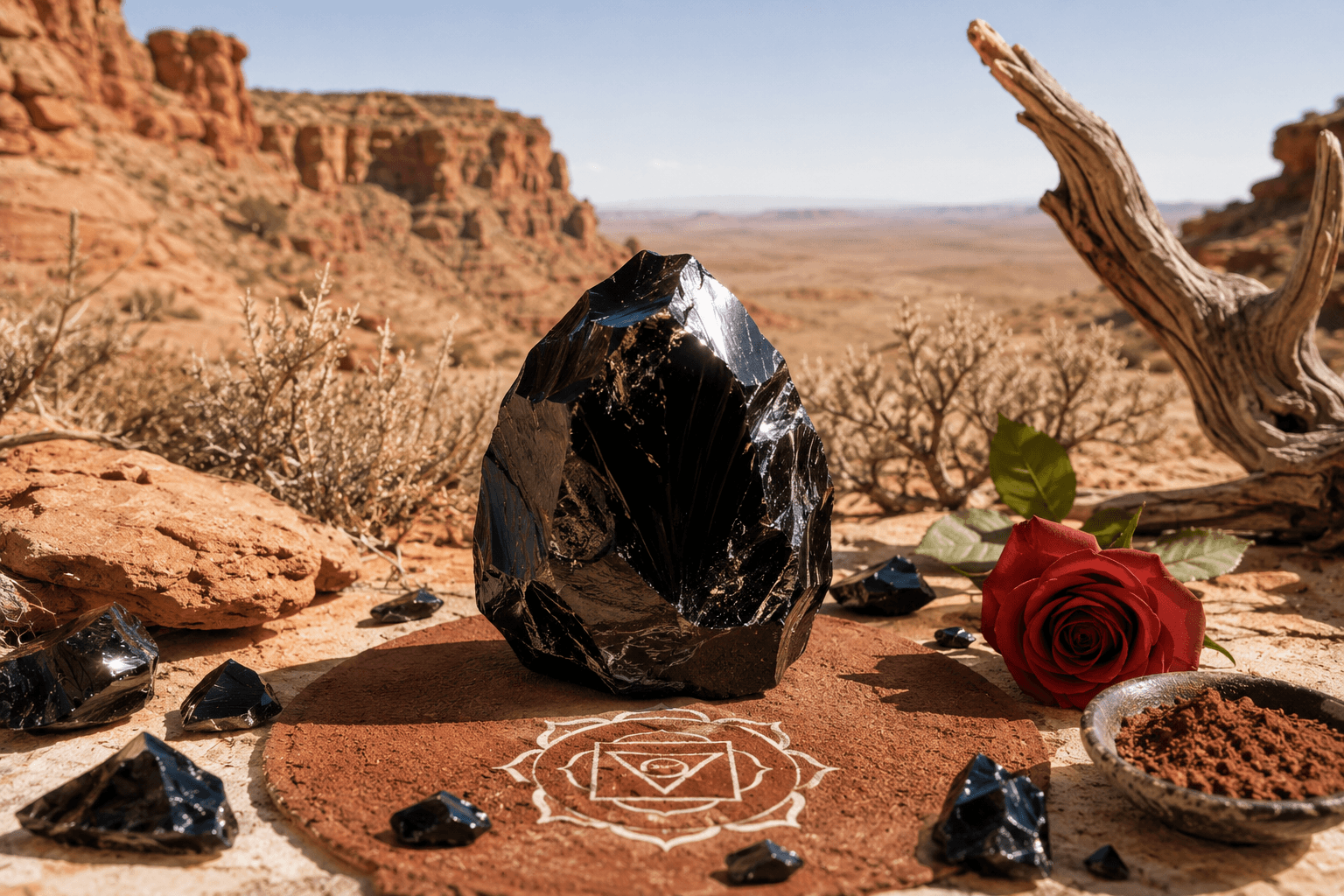
Black obsidian is traditionally one of the principal stones for this chakra. Its dark color, its density, and its telluric origin, born from Earth, fire, and stone, naturally link it to Muladhara. That's why it's so often recommended whenever someone wants to reconnect with the ground and find stability again.
Choosing and preparing your stone
Before meditating, take a moment to choose your obsidian and prepare it. Nothing complicated: just a few simple gestures that set the stage.
- The form: for meditation, I especially love stones you can hold in the palm of your hand, a tumbled stone or small sphere. A bracelet works beautifully too if you prefer to wear it on your wrist.
- Cleansing: if the stone is new or hasn't been worn in a while, cleanse it before you begin. Smudging and moonlight suit it well; I detail these gentle methods in my article on cleansing and charging obsidian.
- The setting: settle into a quiet space where you won't be disturbed. Soft lighting, phone on silent.
- Your intention: before closing your eyes, set a simple intention, "I ground myself," "I return to my body," "I feel safe."
- Chakra
- Root (Muladhara), at the base of the spine
- Element & color
- Earth · red
- What we cultivate
- Grounding, inner security, stability
- Recommended form
- Tumbled stone to hold, or bracelet worn
- Duration to start
- 5 to 10 minutes
Grounding meditation with obsidian, step by step
Here's a simple grounding meditation to practice with your obsidian. Allow five to ten minutes to begin; you can extend it later, at your own pace.
- Settle in: sit comfortably with your spine upright but relaxed, feet flat on the ground. Hold the obsidian in one hand or cupped in both on your lap. Close your eyes.
- Breathe: take three slow, deep breaths. With each exhale, release your shoulders a little more. Feel the weight of the stone in your hand.
- Feel the contact: bring your attention to every place where your body touches the ground and seat. Feel how the ground holds you.
- Descend to the base: gently move your awareness to the base of your spine, at your root chakra. Imagine a warm, stable red glow there.
- Send roots downward: visualize roots leaving the base of your body and sinking deep into the earth (detailed visualization just below). Let the stone's density pull you downward, like an anchor.
- Stay: remain here for a few minutes, breathing, grounded, the stone's weight as your anchor. With each breath out, root yourself deeper.
- Return gently: when you're ready, deepen your breath, move your fingers slowly, thank the stone, then open your eyes.
Visualizing the roots
Visualization is the heart of grounding meditation. The most classic and effective image is the tree: imagine that from the base of your spine and the soles of your feet, roots descend into the earth, pass through layers of soil, and anchor you to the planet's core.
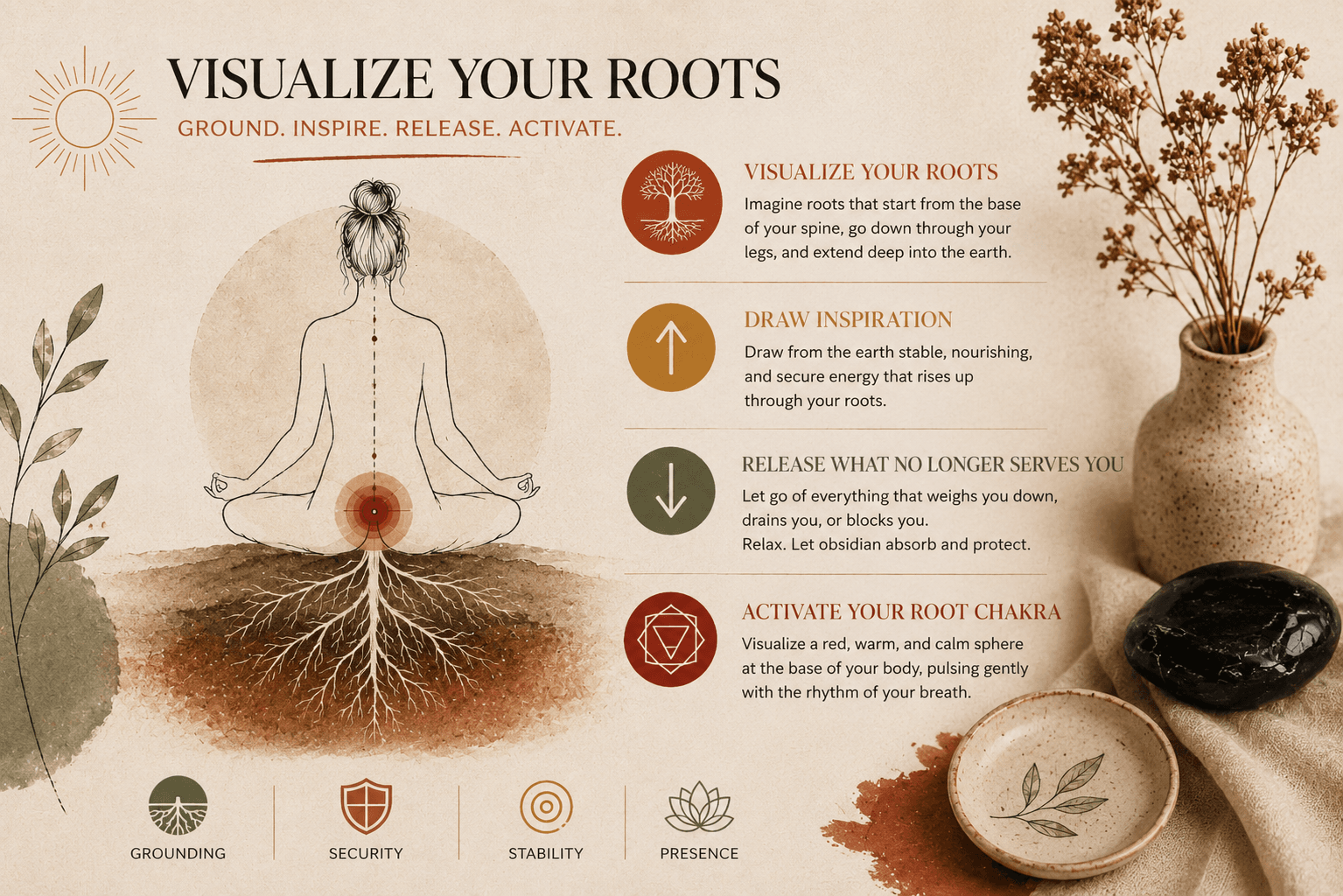
On the inhale, you can visualize drawing stable, nourishing energy up from the earth through your roots. On the exhale, let anything heavy, restless, or excess descend into the ground, and obsidian, with its reputation as a stone that absorbs and protects, naturally supports this downward release.
The red color of the root chakra is another gateway: visualize a warm, calm sphere of red light at the base of your body, pulsing gently with your breath.
An image that works really well for me: place the obsidian on the ground in front of you and imagine it as a small stone sinking all the way to the bottom of a very still lake. My awareness sinks with it, and the mind settles.
Where to place obsidian during meditation
Several options, depending on your position and what feels right:
- In your hand: the simplest, the stone in the palm, or between both hands. Ideal in a seated position.
- At the base of your spine: lying on your back, you can place the stone right at the lower back, toward the tailbone, as close to the root chakra as possible.
- Between or under your feet: to strengthen your connection to the earth, place the stone on the ground between your feet or under the sole while you sit and meditate.
- On your lower belly: hand and stone resting on the lower belly, so you can feel both the breath and the grounding at once.
Traditionally, people often hold the stone in the left hand to receive its energy, in the right hand to radiate protection outward. Follow what feels right for you.
Extending grounding into daily life
Formal meditation is just one doorway: grounding is also cultivated in everyday gestures.
- Wear your obsidian: an obsidian bracelet kept on your wrist accompanies you all day and brings grounding into every movement.
- Keep a stone on you: a tumbled stone in your pocket, to squeeze in moments of tension.
- Take pauses: thirty seconds, feet flat, stone in hand, three breaths, a mini-grounding that fits anywhere.
It's often these small, repeated reminders that let the stone truly settle into your practice.
My obsidian pieces for meditation and grounding
Each of my obsidian pieces is hand-chosen for quality, then crafted with care. For meditation and grounding, I naturally point you toward black obsidian, the most grounding of the family. Here are the pieces currently available in the shop:
You can also browse my bracelets, necklaces, pendants, and rings in obsidian.
Cautions and best practice
Obsidian is a powerful stone, and that demands a bit of care. In tradition, it's described as a truth stone that can bring buried emotions to the surface. In practice: move forward gradually, especially if you're new to this. Short, regular sessions are better than long, occasional ones; and if strong feelings arise, that's fine, welcome them, and stop if you feel you need to.
For more on this, I've written a dedicated article: obsidian safety and precautions.
Remember: the properties described here come from crystal healing, an approach rooted in tradition and belief. They are not medical claims, do not treat disease, and never replace professional health advice.
Frequently asked questions
Which obsidian should I choose for meditation and grounding?
How do I meditate with obsidian as a beginner?
Where should I place obsidian during meditation?
Is obsidian really linked to the root chakra?
How long should I meditate with obsidian?
Should I cleanse my obsidian before meditating?
Adopt your grounding obsidian
Bracelets, necklaces, pendants, and rings in natural black obsidian, handmade with care, to meditate and ground yourself daily.