How to Use a Black Obsidian Pendulum
Let's start with what most pages avoid saying: a pendulum moves because your hand makes it move. That's not an accusation, it's a mechanism understood for nearly two centuries, and it takes nothing away from the value of the object, as long as you know what you're actually asking of it. Here's how to use a black obsidian pendulum: setting it up, framing your questions, and knowing its limits.
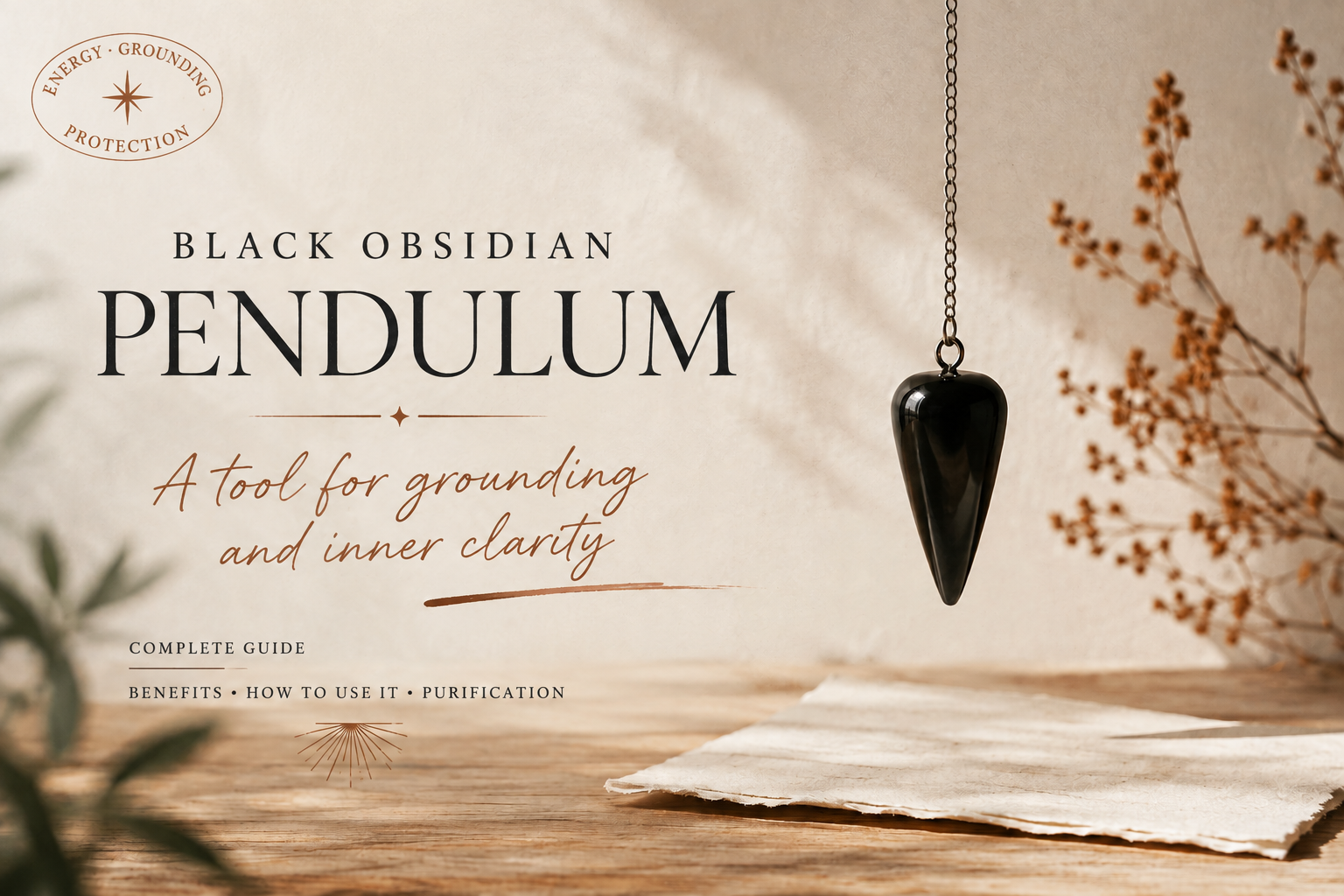
What a black obsidian pendulum is
A pendulum comes down to three things: a weight, a cord, and a hand. Nothing more. In black obsidian, the weight is usually a carved drop or cone of 3 to 4 cm, sometimes a sphere, hung on a 15 to 20 cm chain finished with a small bead held between thumb and forefinger.
Obsidian is a volcanic glass with a density of around 2.4: a pendulum of this size weighs around twenty grams, making it a fairly heavy pendulum. The very concrete consequence: its swings are wide, slow and distinct, and it takes a while to settle. Some see that as a strength, the movement is easy to read, others as a drawback, since a heavy pendulum keeps swinging on momentum well after the hand has stopped acting.
To be clear, I don't make pendulums. My workshop makes jewellery: bracelets, pendants, necklaces, rings. So what follows is what I know about the object, with nothing to sell you at the end of it, except to note, honestly, that a sphere pendant hanging from its chain is, physically, a pendulum, and plenty of people use it that way.
If your main intention is simply to wear the stone day to day, that's a different subject, covered in how to wear a black obsidian pendant. The pendulum itself sits somewhere between two uses.
What actually makes it move
Here's the section I wish I'd read when I started, and that you won't find anywhere else.
As early as 1833, the French chemist Michel-Eugène Chevreul studied the "exploring pendulum," fashionable at the time. His conclusion, which still holds: the movement comes from involuntary micro-contractions in the hand holding the cord. This is known as the ideomotor effect. These movements are too small to feel, but a pendulum is a remarkable amplifier: a few tenths of a millimetre at the fingertips is enough to produce a swing of several centimetres.
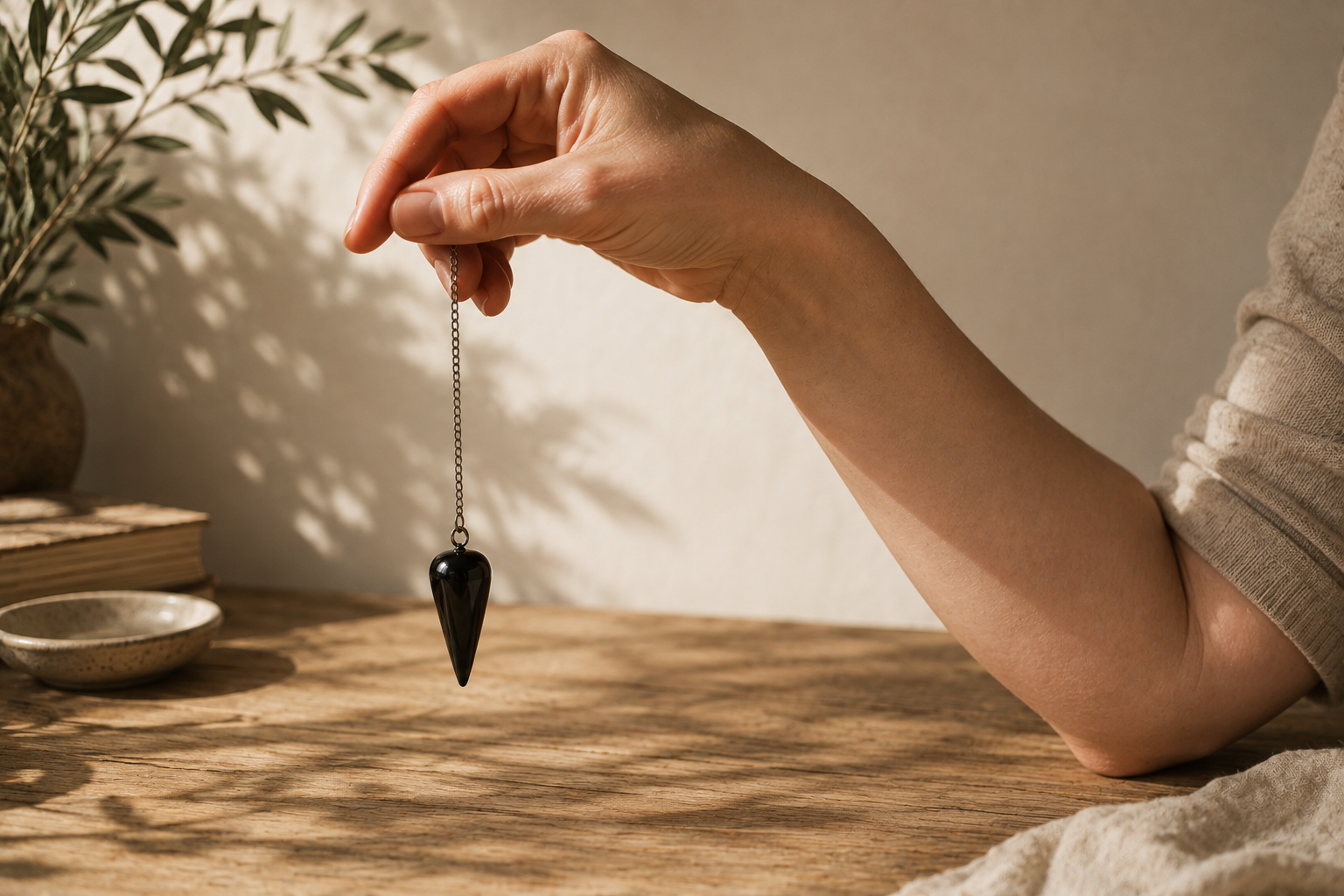
You can check this yourself in a minute. Hang your pendulum from a fixed hook, or clamp it to something that can't move, then ask it the same question. It won't move. That's the simplest test there is, and it doesn't need anyone's word for it.
Many people assume that saying this dismisses the practice. I think the opposite. If the pendulum reflects a movement that comes from you, then it isn't fetching information from outside: it's making visible a leaning you already have but haven't put into words. That's very different from an oracle, and far more useful.
I use it as a mirror, never as a judge. When the pendulum answers "no" and I feel a flicker of frustration rise, that's my real answer, and it isn't in the pendulum, it's in the frustration. That's exactly why I keep using it while knowing perfectly well how it works.
This reading applies just as well to the whole family of divinatory practices tied to this stone, including the black obsidian scrying mirror: they're tools for projection, and that's precisely where their value lies.
Setting your convention: yes, no, no answer
Before asking anything, you need to establish a mental convention: decide which movement means what. It isn't a ritual, it's a protocol, the equivalent of calibrating an instrument before you use it.

The process, step by step:
- Sit down, upright, elbow resting on the table. This is the single most important point: an arm held in the air trembles and muddies everything;
- Hold the chain 10 to 12 cm above the stone, between thumb and forefinger, without gripping tightly;
- Still the pendulum with your other hand, then let go;
- Ask "show me yes" and let it come, thirty seconds if needed. Note the movement you get;
- Repeat with "no," then with "I can't answer", this third response is the one people forget, and the most valuable of the three;
- Check with two or three questions whose answers you already know: your name, today's date.
The most common conventions are: forward-and-back for yes, side-to-side for no, a rotation for no answer. But nothing obliges you to adopt them: keep whatever comes naturally, and above all keep it consistent. A convention that shifts from one day to the next stops meaning anything.
Worth knowing, the length of the cord changes everything, and it's pure physics. A pendulum swings more slowly the longer its cord: roughly 0.6 seconds per swing at 10 cm, 0.9 seconds at 20 cm. A longer cord gives slower, wider, more readable movements; a shorter one reacts faster but tires the fingers. Find your length and stick with it.
Framing your questions
This is where the real value of the exercise lies. A pendulum doesn't give information: it gives a yes or a no. The whole challenge, then, is turning a vague concern into a closed, unambiguous question, work that, on its own, often clarifies the situation before you've even picked up the pendulum.
A good question
Closed, precise, on a single subject, with a timeframe. "Do I want to accept this offer?" "Do I need rest this week?"
A poor question
Open-ended, doubled up, or about someone else. "What should I do with my life?" "Does he love me and will he come back?" "What does so-and-so think of me?"
Three rules that make the difference:
- One question at a time, a double question has no single-movement answer;
- A question about you, your wants, your reservations, your priorities. A pendulum knows nothing of what someone else is thinking;
- No looping rephrasing, asking the same question ten times until you get the answer you wanted is the surest way to learn nothing at all. If the answer displeases you, that's where the real information is.
And above all, stop after a few questions. Concentration fades fast, and answers turn vague right at the point you start pushing for a different one.
Obsidian or another stone?
Honest question, honest answer: if you're just starting out, black obsidian isn't the pendulum I'd recommend first, and I'm saying that while it's the only stone my whole shop is built on.
Tradition describes it as blunt, direct, sometimes intense, which is exactly what gives it its reputation in protection and grounding. Applied to an introspective practice, that bluntness translates into answers you don't always want to hear. For a first attempt, clear quartz is more neutral, and easier to live with.
| Stone | What tradition credits it with | How the pendulum behaves | My take |
|---|---|---|---|
| Clear quartz | Neutrality, clarity | Light, responsive, moderate swings | The best for beginners |
| Amethyst | Intuition, calm | Light, fine movements | A good gentle second choice |
| Black obsidian | Bluntness, grounding, introspection | Heavy, wide swings, long inertia | For those with an established practice |
| Tiger eye | Discernment, protection | Fairly heavy, very stable | Practical outdoors |
| Brass or copper | No particular tradition | Very heavy, the most consistent | The most technically readable |
These correspondences belong to tradition, not to measurement: none of them is verifiable. What is verifiable, on the other hand, is the mechanical behaviour, weight and cord length genuinely determine the character of the movement. To place obsidian among its relatives, see the obsidian varieties; rainbow obsidian is the one most often linked to introspection.
Common uses
Beyond yes/no, three uses come up repeatedly. I'll give them as they're actually practised, noting each time what they're worth.
- Choosing between several options, write each option on a slip of paper and pass the pendulum over each one. This is the most useful application: it mainly reveals which way you were already leaning;
- Choosing a stone, passing the pendulum over several minerals for "the one you need." Traditional, with no measurable basis, but harmless, and often a way of giving yourself permission for a preference. See also crystals not to pair with obsidian;
- Exploring a place or a plan, dowsing applied to space. Tests run under controlled conditions have never shown results better than chance. Best treated as an exercise in attention, not a detection method;
- Working with energy centres, some people pass the pendulum over the chakras. A widespread practice, described in my guide to obsidian and chakras; it establishes no diagnosis, about anything or anyone.
If what you're after is calm and re-centring rather than an answer, meditation offers more, without the ambiguity: see meditating with obsidian.
Caring for and cleansing your pendulum
A pendulum is more fragile than a worn piece of jewellery: it falls. An obsidian point that hits tiles chips, and volcanic glass breaks into sharp edges.
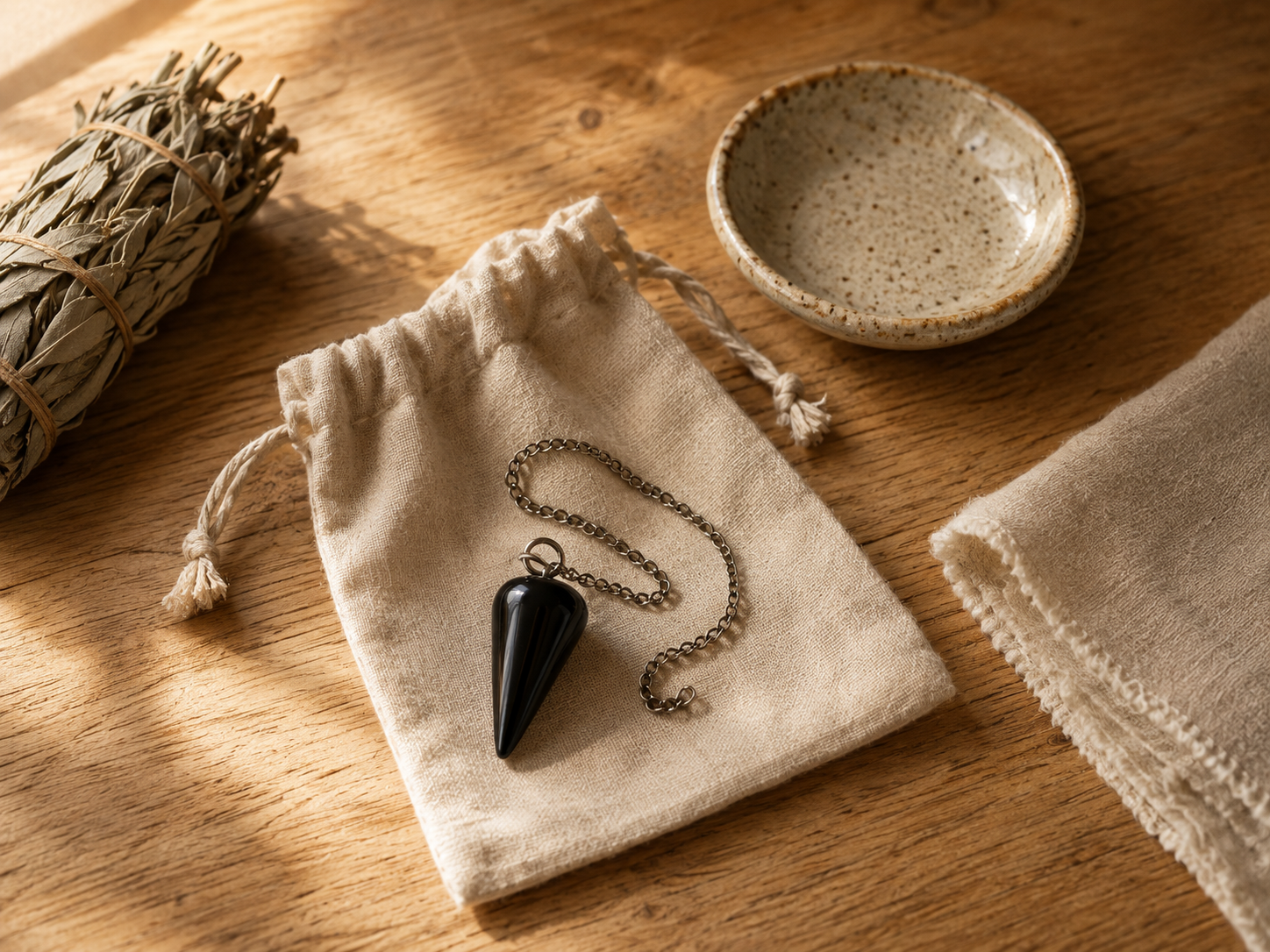
- Storage, in a fabric pouch, chain coiled without knots. This is the object's one real risk;
- Cleaning, a soft, dry cloth; lukewarm clean water now and then, dried immediately, taking care around the chain fitting;
- Never salt, dry or dissolved: it dulls the surface and attacks the metal fitting;
- Never an ultrasonic cleaner, the vibrations spread micro-fractures through volcanic glass;
- Cleansing, smudging with sage or palo santo, or a quick rinse under clean water, depending on the tradition you follow;
- Charging, moonlight, or contact with the earth. Avoid prolonged direct sunlight.
The full guides are here: cleaning your obsidian and cleansing and charging obsidian. On what you're buying: moulded black glass sold as obsidian is very common in pendulums, whose drop shapes are easy to cast. The markers are in obsidian price and value, and for the meaning of the word itself, see what does obsidian mean.
Finally, if the stone appeals to you more than the practice, which happens often, and is perfectly fine, wearing it day to day remains the simplest way to live with it.
Precautions & good practice
One point comes before all the others, and I won't bury it in small print.
What I'd tell a friend, never put a health question to a pendulum. Not for yourself, not for a loved one, not for a child. No diagnosis, no choice of treatment, no stopping medication, no "is it serious?" A pendulum reflects what your hand is doing: in a moment of worry, it will reflect your worry, and nothing else. A reassuring answer can delay a consultation that was actually needed; an alarming one can put you through weeks of dread for nothing. Those questions belong with a doctor.
The same principle applies to major decisions: leaving a job, ending a relationship, committing money. A pendulum can help you notice which way you're leaning; it shouldn't decide for you, and it certainly shouldn't be used to justify, after the fact, a decision you'd already made.
Two material points, finally:
- Chips, a chipped point is sharp. A cracked pendulum should be replaced;
- Children, a long chain and a small stone: not an object to leave within reach of a young child.
If you're going through a period of anxiety and the pendulum becomes a daily reflex, take a break: a tool for introspection that starts deciding your days no longer settles anything. Talk to a professional, it's the most useful step. See also obsidian, dangers and precautions.
Worth knowing, the properties described here belong to spiritual tradition and crystal healing, a wellbeing practice founded on belief. They are not a medical claim, they treat no illness, and they never replace the advice of a healthcare professional. See my medical disclaimer and the complete obsidian guide.
Frequently asked questions
How does a black obsidian pendulum work?
How do you set up your pendulum?
Is black obsidian a good pendulum for beginners?
What chain length suits a pendulum?
Can you ask a pendulum a health question?
Why won't my pendulum move?
How do you cleanse a black obsidian pendulum?
Black obsidian, handmade
Bracelets, pendants, necklaces and rings in natural obsidian, shaped in my workshop in France.