How Is Obsidian Formed?
Before it becomes a piece of jewellery, obsidian is a story of fire, lava and geological chance. Here, told simply, is the birth of this black stone that comes straight from a volcano.
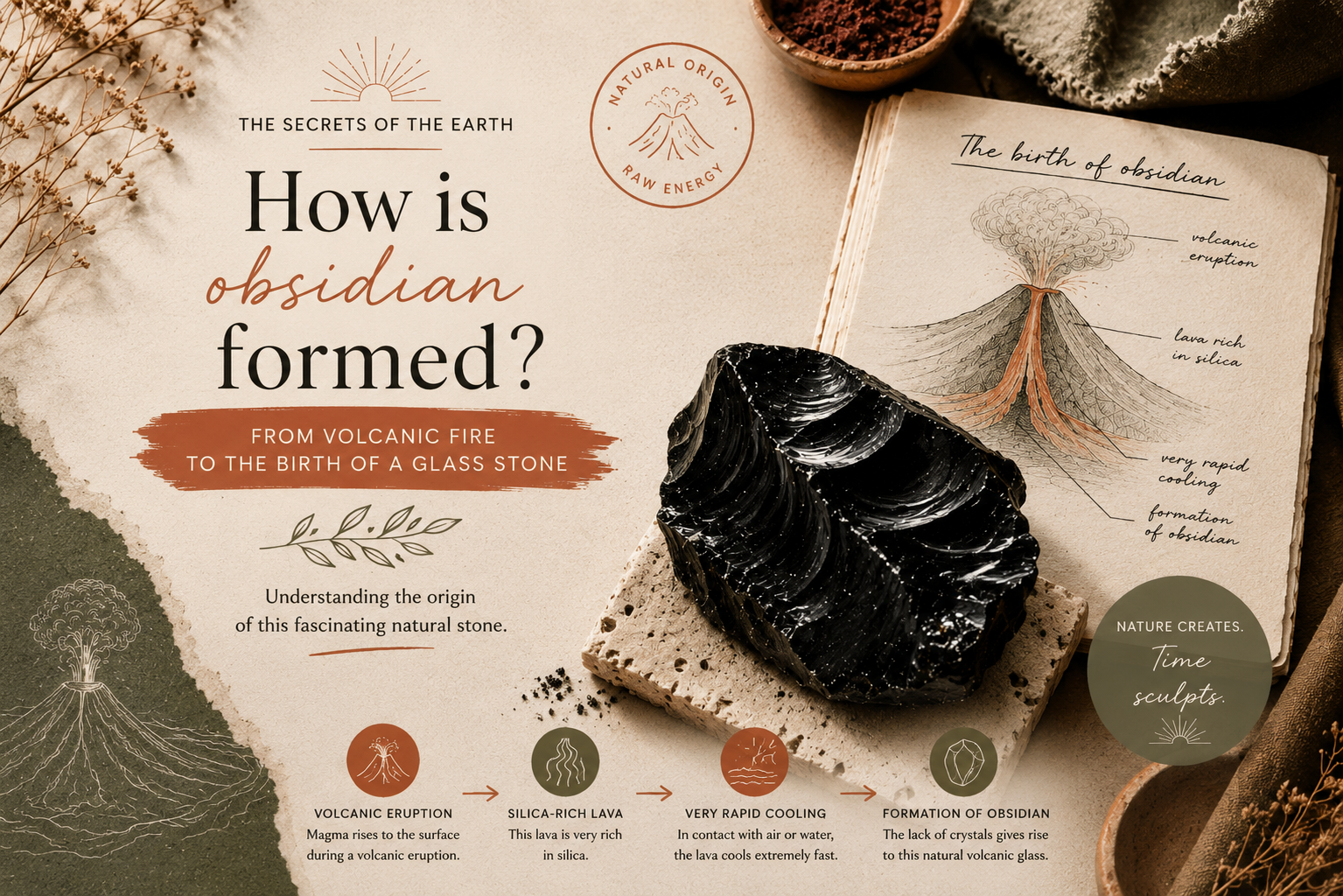
Obsidian, a glass born of a volcano
Unlike most stones, obsidian isn't a crystal: it is a natural volcanic glass. It's classed as a mineraloid, because its matter is amorphous, its atoms aren't arranged in an ordered lattice as they are in quartz, but frozen in disorder, exactly as in the glass of a windowpane.
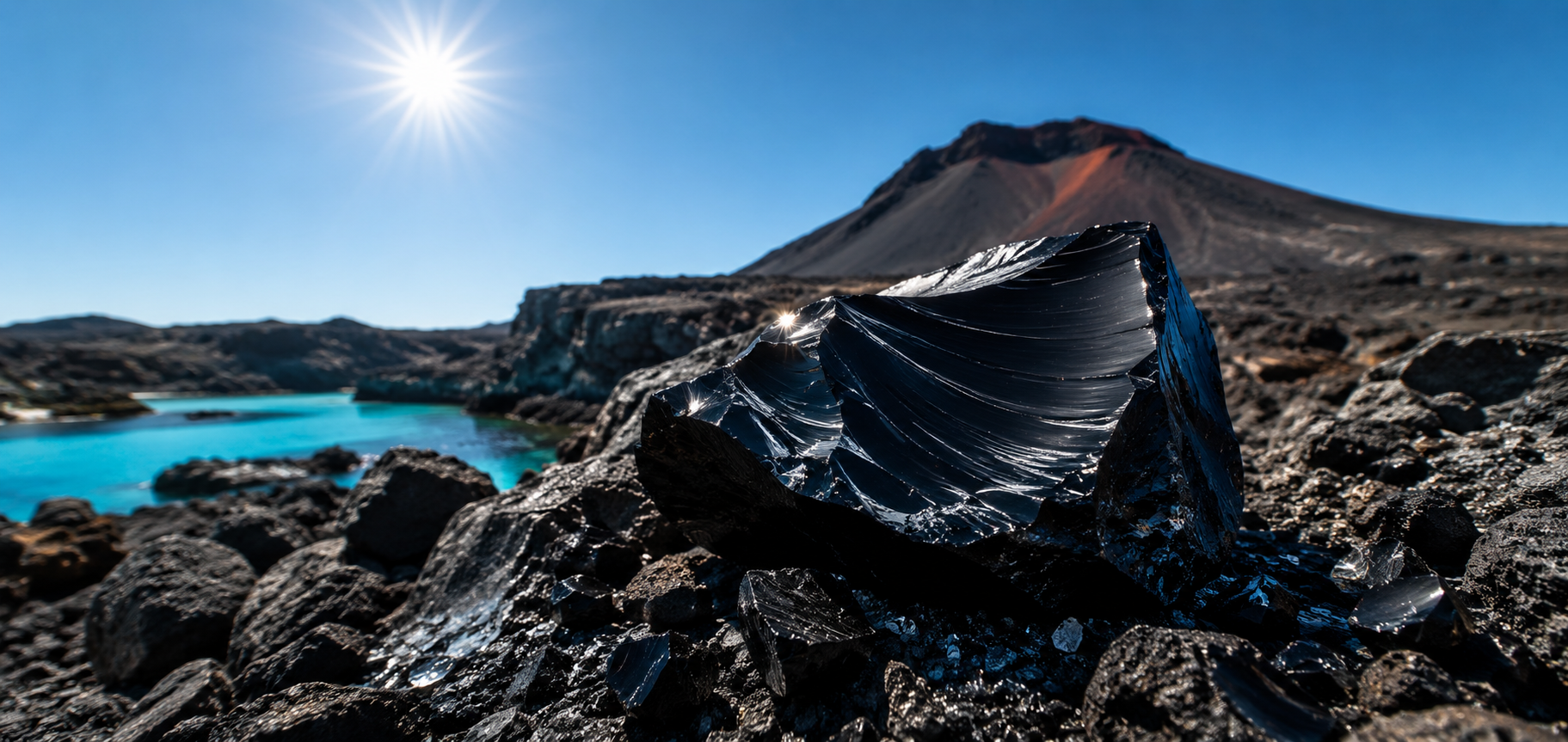
It is more than 70% silica (SiO₂), with a little aluminium, sodium and potassium. Its composition is therefore close to that of granite or rhyolite; what changes everything is its glassy texture, born of a particular kind of cooling.
How obsidian comes about
It all begins with an eruption of felsic lava (so-called "acidic"), very rich in silica. That lava is extremely viscous: it flows slowly, like thick honey. Inside it, long chains of silica tangle together and stop the atoms moving about.
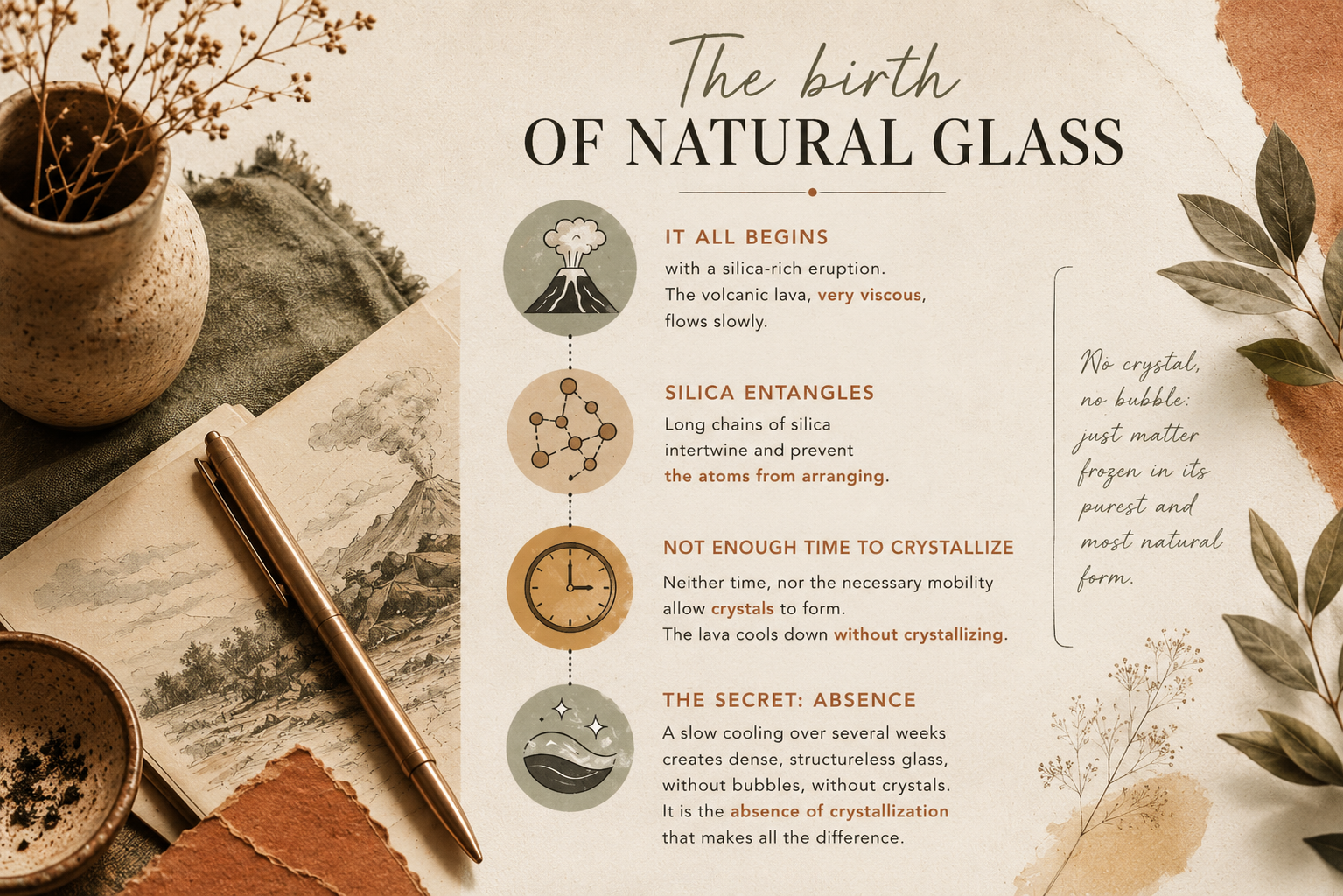
Now, to form crystals, minerals need time and mobility. Here there is neither: the lava solidifies before any crystal can grow. The result is a dense, homogeneous glass, with no crystalline structure, obsidian.
This was long summed up as "flash" cooling. Recent research qualifies that story: to obtain a glass this dense, with no bubbles, the cooling would in fact have to be slower than once thought, over several weeks, giving the gas bubbles time to disappear. One thing remains certain: it is the absence of crystallisation that makes all the difference.
Holding a shard of obsidian in your hand is holding a piece of frozen volcano. I find that idea dizzying: this stone, so smooth, was once molten lava.
Why is obsidian black?
Its dark colour comes chiefly from small amounts of iron and magnesium scattered through the glass. Depending on the impurities and inclusions trapped as the lava flowed, obsidian can also take on other appearances:
- white flecks (cristobalite crystals) → snowflake obsidian;
- aligned gas bubbles creating a golden or silvery veil → sheen obsidian;
- magnetite nanoparticles that break up the light → rainbow obsidian.
I go through all these variations in the varieties of obsidian section of my complete guide.
Where is obsidian found?
Obsidian forms wherever there have been silica-rich eruptions, often at the edges and surface of rhyolite flows, or on the margins of volcanic domes. It's on those edges, cooled faster and cleaner, that the finest material is found.
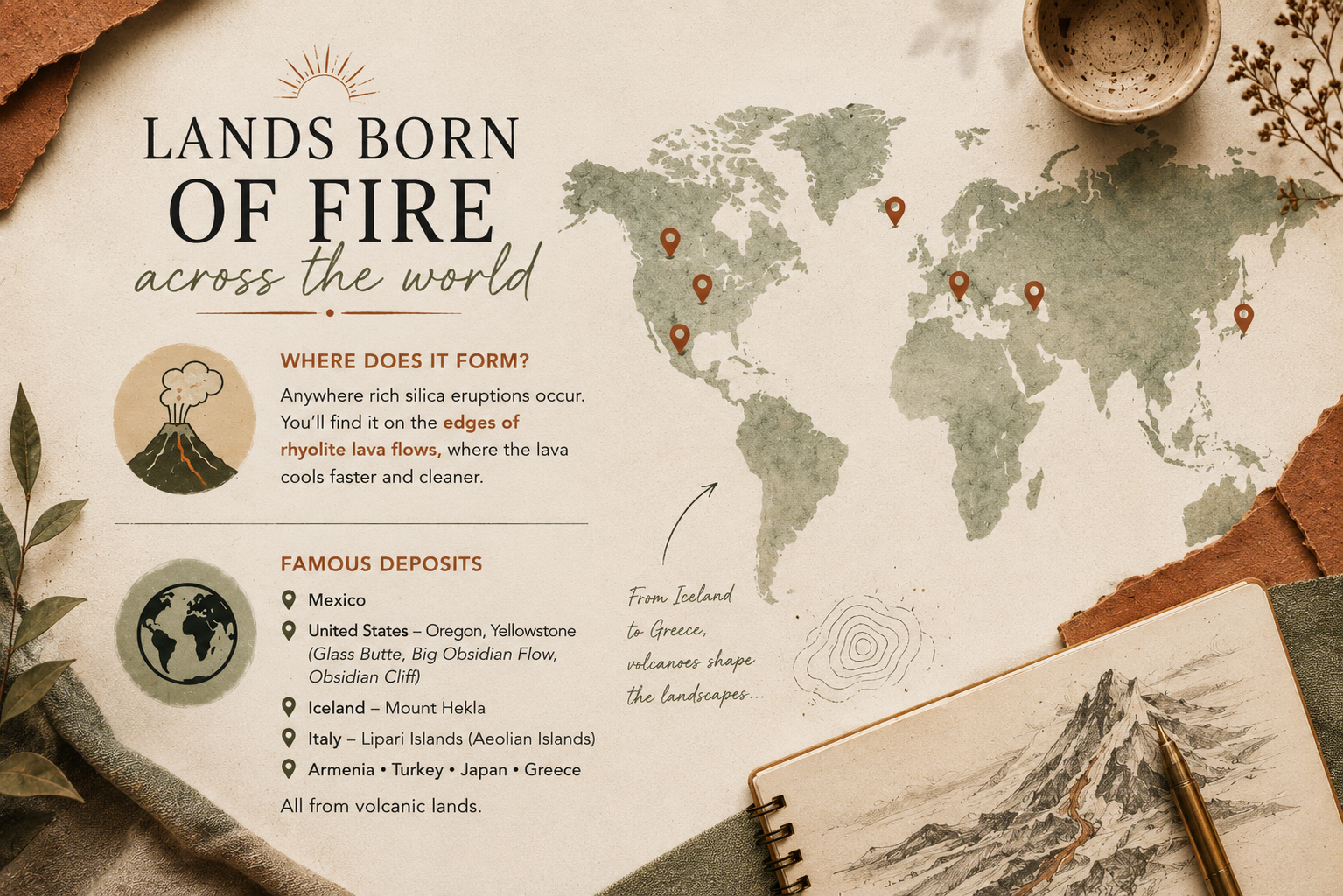
Among the famous deposits: Mexico, the United States (Glass Butte and the Big Obsidian Flow in Oregon, Obsidian Cliff in Yellowstone), Iceland (Mount Hekla), Italy (the Aeolian Islands, Lipari among them), and also Armenia, Turkey, Japan and Greece. All of them volcano country.
A stone that ages
A geological curiosity: obsidian is metastable. In other words, this glass isn't eternal. Very slowly, over millions of years, it tends to reorganise itself into fine crystallisations, that's devitrification, which is what produces the snowflake patterns, among other things.
This is why you'll find almost no very old obsidian: the oldest deposits have already transformed. Water speeds the process up: in contact with groundwater, obsidian gradually hydrates and turns into perlite, a duller glass. The black, glossy stone you wear is therefore, on the Earth's timescale, rather young.
From raw rock to jewellery
The very material that once made blades and arrowheads, thanks to its conchoidal fracture with razor-sharp edges, becomes jewellery today. The work is a matter of choosing good shards, cutting them carefully, then polishing them until you reach that deep, almost liquid black.
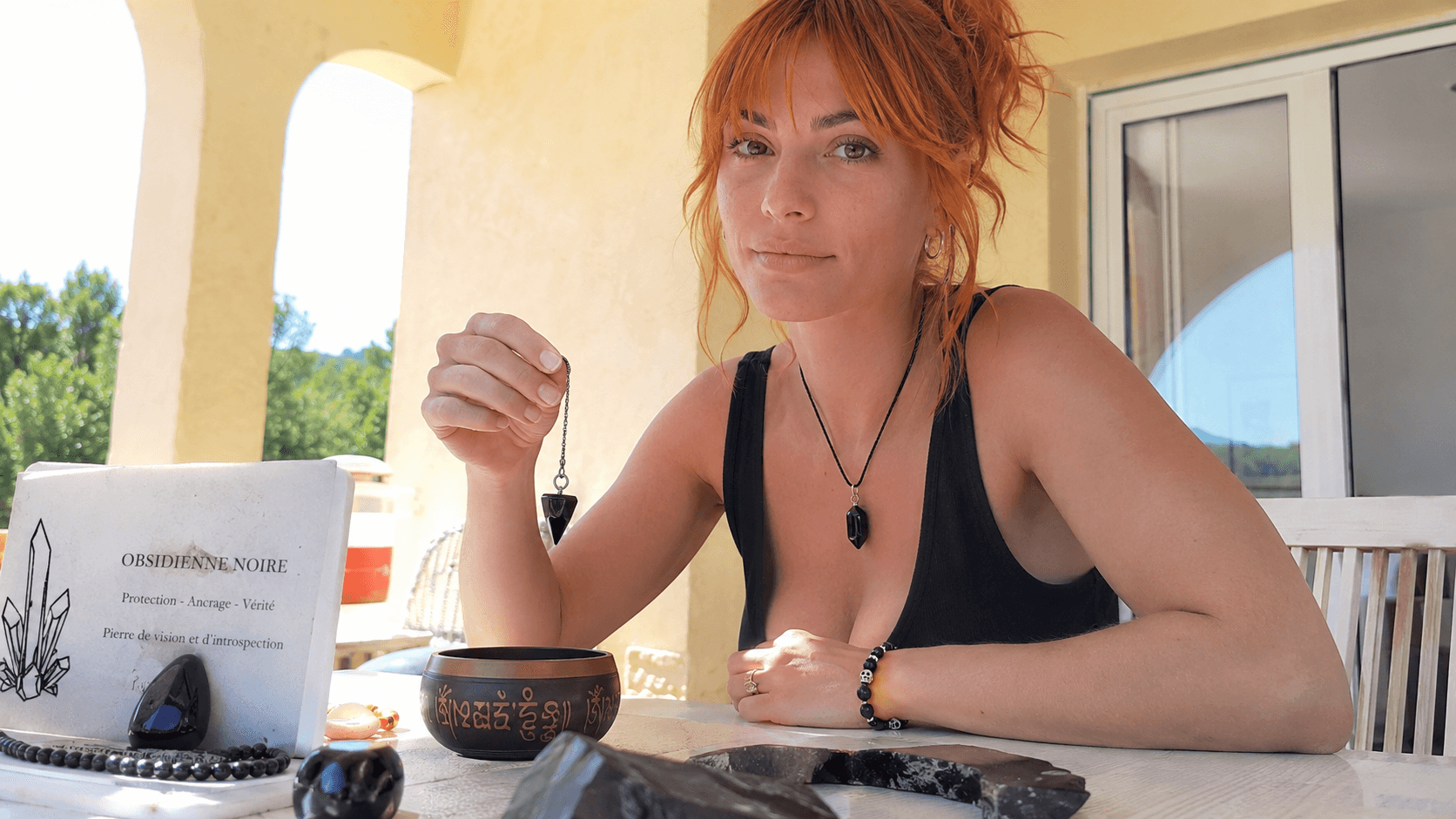
Here, every stone is chosen one at a time, then set by hand. That attention is what makes no two pieces quite alike. Have a look at my obsidian bracelets or browse the whole shop.
When I'm choosing raw stones, I'm always watching for those tiny bubbles and faint glimmers: they're the signature of real obsidian. That, standing at the stall, is where every piece really begins.
And if you're wary of dyed glass imitations, quite rightly so: I explain how to tell real obsidian apart in the guide.
Frequently asked questions
Is obsidian a real stone or is it glass?
What's the difference between obsidian and lava rock (basalt)?
Why is obsidian so sharp?
Is obsidian found in the UK?
Shall we find you an obsidian?
Bracelets, necklaces, pendants and rings in natural obsidian, shaped by hand.