Obsidian Stone: The Complete Guide
Born of volcanic fire, black and deep, obsidian is both a protective stone and an object of real beauty. As a jeweller who works with it every day, here is everything I have learned about it.
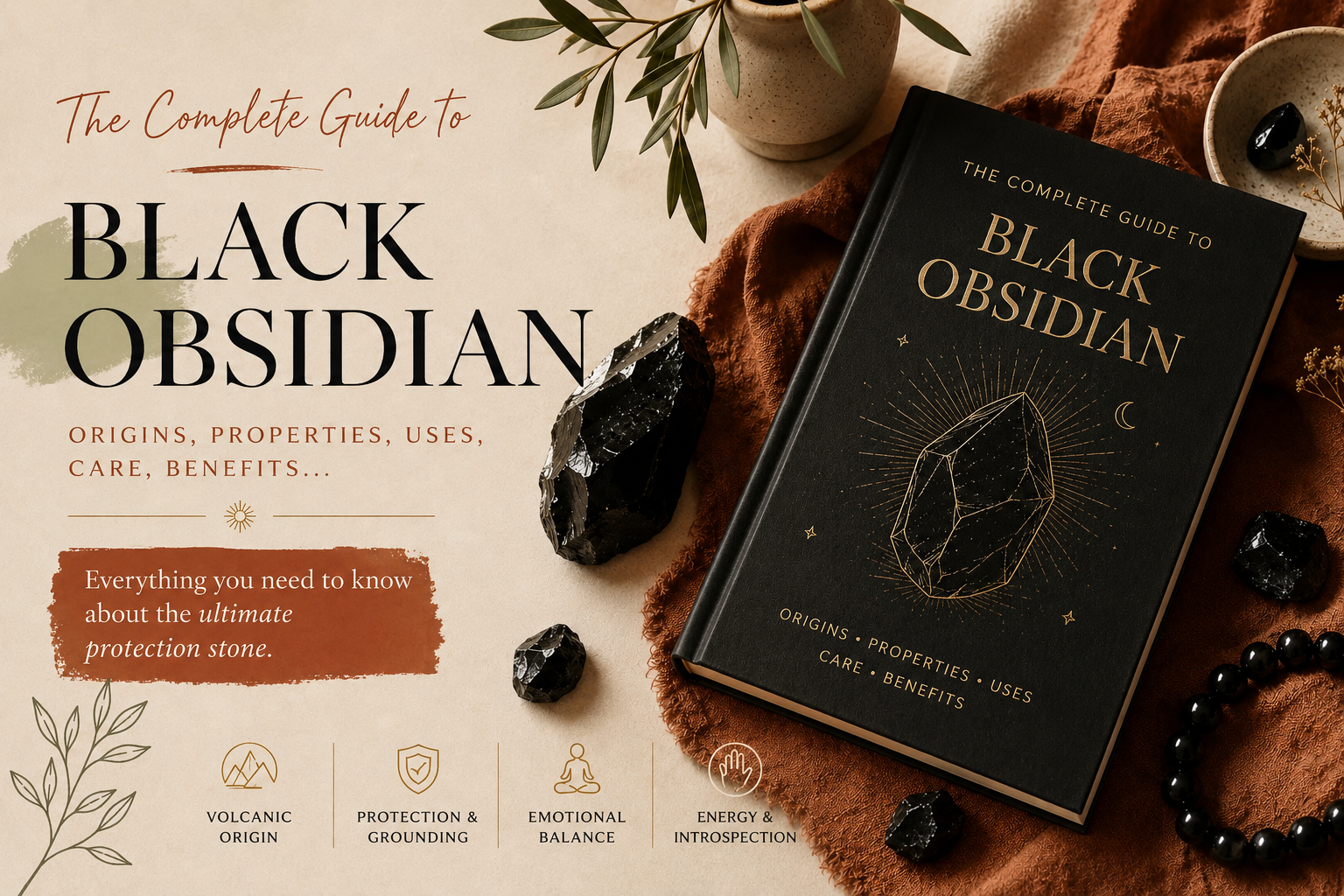
What is obsidian?
Obsidian is a natural volcanic glass. It forms when silica-rich lava cools so quickly that its minerals never get the chance to crystallise, leaving a glassy, smooth, glossy material rather than an ordinary crystalline rock.
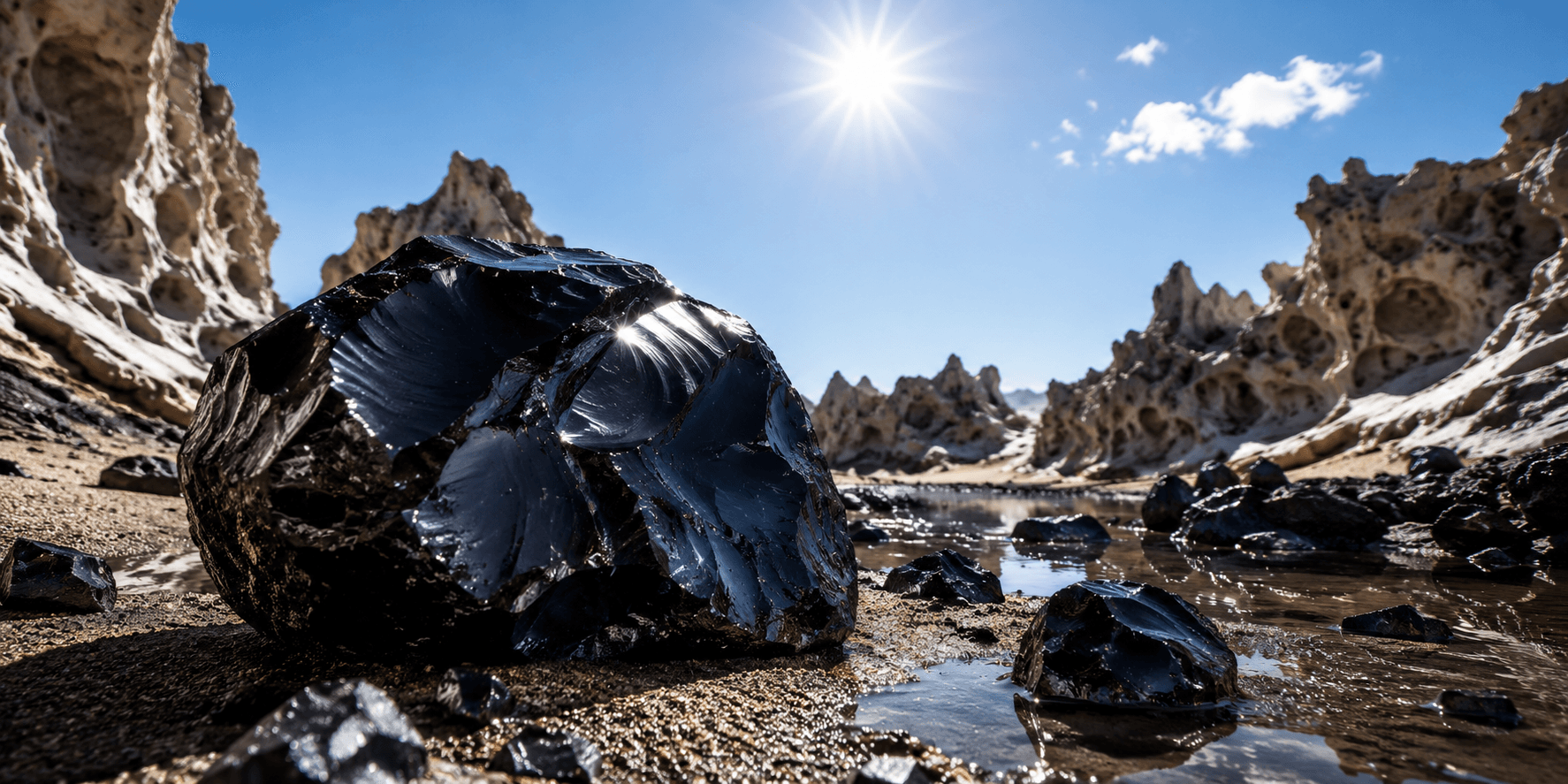
Mineralogically it isn't strictly a mineral at all, but an amorphous mineraloid, made up mostly of silica (SiO₂). It sits at around 5 to 5.5 on the Mohs scale, and its fracture is described as "conchoidal": it breaks into flakes with extremely sharp edges. You'll find it in volcanic regions the world over, Mexico, the United States, Iceland, Italy (the Lipari Islands), Armenia…
The very first obsidian I ever held stayed in my coat pocket for three days. I couldn't quite tell you why, I just needed to feel it there, smooth and cool, against my hand.
If you'd like to go further, I explain how obsidian forms in a dedicated article.
Origins & history
Its deep black comes from iron and magnesium. Thanks to that razor-sharp fracture, obsidian was with us long before it ever became jewellery: from prehistory onwards, people shaped it into blades, arrowheads and tools.
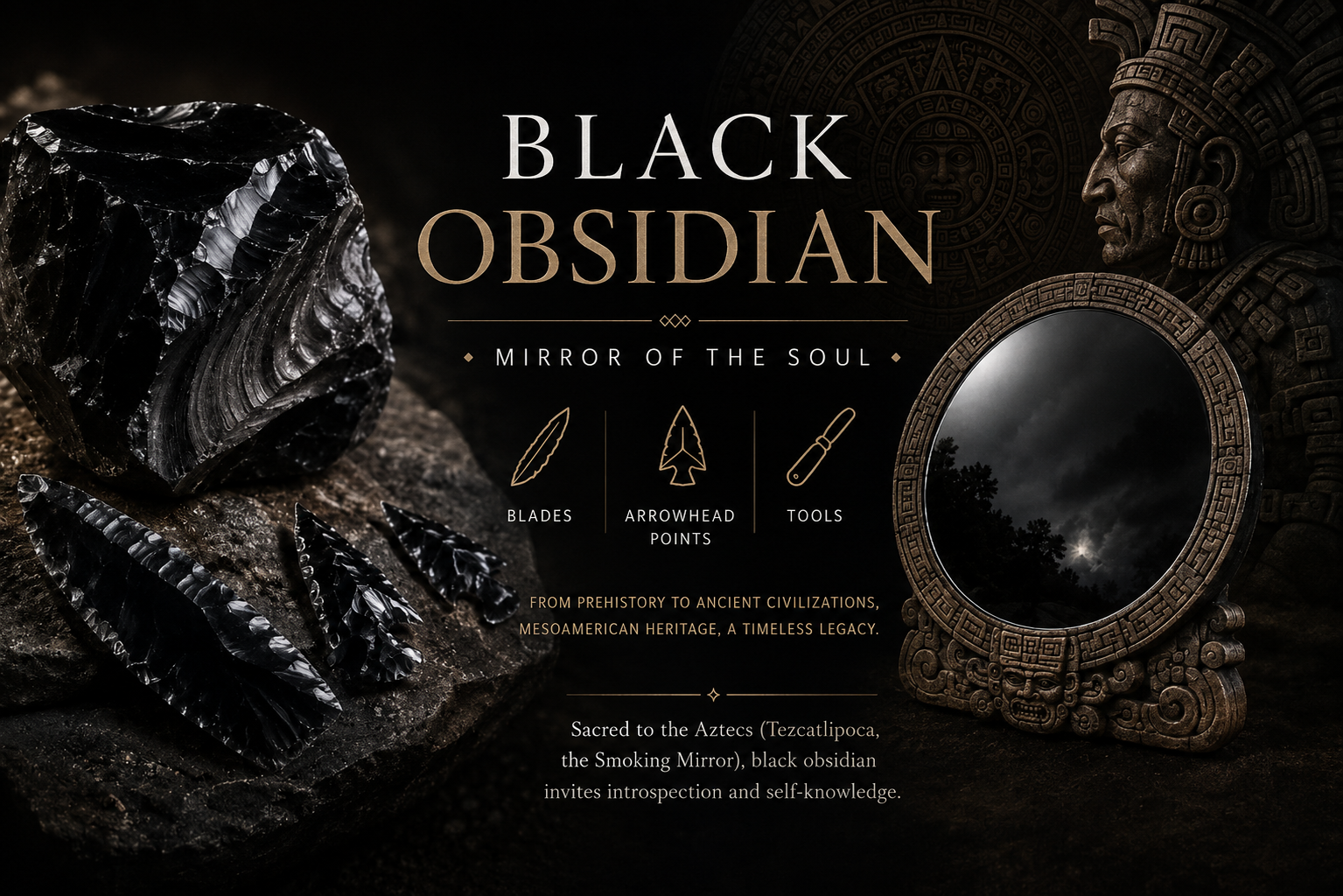
Mesoamerican civilisations, the Aztecs, the Maya, also polished it into mirrors. It was linked to the god Tezcatlipoca, the "smoking mirror". That legacy is where its nickname, the "mirror of the soul", comes from: its dark surface seems to invite you to look inward.
The idea of a "mirror of the soul" moves me. When I polish a stone at the bench and catch my own dark reflection in it, I always feel as though it is quietly asking me something.
The types of obsidian
Obsidian is almost always dark. Its "colours" and patterns actually come from its inclusions, crystals, gas bubbles, magnetite nanoparticles, playing with the light. Here are the loveliest:
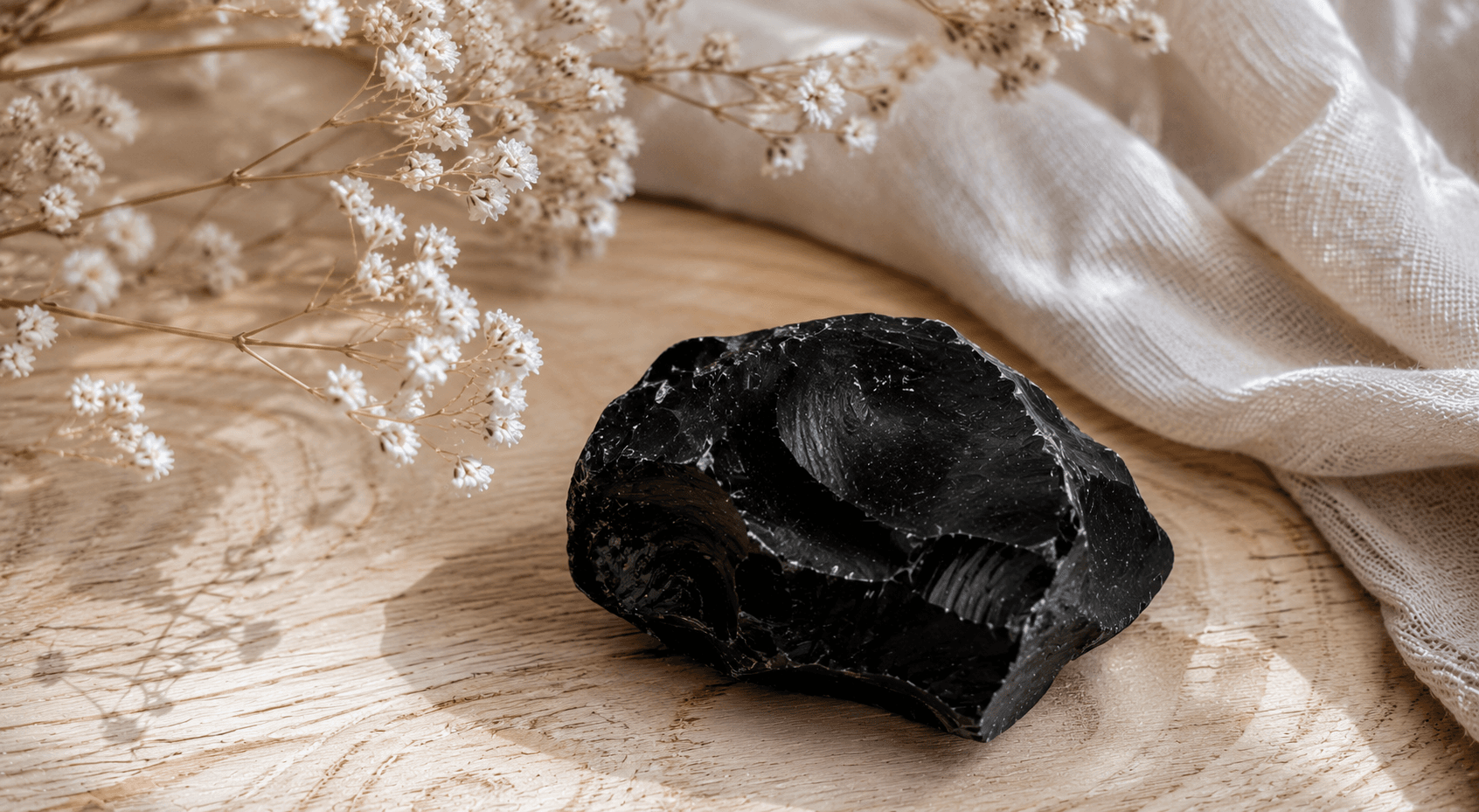
Black obsidian
The most common: black, smooth and glassy. The protective stone par excellence.
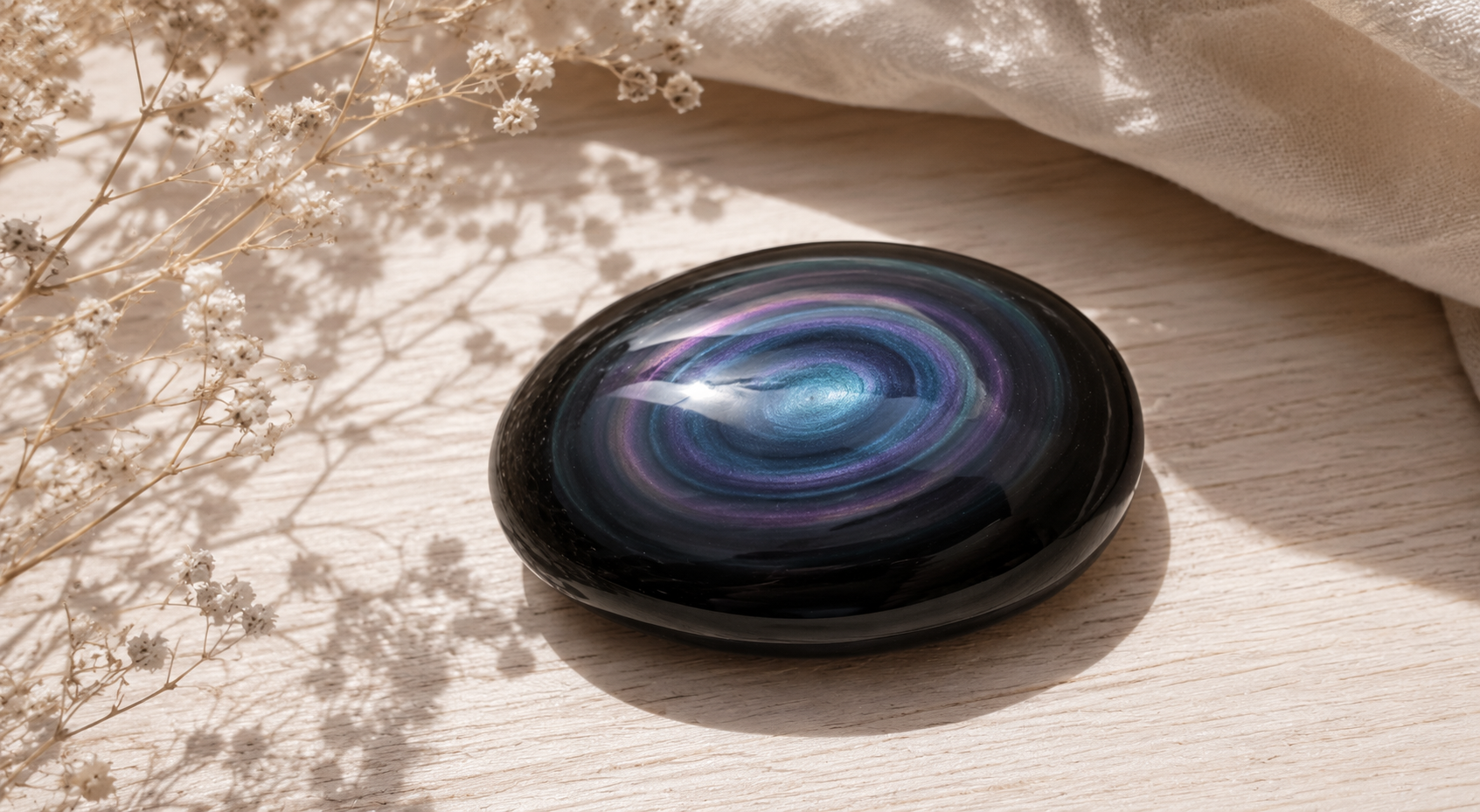
Celestial eye
Blue or violet reflections appear depending on the light. Softness and intuition.
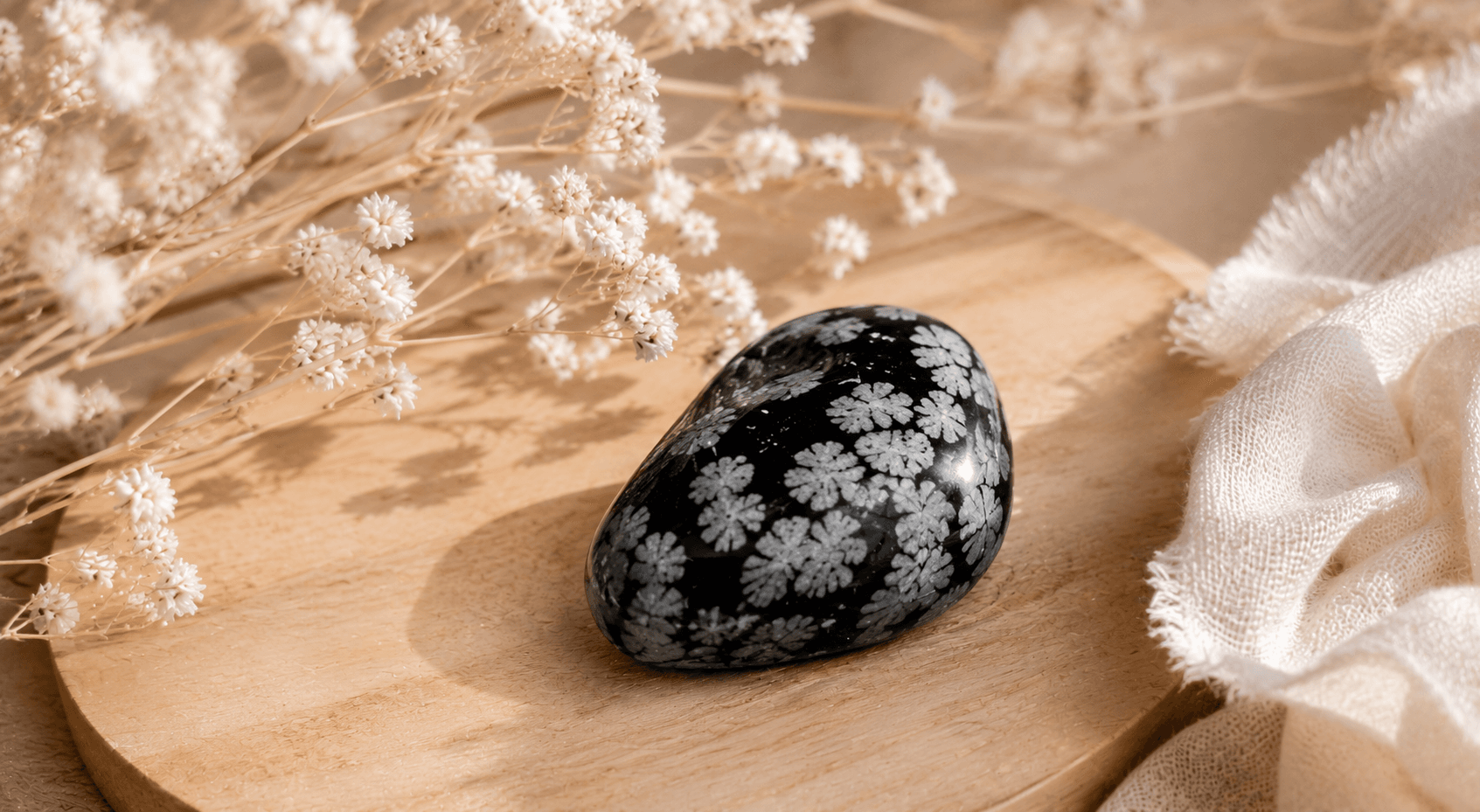
Snowflake
Black flecked with white (cristobalite crystals). Balance and calm.
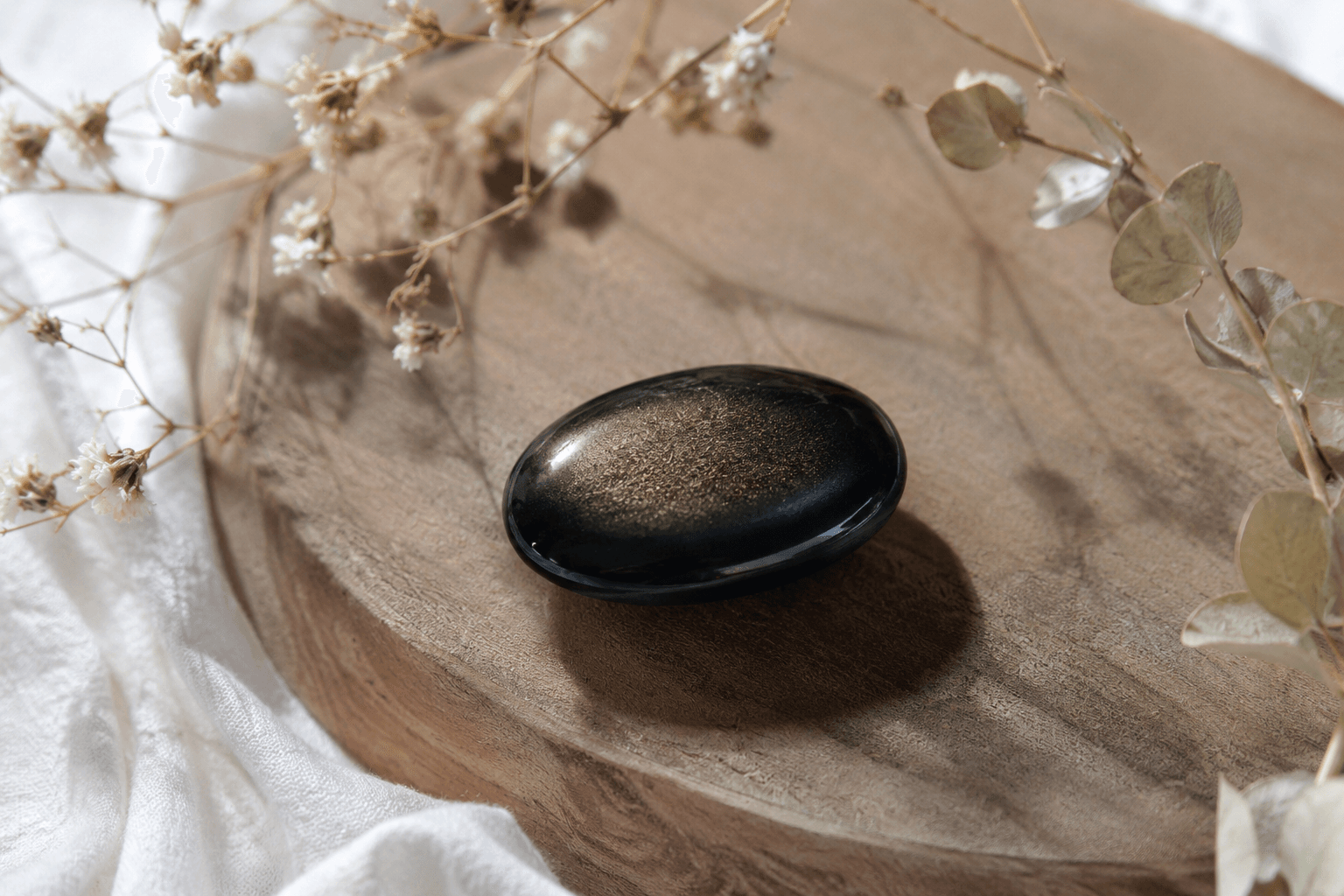
Gold sheen
A golden veil travels across the stone as you tilt it. Confidence and abundance.
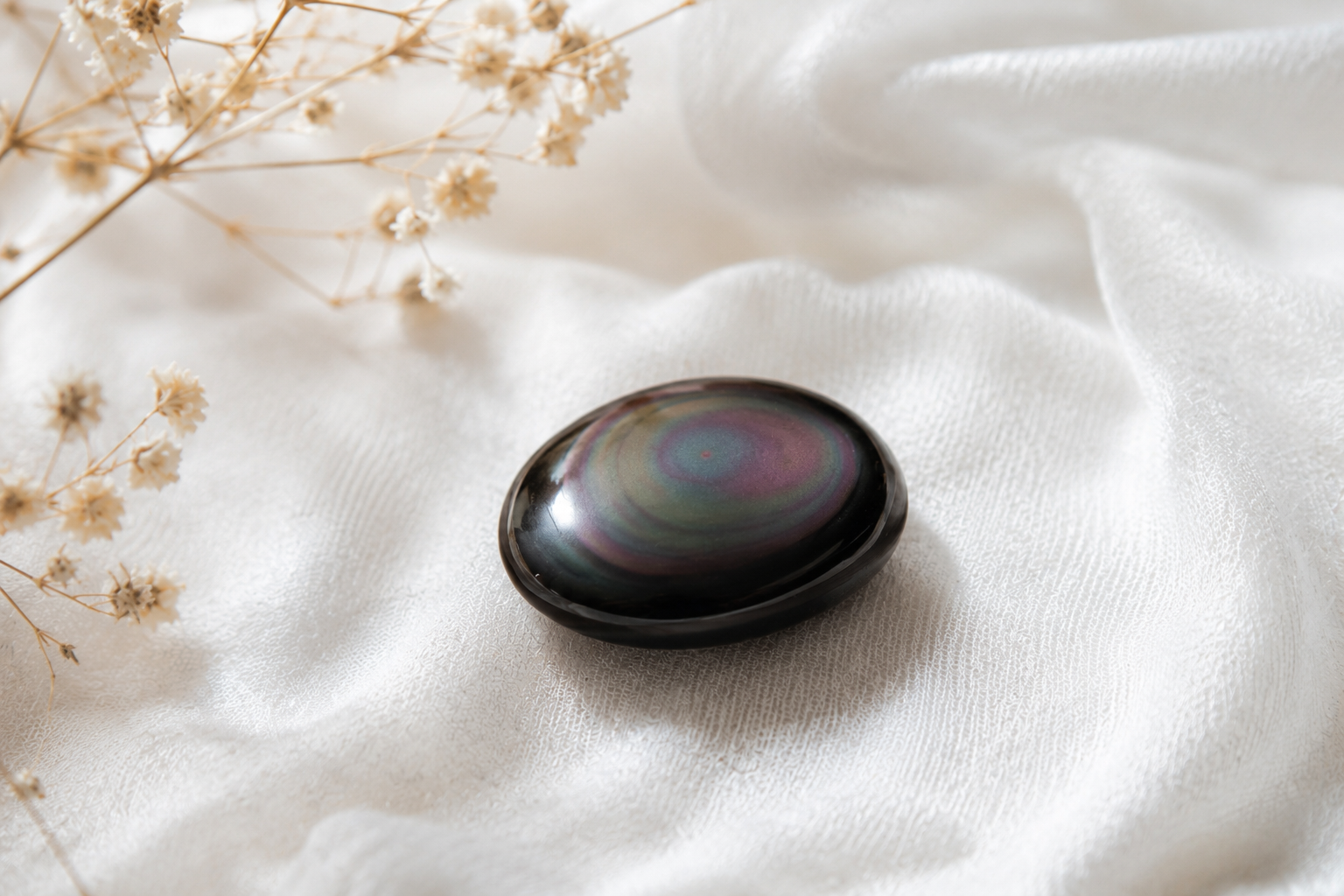
Rainbow
Multicoloured iridescence from magnetite nanoparticles. The most spectacular of all.
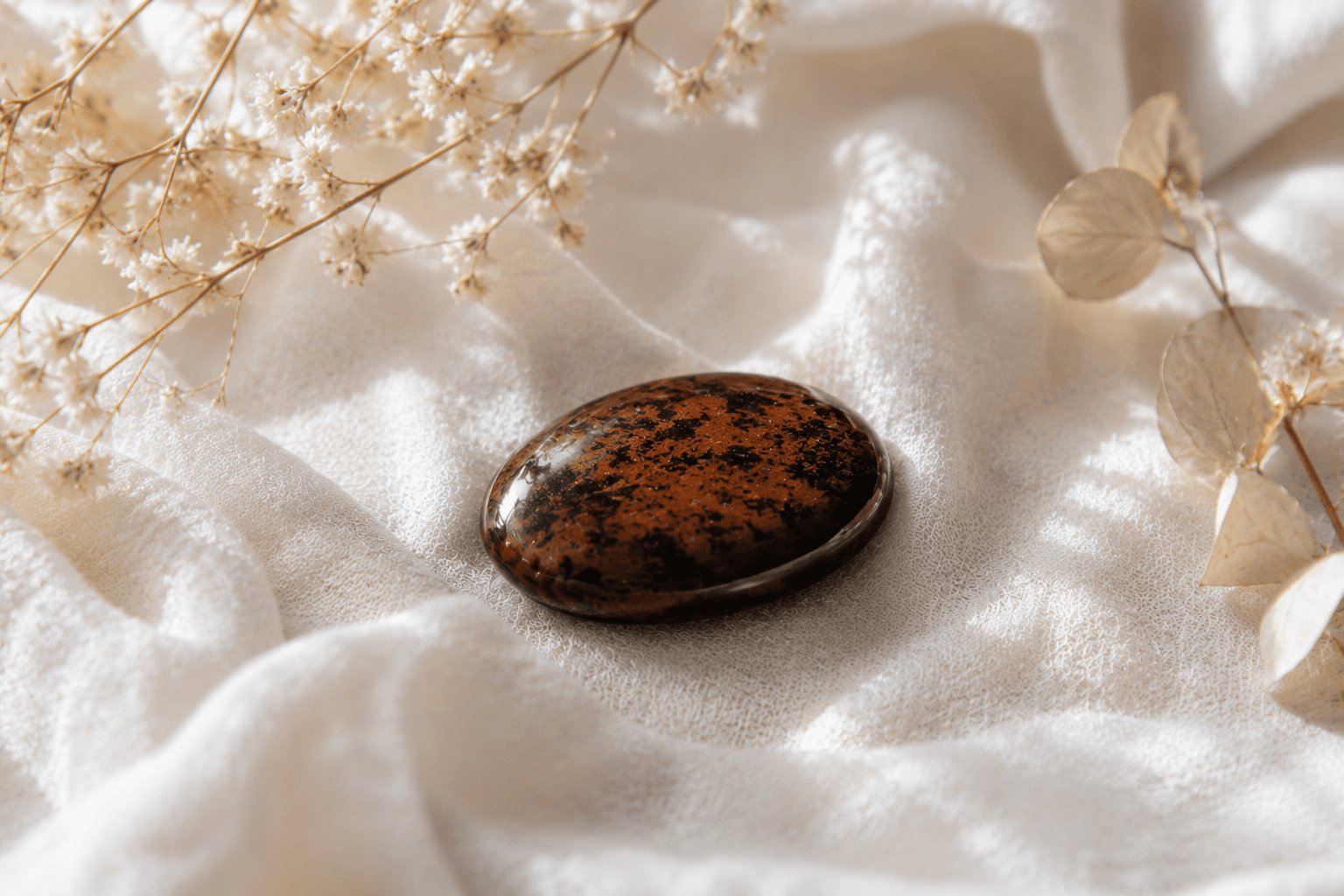
Mahogany
Black shot through with red-brown, thanks to iron. Grounding and vitality.
My favourite is the celestial eye. The first time I tilted one towards the window and that blue-violet veil appeared, I thought it had winked at me. I have never tired of it since.
The full list of natural obsidians
Beyond the best known, here is a fairly complete overview of the obsidians you will actually come across:
- Black obsidian, the most common, black and glassy.
- Snowflake obsidian, black flecked with white (cristobalite crystals).
- Mahogany obsidian, red-brown, from iron and haematite.
- Apache tears, small dark pebbles, naturally rounded and slightly translucent.
- Gold & silver sheen, a golden or silvery veil, created by aligned gas bubbles.
- Rainbow obsidian, multicoloured iridescence from magnetite nanoparticles.
- Celestial eye obsidian, blue and violet sheen, much sought after.
The rare & sought-after varieties
- Fire obsidian, the most prized of all: fine layers of magnetite create opal-like flashes of iridescence (mostly from Oregon).
- Midnight lace obsidian, fine black banding, tightly contorted.
- Spiderweb obsidian, a network of pale veins, like a web.
- Peacock velvet / blue pearl obsidian, waves of lavender, green and violet (Mexico), revealed once the stone is polished.
- Pumpkin & peanut obsidian, banded or spherulitic varieties.
- Tri-flow obsidian, three tones blended together (black, red, translucent).
What about bright blue, green or red obsidian?
Be wary. The transparent, brightly coloured "obsidians" (electric blue, apple green, red, aqua…) sold just about everywhere are almost always manufactured glass, not natural stone. Real obsidian is dark; the few genuinely coloured varieties (a matt green from Mexico, for instance) are opaque and understated. I explain how to tell the difference in spotting real obsidian.
In short, if an "obsidian" is translucent and a vivid blue or green, it is almost certainly glass. Real obsidian stays deeply dark.
Meaning & symbolism
Obsidian is above all a stone of protection and truth. Like a mirror, it is said to reflect back what needs to be seen: buried feelings, our shadow places, the things we sometimes avoid looking at. It has a reputation for being blunt, with no detours, which is why it is associated with honesty towards yourself and with staying grounded in what is real.
Obsidian's properties in crystal healing
In crystal healing, obsidian is credited with several properties:
- Protection: it is said to act as a shield against negative energies.
- Grounding: linked to the root chakra, it is said to reconnect you to the earth and help you re-centre.
- Emotional release: it is said to help blockages surface and clear.
- Clarity & truth: it is said to encourage discernment and clear-sightedness.
Energetically, black obsidian is mostly tied to the root chakra, while celestial eye obsidian is sometimes linked to the third eye. I go into all of this in my article on black obsidian: protection and grounding.
A customer once told me she wore her obsidian bracelet on "high-stakes" days, like a small talisman of courage. I am not promising anything magical, but I find those little rituals of confidence rather precious.
Good to know, the properties described here belong to crystal healing, a wellbeing practice rooted in tradition and belief. They are not a medical claim and are no substitute for advice from a healthcare professional.
How to use obsidian day to day
The simplest way to enjoy obsidian is to wear it, close to you:
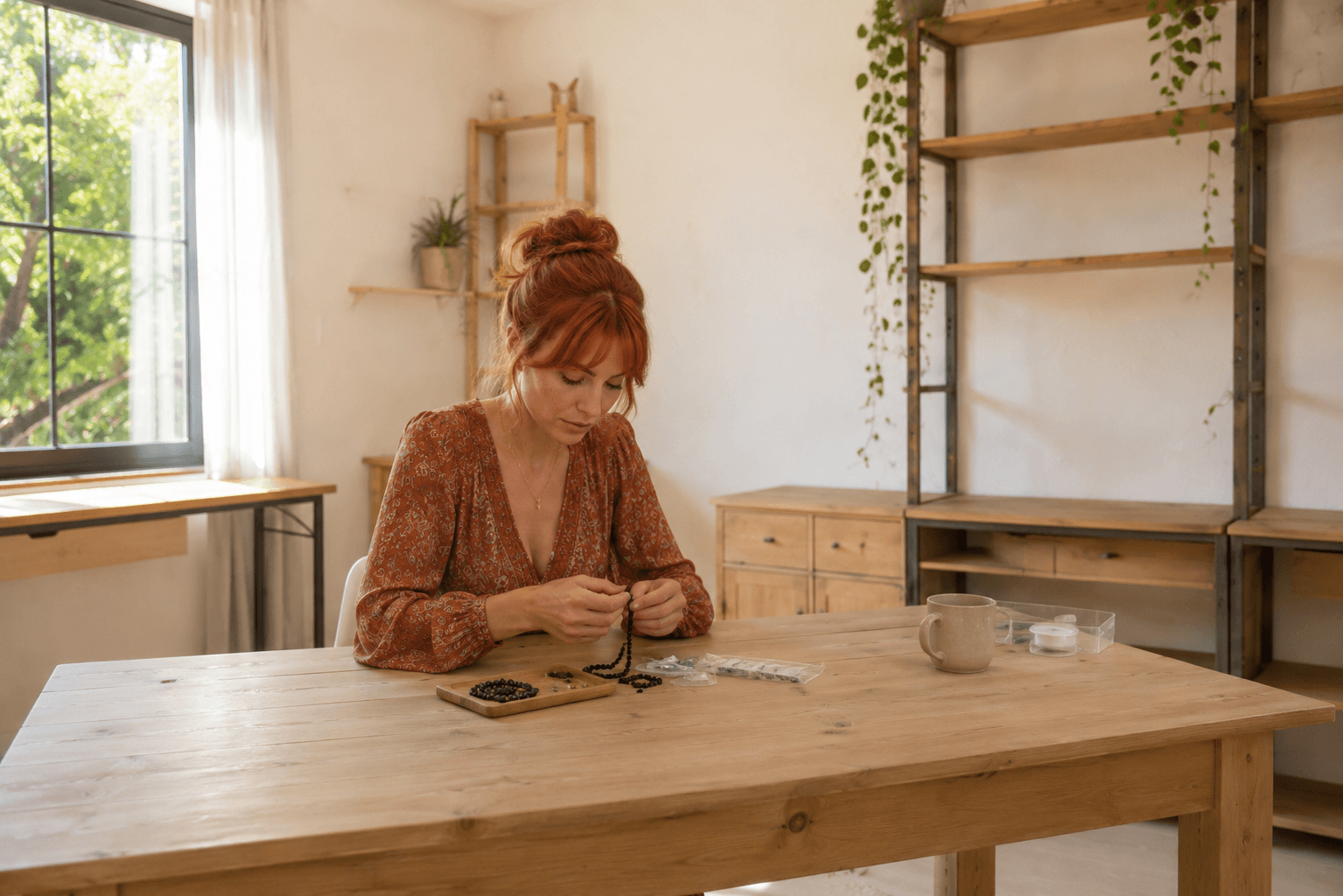
- as a bracelet, for a quiet presence throughout the day;
- as a pendant or a necklace, to keep the stone near your heart;
- as a ring, so you catch sight of it often.
You can also keep a stone at home, in a living space or near the front door, or simply hold it during a quiet moment or a meditation.
Cleansing & recharging your obsidian
Like all stones, obsidian should be cleansed and recharged regularly, especially just after you buy it, and if you wear it often.
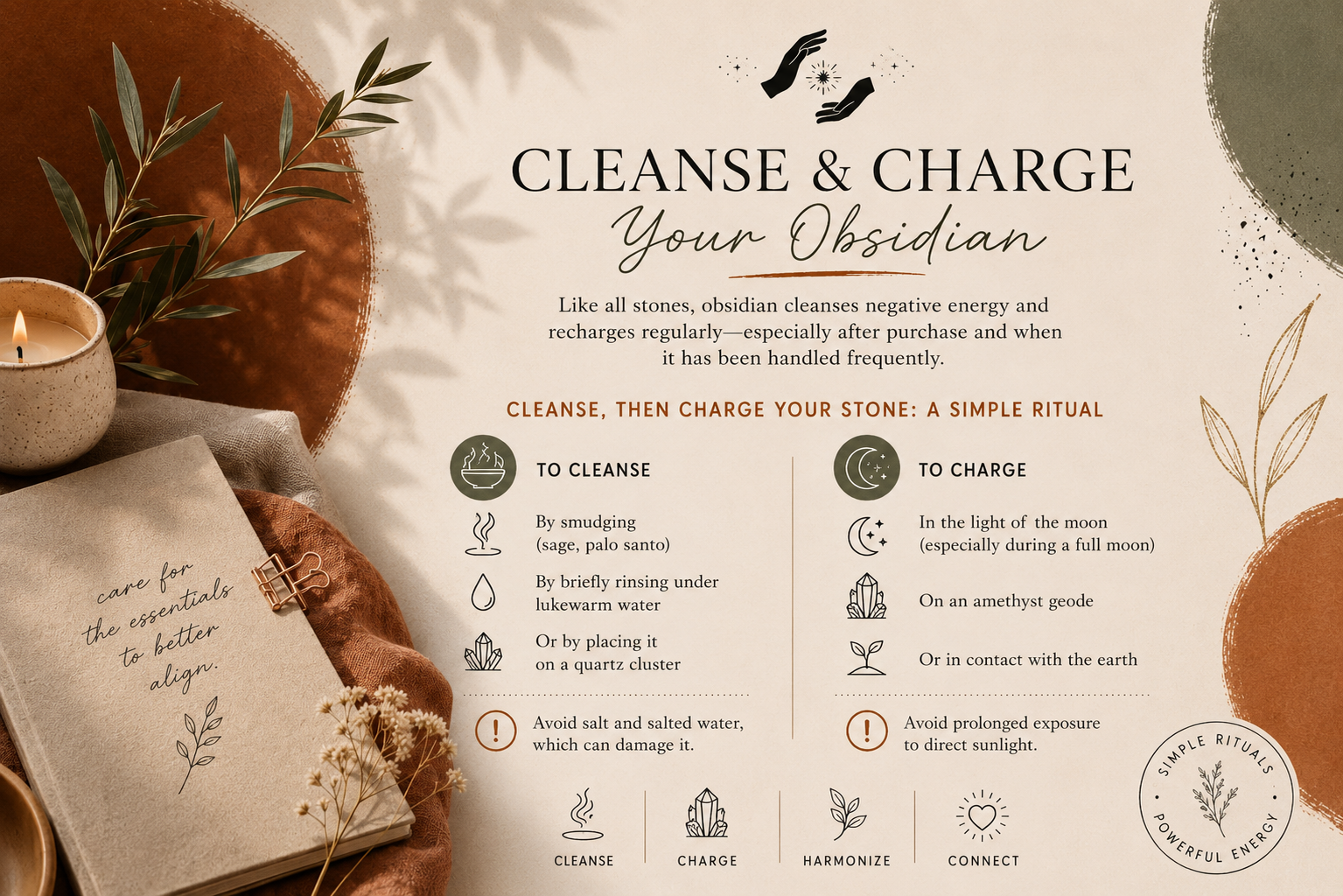
Cleansing it
With smoke (sage, palo santo), a quick rinse under clear water, or by resting it on a quartz cluster. Avoid salt and salt water, which can damage it over time.
Recharging it
In moonlight (a full moon is ideal), on an amethyst geode, or in contact with the earth. Avoid long spells in direct sun. I go through each step in my guide to cleaning your obsidian and the one on cleansing and recharging.
My own ritual: on full-moon nights I line my stones up along the workshop windowsill. In the morning, irrational, I know, they always seem a little more "awake" to me.
How to spot real obsidian
Now that crystals are everywhere, so are coloured-glass imitations. A few things to look for in real obsidian:
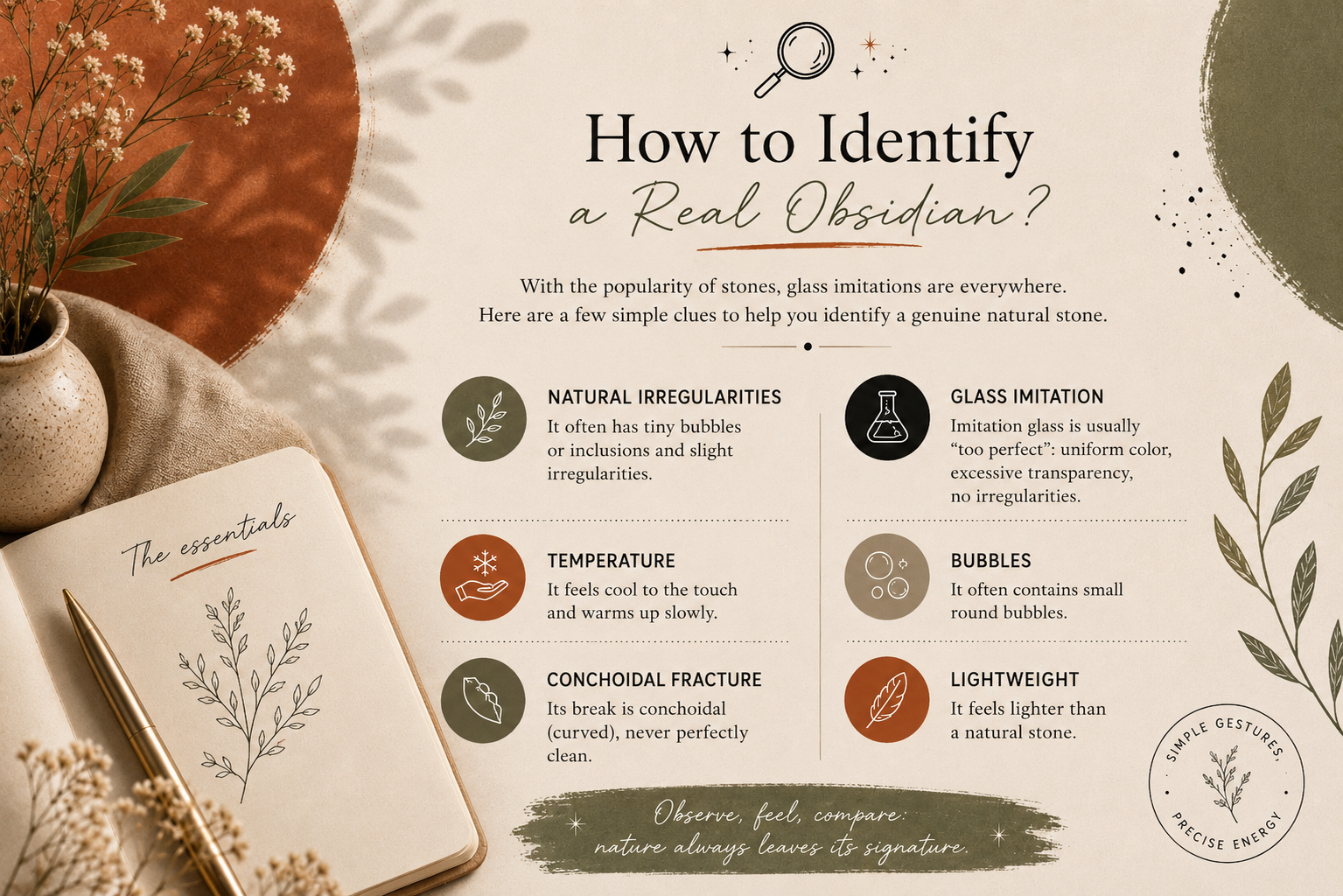
- it often shows tiny bubbles or inclusions and slight irregularities;
- it feels cool to the touch and warms up slowly;
- its fracture is conchoidal (curved), never perfectly clean;
- imitation glass, by contrast, is too "perfect": even colour, uniform transparency, small round bubbles, suspiciously light.
Early on, I was taken in by a "blue obsidian" I spotted online: a gorgeous electric blue… and completely fake. That was the day I decided to work only with stones whose origin I know.
The safest route is still to buy from a seller you trust, one who guarantees natural stones, a commitment I hold to for every single piece I make.
Which obsidian piece should you choose?
It depends what you are looking for:

- for everyday protection, a black obsidian bracelet is the simplest choice;
- to keep the stone near your heart, go for a pendant or a necklace;
- for the sheer beauty of its sheen, let yourself be tempted by a celestial eye or a gold sheen obsidian.
Everything I make is handmade, with stones chosen one by one. Have a look through all my obsidian pieces to find the one that feels like yours.
Frequently asked questions
Can obsidian go in water?
Is obsidian right for everyone?
What is the difference between obsidian and onyx?
Do blue or green obsidian really exist?
Can obsidian be worn every day?
Ready for an obsidian of your own?
Obsidian bracelets, necklaces, pendants and rings, handmade with natural stones.