Black Spinel vs Obsidian: How to Tell Them Apart
The most reliable test needs no loupe and no lab equipment: it's weight. At the same size, black spinel weighs roughly half again as much as obsidian. Here's how to tell these two black stones apart without damaging either, their gemological constants, five checks you can do at home, and why black spinel is not, in any way, a fake obsidian.
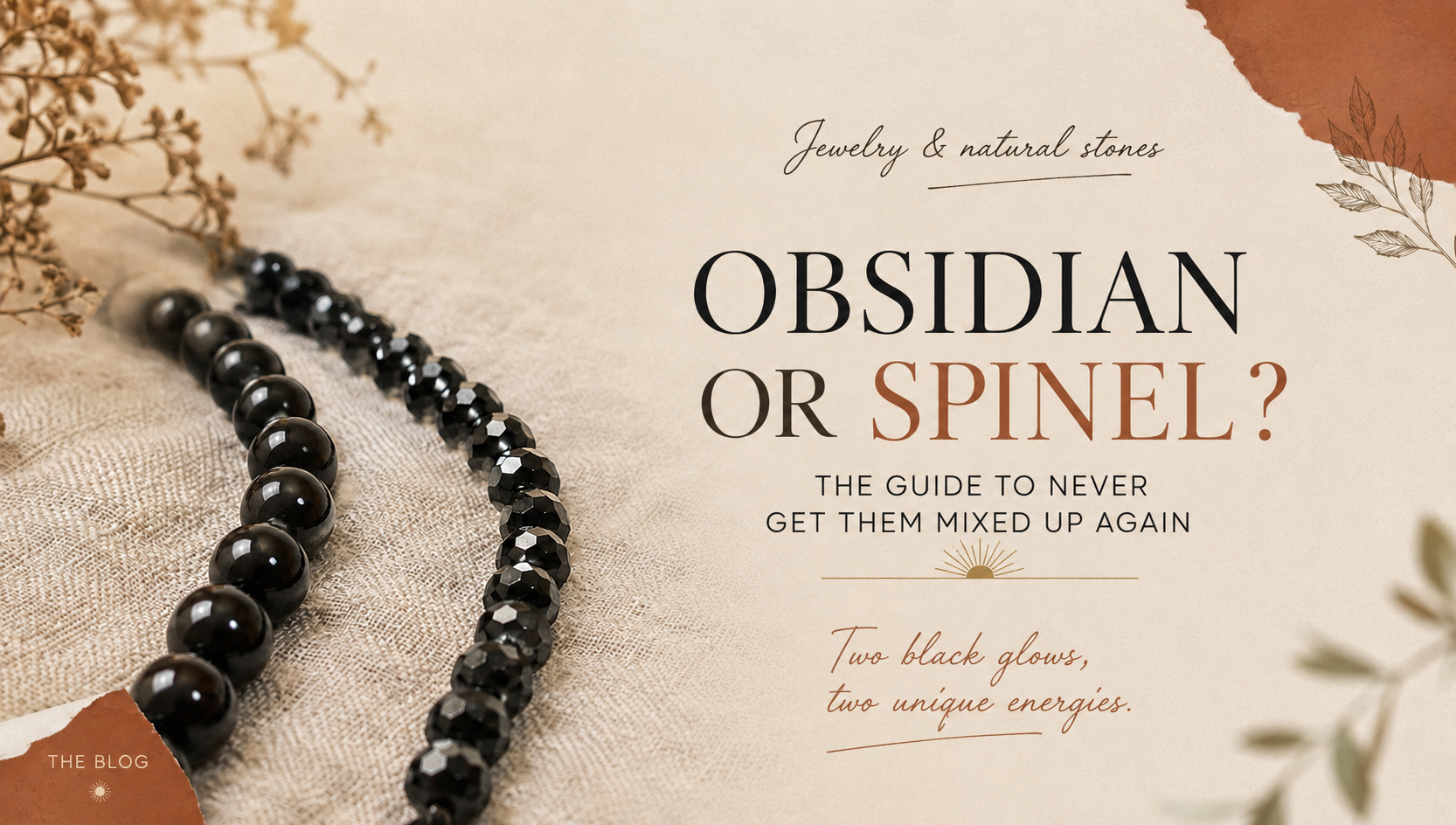
Two black stones with nothing in common
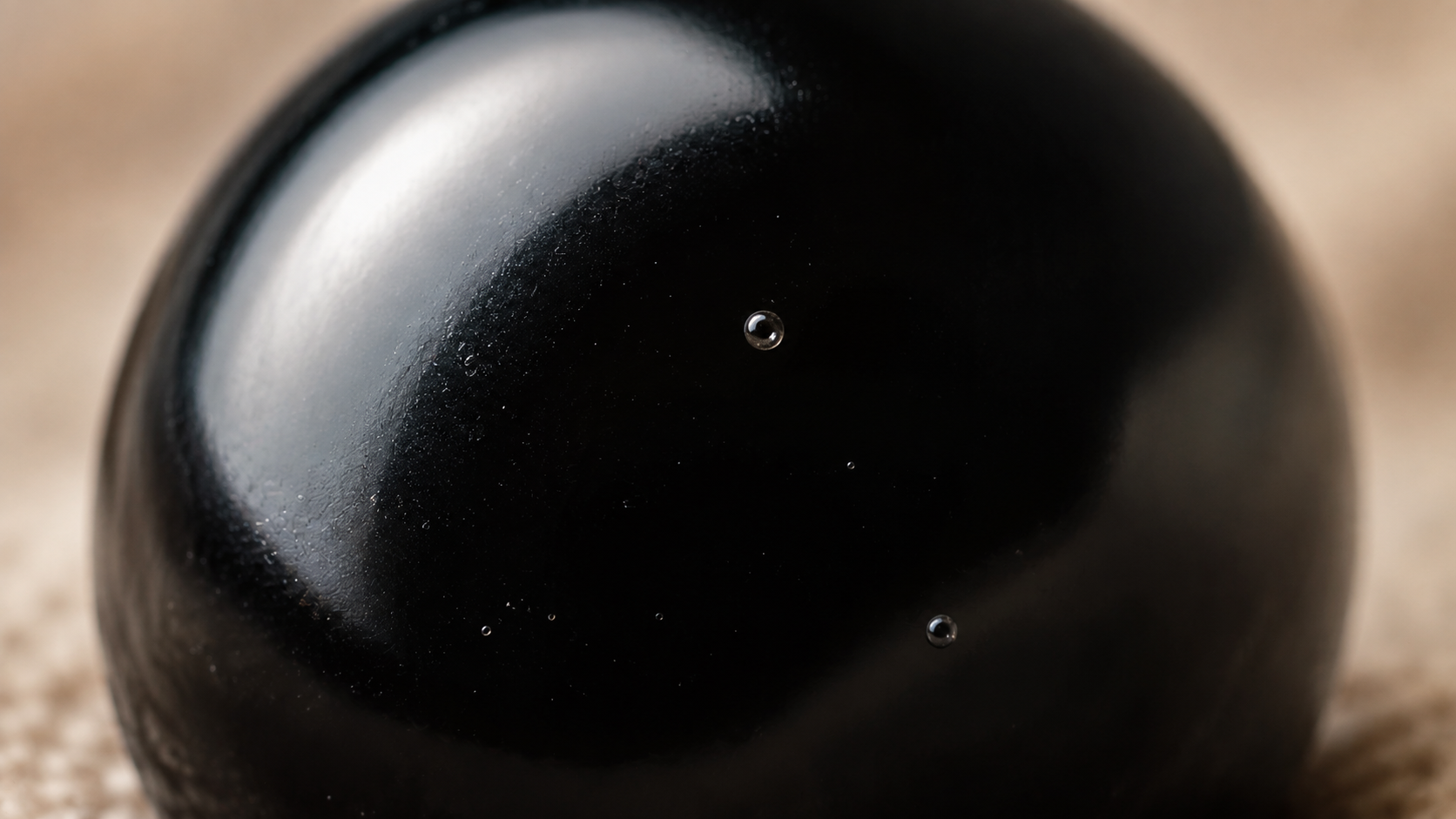
Obsidian isn't a crystal. It's a natural volcanic glass, born from silica-rich lava that cooled too fast to crystallize. Its atoms are locked in disorder, exactly like the glass in a window. Geologists classify it as a mineraloid, not a mineral, I cover that origin story in how obsidian is formed.
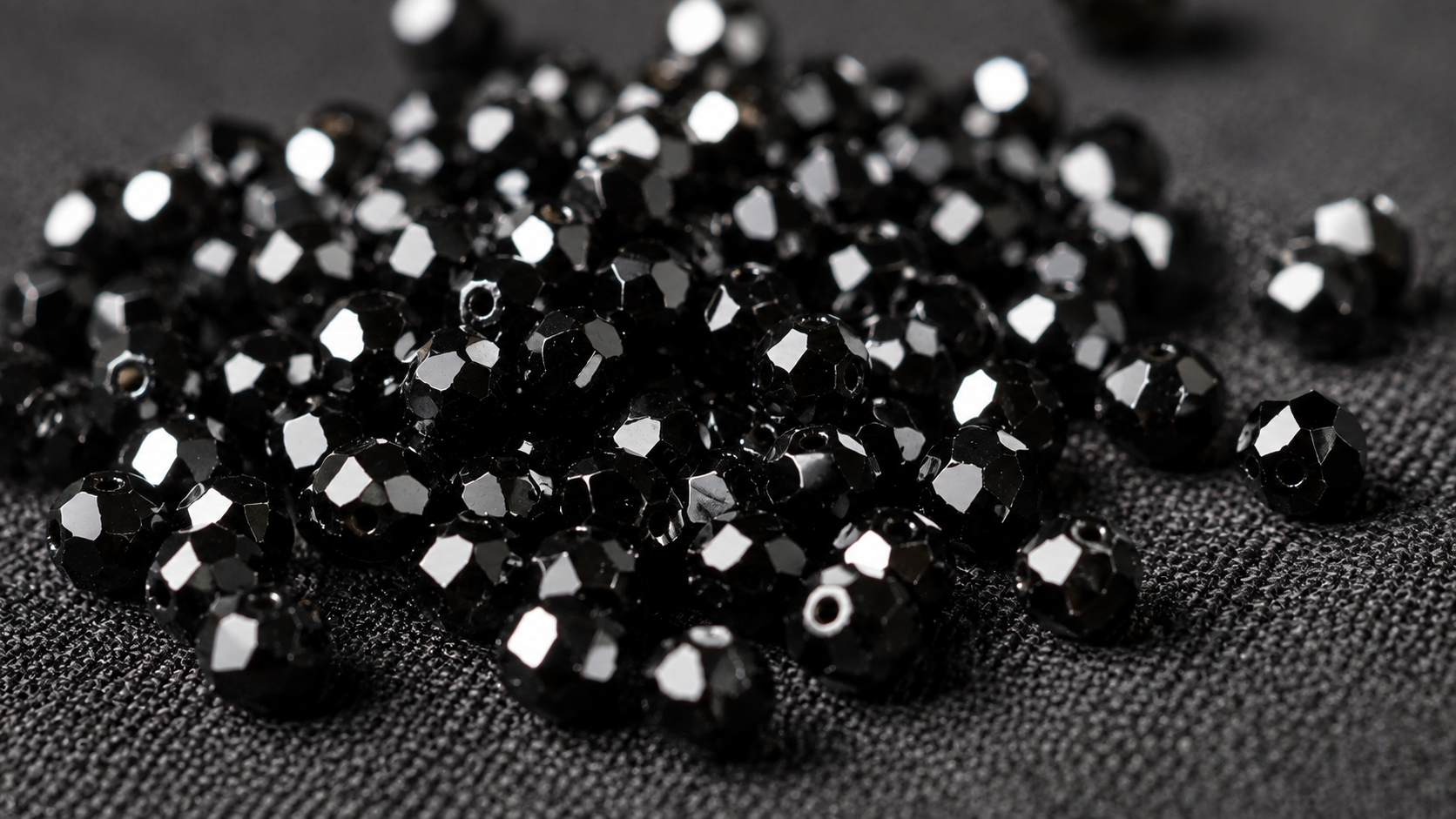
Black spinel is the opposite in every sense: a true mineral, crystallized in the cubic system, chemically a magnesium aluminate (MgAl₂O₄), black varieties owe their color to a high iron content. It forms in metamorphic rock and alluvial deposits, mainly in Thailand, Myanmar, Sri Lanka, and Madagascar.
That difference in nature explains everything else. Glass is light and comparatively soft; a dense crystal from the spinel family is heavy and hard. You don't need to memorize the numbers below, just remember that these two stones only look alike in color.
Black spinel vs obsidian: the side-by-side comparison
| Property | Obsidian | Black spinel |
|---|---|---|
| Nature | Volcanic glass, amorphous | Crystalline mineral, cubic system |
| Composition | Silicate glass, 70%+ SiO₂ | Iron-rich MgAl₂O₄ |
| Hardness (Mohs) | 5 to 5.5 | 7.5 to 8 |
| Density | 2.35 to 2.60 | 3.58 to 4.06 (≈ 3.60) |
| Refractive index | 1.48 to 1.51 | 1.71 to 1.74 |
| Luster | Vitreous | Vitreous to sub-adamantine |
| On thin edges | Often translucent brown, green, or gray | Stays opaque black |
| Common cut | Round beads, cabochons, discs | Faceted beads, rondelles |
| Source regions | Mexico, USA, Iceland, Italy | Thailand, Myanmar, Sri Lanka, Madagascar |
In short, two lines matter in practice. Density (≈2.45 vs ≈3.60) is something you feel the instant you hold the piece. Hardness explains the rest: why spinel gets cut into facets and obsidian doesn't, why one scratches easily and the other doesn't.
Five checks you can do at home
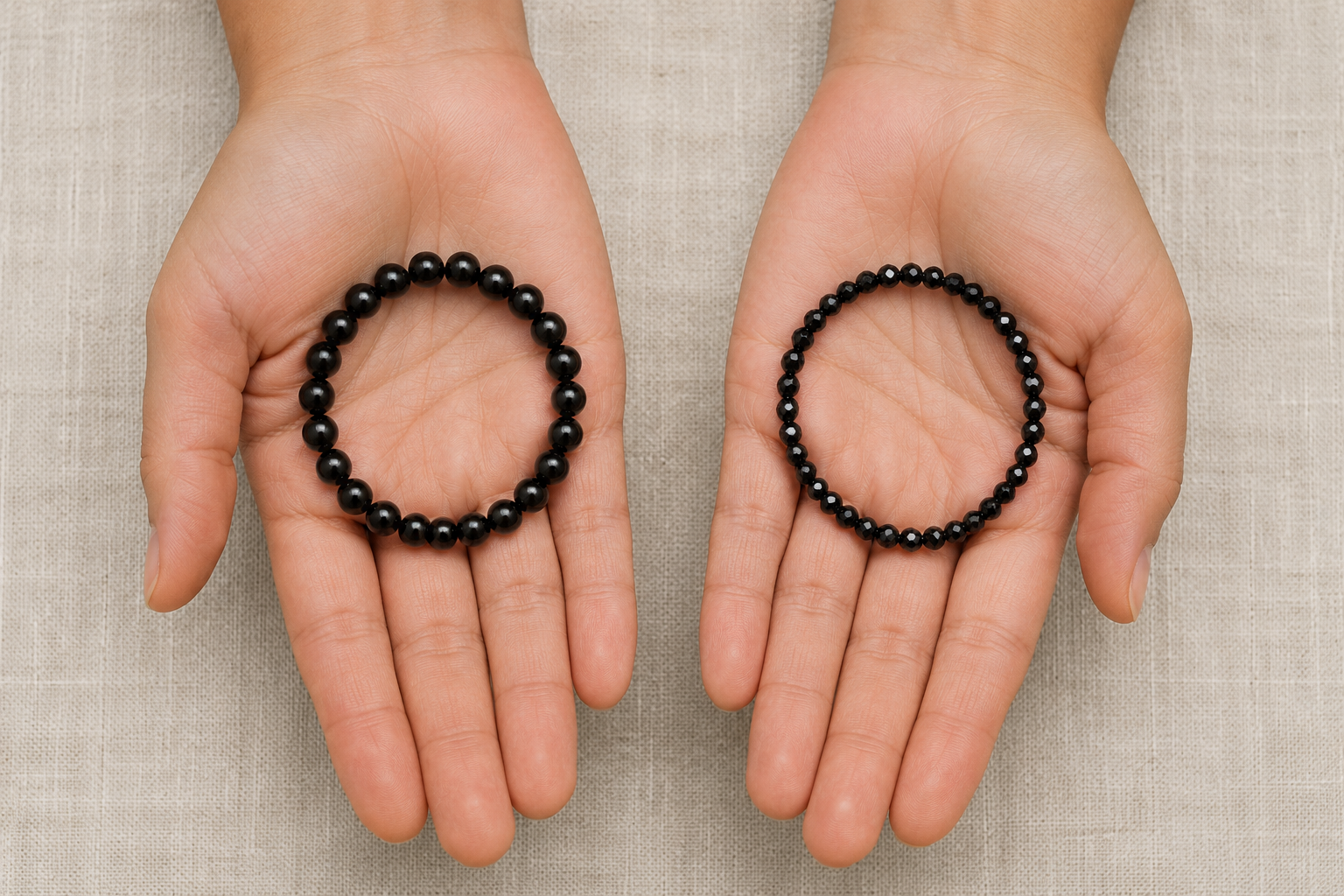
Ranked from most to least reliable, and all of them non-destructive except the last one, which I'd skip.
Weigh it in your hand
The decisive test. A bracelet of 22 beads at 8mm weighs about 14.5g in obsidian versus 21g in black spinel, nearly 50% more. Hold one bracelet in each hand and the difference is obvious within seconds. A small kitchen scale settles it for good.
Check the edges in bright light
Hold the stone up to a window or a strong lamp. On a thin edge or a slim bead, obsidian often lets through a brown, green, or gray glow, sometimes with tiny trapped gas bubbles. Black spinel stays solidly opaque no matter how you angle it.
Look at the cut
The fastest shortcut. Black spinel is almost always faceted, its hardness lets it hold crisp, sharp edges. Obsidian, being softer, is usually shaped into rounds or cabochons. A black bead with clean, glittering facets is very likely spinel.
Touch it
A minor clue, not proof. Both feel cool at first contact, but obsidian, a glass, and a poor heat conductor, warms up faster in your hand. Spinel stays cool longer. Best used alongside the other tests, not on its own.
Scratch it, best avoided
You'll often read that a steel point (hardness ≈5.5) scratches obsidian but not spinel. That's true, and it's also the surest way to permanently damage a piece of jewelry. If you insist, do it on a hidden spot near the base of a bead. Otherwise, the four tests above are more than enough.
Keep in mind, none of these home checks replace a real gemological exam. For a valuable piece, or a dispute with a seller, only an independent lab can settle it, refractive index and density measurements take just a few minutes there.
Which one should you choose for jewelry?
I'll be upfront about it: on pure technical merit, black spinel wins. At 7.5 to 8 on the Mohs scale, it resists everyday scratches far better than obsidian's 5 to 5.5. For a ring worn daily, that's a real advantage.
Black spinel isn't a fake obsidian. It's a beautiful stone in its own right, harder than mine, and it ages better. The problem was never the stone, it's the label. Selling spinel under the name "obsidian," or the reverse, is what's not acceptable.
What obsidian has going for it is a different kind of appeal. Its material tells a story: cooled lava, a geological accident, glass born of fire. Its black isn't sparkly but deep, almost liquid depending on the light, an effect spinel's sparkle simply doesn't produce. And it's obsidian, not spinel, that crystal healing tradition links to grounding and protection.
In practice: choose spinel if you want sparkle and everyday durability, obsidian if you want depth and a story behind the stone. These are two different choices, not a right one and a wrong one.
Other black stones people confuse with obsidian
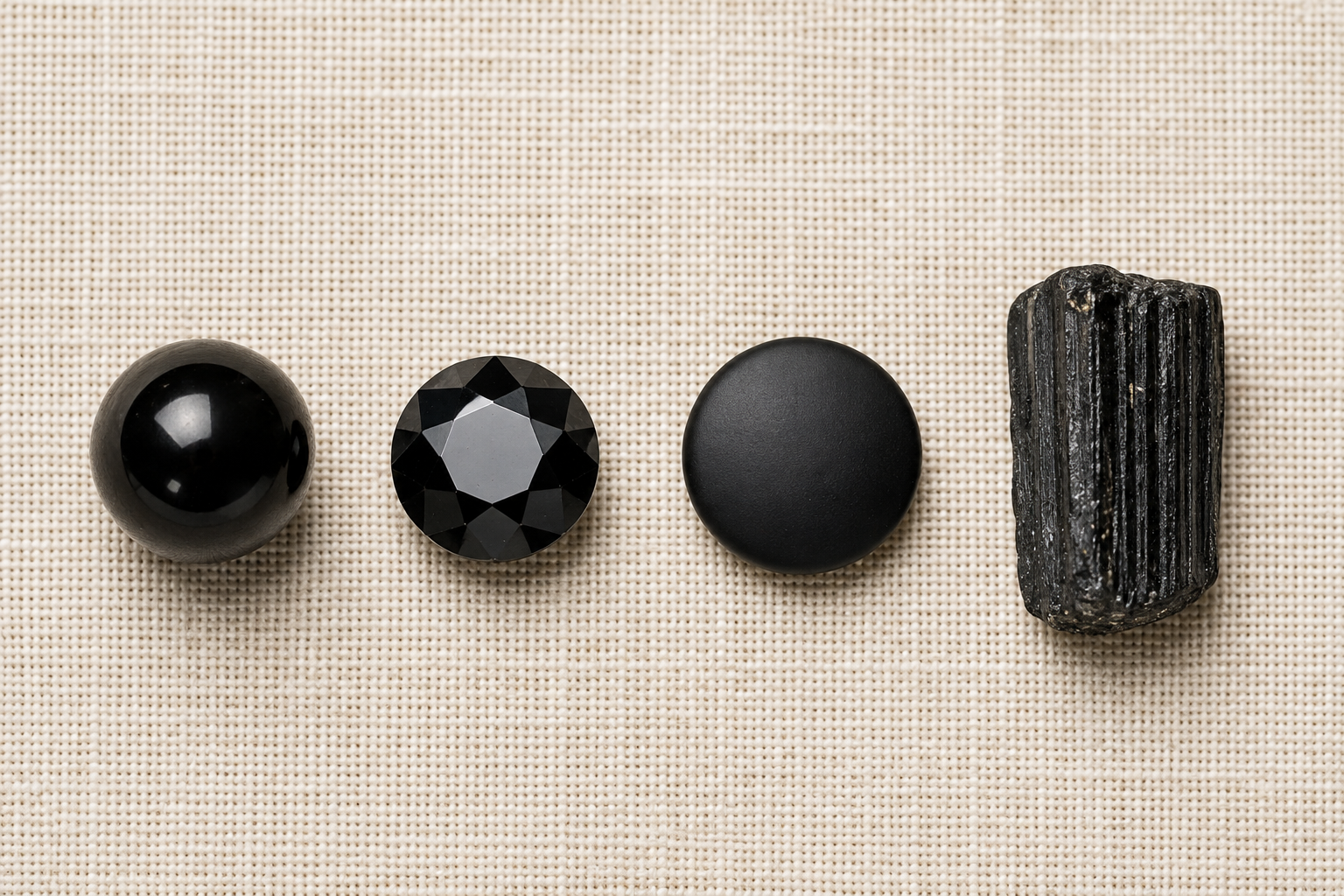
Spinel isn't the only stone that gets mixed up with obsidian. Three others circulate under loose labels:
- Black onyx, a chalcedony, meaning microcrystalline quartz, hardness 6.5 to 7, density ≈2.6. The uniform black sold commercially is almost always achieved through dyeing, a common and accepted practice, though it should be disclosed. Its look is flatter and more "solid" than obsidian's;
- Black tourmaline (schorl), hardness 7 to 7.5, density ≈3.1. Recognizable by its characteristic lengthwise striations, clearly visible on raw pieces. Usually sold as a tumbled stone rather than polished beads;
- Manufactured black glass, the one genuine problem on this list. Too perfect, no inclusions, often translucent at the edges, sometimes with a visible mold seam. It warms up in your hand very quickly. This is what's behind those impossible-colored "blue obsidians" you sometimes see online.
A simple rule of thumb: faceted and sparkly means spinel. Matte and perfectly uniform suggests dyed onyx. Striated means tourmaline. Too perfect and too light means glass. Obsidian, by contrast, almost always carries a small imperfection, a bubble, a haze, a shift in tone within the black.
Buying without getting it wrong
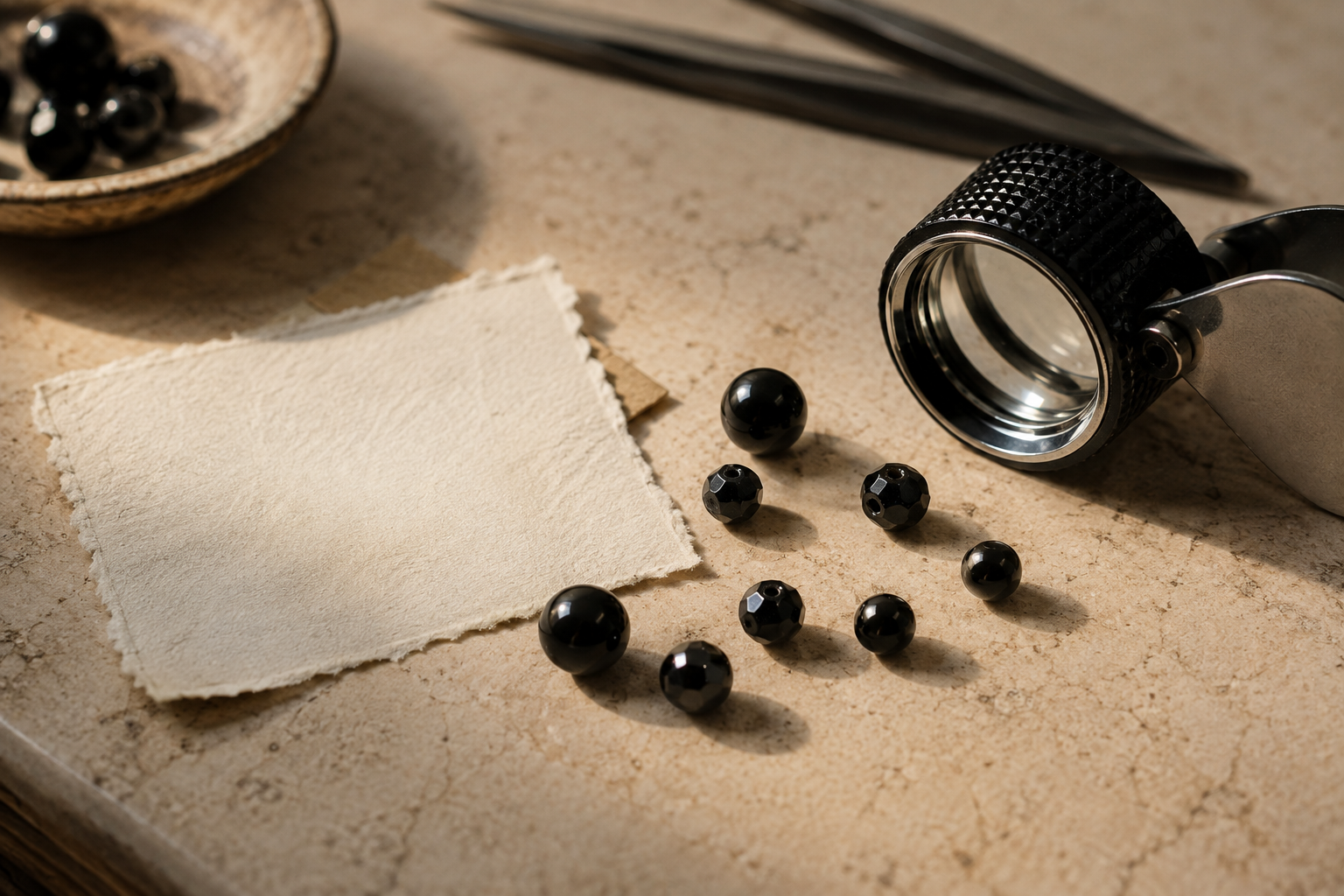
Three habits will save you from nearly every bad surprise.
Ask for a precise name. "Black stone," "black onyx" used loosely for anything dark, "rainbow obsidian" slapped on a stone with no sheen at all, a seller who knows their material names it without hesitation and can tell you where it came from. Vagueness about the name is the first red flag.
Watch for marketing names. "Midnight obsidian," "black diamond" for what's actually spinel, "obsidian onyx", none of these exist in any real mineralogical classification. They exist to make price comparison harder. My guide to obsidian pricing and value breaks down the real ranges.
Ask for the weight. It's the most honest piece of information anyone can give you about a beaded bracelet, and the one most rarely offered. Combined with bead size and count, it lets you check the density yourself in about thirty seconds.
Almost nobody asks me this, and I wish more people did. Message me and I'll tell you the exact weight of the piece you're eyeing, it's the simplest check there is, and an artisan who won't answer that question is already telling you something.
✦ Every stone, clearly named
My obsidians, variety by variety
Loading pieces…
If you're torn between the different obsidians, black, gold sheen, snowflake, rainbow, the full picture is in my obsidian varieties guide. For the bigger overview, see the complete obsidian guide.
Care & precautions
The hardness gap has one very practical consequence: never store these two stones together. Spinel, at 8 on the Mohs scale, will scratch obsidian without any effort at all. Give each piece its own pouch or compartment.
For obsidian: a soft microfiber cloth, brief lukewarm water if needed, never salt, abrasive cleaners, ultrasonic cleaners, or steam. Take your jewelry off before showering, exercising, or sleeping, on a bracelet strung on elastic cord, the cord is what wears out first. Full details are in cleaning your obsidian, and the energetic-care side in cleansing and charging.
Good to know, the gemological constants cited here (hardness, density, refractive index) are measurable data. The properties attributed to crystals, on the other hand, come from spiritual traditions and crystal healing, a wellness practice grounded in belief rather than science. They are not medical claims, do not treat any condition, and never replace advice from a healthcare professional.
Frequently asked questions
How do you tell black spinel from obsidian?
Is black spinel a fake obsidian?
What is the hardness of obsidian versus black spinel?
Can you test a piece of jewelry by scratching it?
How do you recognize black onyx versus obsidian?
Which black stone is the toughest?
How do you check the density of a bracelet?
Real obsidian, nothing more, nothing less
Bracelets, necklaces, pendants, and rings in natural obsidian, handcrafted in France, every variety sold under its true name.