What Does "Obsidian" Mean?
The word doesn't describe a color or a property: it's a proper name. "Obsidian" comes from a certain Obsius, credited by Pliny the Elder with discovering the stone. And it carries a two-thousand-year-old copying error. Here's what "obsidian" actually means, in the dictionary sense, the mineralogical sense, and the crystal healing sense.
The definition, in one sentence
Obsidian is a natural volcanic glass, black and glassy, formed when silica-rich lava cools too quickly to crystallize. That's the definition dictionaries give, and it's the only one that's actually verifiable.
But when people ask "what does obsidian mean," they're usually asking three different questions at once: where the word comes from, what it precisely refers to, and what the stone is supposed to signify. Those three answers don't carry the same weight, and I'll treat them separately, because mixing up etymology and symbolism is the fastest way to end up saying something inaccurate.
In short, the word "obsidian" doesn't mean anything on its own. It describes neither the color, nor the material, nor a use. It's a Latinized man's name, and that's exactly what makes its history worth telling.
Where the word "obsidian" comes from

It all starts with Pliny the Elder, in the first century CE. In his Natural History, he describes a dark, glassy stone he calls obsianus lapis, "the stone of Obsius", after a Roman he credits with discovering it in Ethiopia.
And here's where it gets interesting. The form obsidianus, with a "d," only appears in later manuscripts of Pliny's text: the original form is obsianus, with no "d" at all. In other words, a copyist added a letter at some point over the centuries, the error spread from copy to copy, and it's this corrupted version that gave us our modern word.
Obsianus lapis, 1st century CE
The original form in Pliny. "The stone of Obsius," named after a person.
Obsidianus, later manuscripts
A "d" slips in during a recopying. The error goes unnoticed and becomes standard.
French obsianne, then obsidiana
Intermediate forms that still waver between the two Latin spellings.
Obsidian, 18th century
The modern form settles into place in an early-18th-century encyclopedia, and hasn't moved since.
Two honest caveats before moving on. First, almost nothing is known about Obsius: he exists only in that one line from Pliny. Second, the stone he described may not even have been our obsidian, ancient mineralogical identifications are notoriously vague, and Ethiopia isn't the first source people would point to today. The word reached us intact; its exact original reference, far less so.
I really love this: the name of the stone I work with every day carries the trace of a tired copyist who misspelled a manuscript. Two thousand years later, the typo is in the dictionary.
The word spread into every European language, keeping the same root throughout:
| Language | The word | Note |
|---|---|---|
| Latin (Pliny) | obsianus lapis | The original form, no "d" |
| English | obsidian | Closest to the later Latin form |
| French | obsidienne | Settled in the 18th century |
| Spanish / Portuguese | obsidiana | Same root |
| Italian | ossidiana | The "b" assimilates |
| German | Obsidian | Direct borrowing |
| Nahuatl (Aztec) | itztli | An unrelated word: a whole different history |
What the word actually refers to
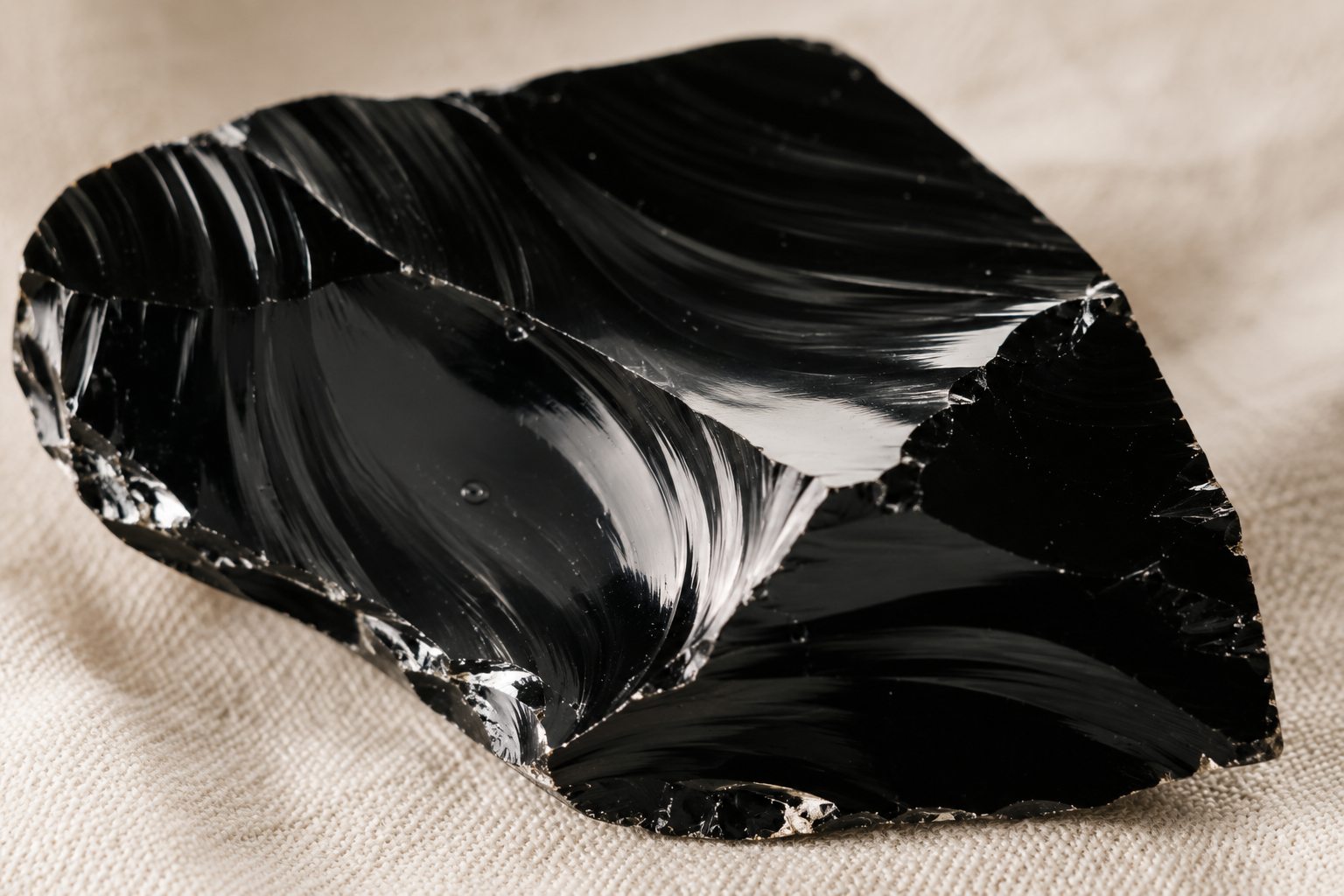
Technically, "obsidian" refers to a mineraloid, not a mineral. That's not a minor point of vocabulary: a mineral has an ordered crystalline structure, and obsidian doesn't. Its atoms are locked in disorder, exactly like the glass in a window.
It's composed of more than 70% silica, with small amounts of aluminum, sodium, and potassium. Its dark color comes from trace amounts of iron and magnesium. The full mechanics of how it forms, the viscous lava, the absence of crystallization, are covered in how obsidian is formed.
The word also covers a whole family of stones. Depending on what's trapped inside the glass, you'll hear snowflake, gold sheen, or rainbow obsidian: the full picture is in my obsidian varieties guide.
Watch out, the word also gets misused commercially. Electric-blue "blue obsidians" are almost always manufactured glass. Saying "obsidian" unfortunately commits nobody to anything: see obsidian pricing and value.
What obsidian "means" in crystal healing
Different register now. What follows comes from tradition and belief, not measurement, but it's what most people are actually looking for when they type this question, so it's worth stating plainly.
In crystal healing, obsidian is tied to three ideas that show up everywhere:
Protection
Described as a dark shield, said to deflect what's perceived as negative. It's the most consistent association, covered in protection and grounding.
Grounding
Dense, dark, earthy, it's linked to the root chakra, the center of safety and bodily connection.
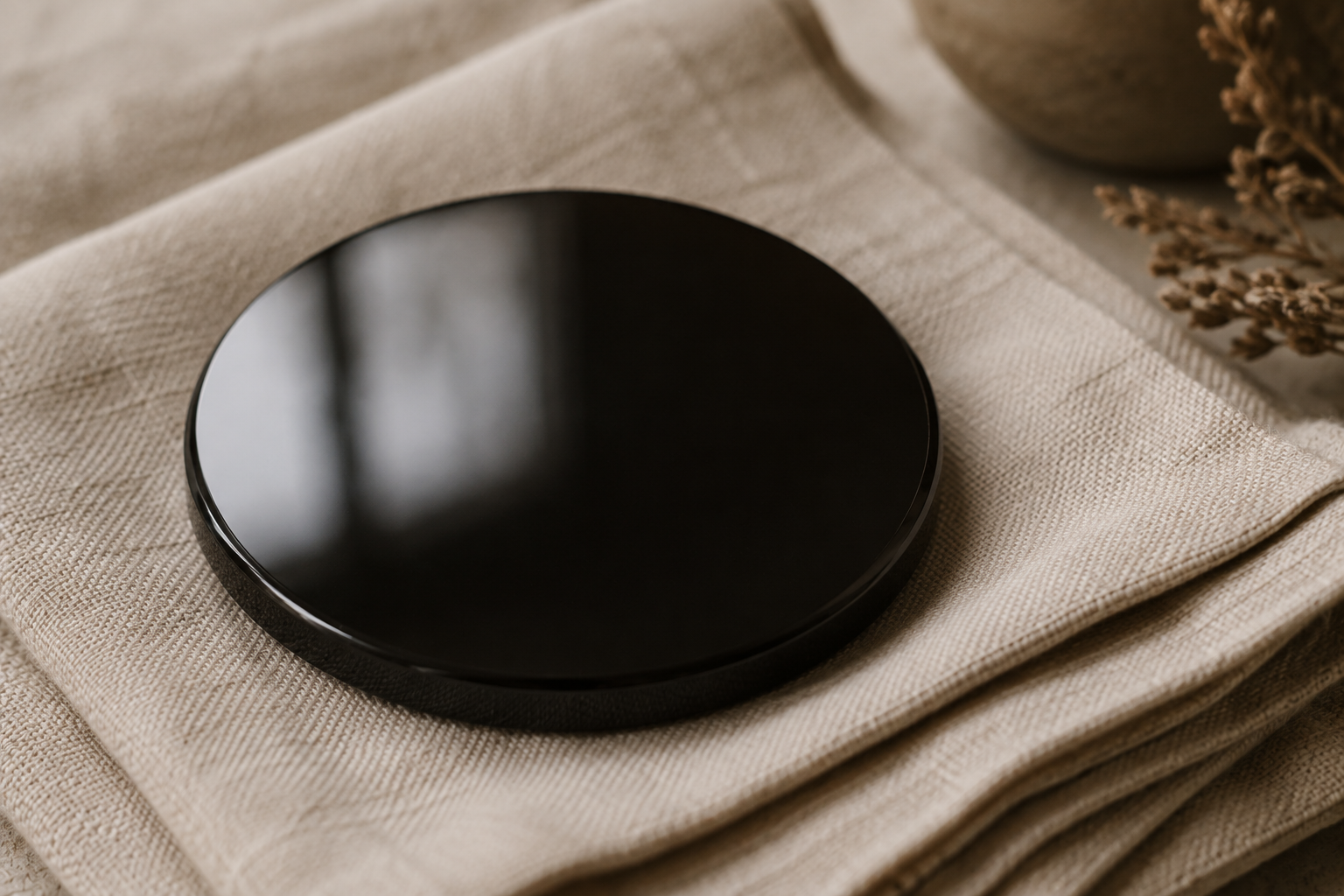
The third is the most interesting: the mirror. Obsidian is said to reflect the self back, to bring things forward, to surface what's usually avoided. It's a stone of clarity more than comfort, and that reputation isn't accidental: people genuinely carved mirrors from this material for centuries.
I'll say what I always say: these meanings are cultural constructs. They have internal coherence, a history, sometimes real beauty; they don't have demonstrated validity. Recognizing them for what they are doesn't make them less useful.
What it meant elsewhere
While Europe was busy recopying the name of Obsius, the same stone carried a different name on the other side of the world, in a culture that knew it far more intimately.
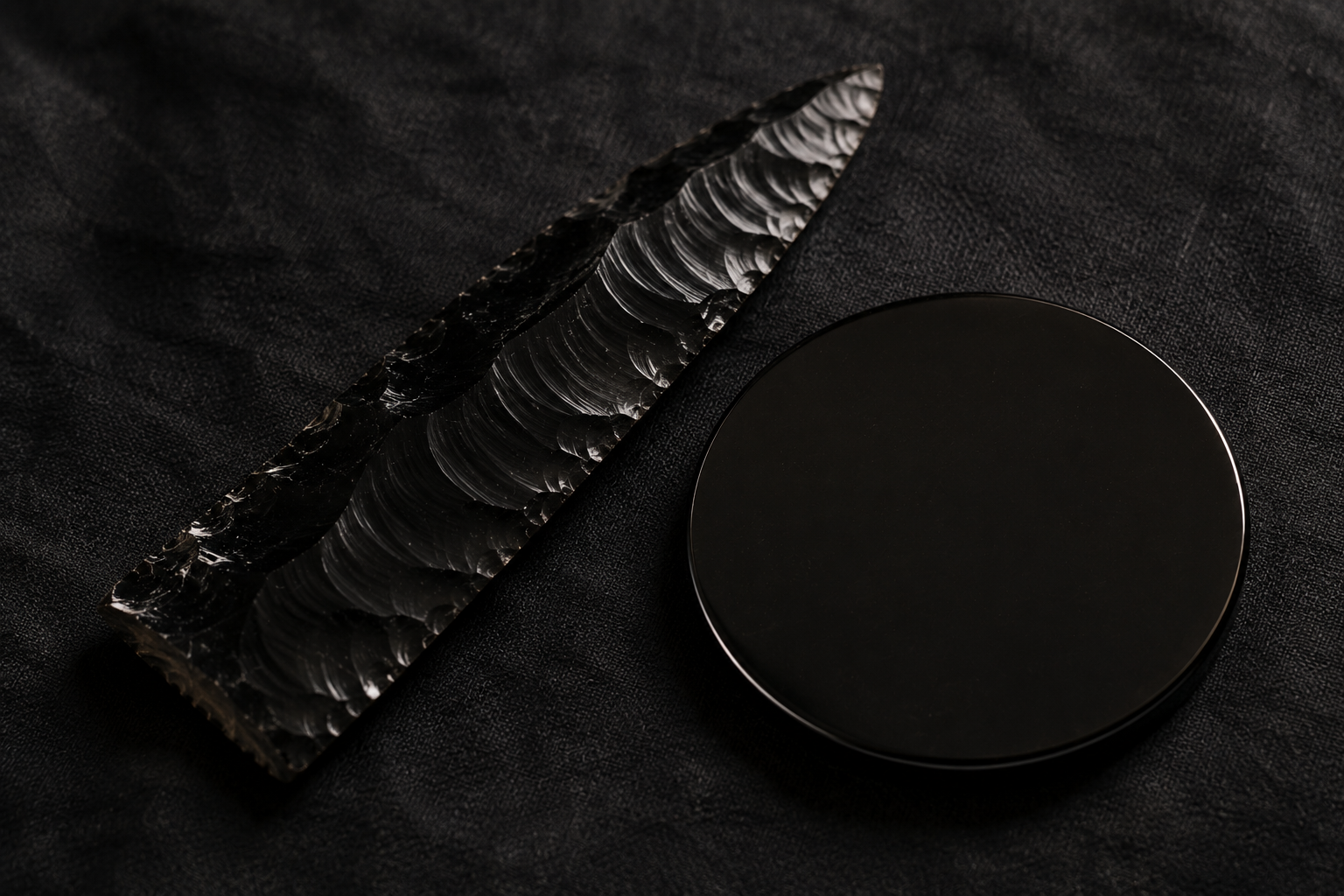
In Mesoamerica, the Aztecs called it itztli. It was an everyday material as much as a sacred object: it produced razor-sharp blades, its conchoidal fracture yields edges of remarkable fineness, and divination mirrors. The god Tezcatlipoca, whose name literally means "Smoking Mirror," carries an obsidian mirror.
The contrast in perspective is striking. For Pliny, obsidian is a curiosity brought back from elsewhere, named after the man who found it. For the Aztecs, it was a central material, with its own deity, its own uses, and its own vocabulary. The word we use today comes from the most distant point of view, not the most intimate one.
I find this a little dizzying: we call this stone after a Roman we know almost nothing about, while entire peoples worked it for millennia with a word that was truly their own. The history of names is never the history of things.
What it means, today, to wear obsidian
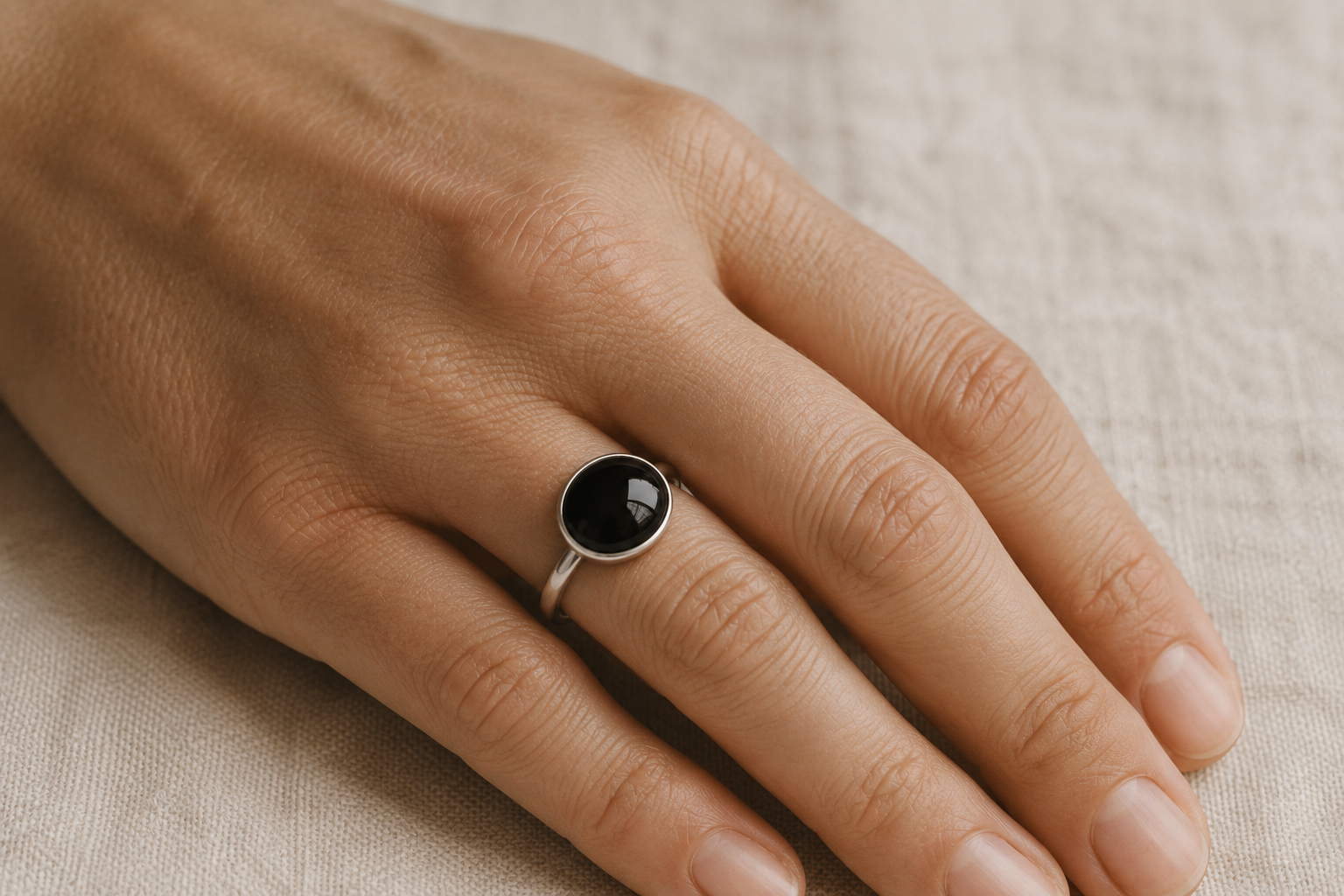
After all that, the question is worth asking differently: what does it actually mean to wear this stone in 2026?
For some people, it's a deliberate crystal healing practice, with its correspondences and rituals. For plenty of others, and this is what I see at the workshop, it's simpler than that: an anchor object. You feel it on your wrist or your finger, and it recalls an intention you set for yourself. That's not nothing, and it asks you to believe in nothing at all.
And then there's the material itself, which needs no justification: a black that shifts with the light, flat one moment and almost liquid the next, born of lava that cooled thousands of years ago. You can wear obsidian simply because it's beautiful.
If you're unsure on sizing, my jewelry size guide can help. And for everything else, origin, properties, care, the complete obsidian guide brings it all together.
Precautions & good practice
Just one caution, but it applies to this entire article: don't mix up the three registers. Etymology is a documented fact. Mineralogy is measurable. Symbolism comes from belief. Sites that present the third with the same confidence as the first two are telling you a story, not giving you information.
On the material side, obsidian is a glass at 5 to 5.5 on the Mohs scale: it scratches and doesn't handle impact well. Microfiber cloth, no salt or abrasive cleaners, separate storage. Full details are in cleaning your obsidian, and the energetic-care side in cleansing and charging.
Good to know, the properties and meanings described here come from spiritual traditions and crystal healing, a wellness practice grounded in belief rather than science. They are not medical claims, do not treat any condition, and never replace advice from a healthcare professional.
Frequently asked questions
What does the word obsidian mean?
Why is there a d in obsidian?
Who was Obsius?
What does obsidian symbolize in crystal healing?
What did the Aztecs call obsidian?
Is obsidian a stone or a glass?
How do you say obsidian in other languages?
The stone of Obsius, handmade
Bracelets, necklaces, pendants, and rings in natural obsidian, handcrafted in France, every variety sold under its true name.