How to Use a Black Obsidian Pyramid
You've just got hold of a black obsidian pyramid and it's sitting there, somewhere in the house, while you're not entirely sure what to do with it. That's very common. Here is where to place it, how to orient it, how to use it in meditation, how to care for it, and the handful of mistakes that come up most often.
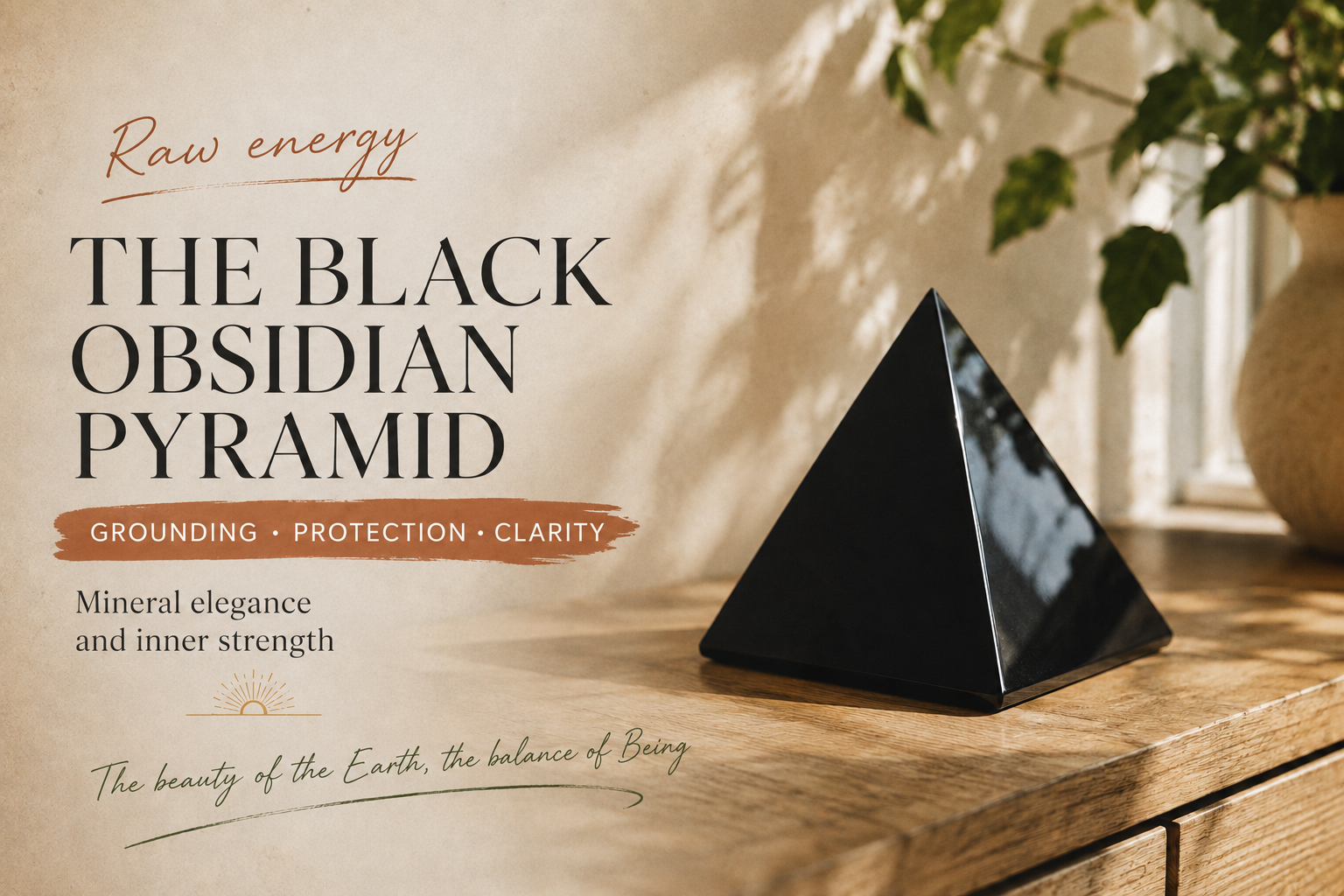
Why a pyramid, and not just a tumbled stone?
The shape matters as much as the stone. A black obsidian pyramid rests on a square base, a symbol of stability, of the four directions, of matter, and rises to a single point turned upward.
In traditional practice, this geometry is described as a concentrator: the base gathers, the point emits. Where a tumbled obsidian stone sits in the hand and travels with the person, a pyramid is set down: it is an object of place. You install it in a room, on a desk, on an altar, and it stays there.
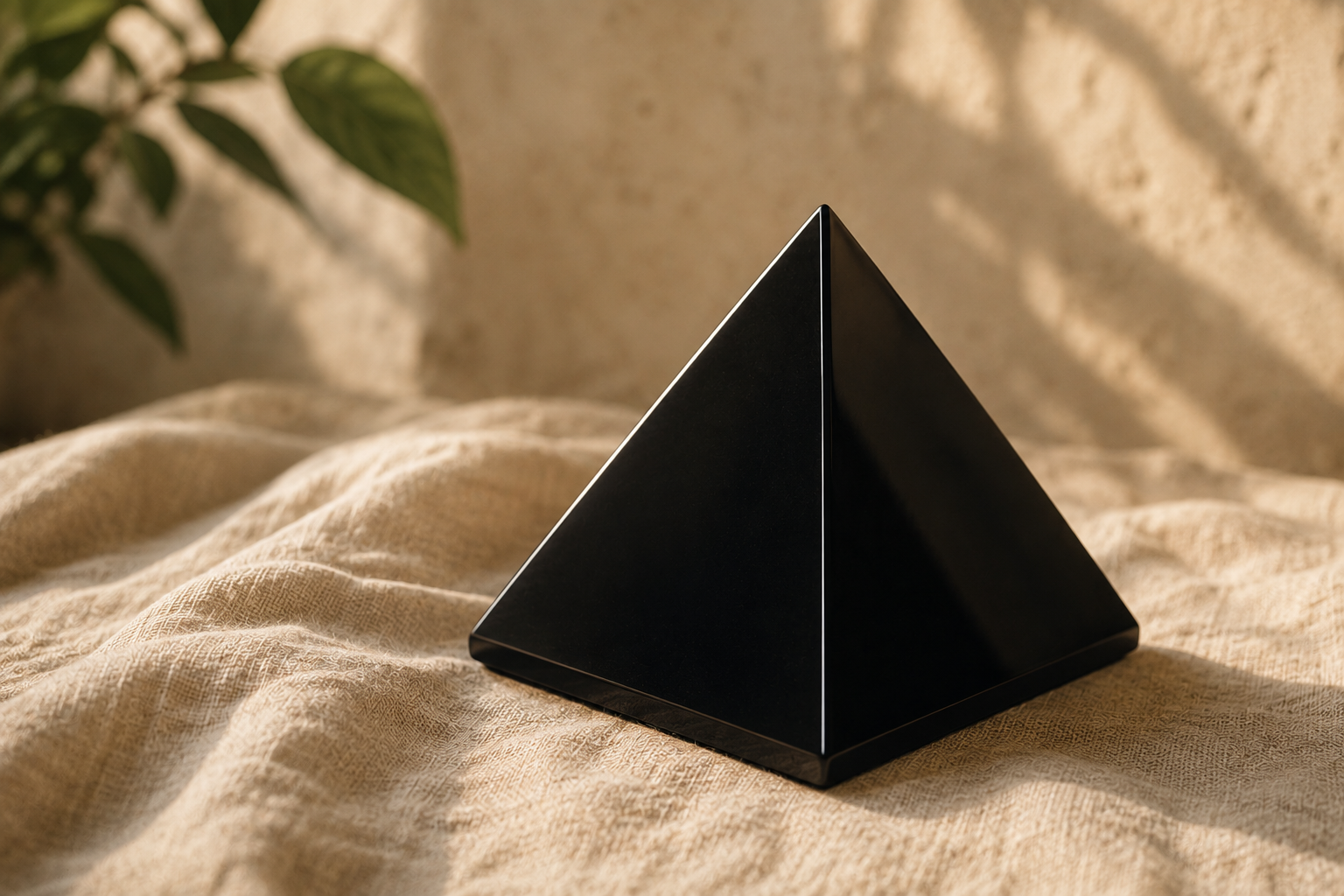
On top of that come the properties tradition credits black obsidian itself with: protection and grounding. I go into these in my article on obsidian, the stone of protection and grounding, and more broadly in the complete obsidian guide.
Let's be clear, the idea that a pyramid shape "amplifies" or "emits" energy belongs to tradition and symbolism, not to any measured physical mechanism. That takes nothing away from the object: a focal point set in a room has real value. But it is worth saying honestly.
Choosing your black obsidian pyramid
Three criteria are enough.
Size
A pyramid of 3 to 5 cm suits a desk or a bedside table. Between 6 and 10 cm, it becomes a living-room piece, visible and present. Beyond that, you are into a decorative object in its own right. Start small: a pyramid you see every day does more than a large one relegated to a shelf.
The quality of the cut
Look at the base: it should be perfectly flat, or the pyramid will rock. Check that the four edges meet cleanly at the apex, and that the polish is even, with no matt patches. Obsidian works well: a rough cut betrays sloppy craftsmanship.
Genuine obsidian or glass?
This is the real trap. A genuine black obsidian is opaque, cool to the touch, and often shows tiny bubbles or slight irregularities. A pyramid that is perfectly uniform, light, or translucent under a strong lamp is probably moulded glass. Be wary too of brightly coloured "blue obsidian pyramids": they are almost always manufactured. All the markers are in my guide to the types of obsidian and in obsidian price and value.
The test I always do first: hold the stone against my cheek. Genuine obsidian is noticeably cool and takes a while to warm up. Glass, by contrast, warms almost at once.
Where to place your pyramid at home
This is the question that comes up most often. There is no absolute rule, but a few spots stand out clearly.
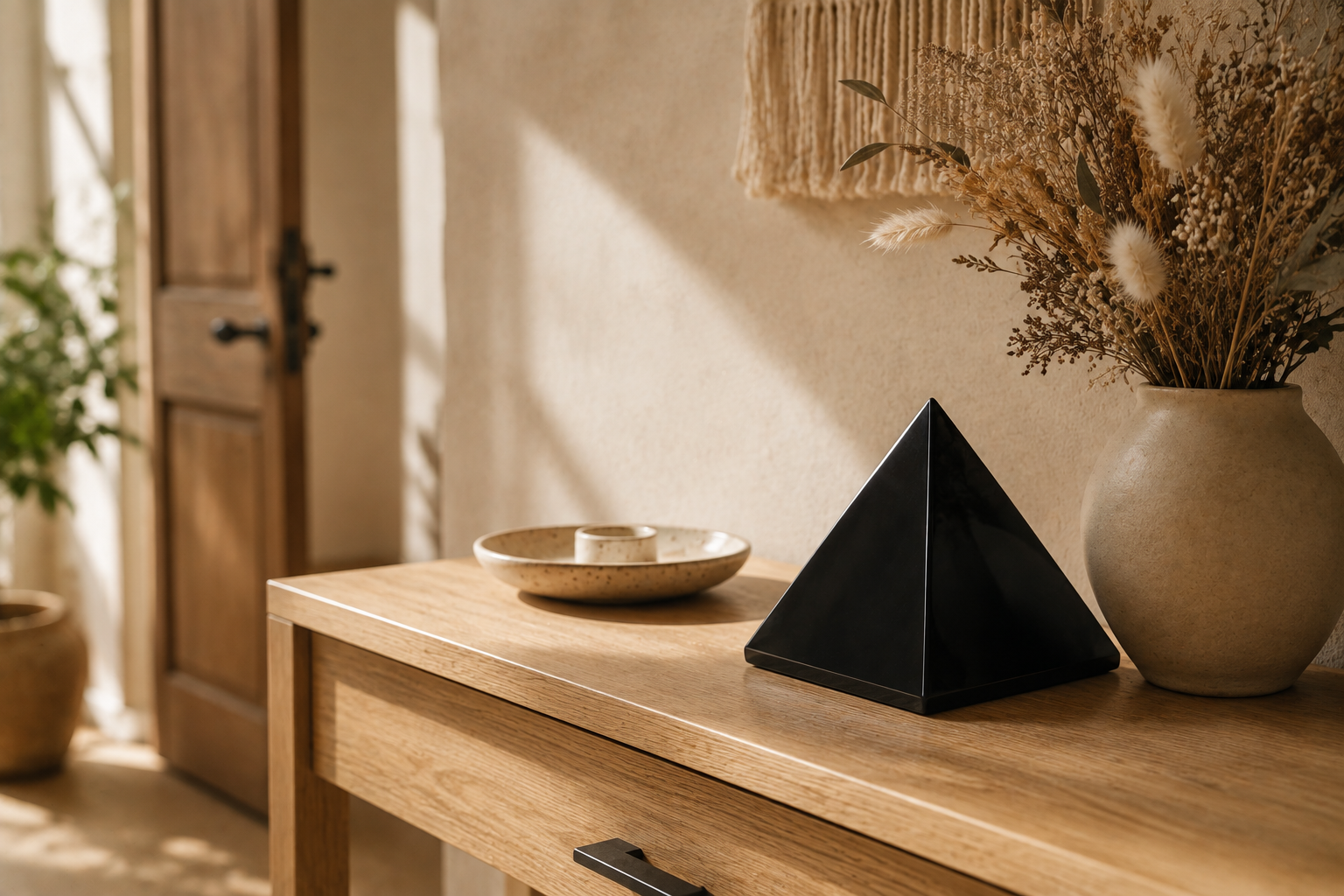
Near the entrance
On a console or a low piece of furniture, a few steps from the door. The most traditional placement, linked to filtering what comes in.
On the desk
Within eyeshot, preferably to the left. Credited with helping concentration and creating a break from outside noise.
In the living room
Lounge or sitting room, on a stable, uncluttered surface. Avoid crowded spots: the object needs to stay visible.
On an altar or a quiet corner
With a candle, a plant, a few objects that matter to you. That is where it takes on the most everyday meaning.
A word on the bedroom: many practitioners advise against putting obsidian there, on the grounds that it is too stimulating for sleep. If you would like to try it, place it far from the bed and watch how you sleep for a week. At the first sign of restless nights, move it.
Orientation and feng shui
In feng shui, black obsidian is linked to the Water element and to the North sector of the home, the one governing career and life path. This is the most commonly cited correspondence.
| Placement | Associated intention | Direction of the point |
|---|---|---|
| Entrance | Filtering, protecting the threshold | Upward, base parallel to the wall |
| North sector | Career, life path | Upward |
| Desk | Concentration, clarity | Upward, point not aimed at yourself |
| Living room | Calm, grounding the home | Upward |
A simple rule, and it is enough: point upward, base flat. Avoid aiming the point at a bed, a regularly used armchair or a seated person, not out of superstition, but because tradition sees this as a directed flow, and a sharp object pointed at you is never especially restful to look at.
If the world of feng shui interests you, my feng shui black obsidian bracelet rests on the same logic, in a wearable form.
Using your pyramid in meditation
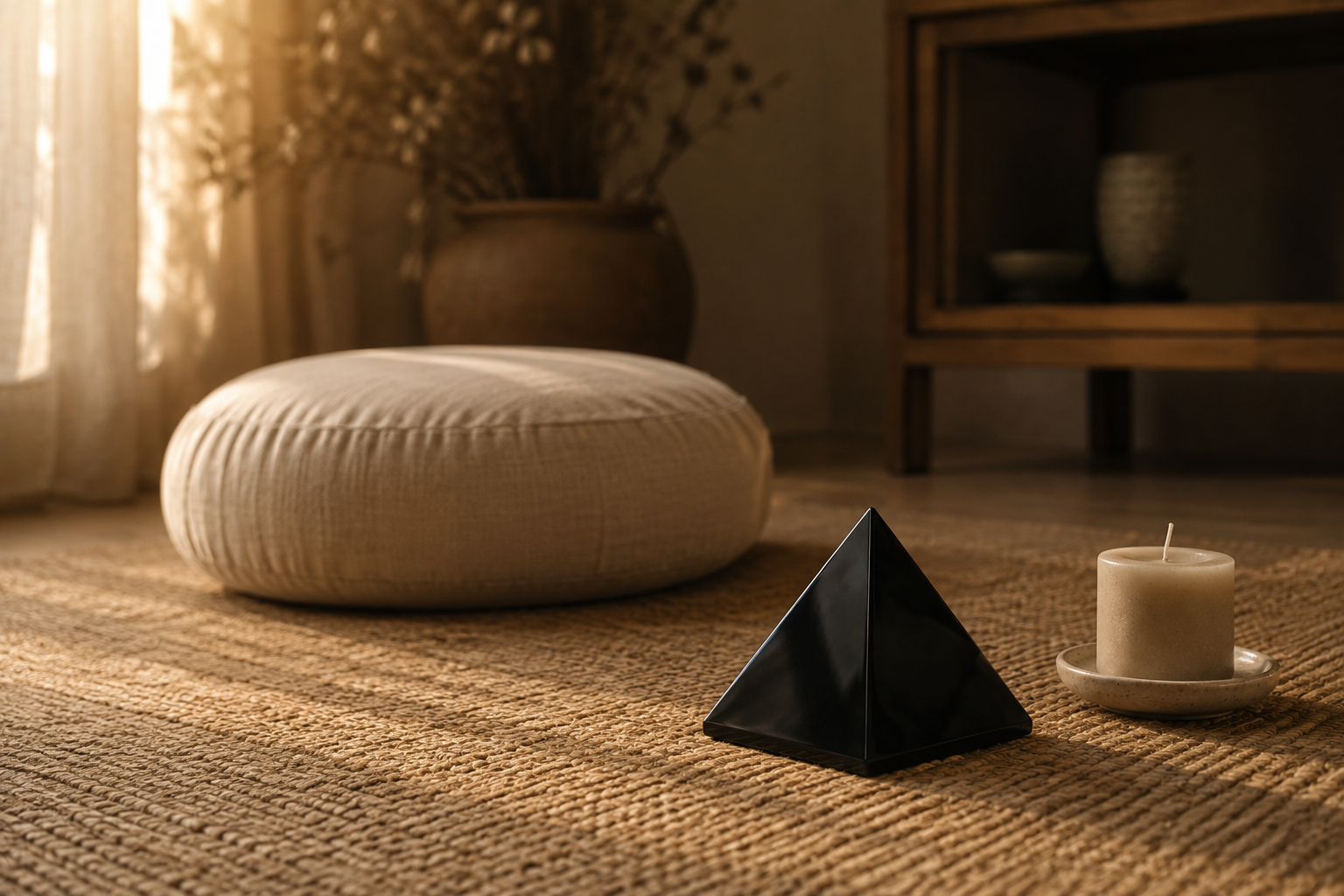
A pyramid does not lend itself well to being held, its point gets in the way. So it is used set down, and that is exactly its strength:
- In front of you, on the floor, about half a metre away, slightly below eye level. Fix your gaze on it for a few seconds, then close your eyes while holding its image;
- On a coffee table, at chest height if you meditate seated on a chair;
- Between your feet, for grounding work, seated on the floor;
- On the lower belly, lying down, base against the body and point upward, for a short session.
Five to ten minutes is enough. The full run-through of a grounding session, breathing, visualising roots, easing gently back, is set out in my article on obsidian meditation and the root chakra. And if you are wondering which energy centres obsidian genuinely touches, I have covered that in full in obsidian and chakras.
I find the pyramid particularly good for people who cannot close their eyes without drifting off into their thoughts. The gaze settles on the point, and the mind follows. It is almost easier than a stone held in the hand.
The pyramid at the centre of a crystal grid
This is the most striking use, and one of the simplest to set up. A crystal grid involves arranging several stones in a regular geometry, with a master stone at the centre. The pyramid plays that role beautifully: it is stable, upright, and naturally draws the eye.
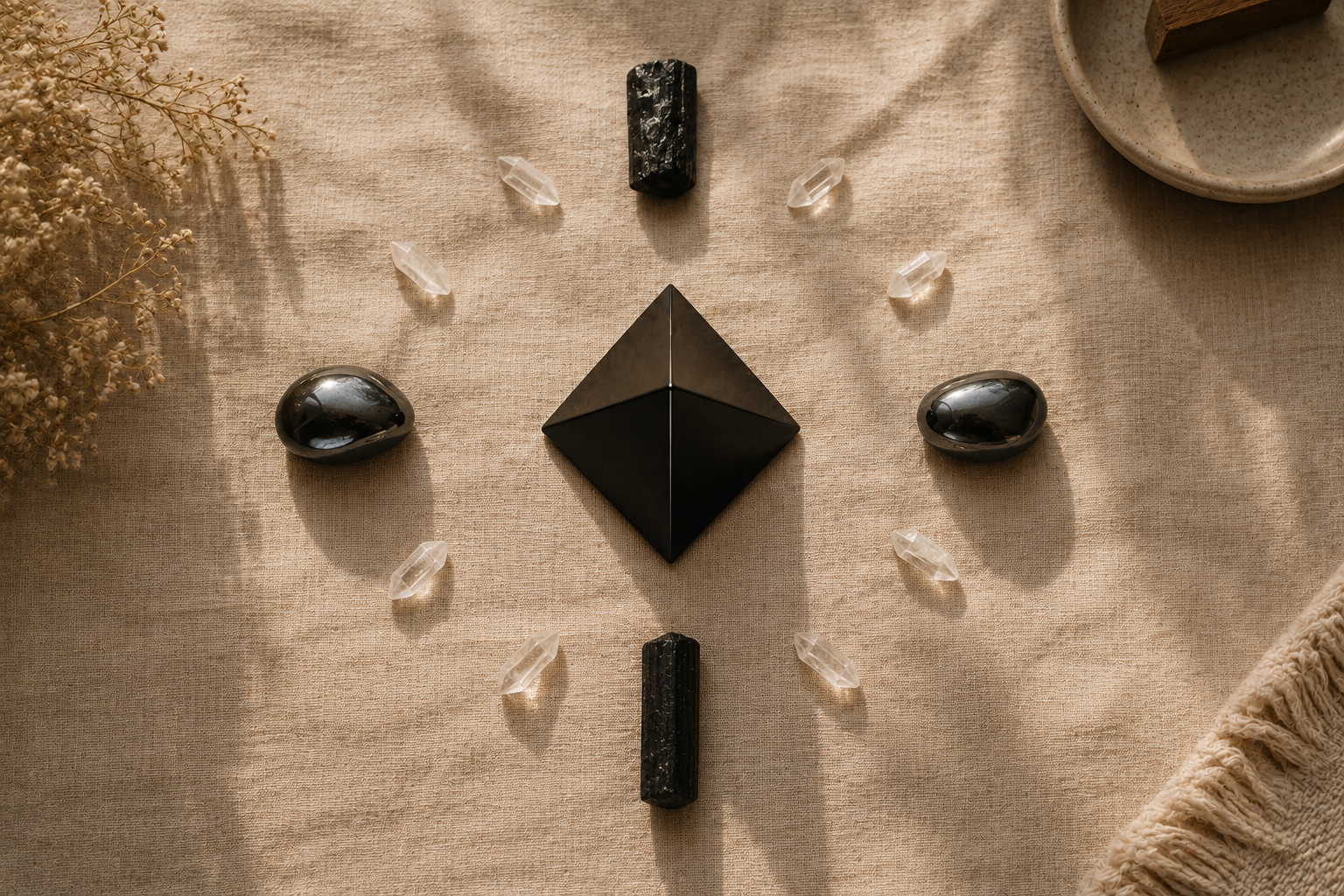
A simple protection grid: the pyramid at the centre, four grounding stones at the four cardinal points, haematite, black tourmaline or tiger eye, and a few clear quartz points between them. Set the whole arrangement on a stable surface, state your intention aloud or silently, and leave the grid in place for as long as you like.
To choose stones that pair well with obsidian, see my guide to crystal pairings with obsidian.
Cleansing and charging your pyramid
A pyramid left permanently in a room needs cleansing more often than a piece of jewellery you wear, simply because it collects dust and gets overlooked. A monthly rhythm is reasonable.
- Cleansing, smoke from sage or palo santo, or a brief pass under clear running water, dried immediately. Avoid salt, which dulls the polished surface over time;
- Charging, a night in moonlight, ideally a full moon, or a few hours resting on a quartz cluster. Avoid prolonged sun exposure;
- Dusting, a soft, dry cloth is enough. No household products, no abrasive microfibre.
Watch for fragility: obsidian sits around 5 to 5.5 on the Mohs scale, and the point is a pyramid's weak spot. Even a modest fall can chip it. Handle it by the base, never by the tip.
The full run-through is in my guides to cleaning your obsidian and to cleansing and charging.
Common mistakes
- Leaving it in its packaging, by far the most common. A pyramid stored in a drawer serves no purpose. Take it out, set it down, live with it;
- Placing it in the bedroom without testing first, obsidian is reputed to be stimulating; watch how you sleep before settling it there long-term;
- Pointing it at a chair or a bed, no need to dramatise, but it is worth orienting it upward instead;
- Soaking it for long periods or using salt on it, the polished surface does not take well to either;
- Piling up too many stones in one spot, three well-chosen objects beat a crowded collection;
- Expecting a dramatic effect, crystal healing is a wellbeing practice, not a remedy. I address this directly in obsidian, dangers and precautions.
Pyramid or jewellery: which should you choose?
The two do not do the same job, and I would rather say that plainly than let you think you have to pick one over the other.
The pyramid
An object of place. It lives in a room, marks a corner, serves as a focal point. It does not travel with you.
The piece of jewellery
An object of the person. It goes with you everywhere, in contact with your skin, exactly when you need it.
If your intention concerns your home, a threshold to mark, a desk to calm, the pyramid makes complete sense. If it concerns you, getting through a demanding stretch, keeping a touchstone through the day, a bracelet, a pendant or a ring will do more, simply because it is there all the time.
In my workshop, I only work with jewellery: every piece is handmade, with stones chosen one by one. Do check the size guide before ordering, and have a look at the necklaces if you like keeping the stone close to your heart.
Worth knowing, the properties described here belong to crystal healing, a wellbeing practice founded on tradition and belief. They are not a medical claim, they treat no illness, and they are never a substitute for the advice of a healthcare professional.
Frequently asked questions
Where should you place a black obsidian pyramid?
Which way should the point face?
Can you put an obsidian pyramid in the bedroom?
How often should you cleanse your pyramid?
How can you recognise a genuine obsidian pyramid?
What size of pyramid should you choose?
Should you choose a pyramid or a piece of jewellery in obsidian?
Black obsidian, with you everywhere
The pyramid watches over the room, the jewellery goes with you. Bracelets, necklaces, pendants and rings in natural black obsidian, handmade in France.