Peacock Velvet Obsidian and Blue Pearl
Lavender, green and violet ripples that seem to float beneath the surface, like a peacock feather. Peacock velvet obsidian and its cousin blue pearl are among the most delicate stones in the family, and among the least well explained. Here is what these two names actually describe, and why you must never confuse them with fake blue obsidian.
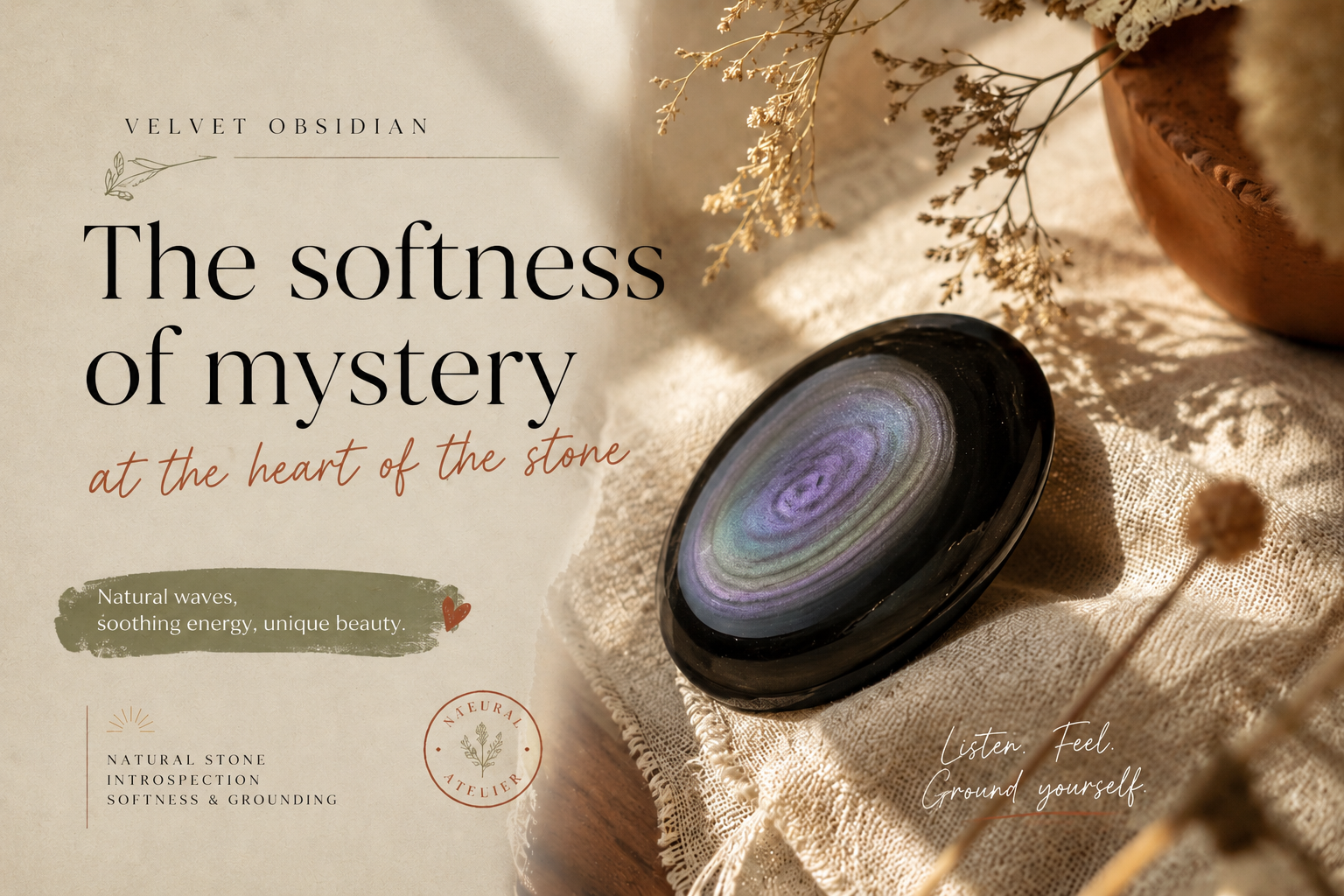
What is peacock velvet obsidian?
Peacock velvet obsidian, sometimes just "peacock obsidian", is a variety of black obsidian that reveals, once polished and turned towards the light, lavender, green and violet ripples.
What defines it is less the palette than the visual texture. Where rainbow obsidian shows crisp bands and fire obsidian shows metallic patches, peacock velvet gives soft, diffuse gradients with no sharp edges. Hence the name: it looks like velvet, or the down of a peacock feather.
Blue pearl names the same family of effect, but with a cooler, more understated silvery-blue as the dominant tone. Both names come from Mexican quarries. You will find them alongside the others in my guide to the types of obsidian.
Two names, one effect
Best to say it upfront, since no site spells it out: peacock velvet and blue pearl are not distinct mineralogical species. They are commercial names, coined in Mexican quarries and workshops to describe particular coloured expressions of one single phenomenon.
That phenomenon is the same one behind rainbow obsidian and celestial eye: light diffracting through fine layers of magnetite nanoparticles locked in the glass. Depending on the thickness and regularity of these layers, you get:
| Name | Dominant palette | Texture of the effect |
|---|---|---|
| Peacock velvet | Lavender, green, violet | Soft, diffuse ripples |
| Blue pearl | Cool silvery-blue | Satiny, understated veil |
| Rainbow | Green, purple, gold, blue | Marked concentric bands |
| Celestial eye | Blue, silvery | Localised eye-shaped halo |
| Fire | Red, gold, green | Saturated, metallic patches |
A single flow can, in fact, yield several of these expressions, and a single stone can show a lavender velvet on one side and sharper bands on the other. The boundaries are commercial, not geological.
Worth remembering, don't pay a premium for the name. What gives a velvety stone its value is the intensity and regularity of the effect, the quality of the polish and the beauty of its ripple, not the label stuck on it.
Where does the velvet effect come from?
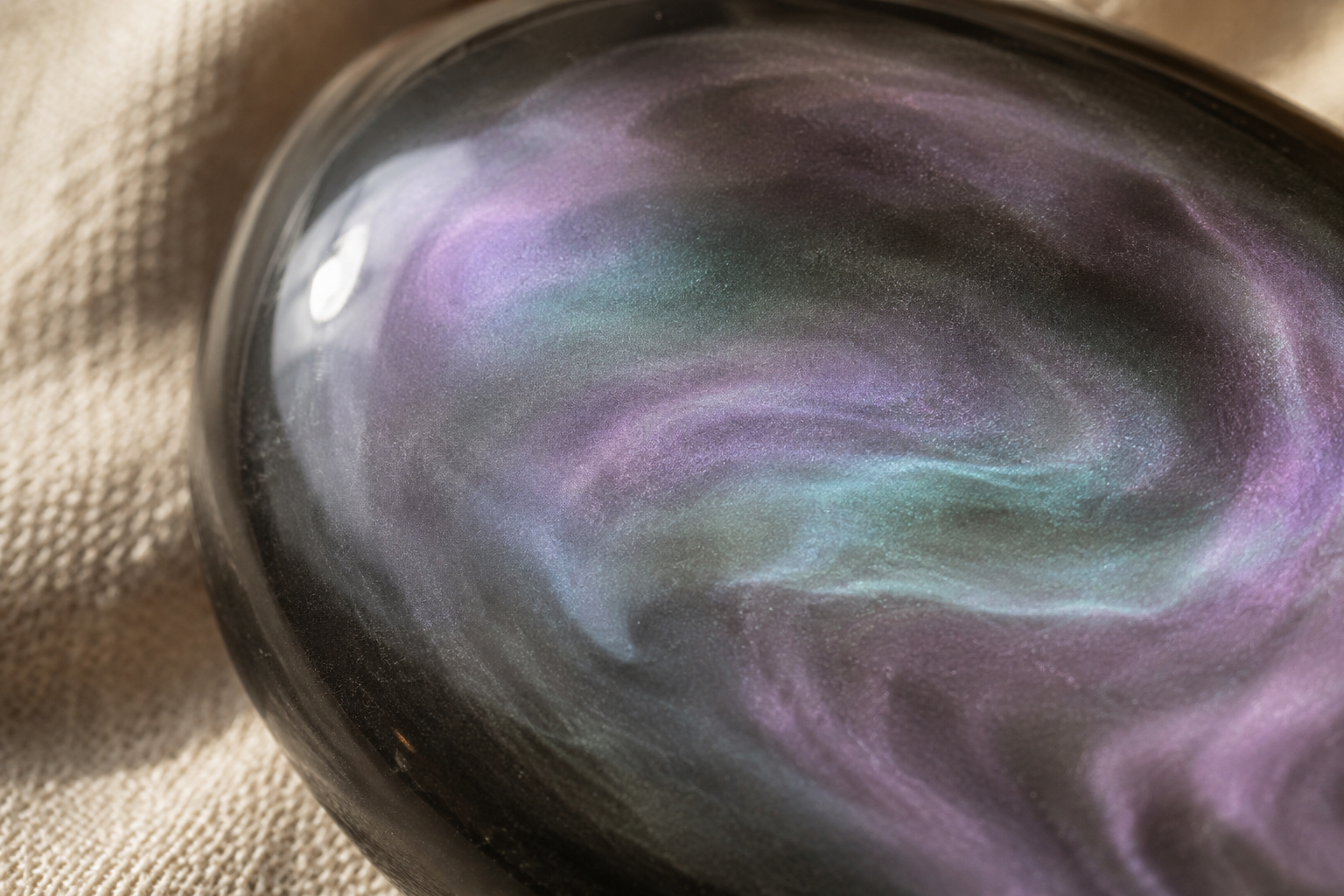
The optical mechanism is the same as in rainbow obsidian: light reflects off both the top and the bottom of extremely fine magnetite layers, and the two waves recombine, cancelling some colours and reinforcing others.
What changes here is the geometry of these layers. In peacock velvet, they are a little thicker, less regular, and above all strongly rippled, folded by the motion of the lava before it froze.
The direct consequence: instead of reflecting a sharp colour off a flat surface, the stone reflects a multitude of slightly offset tones that blend into one another. The eye perceives a soft gradient rather than a crisp band. That is exactly what produces the velvet impression.
To understand how obsidian forms, see my article on how obsidian is formed.
This is the hardest of all to photograph. The colours are so soft that a camera almost always flattens them. In real life you see a kind of coloured mist that shifts as you turn the stone, and no photo captures that properly.
Blue pearl is not blue obsidian
This point deserves a warning of its own, because the confusion can be costly.
Careful, a blue pearl is a black, opaque obsidian that reflects a silvery-blue veil on the surface at certain angles. The blue is a reflection.
A translucent "blue obsidian", a bright blue visible from every angle and coloured throughout, is almost always manufactured glass. There, the blue is a dye, not a reflection.
The test is simple and conclusive: set the stone flat on a table, in ordinary light.
- If it looks black and you have to tilt it to see the blue appear, it is a genuine blue pearl;
- If it stays blue at every angle, and especially if light passes through it while colouring it, it is glass.
This matters all the more because the market for "blue obsidian" is overwhelmingly made up of manufactured glass. I set out every marker in my guide to the types of obsidian, and fair price ranges in obsidian price and value.
Mexico, home of the velvety obsidians
These varieties come mainly from Mexico, whose volcanic deposits have long supplied the global obsidian trade. The western and central regions of the country produce most of the stones with these effects.
That is no accident: obsidian has a history there stretching back several thousand years. Mesoamerican civilisations already worked it intensively into blades, points and mirrors, a legacy I mention in the complete obsidian guide.
Working stones with a sheen therefore developed there on top of ancient skill. The evocative names, pavo real (peacock), perla azul (blue pearl), arcoíris (rainbow), were born in these workshops, and later spread, often imperfectly translated, into the international trade.
The properties credited to peacock velvet
As with other recently named varieties, this needs saying: there is no ancient tradition specific to peacock velvet. Today's correspondences were formulated by analogy with its palette and its softness.
It is generally credited with:
- calm: its dominant reputation, tied to the softness of its colours, described as the least blunt of the obsidians;
- sensitivity and receptiveness, by analogy with its lavender tones;
- harmony, through the way its tones blend into one another;
- protection and grounding, qualities common to all obsidians.
As for chakras, it is linked to the root chakra like any obsidian, and sometimes to the third eye or the crown chakra for its violet tones. The full picture is in my guide to obsidian and chakras.
If this softness appeals to you, celestial eye obsidian shares the same family of effect and the same calming reputation, with the advantage of being easier to find, and it is the one I work with in the workshop.
Choosing and wearing it
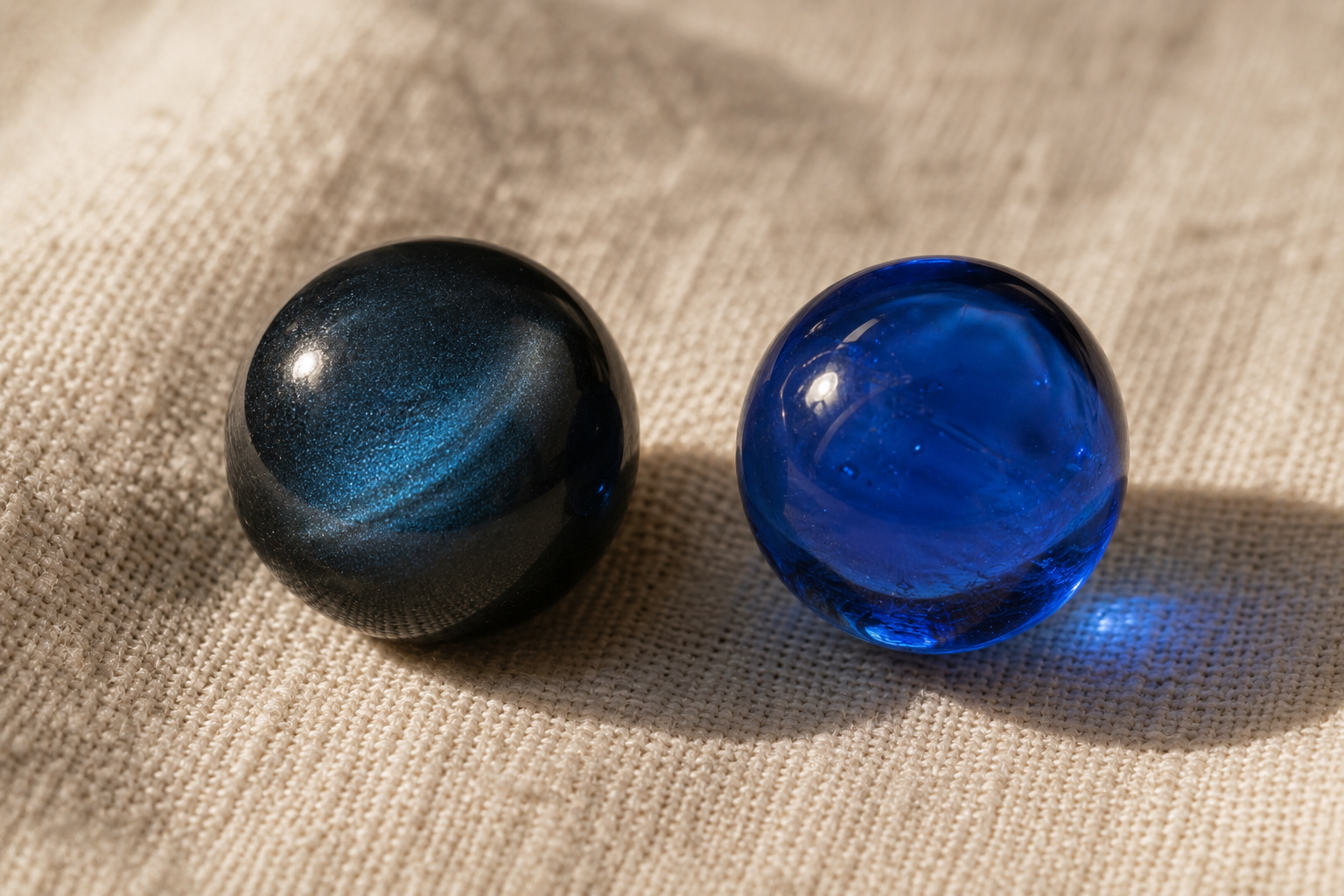
Peacock velvet shares the constraint of every shimmer stone: it needs directional light. Under diffuse ceiling lighting, the stone simply looks black.
- Favour curved surfaces, a sphere or a domed cabochon multiplies the angles, so your chances of catching the effect. A flat slab shows it only from one precise orientation;
- As a bracelet, the movement of the wrist brings the sheen to life throughout the day, the best format;
- Assess the stone by turning it, never from a still photo. Ask your seller for a video;
- Look for consistency, a good piece keeps its effect across its whole surface, not just in one spot.
I don't work with peacock velvet in the workshop: sourcing it with consistent quality remains difficult, and the effect varies too much from stone to stone for me to promise a result. Celestial eye, from the same family, lets me guarantee a consistency I can stand behind.
Check the size guide before ordering, and see my guide to crystal pairings with obsidian if you would like to pair it, it works well with labradorite, another stone with an optical effect.
Mineralogical fact sheet
- Nature
- Natural volcanic glass (mineraloid, amorphous)
- Other names
- Peacock obsidian, blue pearl obsidian
- Colour
- Opaque black, lavender, green, violet or silvery-blue reflections
- Source of the effect
- Diffraction across thick, rippled magnetite layers
- Status
- Commercial name, not a distinct species
- Composition
- Silicon dioxide (SiO₂), magnetite nanoparticles
- Hardness (Mohs)
- Around 5 to 5.5
- Structure
- Amorphous (no crystal lattice)
- Deposits
- Mexico, mainly
- Chakras
- Root, sometimes third eye and crown
- Age of the tradition
- Recent: modern commercial name
Care and cleansing
Like every stone with an optical effect, peacock velvet depends on the state of its polish: a dulled surface scatters light and blurs the effect. A subtlety already this soft disappears fast once the stone is scratched.
- Cleaning, a soft, dry cloth only. A microfibre lens cloth works very well;
- Cleansing, smoke is preferable, or a brief rinse in clear water with immediate drying. Avoid salt, which micro-scratches;
- Charging, moonlight, without prolonged sun exposure;
- Storage, in its own pouch, away from harder stones.
The full run-through is in my guides to cleaning your obsidian and to cleansing and charging.
Worth knowing, the properties described here belong to crystal healing, a wellbeing practice founded on tradition and belief. They are not a medical claim, they treat no illness, and they are never a substitute for the advice of a healthcare professional. See also obsidian, dangers and precautions.
Frequently asked questions
What is peacock velvet obsidian?
What is the difference between peacock velvet and blue pearl?
Is blue pearl a blue obsidian?
How do you test a blue pearl?
Is peacock velvet a rare variety?
Why does my stone look black?
My obsidians with a shimmer
Celestial eye, rainbow, gold sheen: stones with a sheen chosen one by one, handmade in my workshop in France.