Apache Tears, the Comforting Obsidian
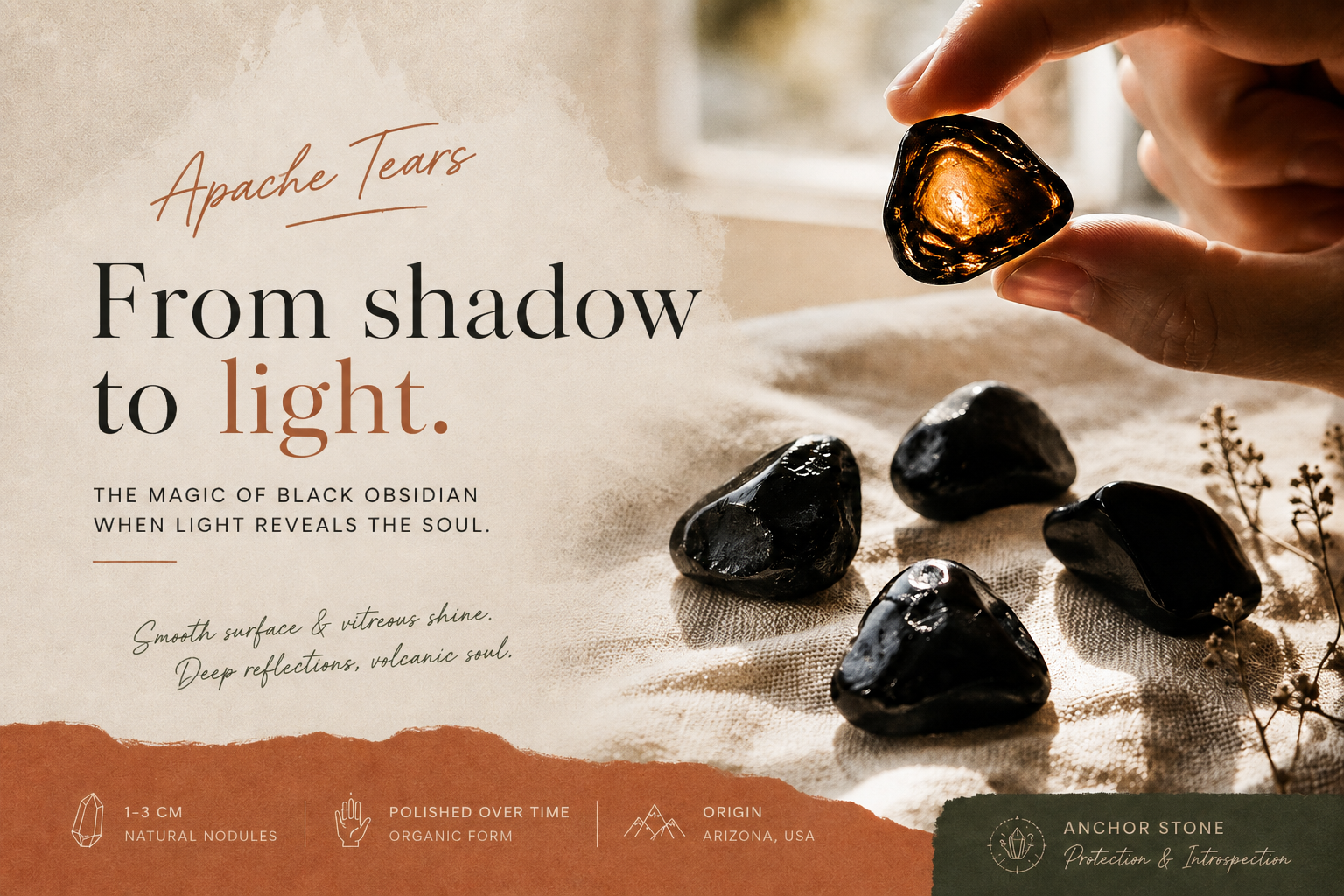
Small, dark pebbles, rounded by nature, that let light through when you hold them up to a window: Apache tears are the gentlest obsidians in the family. Here is their story, a true story, one that deserves to be told with care, the very particular way they form, and what crystal healing credits them with.
What is an Apache tear?
Apache tears are small nodules of black obsidian, so, volcanic glass, naturally rounded, generally one to three centimetres across. Two traits set them apart from other obsidians.
First, they arrive already round, with no cutting involved: erosion alone gave them their pebble shape. Second, and this is their signature, they are translucent: held up to a lamp or a window, they let through a brown or reddish glow, where a classic black obsidian stays fully opaque.
This translucency comes from their thinness and their composition. It also explains their poetic name: they really do look like frozen drops. You will find them alongside the others in my guide to the types of obsidian.
The first time someone put one in my hand, I found it unremarkable. Then I held it up to the workshop window, and that warm brown appeared right in the middle of the black. It is a stone that doesn't give itself away at first glance.
The Apache Leap story
The name comes from a real place and a painful episode in American history. Apache Leap is a cliff near Superior, Arizona, on land traditionally belonging to the Apache people.
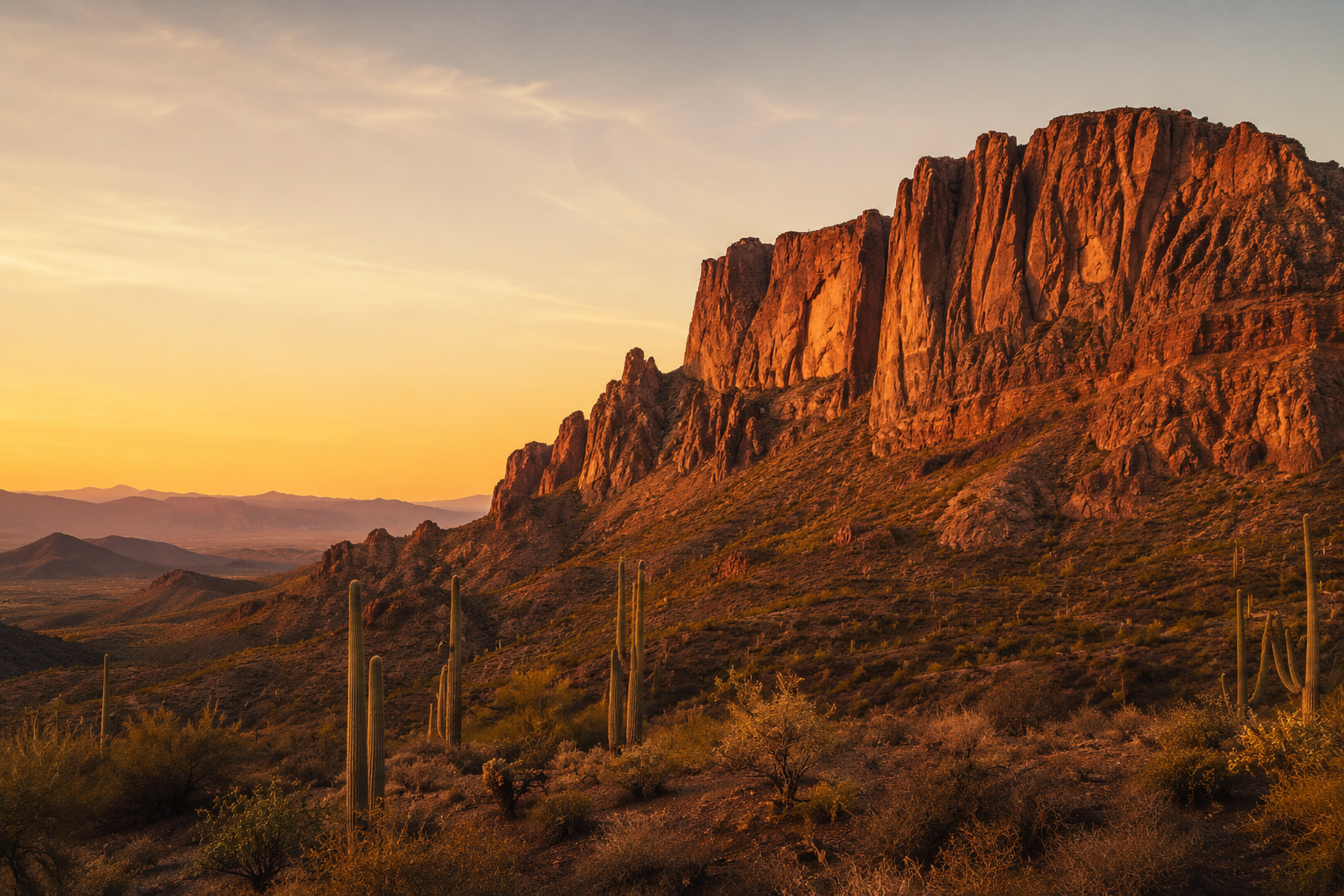
Tradition holds that, in the 1870s, a group of Apache warriors, surrounded by the US cavalry, chose to leap from the top of this cliff rather than be captured. The story goes on that the women of their community wept at the foot of the cliff, and that their tears, touching the ground, turned into these small black stones.
The tradition then says that whoever owns an Apache tear need never cry again: the Apache women are said to have shed all the tears in their place.
To be accurate, Apache Leap is a real place, and the Apache wars did take place. But the exact details of what happened on that cliff are not established with certainty by historians, and the figure of seventy-five warriors, often quoted, is not documented. This is an oral tradition woven together with history, not a verified fact. It deserves to be told for what it is, without embellishment: it points to the real dispossession of a people.
The commercial name "Apache tears" is now universal in the mineral trade. It was not chosen by Apache people themselves.
How Apache tears form
This is the most interesting point, and oddly the least explained: their formation is different from that of other obsidians.
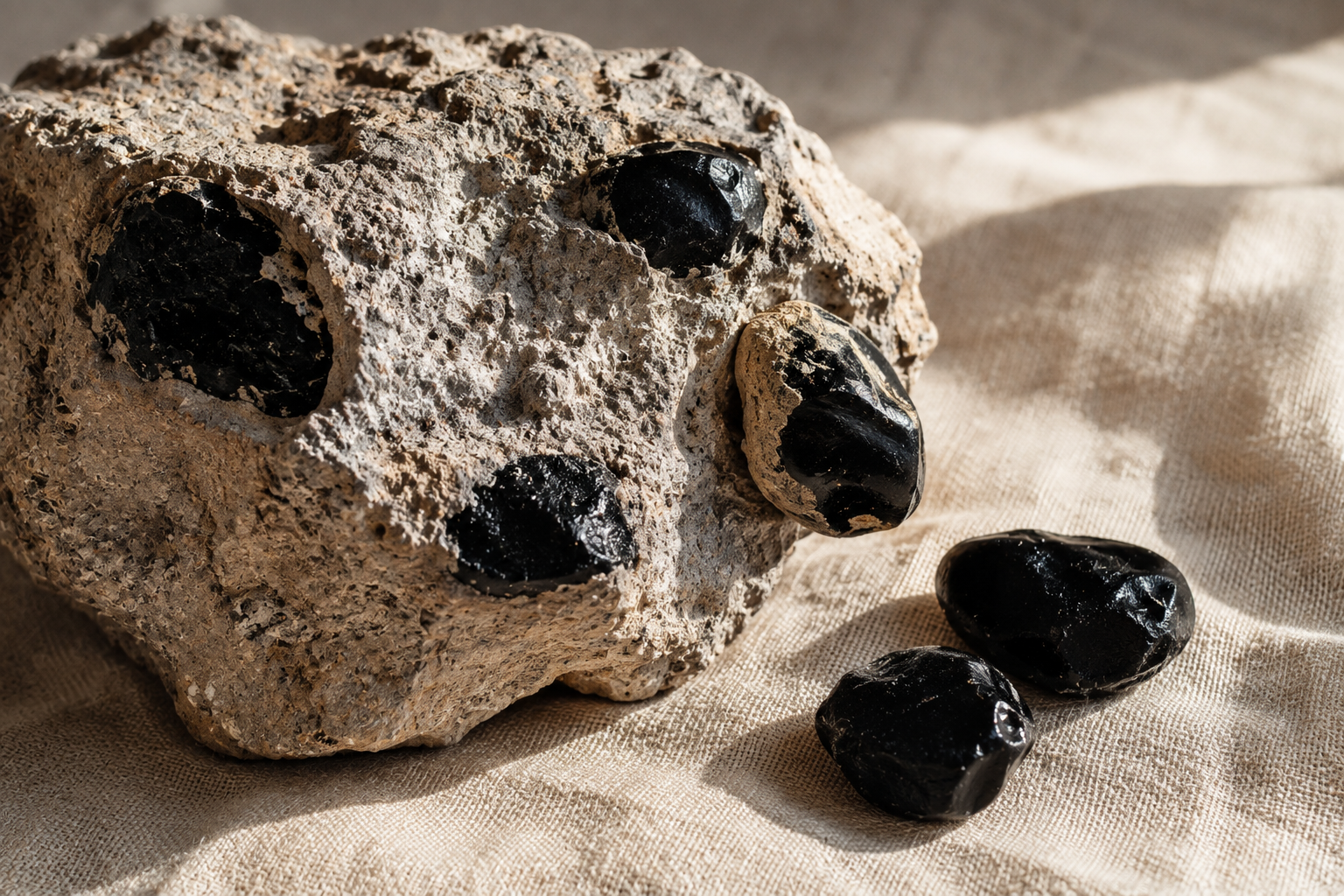
It all starts with a rock called perlite: a volcanic glass that, unlike obsidian, absorbed water over time. Perlite is grey, crumbly, chalky in appearance. It breaks down easily.
Within this perlite, pockets that stayed dry survive, areas that never absorbed water and remained genuine obsidian, dense and black. These pockets form nodules.
Over time, rain and wind erode the soft perlite, which crumbles away and disappears. The far more resistant obsidian nodules are freed one by one and roll down the slopes, where they are collected. Their rounded shape and softened edges owe nothing to human polishing, then: erosion did all the work.
To understand how obsidian forms in general, see my article on how obsidian is formed.
I love this image: the soft stone falls away, the dense stone remains. Maybe that is why this story of grief wearing down feels so fitting to them, there is something honest in the way they come into the world.
The properties of Apache tears
In crystal healing, Apache tears hold a place of their own: they are the obsidians of comfort. They are credited with the grounding and protection common to the family, but in a noticeably gentler form.
They are generally linked to:
- supporting grief: their dominant reputation, directly inherited from the legend;
- releasing held-back emotion: described as helping let out what has been kept in for too long;
- forgiveness, of yourself as much as of others;
- gentle grounding: often recommended to anyone who finds black obsidian too blunt;
- comfort through transition: bereavement, separation, moving house, the end of a chapter.
It is the variety most often given as a gift, precisely because it carries this intention of support. Its closest cousin in spirit is rainbow obsidian, also linked to emerging from dark periods.
The grief stone: what to know
This needs saying plainly. Apache tears are very often given to someone in mourning, and the phrase "whoever owns one need never cry again" circulates a great deal. It is a beautiful line, but it deserves to be qualified.
What I'd tell a friend, a stone does not make grief disappear, and no one should ever feel ashamed to cry. What a small object can offer is something else: something to hold when words fail, a point of focus that brings you back to the present, tangible proof that someone was thinking of you. That is already a great deal, and it is honest to leave it there.
If you are going through bereavement or a difficult period, a stone can accompany you, it replaces neither time, nor the support of loved ones, nor the help of a professional when the pain becomes too heavy to carry alone. Bereavement charities and counsellors exist for exactly that, and turning to them is never excessive.
Giving Apache tears remains a fitting gesture, as long as it comes with what actually matters: your presence.
Chakras and energy
Apache tears are traditionally linked to:
- the root chakra (Muladhara), like all obsidians, grounding, security;
- the sacral chakra (Svadhisthana), the seat of emotion and its flow;
- the heart chakra (Anahata), for their quality of comfort, an unusual association for an obsidian, and one that comes precisely from their gentleness.
The full map of the varieties and their centres is in my guide to obsidian and chakras, and for the practice, see meditating with obsidian.
In astrology, they are traditionally associated with Cancer and Pisces for their sensitivity, and with Scorpio for its connection to transformation. These correspondences remain indicative.
How to use Apache tears
Small, rounded and rarely drilled, they lend themselves poorly to jewellery and much better to the hand. That is, in fact, their traditional use.
- In the palm of the hand, the most common way: close your hand around it for a few minutes, breathing slowly;
- In a pocket, to have it within reach in tense moments, like a small pebble to hold onto;
- Under the pillow or on the bedside table, gentler than black obsidian, it sits more easily in a bedroom;
- In meditation, placed on the lower belly while lying down, or held between both hands;
- As a gift, in a small fabric pouch, with a note.
A gesture I like: hold it up to the light before you begin, to watch the light pass through it. It focuses attention and is a reminder that there is brightness within the dark.
If you are after something to wear day to day instead, black obsidian jewellery plays a similar role, with a permanent presence.
Spotting genuine Apache tears
Good news: this is one of the easiest varieties to authenticate, thanks to a test that needs nothing more than a lamp.
| Criterion | Genuine Apache tear | Imitation or mix-up |
|---|---|---|
| Held to the light | Lets through a brown or reddish glow | Stays opaque (tumbled obsidian) or too clear (glass) |
| Surface | Irregular, matt in places, small dips | Perfectly smooth and shiny (barrel-polished stone) |
| Shape | Rounded but never perfectly regular | Oval or spherical, too symmetrical |
| Touch | Cool, warms up slowly | Glass warms almost at once |
| Size | Generally 1 to 3 cm | Large pieces sold as such: dubious |
The most common mix-up, in fact, is not a fake at all: many sellers offer simple barrel-tumbled black obsidian under the name Apache tears. These are genuinely obsidian, but they are not true tears, they stay opaque and their roundness comes from a machine, not from erosion.
For pricing benchmarks, see my guide to obsidian price and value. Apache tears are among the most affordable obsidians: a high price is not a mark of quality here.
Mineralogical fact sheet
- Nature
- Obsidian nodules (volcanic glass, amorphous mineraloid)
- Other names
- Apache tear stone, tear obsidian
- Colour
- Black to dark brown, translucent against the light
- Host rock
- Perlite (hydrated volcanic glass, grey and crumbly)
- Source of the shape
- Natural erosion of the perlite, not cut
- Typical size
- 1 to 3 cm
- Composition
- Silicon dioxide (SiO₂), iron oxides
- Hardness (Mohs)
- Around 5 to 5.5
- Main deposits
- Arizona, Nevada, New Mexico, Utah (USA)
- Chakras
- Root, sacral, heart
- Star signs
- Cancer, Pisces, Scorpio
Care and cleansing
Apache tears need little care: not being polished, they are unaffected by the micro-scratches that concern other varieties.
- Cleaning, clear water and a soft cloth are enough. Their natural surface needs no special treatment;
- Cleansing, smoke from sage or palo santo, or a rinse under clear water. Avoid salt, which remains inadvisable for all obsidians;
- Charging, moonlight suits them well. Many also rest them directly on the earth, which fits their origin;
- Fragility, moderate hardness and small size: store them in a pouch rather than loose with other stones.
The full run-through is in my guides to cleaning your obsidian and to cleansing and charging.
Worth knowing, the properties described here belong to crystal healing, a wellbeing practice founded on tradition and belief. They are not a medical claim, they treat no illness, and they are never a substitute for the advice of a healthcare professional. See also obsidian, dangers and precautions.
Frequently asked questions
What is an Apache tear?
Where does the name "Apache tears" come from?
How can you recognise a genuine Apache tear?
What are the properties of Apache tears?
Can you give an Apache tear to someone in mourning?
What is the difference from classic black obsidian?
Can you sleep with an Apache tear?
Obsidian, to wear every day
Bracelets, necklaces, pendants and rings in natural obsidian, handmade in my workshop in France.