Rainbow Obsidian and Its Iridescent Sheen
Black at first glance, then suddenly crossed with green, purple and gold the moment you tilt it towards the light: rainbow obsidian is the most spectacular of the family. Here is where its iridescence comes from, what crystal healing credits it with, how to tell it apart from celestial eye, and how I work it in the workshop.
What is rainbow obsidian?
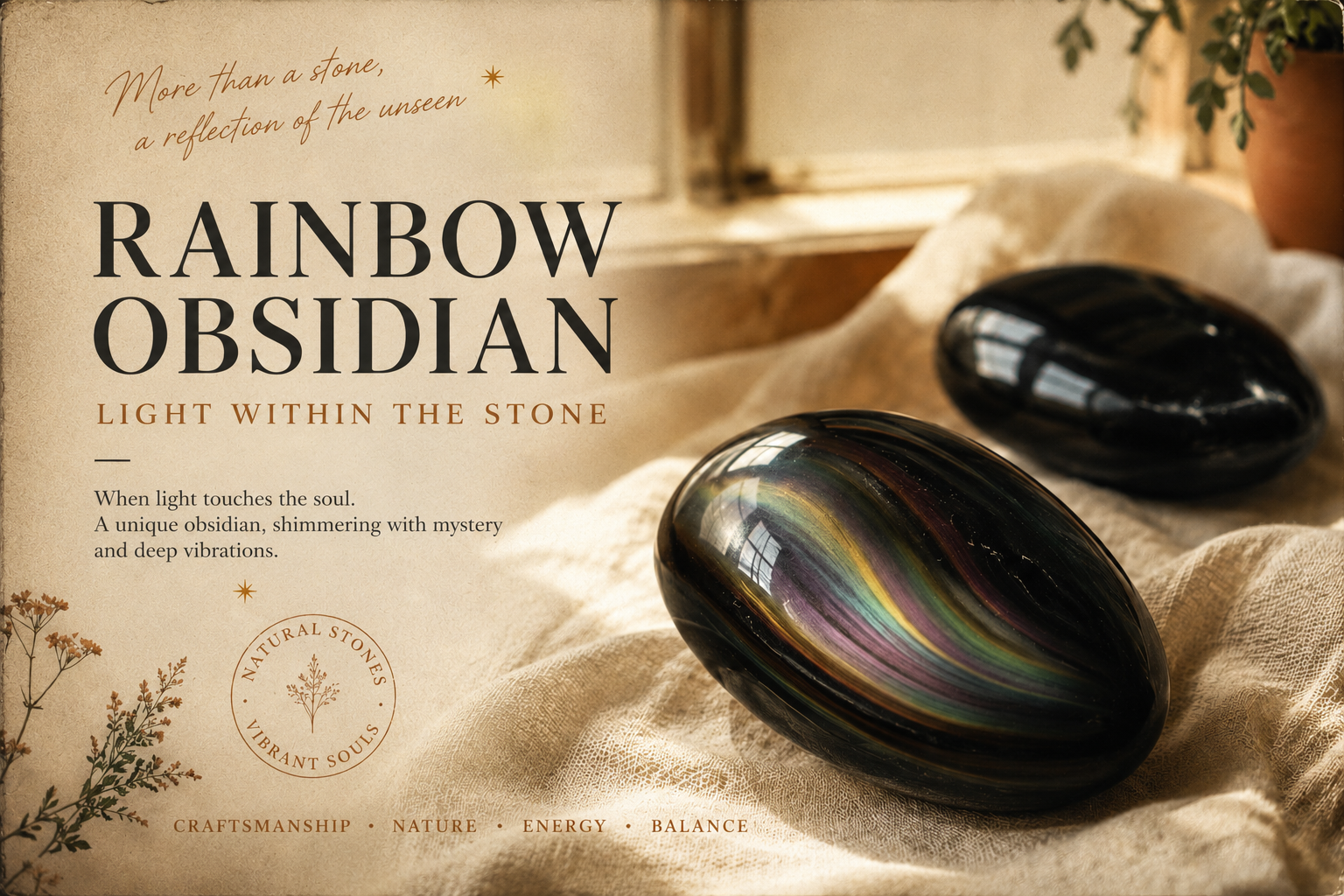
Rainbow obsidian is a variety of black obsidian, that volcanic glass born from the sudden cooling of silica-rich lava. Its distinguishing feature is one word: iridescence. At rest, it looks like ordinary black. Tilted towards a light source, it reveals concentric bands of green, purple, gold and sometimes blue.
It is the most demonstrative of all the obsidians, and probably the hardest to photograph: its colours only exist at a precise angle. The same stone can look unremarkable on a display tray and stunning once worn on the wrist, where movement brings the sheen to life.
It is found mainly in Mexico, historically the volcanic heartland of obsidian, and also in the United States. It remains noticeably less common than classic black obsidian, which I introduce in my guide to the types of obsidian.
This is the stone that has given me the most trouble in the workshop. You have to find the right axis before polishing: get it wrong by a few degrees and the rainbow vanishes. I ruined two or three stones before I understood.
Where does its iridescence come from?
Contrary to what you sometimes read, there is no dye and no treatment involved here. The rainbow is a purely optical phenomenon.
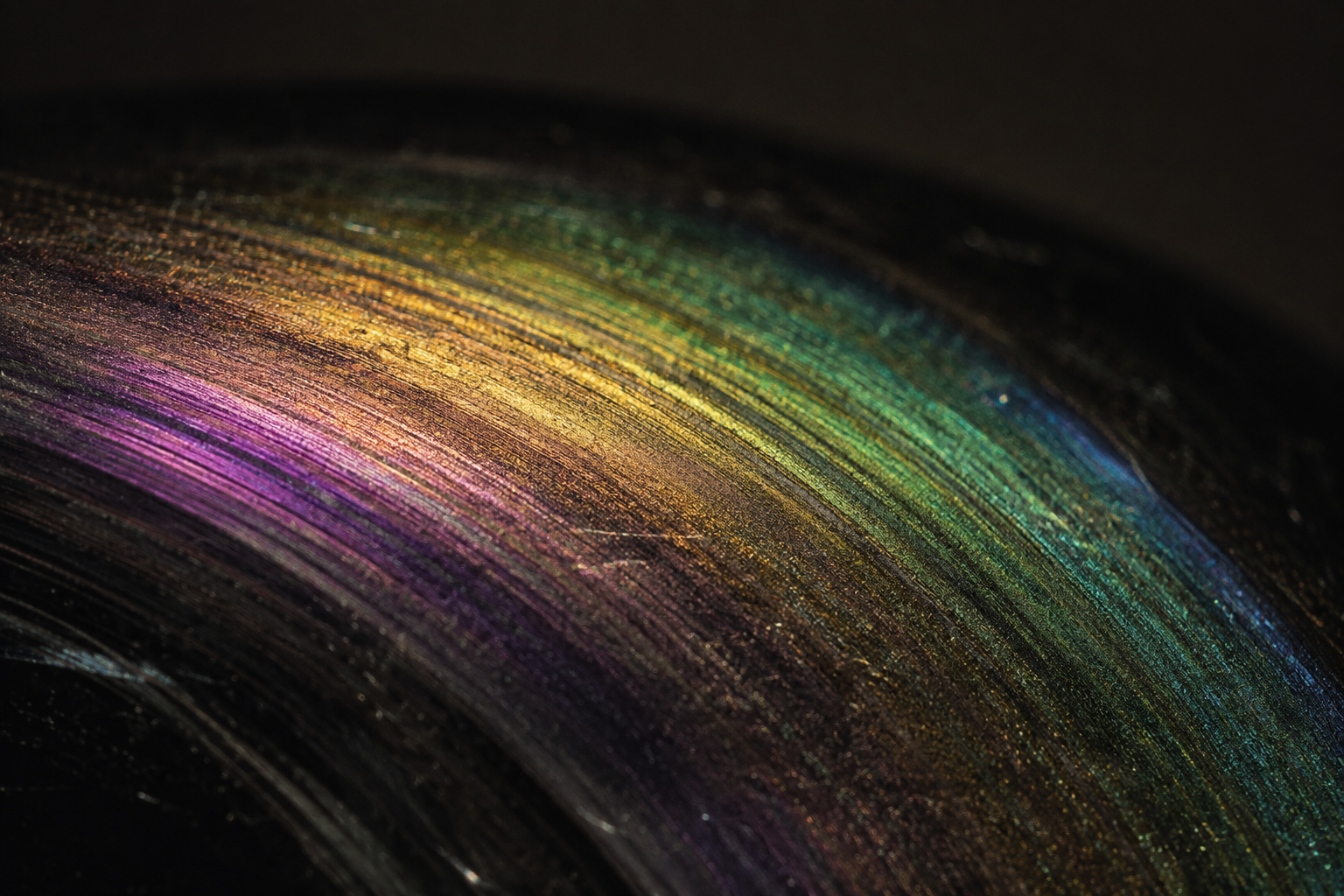
As the lava cools, minute magnetite nanoparticles, an iron oxide, arrange themselves into regular layers within the glass. These layers are so thin they are measured in nanometres, on the scale of the wavelength of visible light.
When a beam of light passes through them, it is diffracted: each colour is reflected at a slightly different angle. It is the same mechanism that colours a soap bubble, a film of petrol on water, or a morpho butterfly's wing. Hence this very particular behaviour, the colours shift as you move the stone, because you are changing the angle of observation.
If how obsidian forms interests you, I devote a whole article to it: how obsidian is formed.
Rainbow or celestial eye: how to tell them apart?
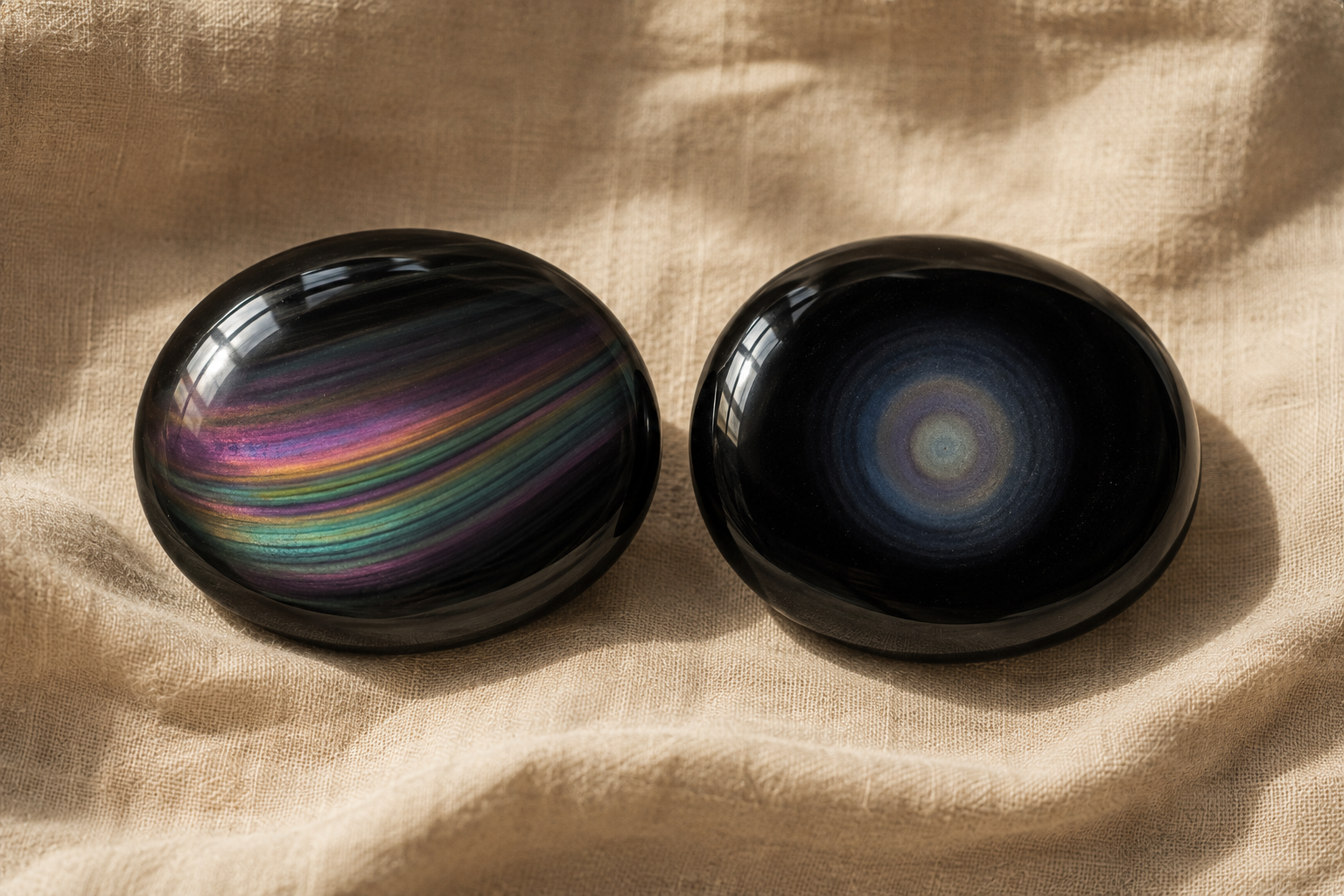
This is the most common point of confusion, and it is a fair one: both varieties rest on exactly the same phenomenon, diffraction by layers of nanoparticles. Only the way the effect shows itself sets them apart.
Rainbow
Broad, multicoloured iridescence, often in concentric bands running across the whole stone. Green, purple, gold, blue.
Celestial eye
A localised sheen, usually blue-tinted or silvery, forming an eye-shaped halo in one specific spot.
In practice, the line between them can be fine: the same stone can show a marked eye on one side and iridescent bands on the other. Commercial naming also varies from one market to the next, and here it matters for you specifically: my shop groups both effects under a single rainbow obsidian range, so a piece labelled that way here may show either the broad iridescence or the localised eye, sometimes both.
If it is the localised eye that draws you rather than the coloured bands, you will find it within the same rainbow obsidian jewellery collection.
In plain terms, don't get hung up on the name. Look at the stone: if the colours spread in bands, it is a rainbow effect; if a blue-tinted halo concentrates in one point, it is a celestial eye. Both are genuine obsidian.
The properties of rainbow obsidian
In crystal healing, rainbow obsidian holds a place of its own within the obsidian family. Where black obsidian is described as direct and sometimes blunt, rainbow is presented as its luminous, consoling counterpart. The symbolism is clear: light passes even through the darkest matter.
It is generally credited with:
- hope and emerging from dark periods: its dominant reputation, tied to the colours hidden within the black;
- protection, as with all obsidians, but in a version described as more enveloping than defensive;
- healing emotional wounds: it is readily linked to heartbreak and breakups;
- transformation: said to accompany periods of change, grief and renewal;
- rediscovered joy, a quality rarely attributed to black stones.
It is the obsidian most often recommended to people who find black obsidian too intense: same family, same grounding, but a gentler way in.
A customer once wrote to me that she had chosen the rainbow variety after a break-up, "because it has hidden colours inside". I think that is the most beautiful way to sum up this stone.
Chakras and energy
Rainbow obsidian is traditionally linked to:
- the root chakra (Muladhara), through its nature as obsidian, grounding, security;
- the heart chakra (Anahata), through its dimension of comfort and emotional healing;
- the crown chakra (Sahasrara), through the richness of its colour spectrum, linked to opening and transformation.
This triple association, low, middle, high, is unusual for an obsidian, and that is precisely what makes it a stone of passage: grounded in the earth, yet turned towards the light. I cover the whole subject in my guide to obsidian and chakras, and for the meditative practice, see meditating with obsidian.
Associated star signs
In crystal healing, rainbow obsidian is traditionally associated with:
- Scorpio: for its connection to deep transformation and renewal;
- Sagittarius: for its optimism and its search for light;
- Pisces: for its sensitivity and its consoling quality;
- Libra: for the balance between shadow and colour it embodies.
As always, these correspondences are indicative: the stone that draws you spontaneously is often the best choice.
How to wear rainbow obsidian
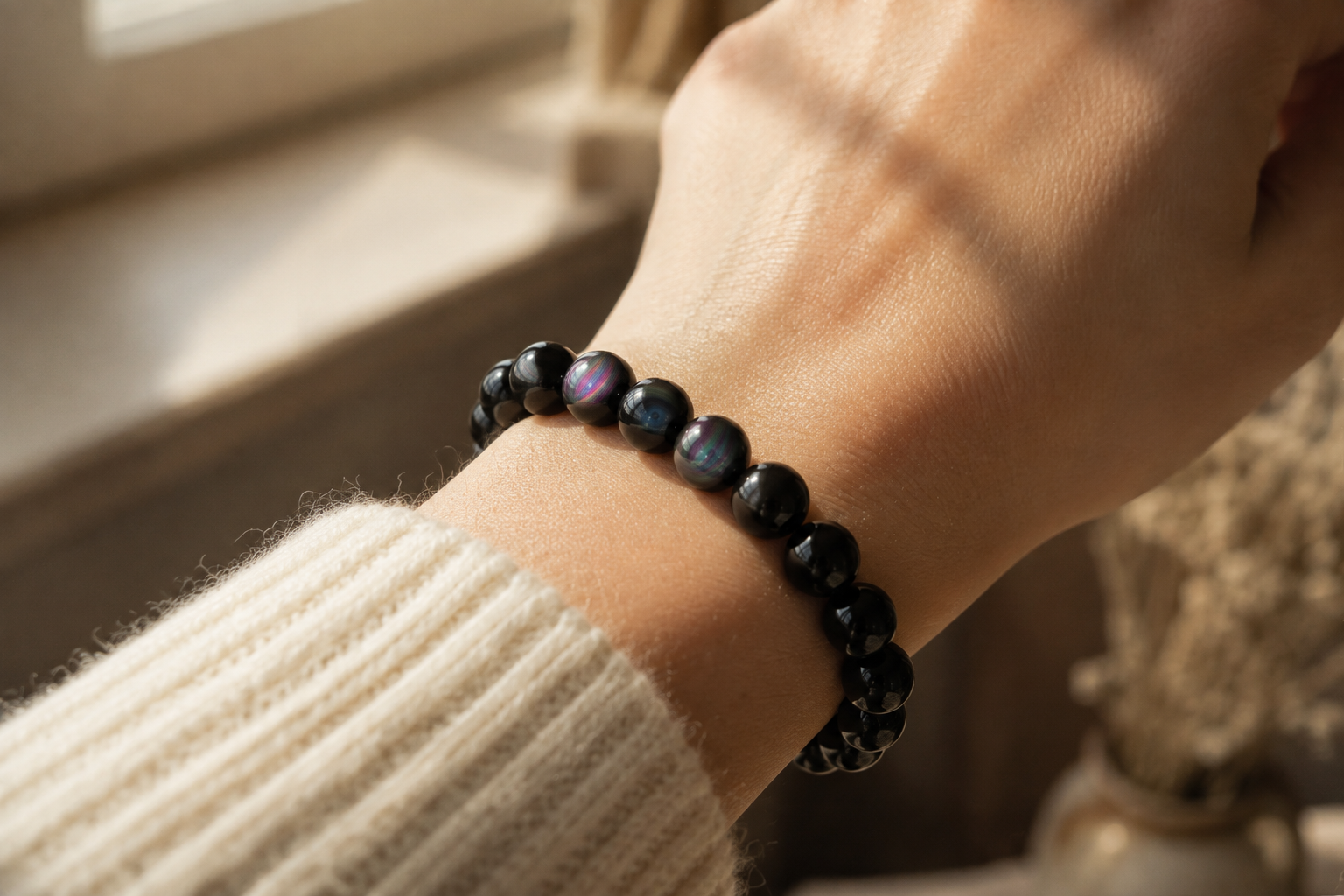
With rainbow obsidian, one rule trumps all the others: it needs to see the light. A stone kept in a pocket will never show what it can do.
- as a bracelet, the best choice: the wrist moves constantly, and the sheen appears throughout the day;
- as a pendant or necklace, the stone turns on itself and catches the ambient light;
- as a ring, to have it in view and be able to tilt it at will.
A tip for showing it at its best: favour natural light or a directional lamp. Diffuse ceiling lighting reveals almost nothing. And check the size guide before ordering.
As for pairings, rainbow obsidian works well with clear quartz, amethyst or labradorite, another stone with an optical effect. The detail is in my guide to crystal pairings with obsidian.
Spotting a genuine rainbow obsidian
This is the most imitated variety, because its colours sell well. Two fakes circulate: iridescent glass, and ordinary black obsidian coated with an artificial metallic finish (often sold as "aura").
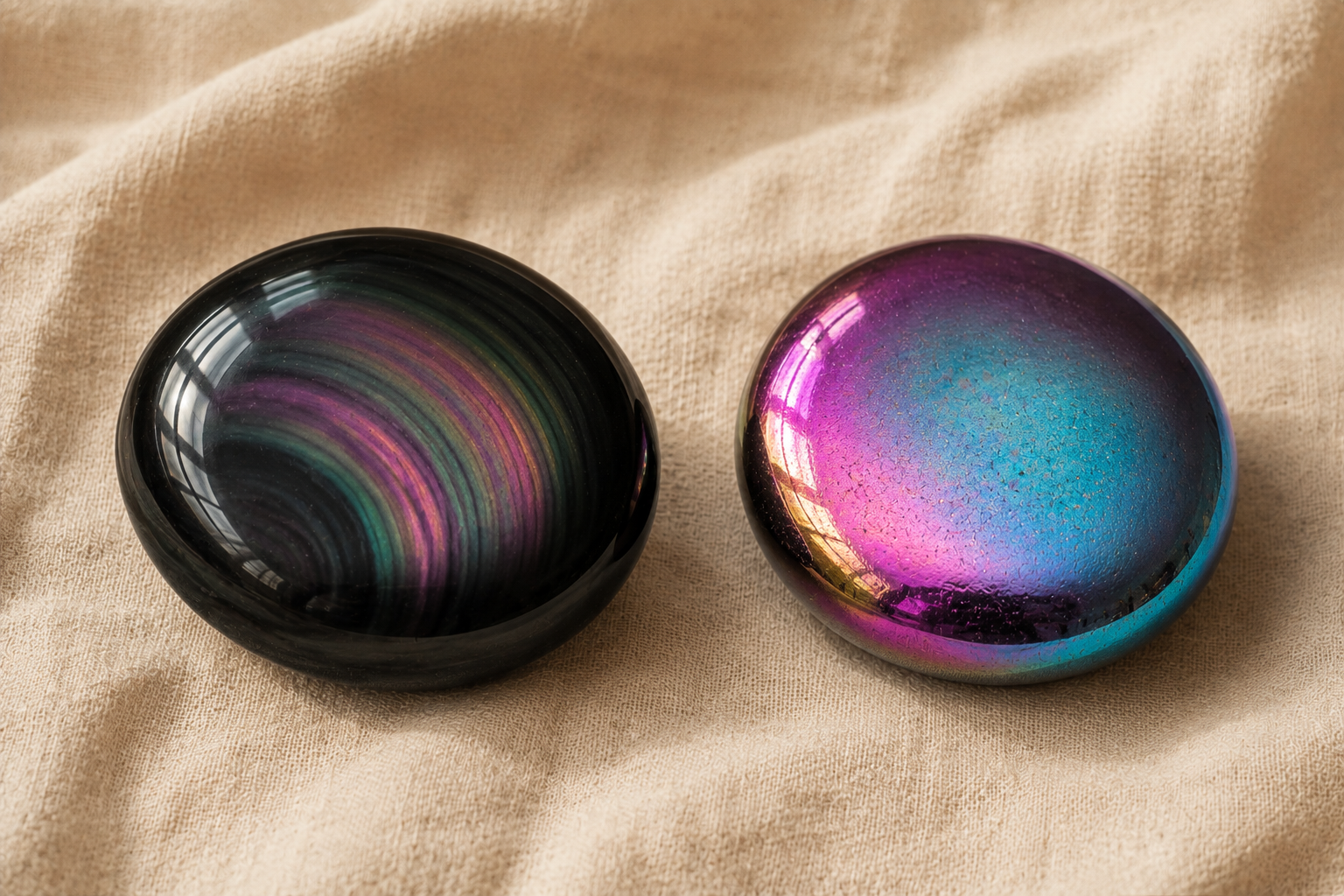
The markers that work:
- The sheen should shift as you turn the stone. Fixed iridescence, identical from every angle, gives away a coating;
- The base colour should stay black and opaque. A translucent stone in bright colours is glass;
- The colours should look deep, as if seen through the material, not sitting on the surface like a soap film;
- The stone is cool to the touch and warms up slowly;
- Be wary of hot pink and electric turquoise: the natural palette runs to green, purple, gold and deep blue.
Price is another clue: a genuine, well-cut rainbow obsidian takes real skill, and that shows on the price tag. I set out fair price ranges in my guide to obsidian price and value.
Mineralogical fact sheet
- Nature
- Natural volcanic glass (mineraloid, amorphous)
- Colour
- Deep black with green, purple, gold and blue iridescence
- Source of the effect
- Diffraction by layers of magnetite nanoparticles
- Composition
- Silicon dioxide (SiO₂), iron and magnesium oxides
- Hardness (Mohs)
- Around 5 to 5.5
- Structure
- Amorphous (no crystal lattice)
- Fracture
- Conchoidal, sharp-edged
- Main deposits
- Mexico (primary), United States
- Chakras
- Root, heart, crown
- Star signs
- Scorpio, Sagittarius, Pisces, Libra
Care and cleansing
Rainbow obsidian needs a little more care than other obsidians, not energetically, but materially: its optical effect depends on the state of the surface. A scratched or dulled surface loses its colours.
- Cleaning, a soft, dry cloth, possibly lightly dampened. Never a household product, never an abrasive microfibre;
- Cleansing, smoke from sage or palo santo, or a brief pass under clear water. Avoid salt, which micro-scratches the polished surface;
- Charging, moonlight suits it well. Avoid prolonged sun exposure;
- Storage, away from harder stones (quartz, agate), which would scratch it.
The full run-through of every step is in my guides to cleaning your obsidian and to cleansing and charging.
Worth knowing, the properties described here belong to crystal healing, a wellbeing practice founded on tradition and belief. They are not a medical claim, they treat no illness, and they are never a substitute for the advice of a healthcare professional. See also obsidian, dangers and precautions.
Frequently asked questions
What is the difference between rainbow obsidian and celestial eye?
Is rainbow obsidian natural?
How can you recognise genuine rainbow obsidian?
What are the properties of rainbow obsidian?
Which chakra is rainbow obsidian linked to?
Why do the colours sometimes disappear?
Is rainbow obsidian rare?
Find your rainbow obsidian
Bracelets, necklaces, pendants and rings in natural iridescent obsidian, handmade in my workshop in France.