Is Obsidian Fragile? A Jewellery Maker's Honest Answer
Yes. I sell obsidian and I'll start there: it's a volcanic glass, 5 to 5.5 on the Mohs scale, and a piece of fragile obsidian scratches faster than quartz and chips on a tiled floor. The good news: almost every accident I hear about comes down to five specific habits, all of them avoidable. Here they are.
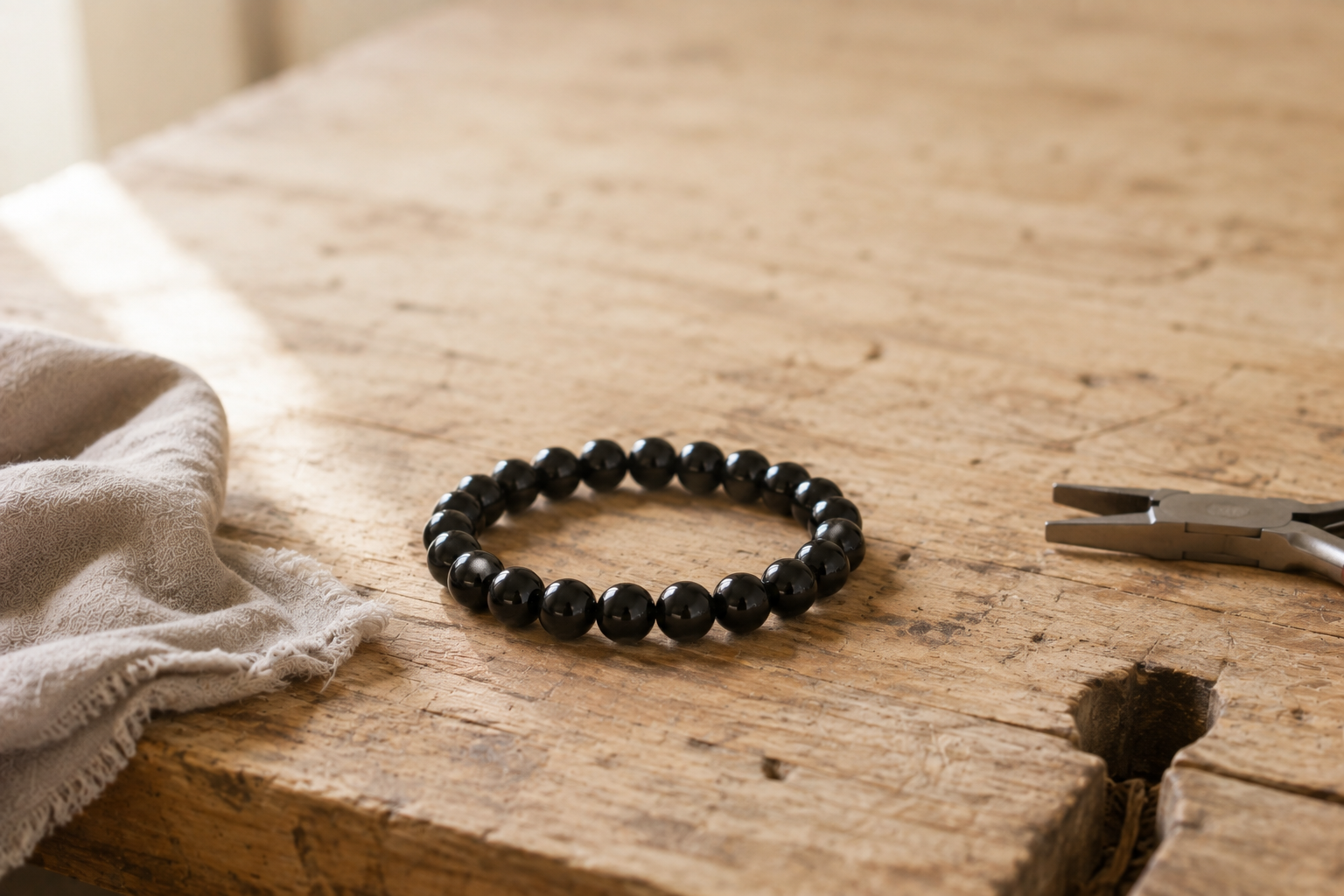
The short answer, no hedging
Obsidian is more fragile than most stones set into jewellery. That isn't an opinion, it's a physical property: 5 to 5.5 on the Mohs scale, roughly the hardness of a knife blade or window glass. Below quartz, below amethyst, nowhere near sapphire.
In practice that means three things. It scratches on contact with anything harder, and household dust qualifies. It chips on a sharp impact, with no deformation first. And when it does chip, the break is clean and cutting, never a soft rounding-off.
Does that mean you should skip it? No, obsidian has been worn for thousands of years. But it asks for attention that lapis or agate don't. That's exactly what this guide maps out: where the real risk sits, and where there is none at all.
People often ask whether my obsidian is "sturdy." I always give the same answer: not especially, no. I'd rather say it before the sale than after the breakage, and honestly, a customer who knows breaks far fewer pieces.
Is obsidian fragile? What the Mohs scale really says
The Mohs scale ranks minerals by their resistance to scratching: a material scratches everything with a lower number. Obsidian sits between 5 and 5.5. For reference, a fingernail is 2.5, a copper coin about 3.5, a steel blade 5.5, quartz 7 and diamond 10.
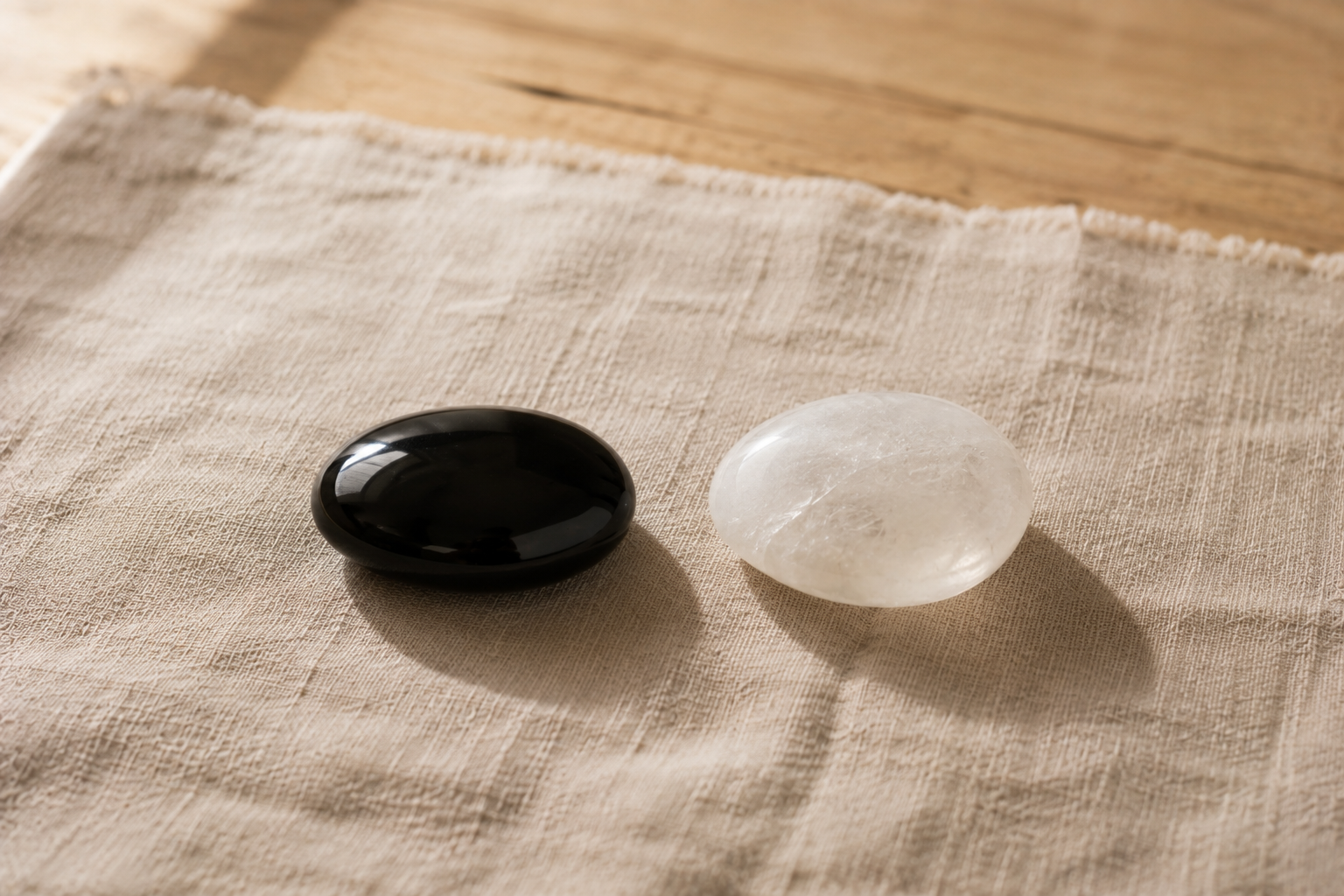
The detail that explains nearly everything: dust
Household dust contains a meaningful share of silica, which is to say quartz, hardness 7. Wiping obsidian with a dry cloth that's been sitting around is running very fine sandpaper across glass. The micro-scratches that dull a bracelet after a year almost never come from an accident. They come from the daily wipe-down.
Hardness and toughness: two words everyone conflates
Hardness measures resistance to scratching. Toughness measures resistance to breaking. They're independent properties, and this is where obsidian is genuinely at a disadvantage: it's both moderately hard and low in toughness. Jade, softer than quartz, is nearly impossible to shatter; topaz, far harder, splits with a well-placed knock.
Obsidian has no cleavage, no preferred plane of weakness, but a conchoidal fracture: it leaves in curved flakes, like a broken bottle. That property is what made it into ritual blades of formidable fineness, and it's the same one that makes a chip on a pendant clean and sharp. The reason for that structure is in how obsidian is formed: a cooling too fast for the atoms to organise into a crystal.
| Black stone | Hardness (Mohs) | Toughness | My take |
|---|---|---|---|
| Obsidian | 5-5.5 | Poor | The most delicate of the group. Beautiful, but handle it gently. |
| Hematite | 5.5-6.5 | Poor | A little harder, just as brittle. And heavy. |
| Onyx (chalcedony) | 6.5-7 | Good | The best compromise if durability is the priority. |
| Black tourmaline | 7-7.5 | Fair | Hard but brittle: it doesn't like impacts either. |
| Black spinel | 8 | Good | The toughest, and by far the most expensive. |
| Jet | 2.5-4 | Fair | Much softer than obsidian: it isn't last in this ranking. |
What the table doesn't say, none of these stones looks or feels alike. If you're unsure what you're holding, I've compared obsidian to its two most frequent lookalikes: black tourmaline vs obsidian and black spinel vs obsidian.
The 5 things that actually damage obsidian jewellery
After several years of customer feedback, the list is short and always the same. These are almost never dramatic accidents.
- Dropping it on a hard surface. Tile, a stainless steel sink, a stone worktop. This is cause number one, and it happens at the exact moment you take the piece off. Get into the habit of removing it sitting down, over a cloth.
- Rubbing against another piece of jewellery. A cubic zirconia ring or a quartz bracelet on the same wrist will scratch obsidian within weeks. Separate them by wrist, or by box.
- Wiping it dry. The most harmless-looking habit, and the most destructive over time. See above: dust is an abrasive.
- Chemicals. Pool chlorine, seawater, hand sanitiser, perfume, sun cream, household cleaners. The stone itself holds up reasonably well; it's the elastic cord, the thread and the silver setting that suffer first.
- Sudden temperature swings. Sauna, steam room, very hot water followed by a cold rinse. Glass dislikes thermal shock, and a glued setting dislikes it more.
Notice what isn't on that list: simply wearing the piece every day. An obsidian bracelet worn continuously, but taken off for the gym, the shower and cleaning, ages very well.
Worth knowing, time itself does no harm. You'll read that obsidian "degrades" over the years: on a human timescale, that's false. Volcanic glass changes over tens of thousands of years, not over a decade of wear.
Which obsidian piece holds up best?
Not every format takes the same knocks. If durability is your main criterion, the order below is the one I give in person, from the most forgiving to the most exposed.
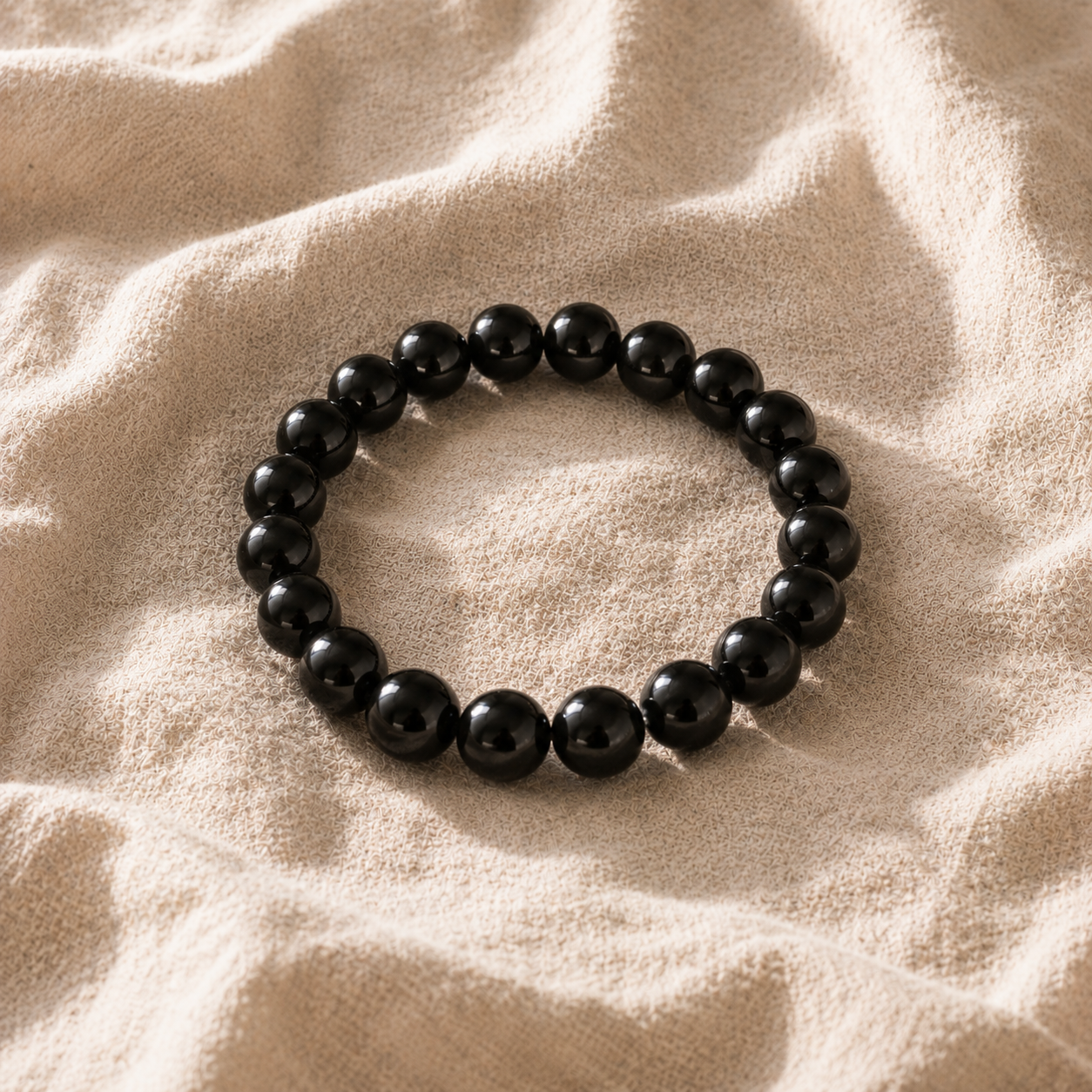
Beaded bracelet
The most forgiving. No sharp edges.
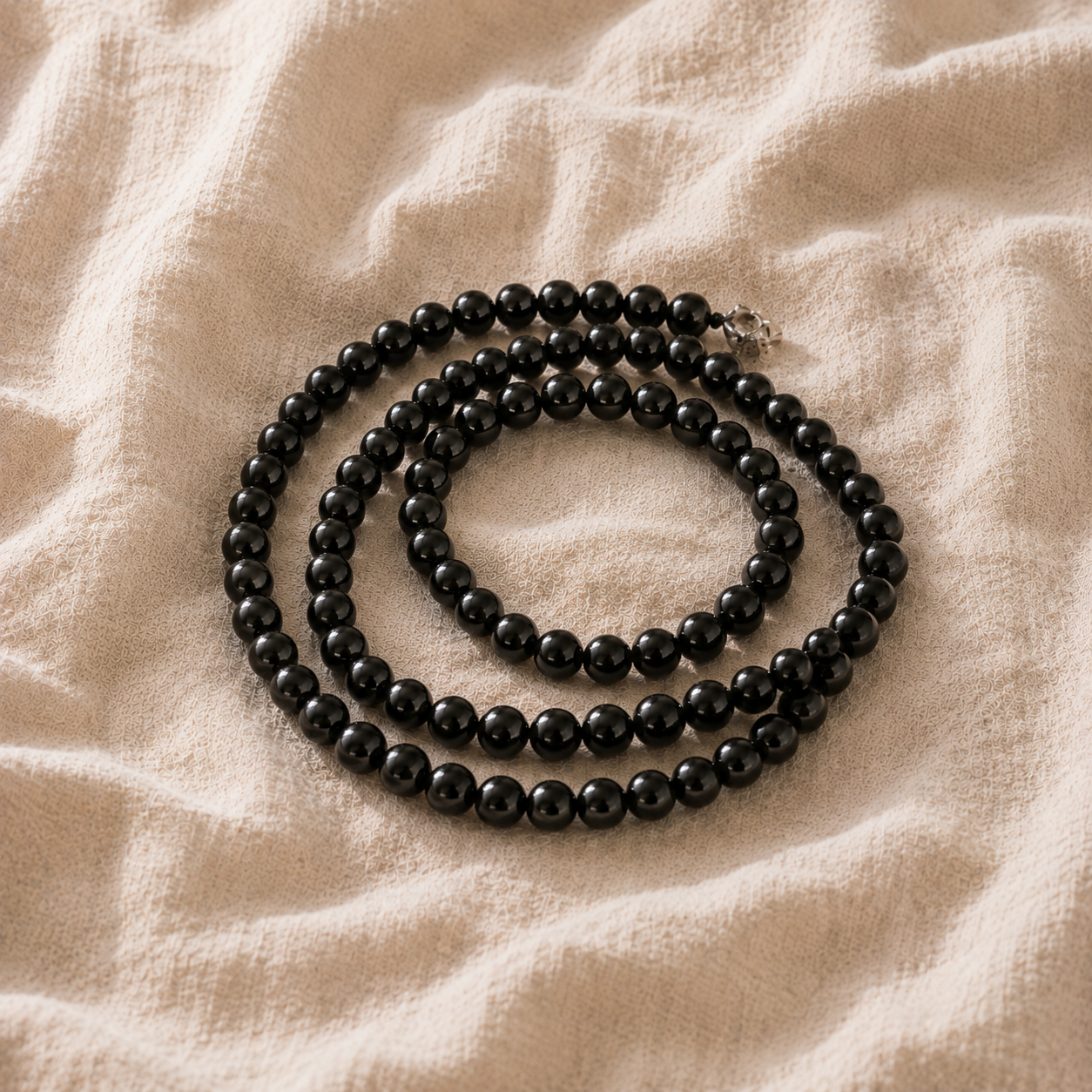
Necklace
Well protected, but the thread wears.
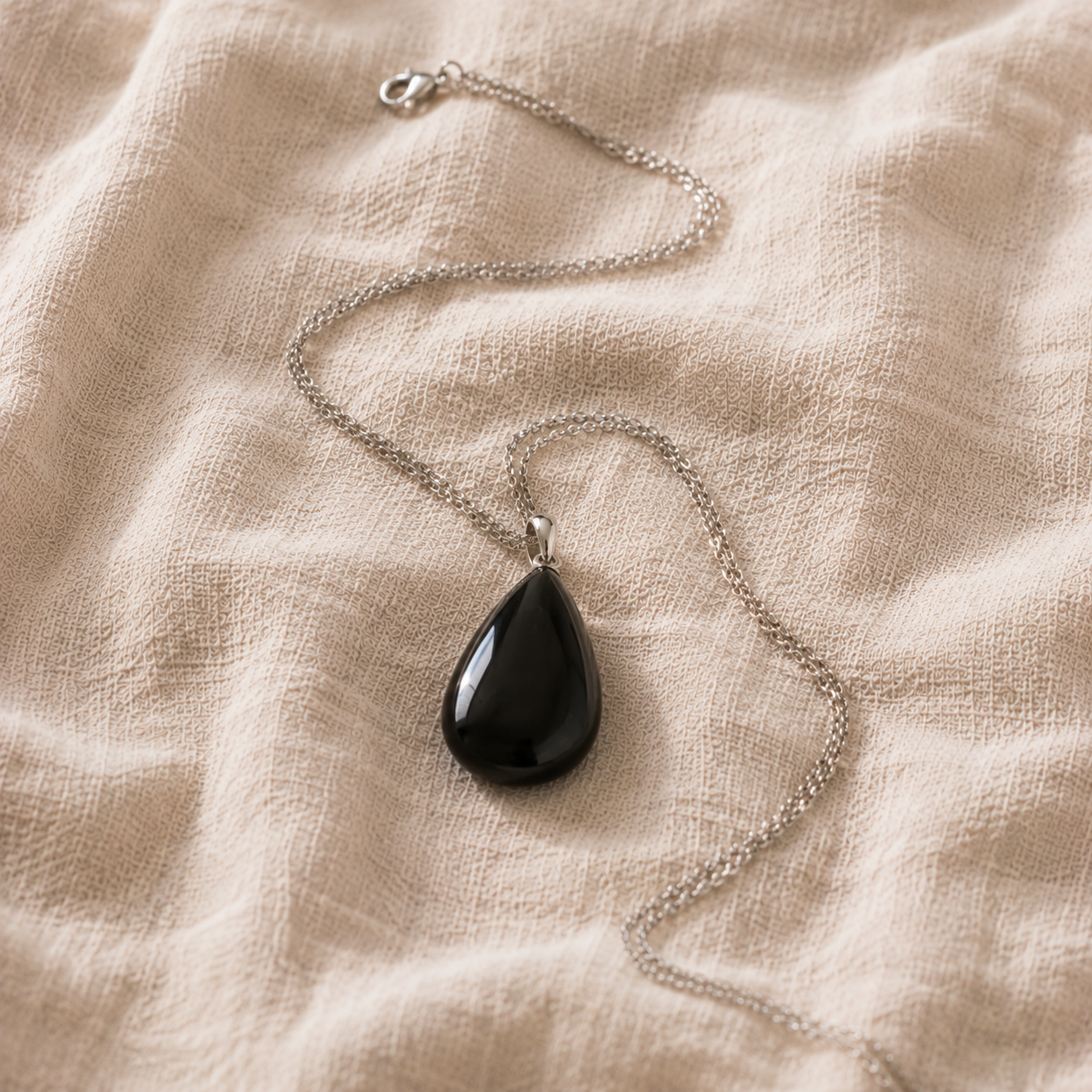
Pendant
One stone: everything rides on it.
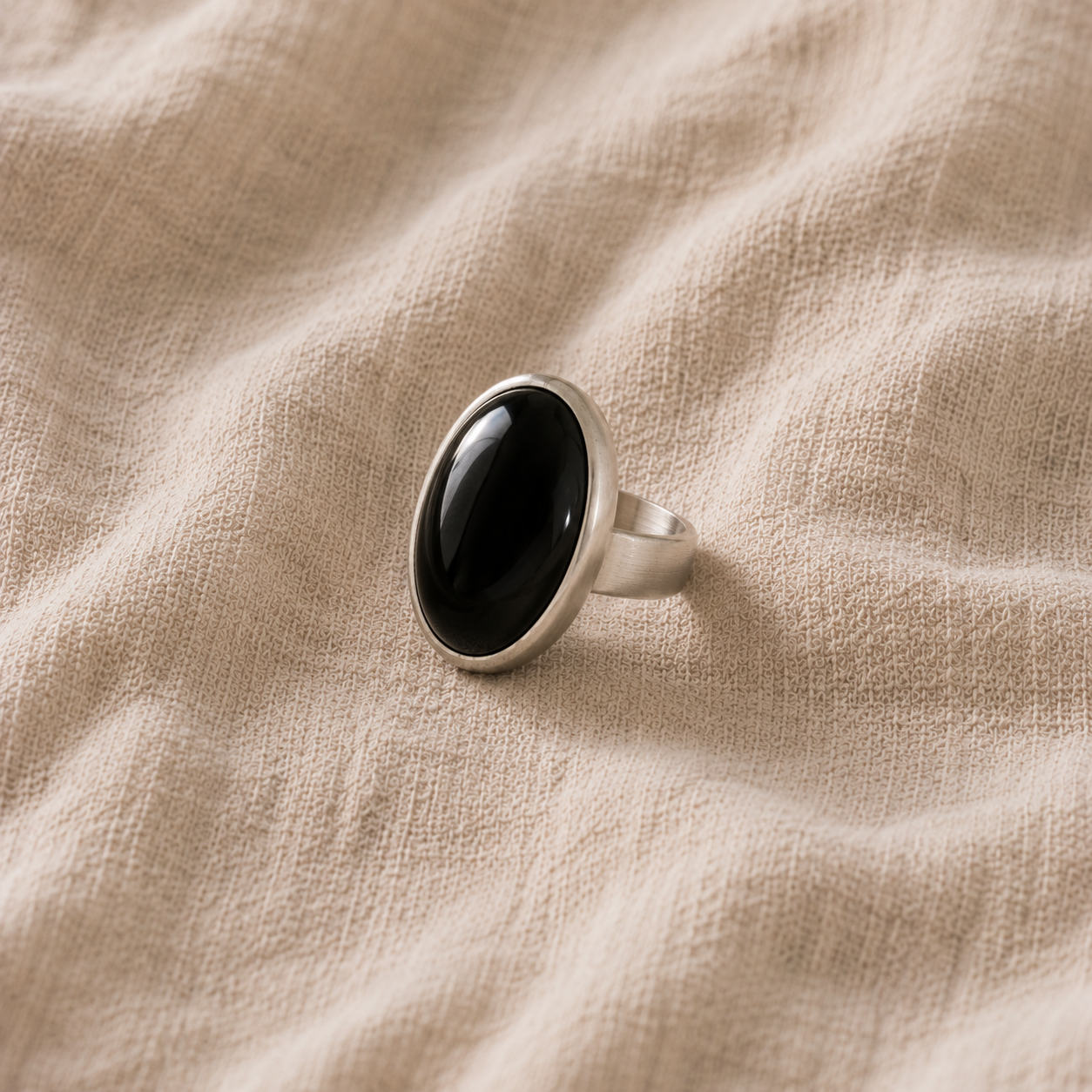
Ring
The most exposed. Get it bezel-set.
The beaded bracelet, the most forgiving
Each bead is small, round, edgeless, and light: in a fall, the energy spreads across the whole strand. One bead may chip, rarely more. This is the format I recommend for a first obsidian piece, and for everyday wear. The real weak point isn't the stone but the elastic cord, expect to replace it every two to three years with continuous wear.
The necklace, well placed, but hanging on a thread
Worn on the chest, it takes few direct knocks. Again, it's the stringing that fails before the stone: a thread that frays, a tired clasp, and the whole strand drops at once, in the worst possible place, usually a bathroom floor.
The pendant, everything rests on one stone
A single stone means a single point of failure. A polished drop or sphere holds up well; a shape with a fine point (an arrowhead, an elongated teardrop) concentrates stress at its tip. If you're torn between two designs, take the rounder one.
The ring, the most exposed, and why the setting matters
Hands hit everything: door handles, keyboards, car doors, steering wheels. An obsidian ring takes in a month what a pendant takes in five years. Which is exactly why a silver bezel wrapping the edges of the stone changes everything, it absorbs the impact instead. Check the fit too: a loose ring spins and knocks, and the jewellery size guide prevents a lot of damage.
✦ The most forgiving format
My beaded bracelets, made for everyday wear
Loading pieces…
The habits that change everything
Nothing complicated, and nothing expensive. These are habits, not a protocol.
- Take it off before the gym, the washing-up, cleaning and the shower. Those four moments hold most of the drop and chemical risk.
- Jewellery goes on last and comes off first. After lotion, after perfume; before you get undressed.
- Clean with lukewarm water and a soft, damp cloth, never dry. Pat it dry afterwards. The full method is in how to clean obsidian.
- Store it on its own. A fabric pouch, a compartmented box, what matters is that it touches no other piece. This is the single most effective item on the list.
- No ultrasonic cleaners, no steam cleaners. Those machines are built for hard, inclusion-free gems. They crack obsidian and loosen settings.
- Skip dry salt and direct sun. Plenty of cleansing protocols recommend both; salt is abrasive and attacks silver, and prolonged exposure adds nothing. The risk-free methods are in how to cleanse and charge obsidian.
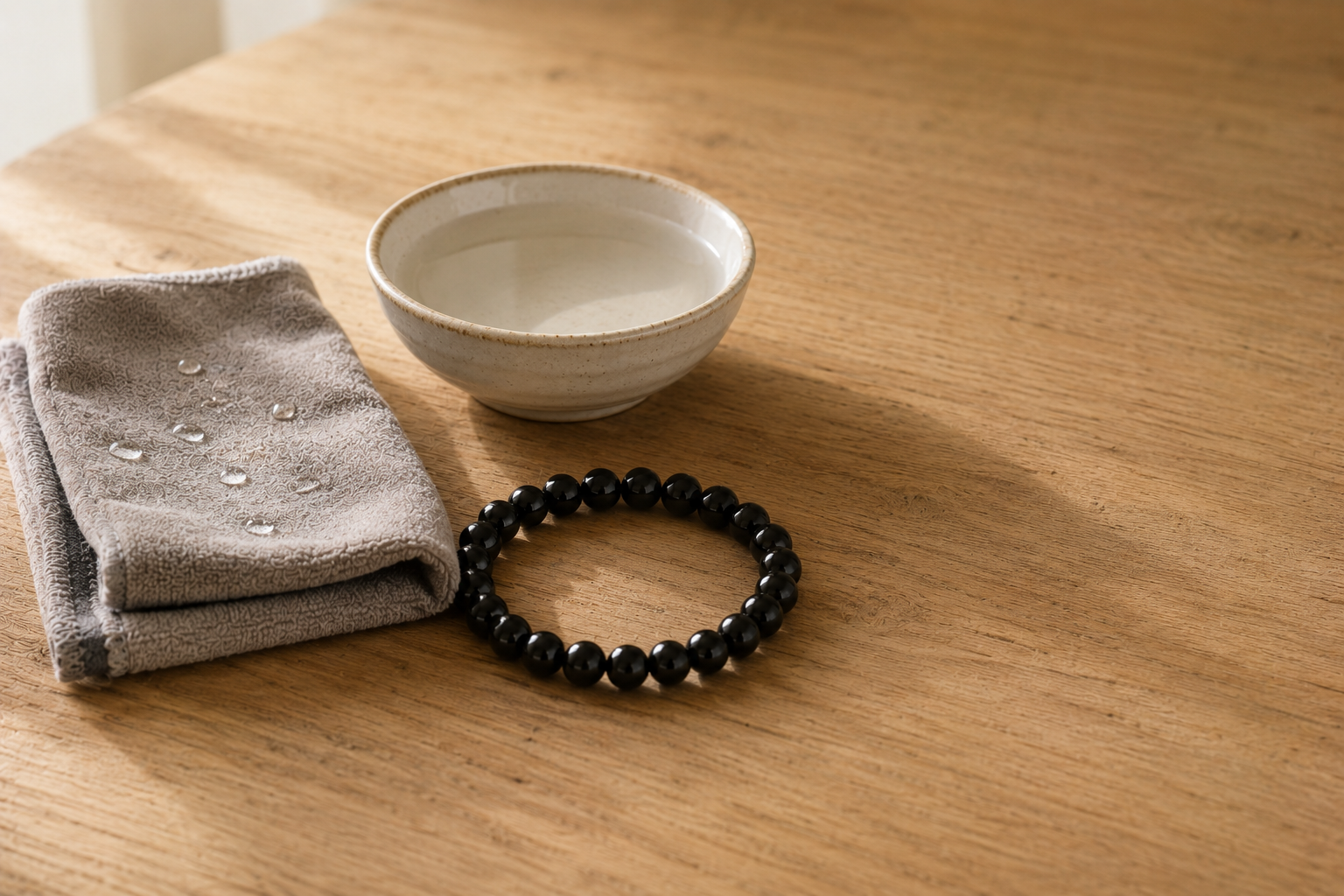
If you only keep one: store your obsidian on its own. Not in the dish where three rings and a watch already live. That single habit prevents more scratches than all the others combined.
One question comes up constantly: should you take it off at night? For the stone, yes, eight hours of rubbing against sheets and a mattress adds up. On everything else my position is more nuanced; I set it out in sleeping with black obsidian.
Scratch, chip, broken cord: what can be fixed and what can't
Fixable
The elastic cord and the thread: a simple restring, at a jeweller's or at home. The clasp: same. Tarnished silver: a polishing cloth handles it. Surface micro-scratches: professional repolishing removes them.
Not fixable
A clean chip: the material is gone, nothing replaces it. An internal fracture: it will spread. A broken bead: it can be swapped, but the new one will never quite match the sheen.
If a stone chips, the first reflex should be safety: a fresh obsidian edge genuinely cuts. Don't run a finger over it to "check." Wrap the piece and have it looked at, or replace it. That point, along with the other handling risks, is covered in obsidian dangers and precautions.
For a beaded bracelet on elastic, replacing the cord is a ten-minute job that gives the piece years back. It's also your chance to check every bead one by one under raking light: a fracture shows up long before it gives way.
I'm happy to restring the bracelets I made, and I tell customers so: write to me before you throw anything away. Nine times out of ten it isn't the stone that failed, it's the cord, and that can be redone. A note through the contact page is enough.
One last word on buying: inexpensive obsidian isn't necessarily more fragile, but fake obsidian, coloured glass, reconstituted material, behaves differently and ages worse. The markers for telling them apart are in obsidian price and value, and the full material overview in the types of obsidian.
Precautions and limits
Handle chipped pieces carefully. This is obsidian's one genuinely physical risk: its conchoidal fracture produces extremely fine edges. Keep children away from a broken stone, and don't try to sand it down yourself without protection.
Don't confuse fragility with poor quality. Obsidian that scratches is doing exactly what its nature predicts. A seller promising "unbreakable" obsidian, or obsidian at "hardness 7," is either mistaken or misleading you.
Be suspicious of surface treatments. Some low-end pieces are lacquered to hide micro-scratches. The coating flakes within months and becomes impossible to correct.
Please note, the properties attributed to obsidian belong to spiritual traditions and to crystal healing, a wellness approach founded on belief. They are not a medical claim, they treat no illness, and they never replace the advice of a healthcare professional. See our medical disclaimer.
To place obsidian in its wider context, where it comes from, its varieties, its uses, everything is gathered in the complete obsidian guide. And if you're curious about what it's traditionally credited with, the benefits of an obsidian bracelet is a good next stop.
Frequently asked questions
Does obsidian break easily?
What is the hardness of obsidian?
Can I wear an obsidian bracelet every day?
Can obsidian jewellery get wet?
How do you remove a scratch from obsidian?
My bracelet broke, was the stone at fault?
Is obsidian more fragile than black tourmaline?
Obsidian assembled with care lasts a great deal longer
Every piece is put together by hand in France, and I'm glad to restring the ones that tire.