Description
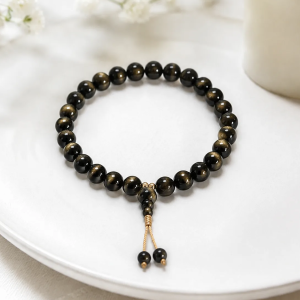
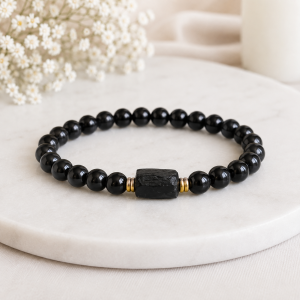
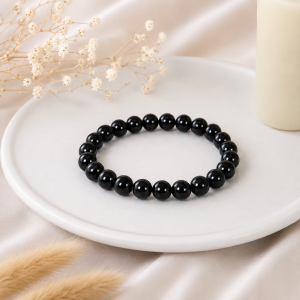
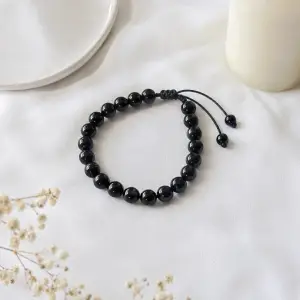
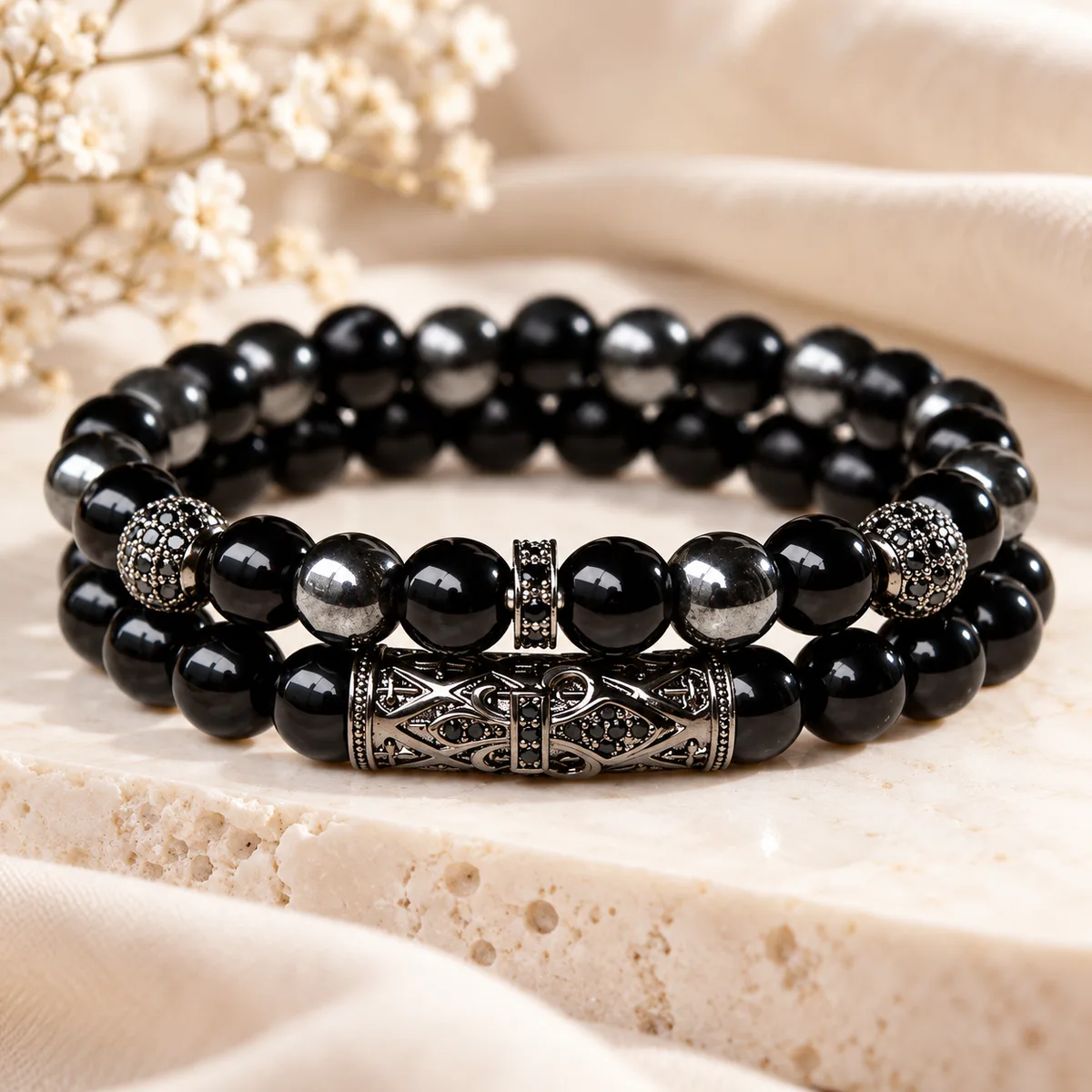
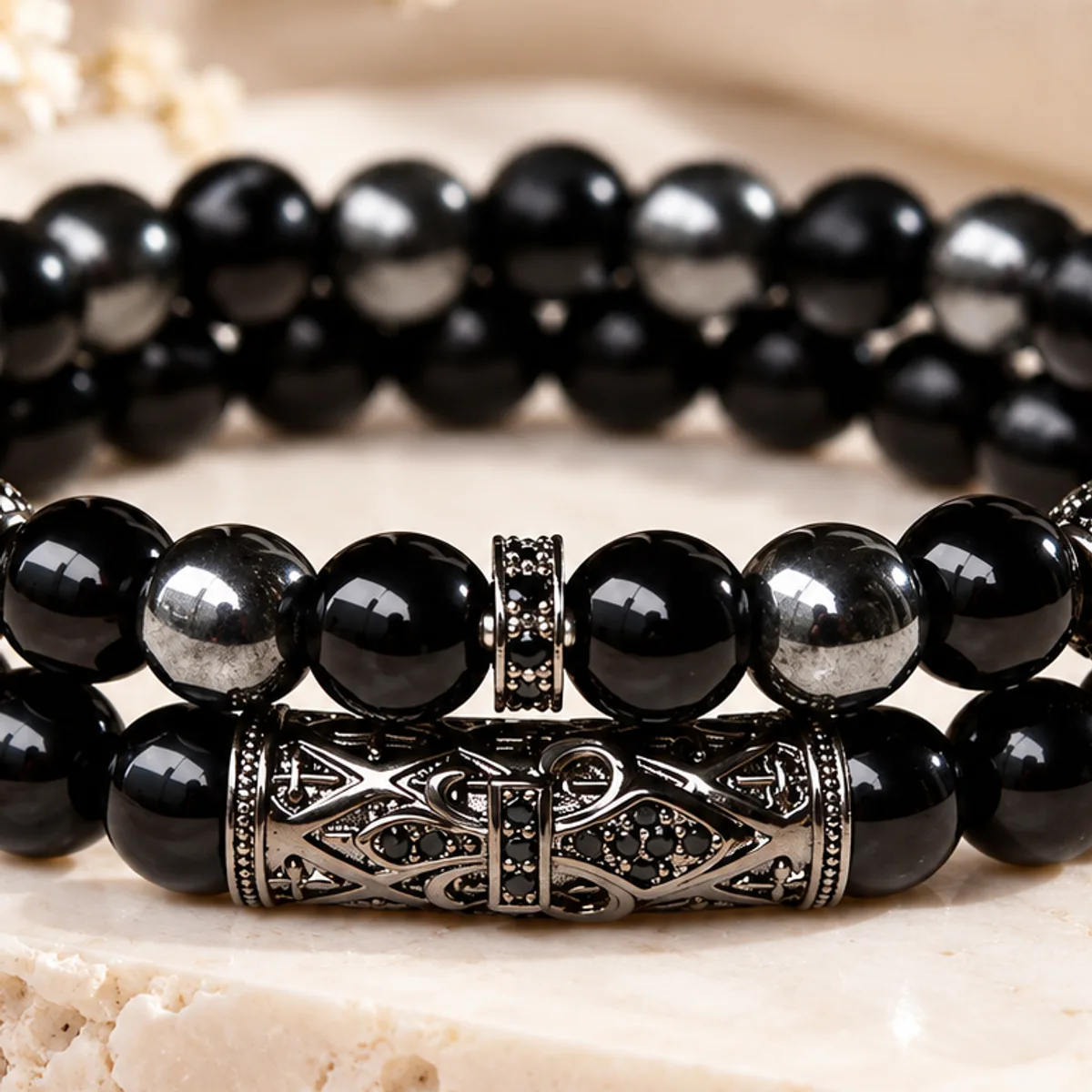
Two 8 millimetre strands where black obsidian alternates with grey haematite. One carries an engraved bar in blackened metal, the other two beads paved with small pale stones. Everything is dark, and relief makes the difference.
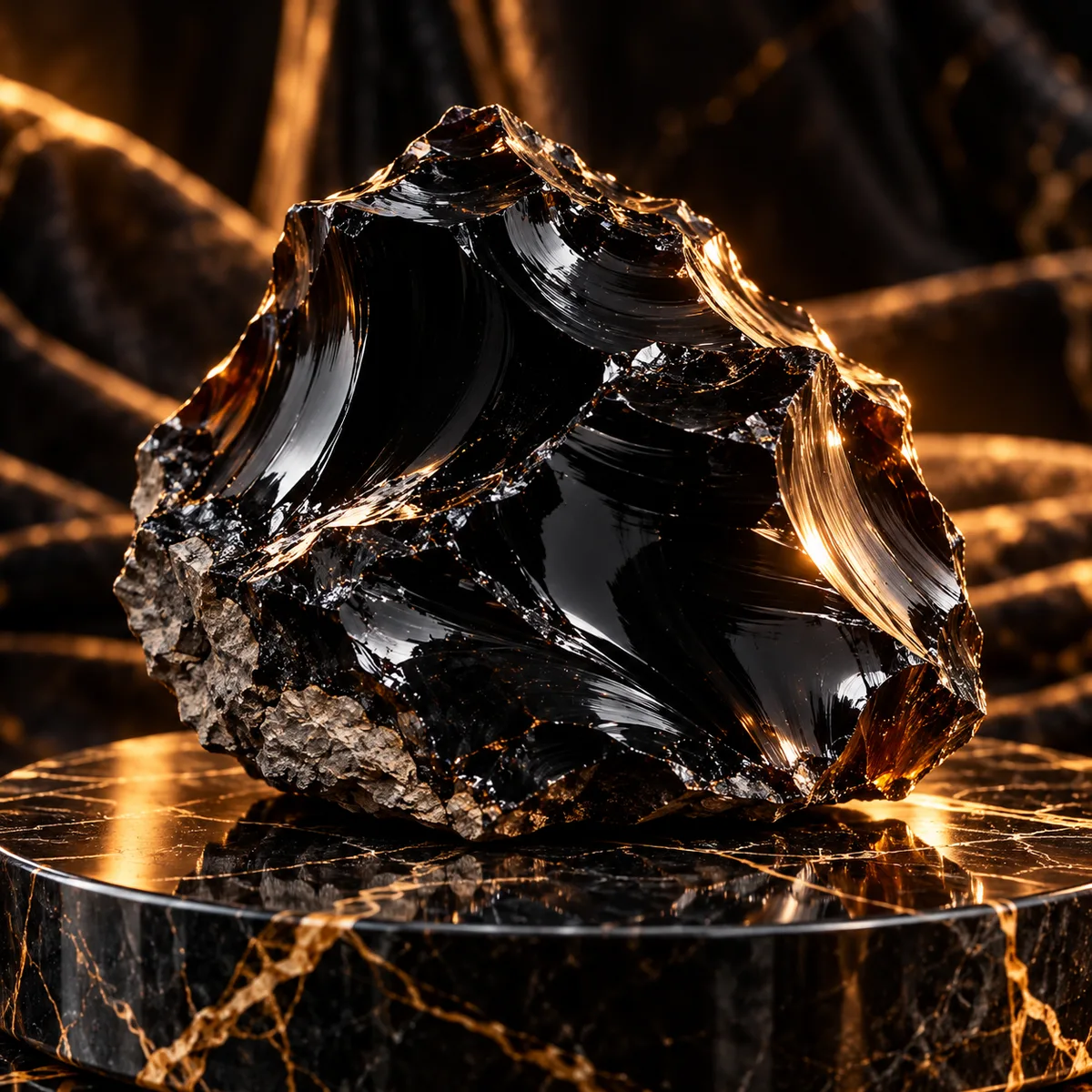
Obsidian and haematite look alike from a distance and look nothing alike up close. Obsidian is a volcanic glass: it returns a deep, slightly liquid light, with black inside it. Haematite is a polished iron oxide: it returns a metallic grey light, like steel. Side by side the eye reads two different blacks, and that is what holds an entirely dark strand together. Pairing obsidian with other stones goes into these mixes.
The engraved bar is not a clasp. It is threaded like a bead, on the same elastic, and it serves as a focal point: without it the strand would be a uniform line and the wrist would have nowhere to stop. The engraved motif is gothic-inspired decoration, kept deliberately quiet by the black patina. The other bracelets are here.
The reservation concerns the blackening of the metal. It is a surface patina, not a colour through the mass, and it wears exactly where things rub: the ridges of the bar’s relief, and the belt of the paved beads. After two or three years those ridges turn pale again and the contrast reverses. Some find that more beautiful, others do not. It is not a manufacturing fault, it is what a patina does.
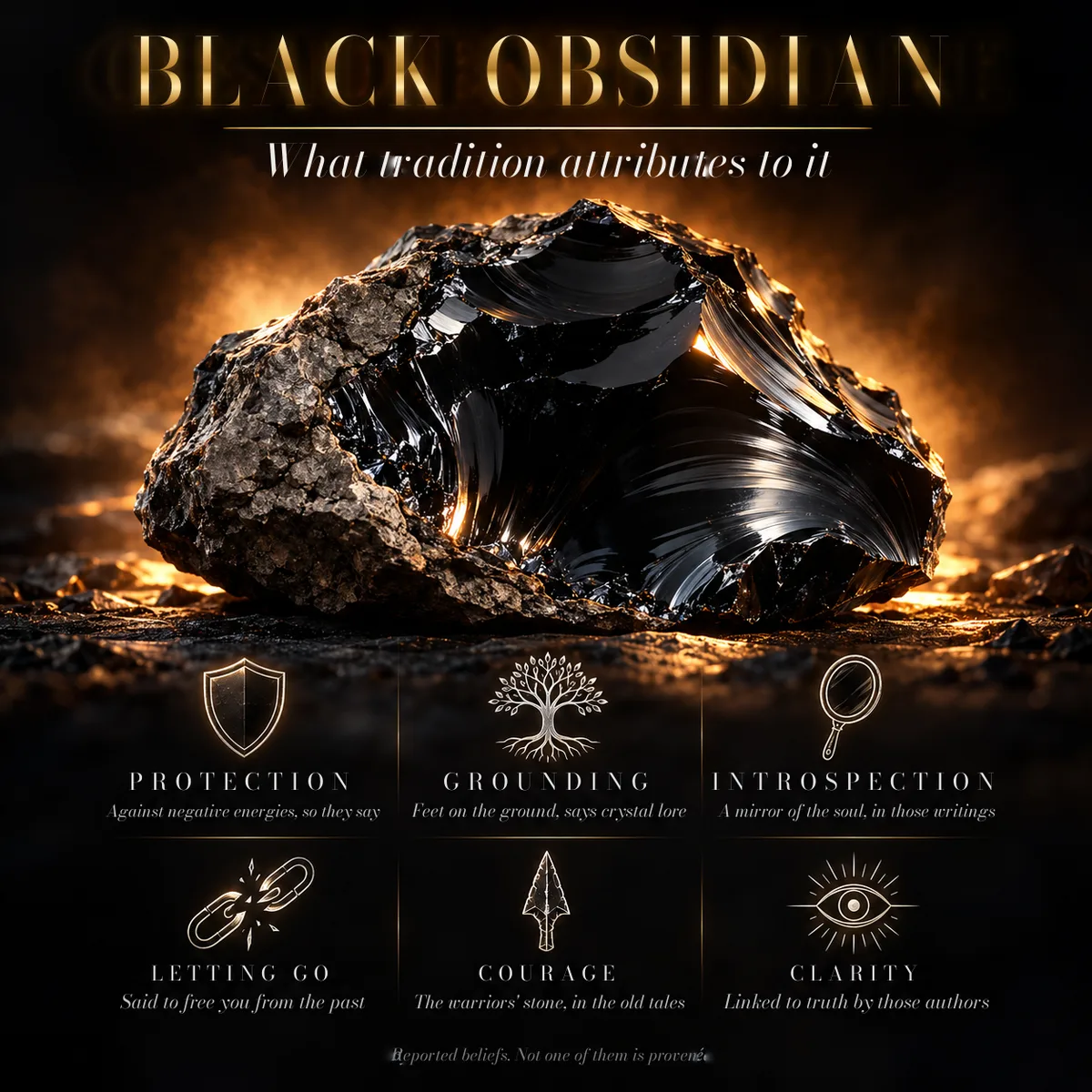
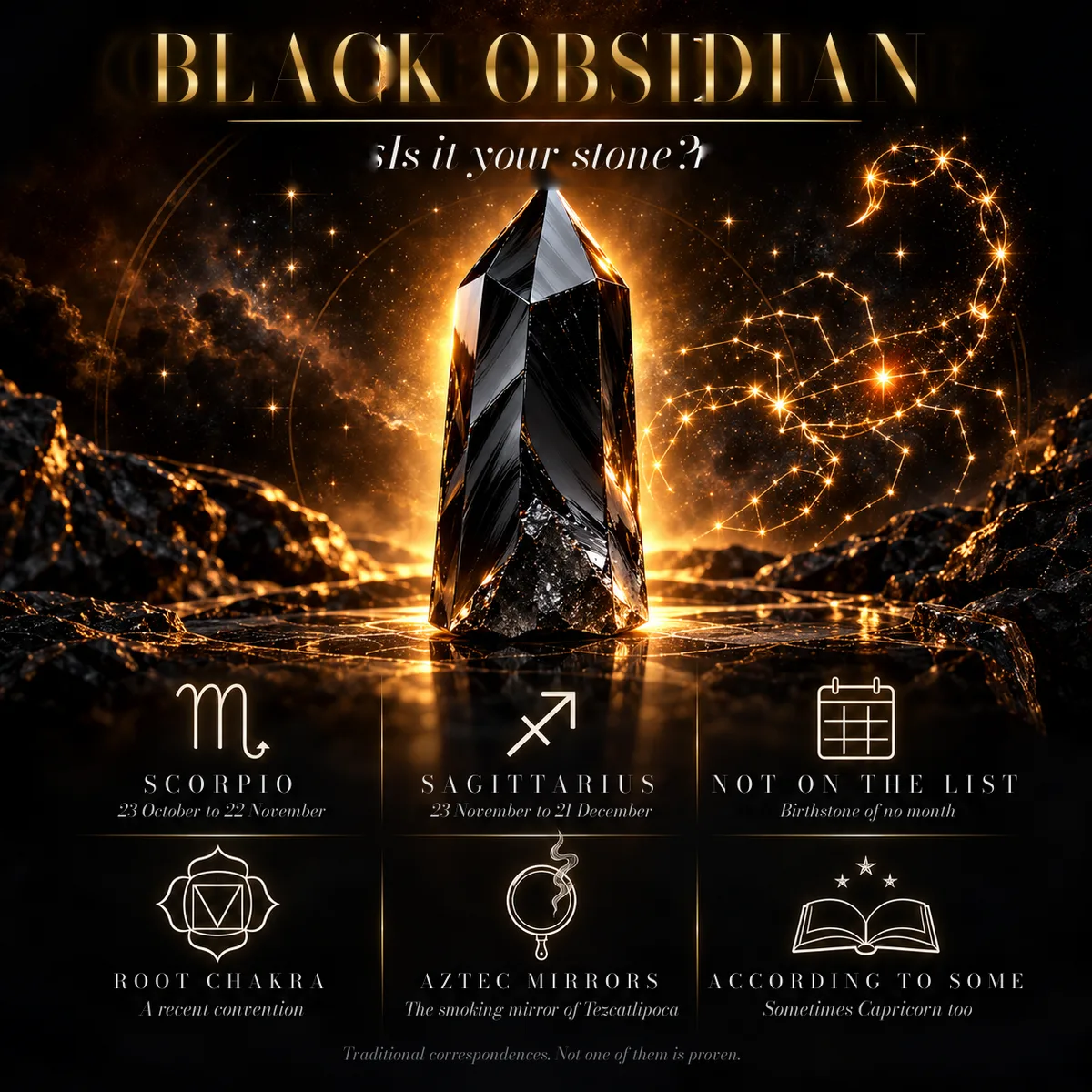
Crystal lore ties obsidian to grounding and haematite to strength. None of that is proven, and no piece of jewellery heals anything. I have gathered separately what tradition attributes to obsidian, in the conditional from start to finish.
- Two bracelets sold together, 8 mm obsidian and haematite beads.
- An engraved bar in blackened metal on one strand, two paved beads on the other.
- The black patina wears on the ridges and the contrast reverses over the years.
- Hand-strung in France on braided elastic cords, no clasp.
What to know before you wear them
 |  |  |
The specifications
- Stones
- Black obsidian, haematite
- Bead diameter
- 8 mm
- Trim
- Engraved bar in blackened metal, two paved beads
- Contents
- Two bracelets
- Wrist size
- 17 to 19 cm / 6 3/4 to 7 1/2 in, elastic
- Stringing
- Braided elastic cords, no clasp
- Stone origins
- Mexico, Brazil
- Gender
- Men
- Brand
- Bijoux Obsidienne

Blackened metal, and what becomes of it
A bar threaded on elastic has to sit opposite the knot, and nowhere else. The reason is mechanical: the knot is the thickest point of the cord, the bar the stiffest point of the strand, and if the two end up on the same side, the bracelet does not close into a circle but into a teardrop. It does not show on the bench, where the bracelet lies flat, but it jumps out on the wrist.
This duo is designed for a man’s wrist, and the word matters little: what matters is the diameter of the wrist. Two 8 millimetre strands fill a seven and a half inch circumference nicely and look heavy on a six inch one. The other bracelets are here, and the obsidian guide explains the stone.
Knot and bar on the same side, and the bracelet closes into a teardrop instead of a circle. Invisible flat, obvious on the wrist.
Obsidian does not mind water, but haematite spots with rust if it stays damp for several days, and the metal’s patina wears faster with soap. Take the bracelets off before the shower. A soft dry cloth, never an ultrasonic bath. Cleaning an obsidian piece covers the rest.