Can You Sleep With Black Obsidian?
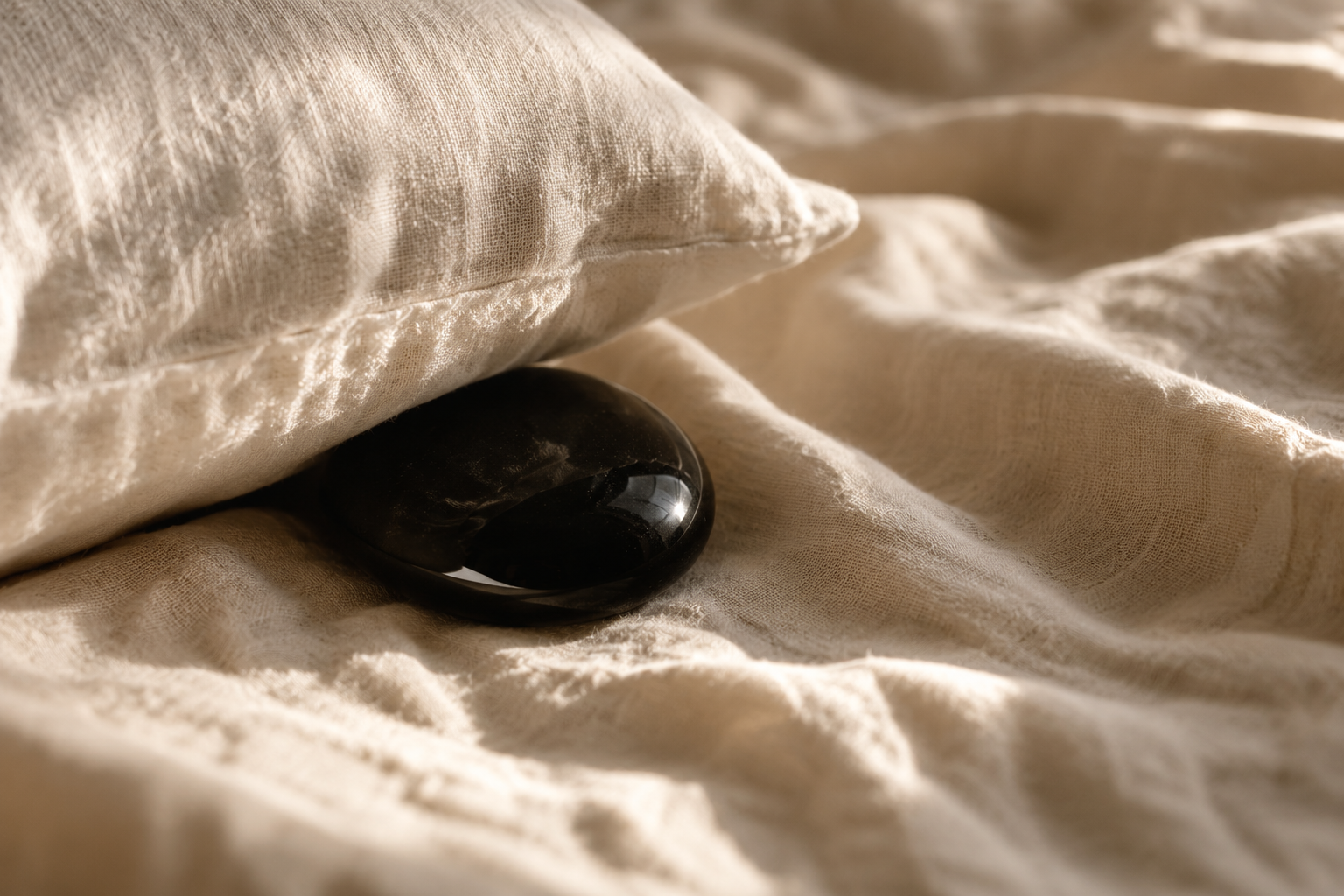
My honest answer: black obsidian is a daytime stone, not a night-time one. Advice everywhere tells you to slip it under your pillow, that's precisely the one placement I'd steer you away from. Here's what crystal healing really says about sleeping with black obsidian, where to place it without disturbing your nights, the signs to watch for, and the stones people reach for instead at bedtime.
Can you sleep with black obsidian? The short answer
Yes, you can, nothing stops you, and a stone sitting near a bed has never kept anyone awake by itself. But in crystal healing traditions, black obsidian is described as a blunt, intense, introspective stone, and that's exactly what makes it a poor fit for bedtime. It's built to accompany a day, not to watch over a night.
The advice you'll see most often, tucking it under the pillow, is also the one its own supporters end up walking back: most sources that give this tip quickly add that you should move it away if dreams become too intense. Better to say that upfront than after three rough nights.
If there's one thing to remember: black obsidian on the wrist during the day, gladly. Black obsidian under the pillow, no. It isn't the same stone depending on the hour, and I'd rather tell you that plainly than sell you a peaceful night I can't actually promise.
Why black obsidian often unsettles sleep
The stone's whole reputation comes down to one image: the dark mirror. In crystal healing, black obsidian is described as a stone that reflects, that confronts, that surfaces what we'd rather avoid looking at. That's a useful quality for grounding and protection work done mindfully, during the day, when you have the resources to sit with whatever comes up.
At night, that same mechanism works against you. Sleep is already, physiologically, when the brain sorts and replays the day; tradition holds that adding a stone reputed to be "revealing" on top of that is like putting an amplifier on a process that didn't need one. Hence the recurring accounts of very vivid, very long, sometimes unsettling dreams in the first few nights.
It's worth being honest about what these accounts actually are: they're anecdotes, not measurements. Nobody has shown that a piece of volcanic glass sitting thirty centimetres away changes sleep architecture. What can be said is that tradition itself places black obsidian among the more demanding stones, and its own practitioners advise easing into it gradually. I go into this in more detail in obsidian, dangers and precautions.
In short, black obsidian isn't "dangerous" at night. It's simply a poor match for a moment when you're trying to let go, while it's credited with doing the opposite. This isn't a warning, it's a question of timing.
Signs it isn't working for you
If you've already tried it, here's what practitioners describe as the signals of a placement that's too close, or introduced too soon:
- Noticeably more vivid dreams than usual, which you remember with unusual clarity on waking;
- repeated night waking, often around the same time, when your nights used to be unbroken;
- new difficulty falling asleep, with your mind racing instead of settling;
- waking up tired despite a normal amount of sleep, as if the night had been "busy";
- an emotional flare-up in the morning: irritability, a diffuse low mood, old memories surfacing for no clear reason.
A sensible rule: if any of these show up within the first three to five nights of bringing the stone into your bedroom, move it further away and watch what happens. If things settle back to normal, you have your answer. If nothing changes, the stone wasn't the cause, and that's just as useful to know.
Worth noting, ongoing insomnia, creeping fatigue or a worsening mood aren't fixed by moving a rock. These are worth raising with a doctor, regardless of any stone.
Where to place black obsidian at night
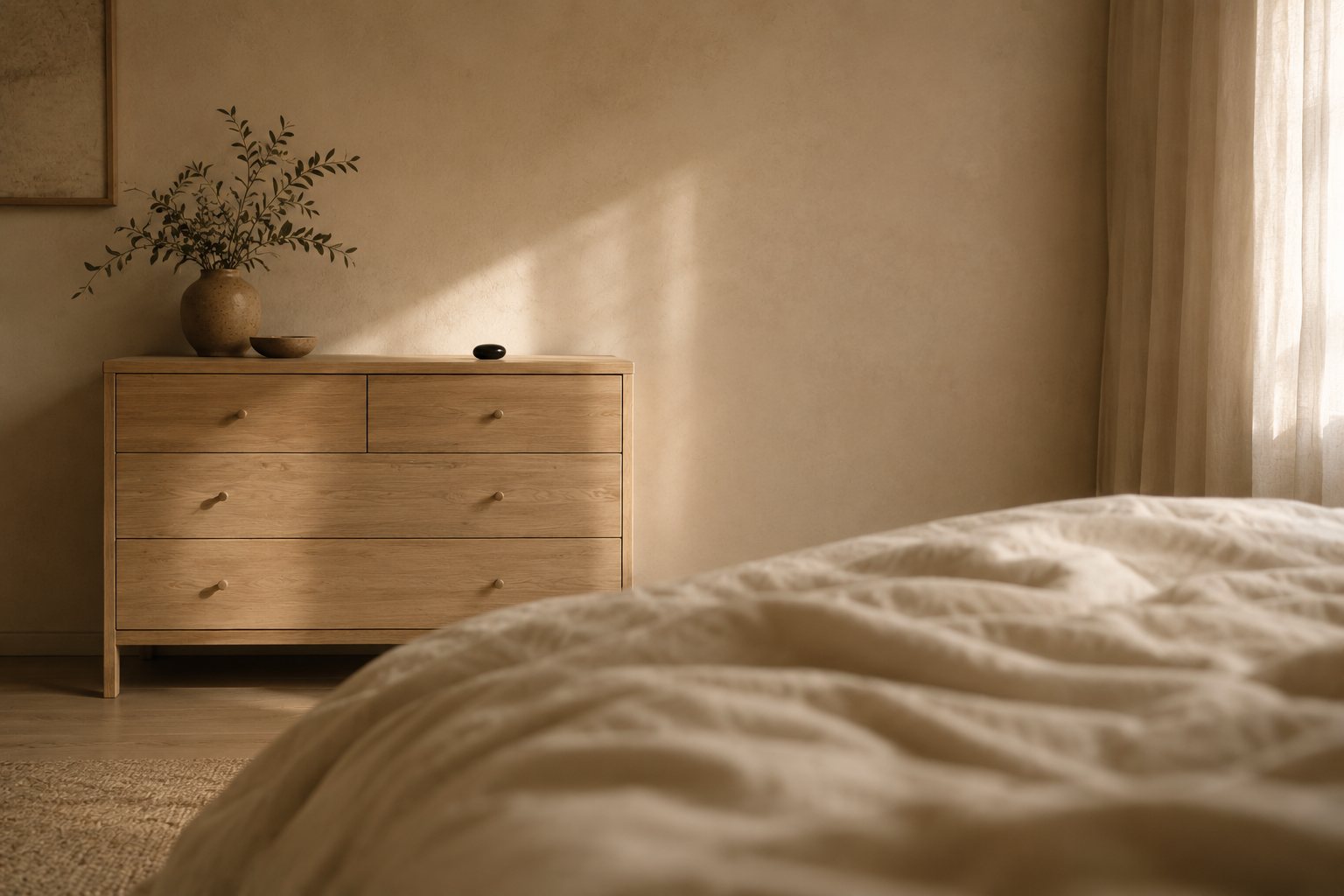
If you'd still like to keep your obsidian within reach overnight, it all comes down to distance from the body. Here are the placements people use, from closest to furthest, and what I make of each:
| Placement | Distance | What's said | My take |
|---|---|---|---|
| Under the pillow | 0 cm | The most common advice | Avoid |
| Under the mattress | 20-30 cm | The "toned-down" version | Still too close |
| Bedside table | 40-60 cm | A common compromise | Fine if you already sleep well |
| Foot of the bed, on the floor | 1.5-2 m | Recommended for sensitive sleepers | The best compromise |
| Outside the bedroom | , | Rarely suggested | What I recommend to start |
Good to know, this table isn't a measured scale. The distances are practical markers carried over from common use, not verified thresholds. Treat them as a progression: start far away, and only move closer if all is well.
One last thing that's often overlooked: in practice, a stone kept continuously near the bed needs cleansing and charging more often than most. And if you're not yet sure how to clean it without damaging it, my obsidian cleansing guide covers exactly that.
The stones people prefer for sleep
Since black obsidian isn't built for this, it's worth saying what is. Here are the four stones most often recommended for the bedside, only one of which comes from the obsidian family.
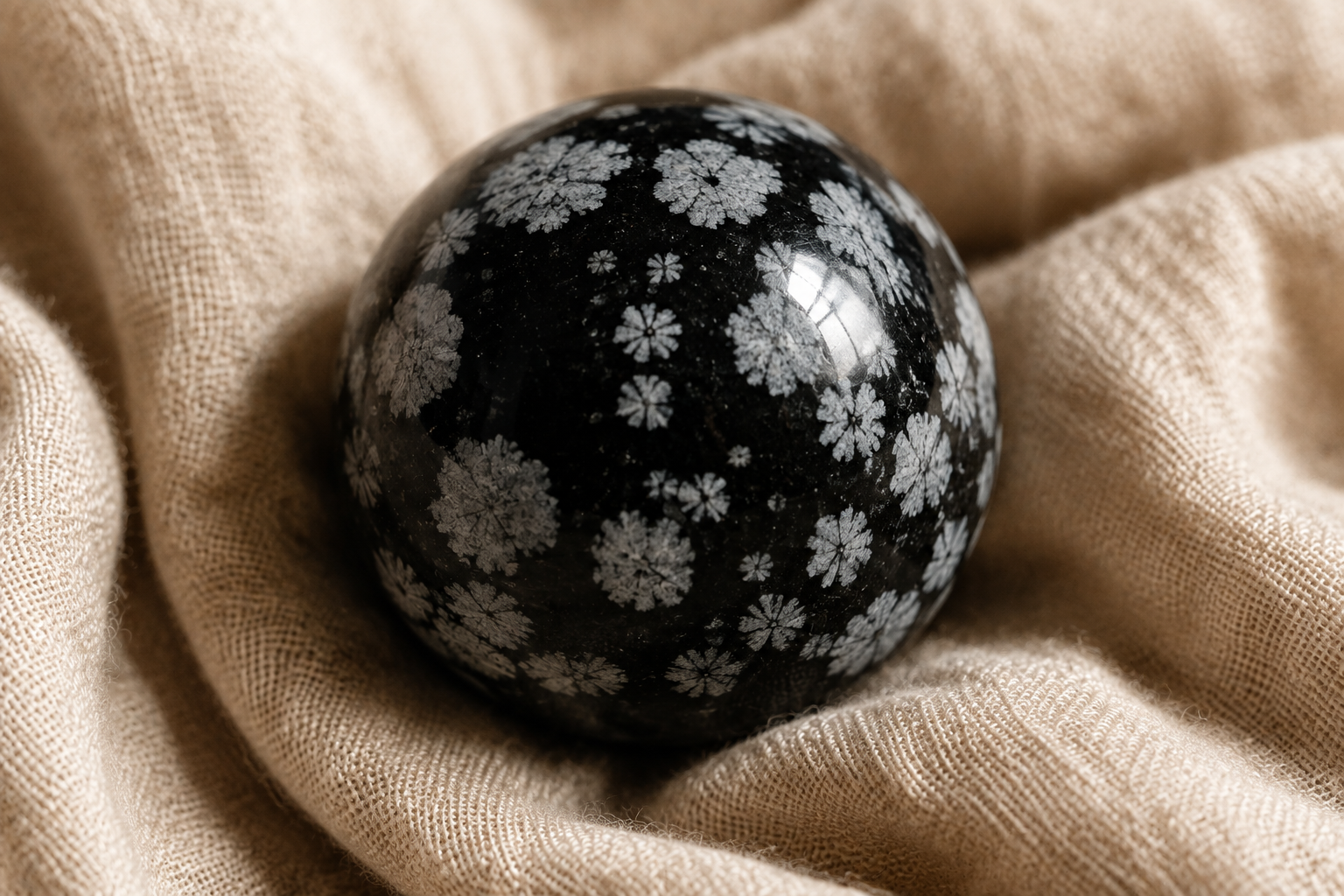
Snowflake obsidian
The only obsidian I keep by my own bed.
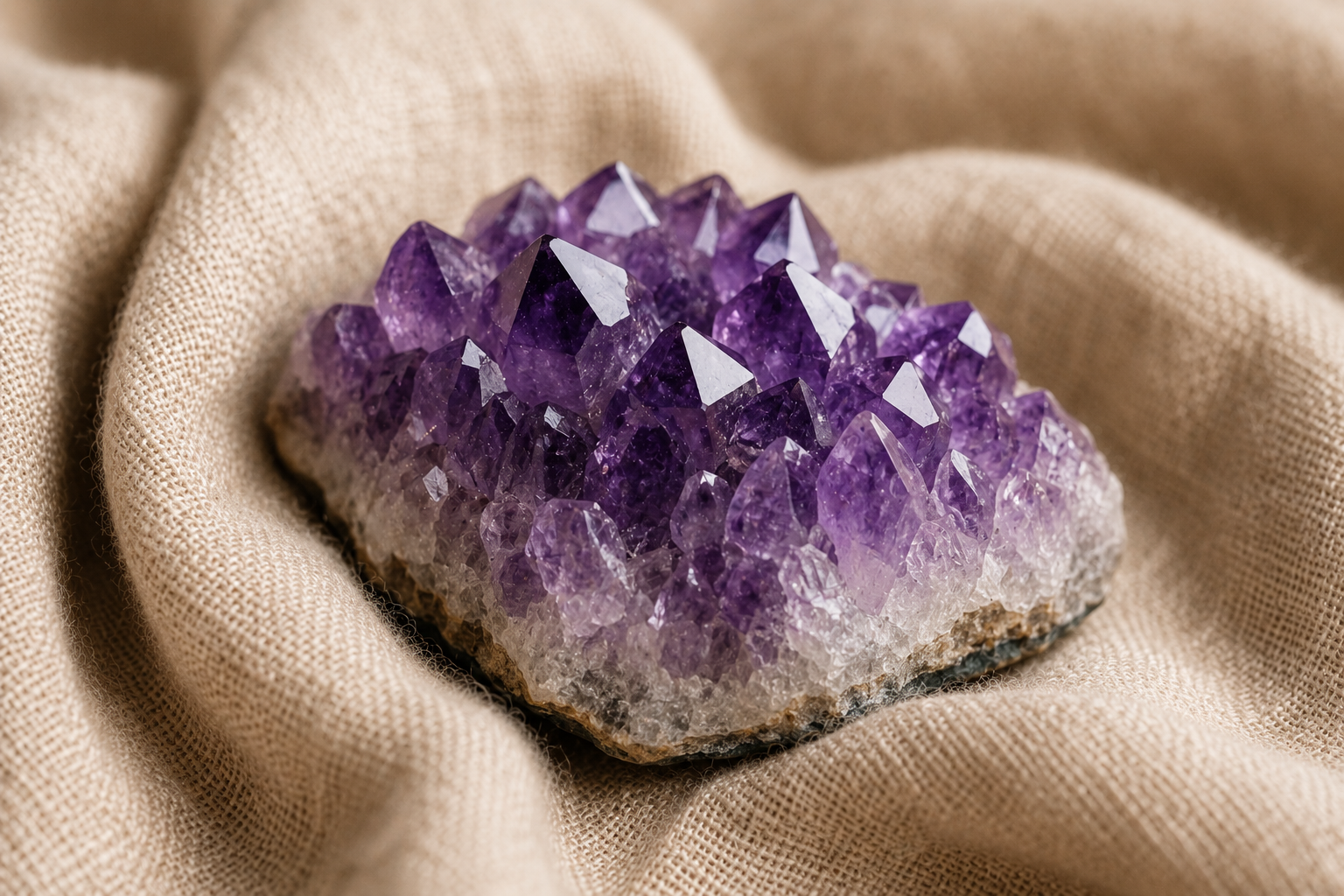
Amethyst
The traditional go-to for sleep.
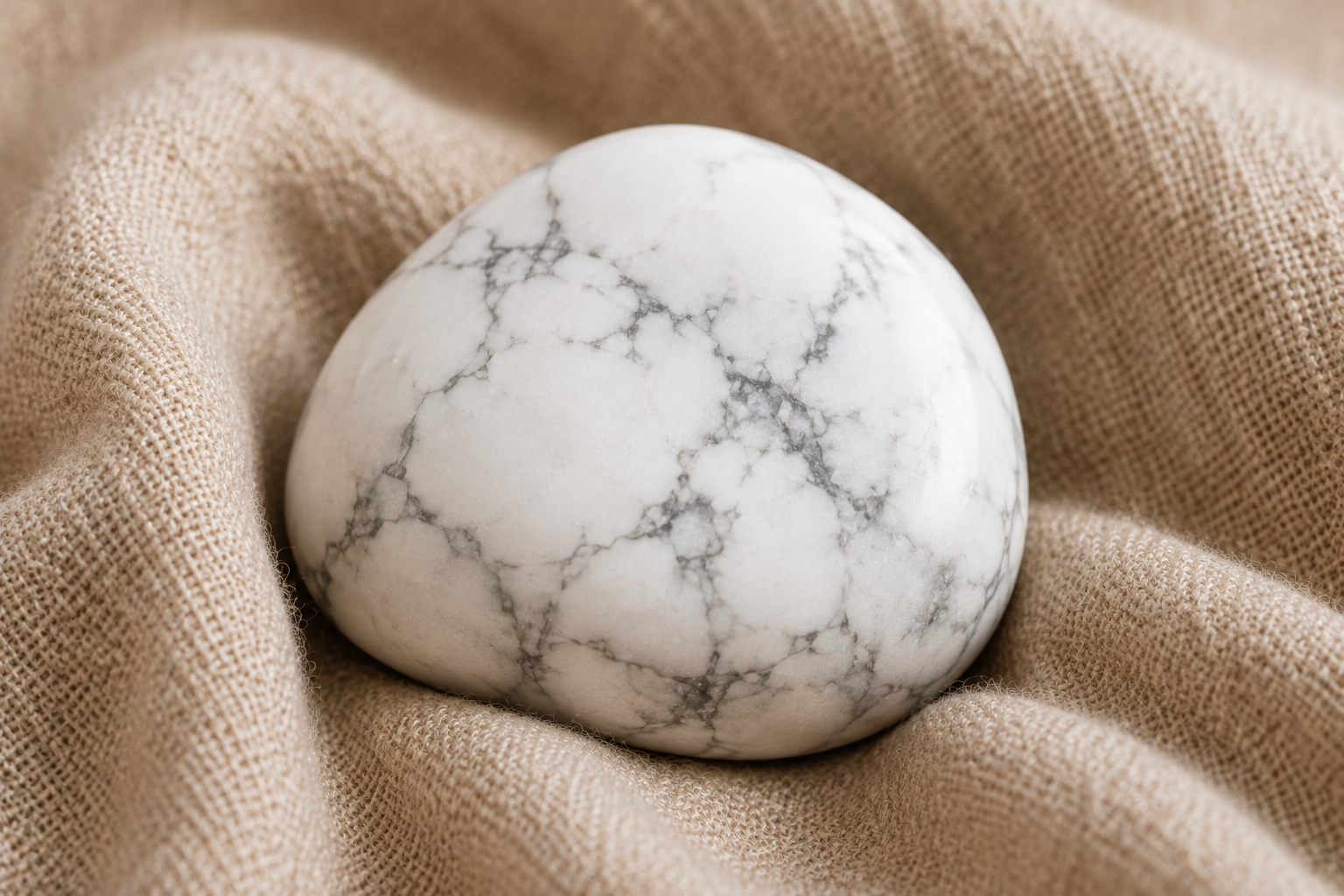
Howlite
For a mind that won't switch off.

Lepidolite
Favoured for restless nights.
Snowflake obsidian, the one exception in the family
Black speckled with white from cristobalite crystals, snowflake obsidian is described as the most soothing stone in the family. Where black obsidian confronts, this one is associated with reconciliation and acceptance. It's the one I recommend to anyone who really wants an obsidian by the bed: same volcanic origin, without the same intensity.
Amethyst, the reliable choice
It's the sleep stone par excellence in Western tradition, to the point that it shows up in almost every bedside recommendation. It's credited with calming the mind and keeping rumination at bay. If you were only going to try one, this would be it.
Howlite, for a racing mind
White veined with grey, howlite is associated with slowing down thoughts. It's often recommended to people who have no trouble feeling tired, but can't quite "switch off" once they lie down.
Lepidolite, for restless nights
Mauve and pearly, it's traditionally linked to emotional calm. It's the choice offered during tense periods, when it's feelings rather than thoughts keeping you awake.
These stones also pair very well with obsidian during the day: that's the whole idea behind crystal pairings, softening a blunt stone with a gentler one.
People sometimes ask why I recommend stones I don't sell. Because doing the opposite would be absurd: if you're after better sleep and I sell you a black obsidian, you'll come back disappointed, and rightly so. I'd rather you come back for a daytime bracelet instead.
That said, if you really do want an obsidian in the bedroom, it's worth choosing the gentlest one in the family. Here are a few of the softer pieces from the studio, blue-violet sheen, golden veil, rainbow iridescence, varieties whose intensity is softened by the light they let through.
Should you take off your obsidian bracelet to sleep?
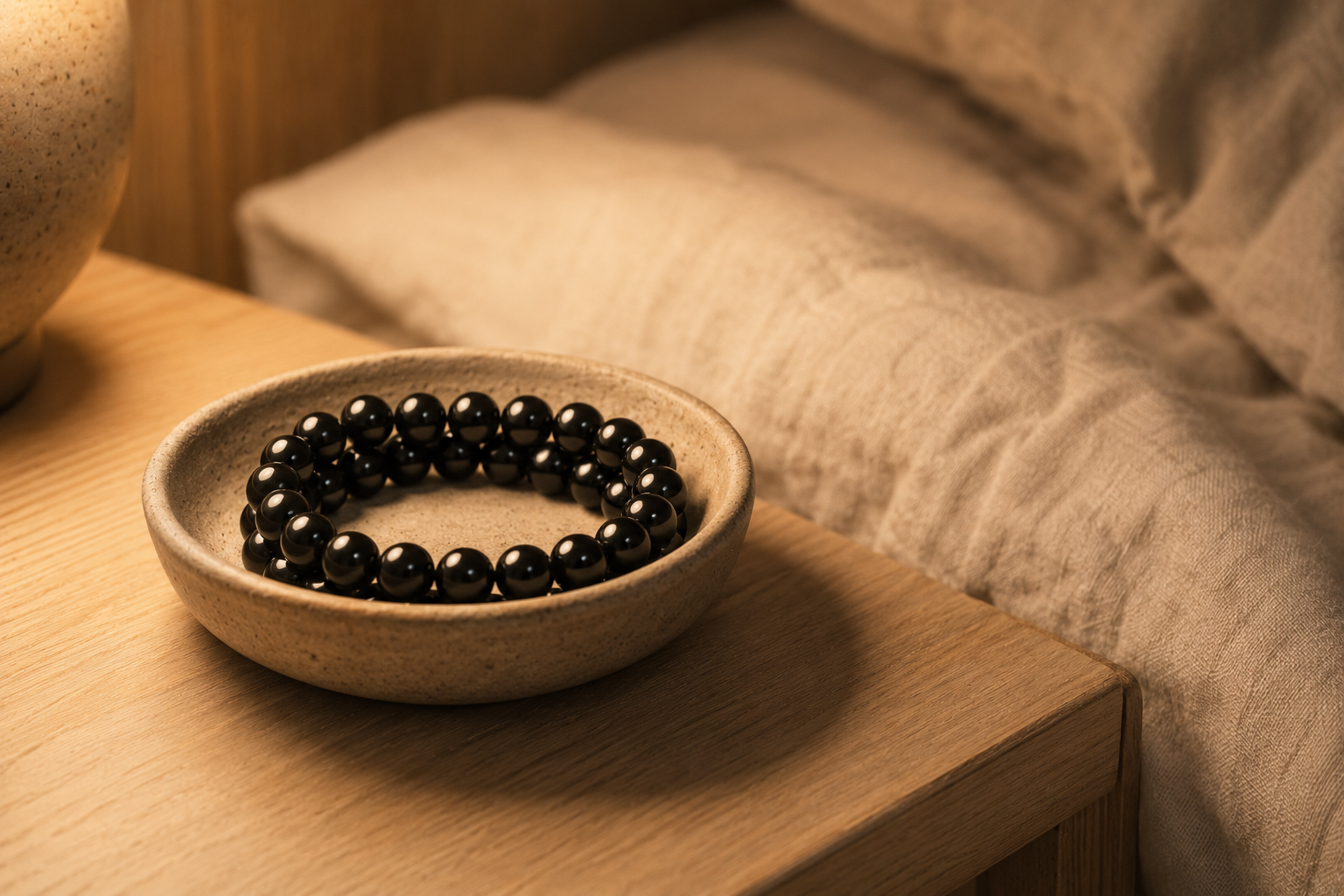
Yes, and this time, for two reasons that have nothing to do with energy.
The first is energetic, in the traditional sense: a black obsidian bracelet means the stone is in constant contact with your skin, eight hours straight. That's the closest placement there is, closer even than under the pillow. Everything said about the stone left nearby applies here, only more so.
The second is purely practical, and it's the one I repeat most often in the studio. Obsidian is a volcanic glass: between 5 and 5.5 on the Mohs scale, it scratches easily and doesn't handle knocks well. A night's sleep means dozens of small knocks against the bed frame, the headboard, your own body. And on a bracelet strung on elastic cord, the cord takes the hit first, overnight perspiration wears it down far faster than you'd expect.
The simple habit: take off your bracelet each evening and always put it in the same spot, a dish or a fabric pouch. It also saves you hunting for it in the morning. For everything else on care, see cleaning and caring for obsidian; and if you're still unsure about wrist size, the jewellery size guide is there to help.
✦ The gentlest pieces in the studio
If you'd still like an obsidian by the bed
Loading creations…
If you're new to this stone and wondering what it actually adds to everyday life, I've covered all of that in the benefits of an obsidian bracelet. And for the full picture, origin, varieties, properties, care, it's all gathered in the complete obsidian guide.
Precautions & good practice
Three simple rules if you still want to give it a try. Start far away: outside the bedroom for the first few nights, then move a step closer each week if all goes well. Change only one thing at a time: if you introduce the stone the same night you switch pillows or shift your schedule, you'll never know what actually made the difference. Stop without hesitation if your nights get worse: no wellbeing practice is worth pursuing against your own sleep.
And keep in mind that obsidian is said to be a stone you ease into gradually, true during the day, even more so at night. The topic is covered in obsidian, dangers and precautions, and the guided practice in my obsidian meditation article, which remains the right setting to work with it: awake, for a few minutes, with intention.
Good to know, the properties and correspondences described here come from spiritual traditions and crystal healing, a wellbeing practice based on belief. They are not a medical claim, do not treat any condition, and never replace advice from a health professional. Persistent sleep problems call for medical advice.
Frequently asked questions
Can you sleep with black obsidian?
Should black obsidian go under the pillow?
Does black obsidian cause nightmares?
Which obsidian can you keep near the bed?
Should you take off an obsidian bracelet to sleep?
Which stone should you use instead for better sleep?
How long before you know if it suits you?
Obsidian is worn by day
Bracelets, necklaces, pendants and rings in natural obsidian, handmade in France, worn morning to night, and set down for sleep.