Fire Obsidian, the Rarest of the Obsidians
Flashes of flame-red, gold and emerald green that seem to burn beneath the surface of a black glass: fire obsidian is the most sought-after variety in the family, and by far the hardest to come by. Here is the physics behind its fire, why it comes almost exclusively from one corner of Oregon, and what to know before buying one.
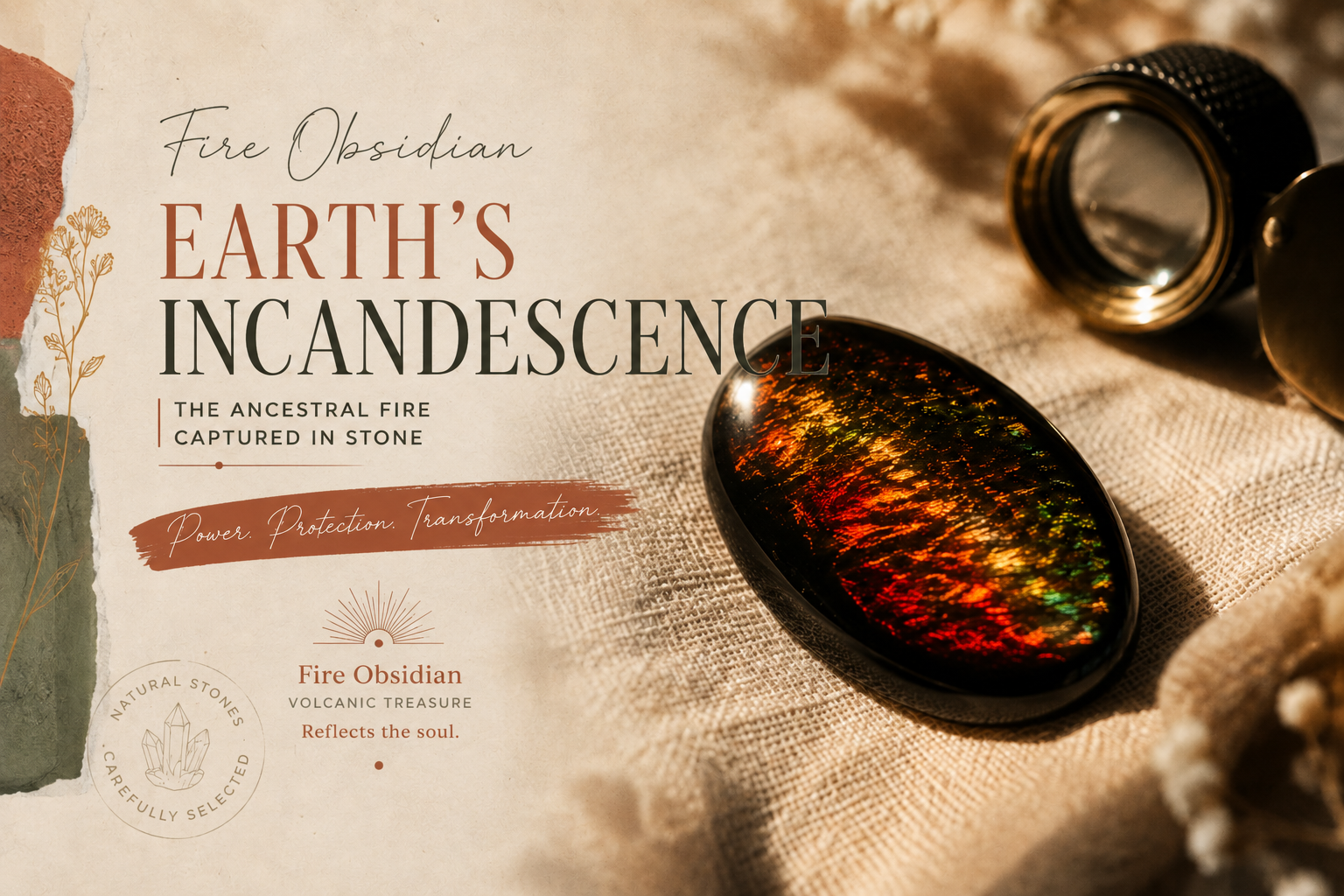
What is fire obsidian?
Fire obsidian is a variety of black obsidian showing iridescence of an intensity unmatched anywhere else in the world of volcanic glass. Flame-red, gold, emerald green, sometimes deep blue: the colours are saturated, metallic, and seem to come from within the stone.
Where other obsidians show a veil or a sheen, this one gives the impression of a fire smouldering beneath the surface. The comparison that comes up most often is black opal, or a morpho butterfly's wing.
It is also the most confidential of all the varieties. You will almost never come across it in ordinary jewellery: it circulates mainly among collectors and lapidaries, as individually cut cabochons. See where it sits among the others in my guide to the types of obsidian.
I don't work with it in the workshop, and I would rather say that plainly. Good pieces are rare, expensive, and cutting them takes a lapidary's skill I don't have. But I held one once, at a mineral fair. You understand at once why it fascinates people.
The physics behind its fire
The mechanism is the same as in rainbow obsidian, but pushed to an extreme.
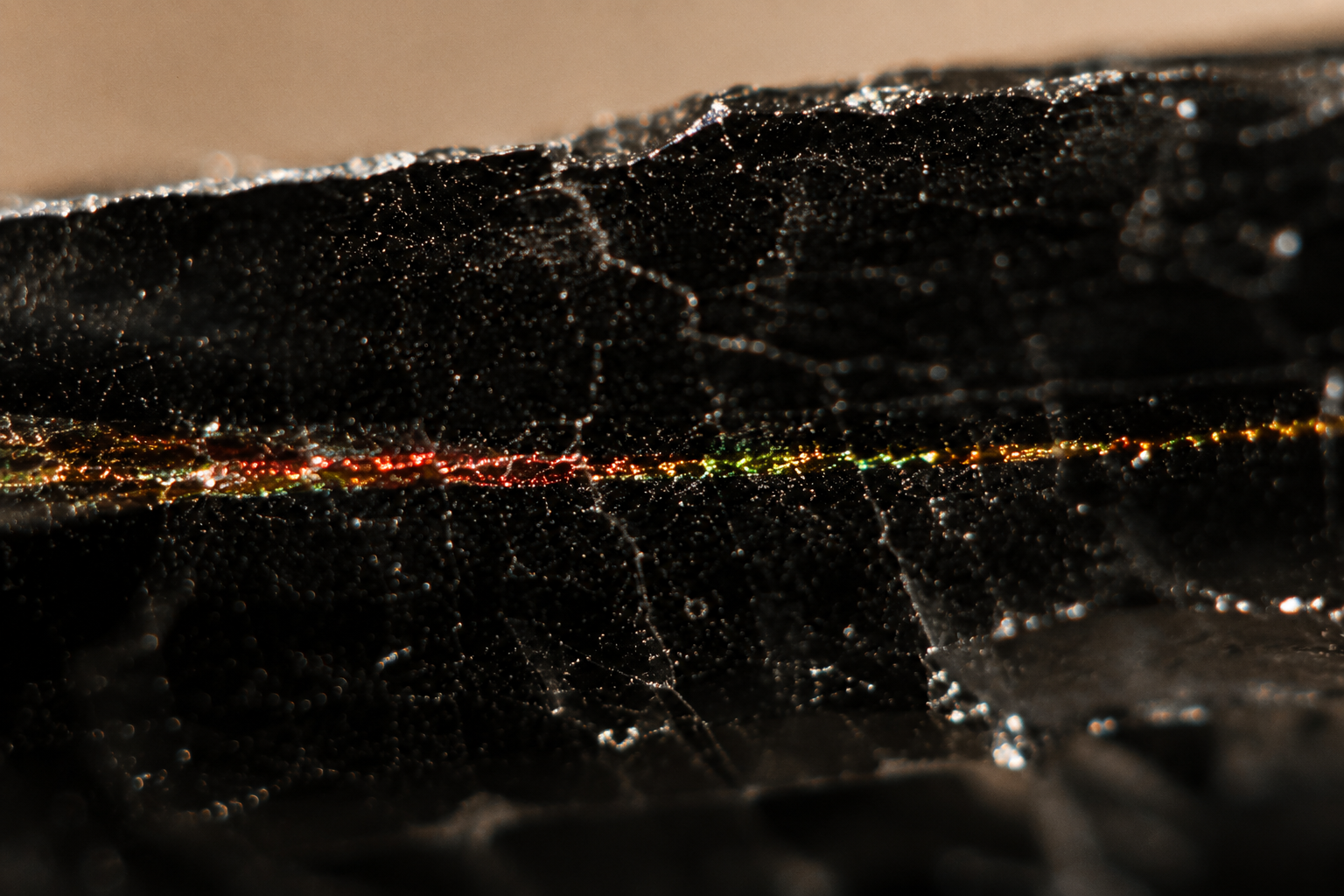
As the lava cools, magnetite nanoparticles, an iron oxide, organise themselves into layers within the glass. When light meets these layers, it reflects off both the top and the bottom: the two waves recombine, some wavelengths cancel out, others are reinforced. This is known as thin-film interference, exactly the phenomenon that colours a soap bubble or a film of petrol on water.
What sets fire obsidian apart is the fineness and regularity of these layers. The thinner and more uniform the layer, the more saturated the colours and the more sharply they shift as you tilt the stone. In rainbow obsidian, the layers are thicker and less regular, giving broad, soft bands. In fire obsidian, you get patches of pure colour, like molten metal.
For how obsidian forms in general, see my article on how obsidian is formed.
Fire or rainbow: how to tell them apart?
Many sellers use the two names interchangeably. That is not correct, and the price gap is considerable.
Fire obsidian
Saturated, metallic colours, in patches or swirls. Red, gold, vivid green. The effect often covers a limited but dazzling area.
Rainbow obsidian
Softer, more widespread iridescence, in concentric bands. Green, purple, deep blue. The effect runs across the whole stone but stays understated.
| Criterion | Fire obsidian | Rainbow obsidian |
|---|---|---|
| Intensity | Highly saturated, metallic | Soft, satiny |
| Pattern | Patches, swirls, blotches of colour | Regular concentric bands |
| Dominant palette | Red, gold, emerald green | Green, purple, deep blue |
| Origin | Almost exclusively Oregon | Mainly Mexico |
| Availability | Rare, individual cabochons | Common, beads and jewellery |
| Price | High to very high | Affordable |
Good habit, if you are offered a bead bracelet labelled "fire obsidian" at an ordinary price, it is almost certainly rainbow obsidian. Genuine fire obsidian is sold as one-off pieces, hand-cut, and rarely as strung beads.
A near-unique deposit in the world
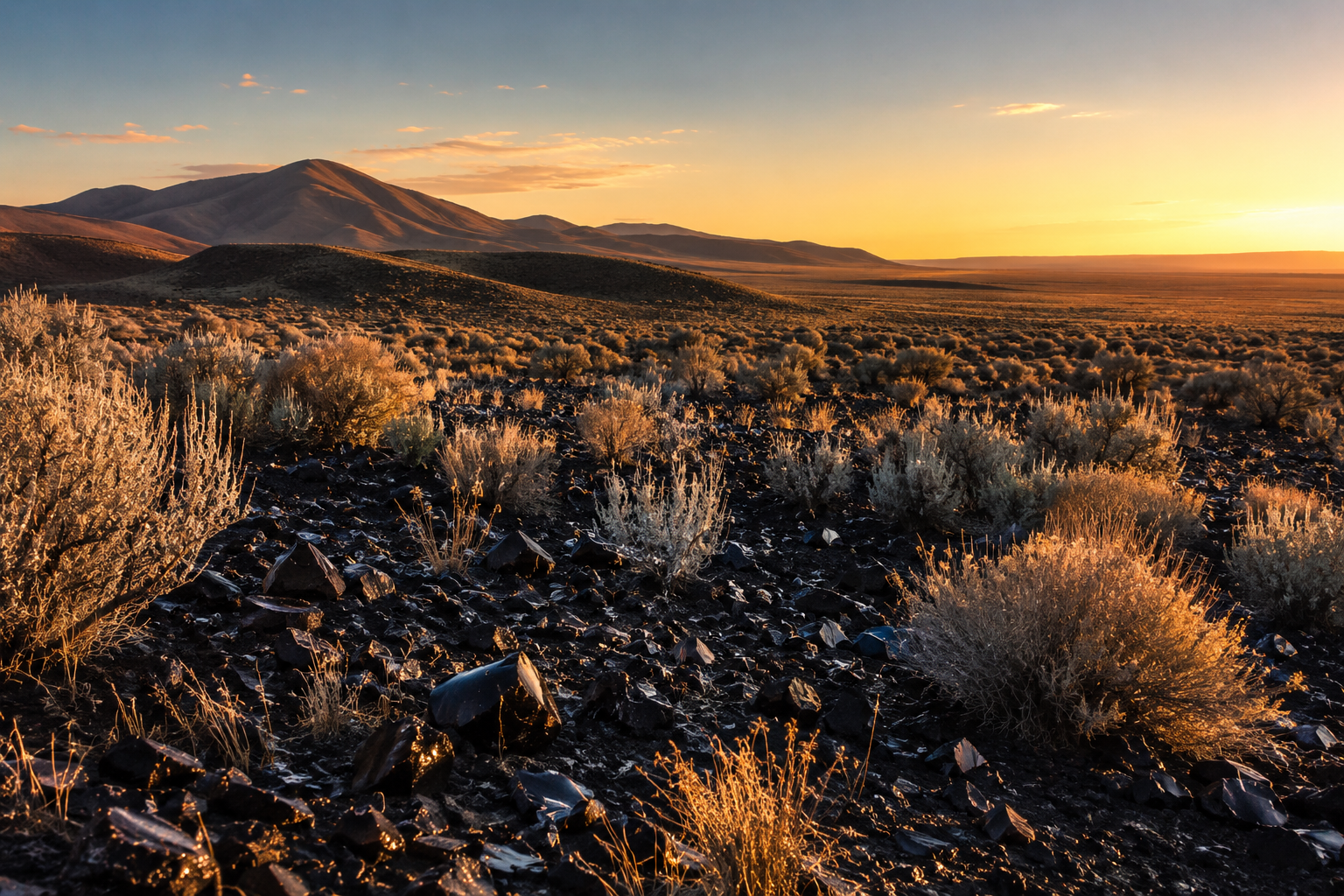
This is one of the most remarkable facts about this variety: it comes almost exclusively from Oregon, in the United States, and mainly from the Glass Buttes area, a cluster of volcanic domes in the centre of the state.
This area has long been known for the diversity of its obsidians, black, mahogany, rainbow, flecked. But the very particular conditions that produce fire, those extremely fine magnetite layers, occur only in certain flows, and only in patches within them.
A few other Oregon localities produce some occasionally, and there are scattered reports elsewhere in the world. Nothing comes close, in quantity or in quality, to what this corner of Oregon produces. This geographic concentration largely explains the stone's rarity, and why the best pieces often stay in the United States.
Why it is so rare and so expensive
The limited deposit only explains part of the price. The rest comes down to something few people know: fire obsidian is extremely difficult to cut.
The magnetite layer that produces the fire is buried within the glass, at a depth that varies unpredictably. To reveal the colours, the lapidary has to grind the stone until reaching exactly that layer, and stop right there.
- Too little ground away, the fire stays buried, the stone looks black;
- Too much ground away, the layer is cut through and destroyed. The fire is gone for good;
- Badly oriented, since the layer is not flat, a flat surface only reveals a fraction of it. You have to follow its curve.
An experienced lapidary works effectively blind, stopping constantly to check under the light. The loss rate is considerable: a large share of blocks will never yield a good piece. And an error of a few tenths of a millimetre wastes hours of work.
It is this combination, a rare deposit, a perilous cut, a niche skill, that places fire obsidian right at the top of the price scale. To see where the other varieties sit, see my guide to obsidian price and value.
I find that idea of a layer to be reached exactly quite dizzying. The cutter doesn't know what lies beneath. They move a hair's breadth, check, move again. And at some point, the colour appears, or it doesn't.
The properties credited to fire obsidian
Here, an honest clarification is needed.
Worth knowing, fire obsidian was only identified and named as a distinct variety recently, as Oregon lapidaries learned how to reveal its effect. It therefore has no ancient tradition in crystal healing. The "ancestral properties" sometimes credited to it on certain sites were invented in the last few decades, by analogy with its colour. That does not make them uninteresting, but it is worth knowing where they come from.
That said, the correspondences credited to it today follow logically from its appearance:
- passion and life force, by direct analogy with fire;
- courage and the will to act, in line with red stones generally;
- transformation, a theme common to all obsidians;
- creativity, often cited for its many colours.
As for chakras, it is generally linked to the root chakra, as with any obsidian, and to the sacral chakra, or even the solar plexus for its fiery tones. The full map is in my guide to obsidian and chakras.
If it is this warm energy that draws you, mahogany obsidian and gold sheen obsidian carry similar correspondences, with a more established tradition and a price in an altogether different league.
Buying fire obsidian without being caught out
This is the variety most exposed to sharp practice, precisely because it is expensive and poorly understood. Three traps come up again and again.
1. Rainbow sold as fire
The most common, and rarely dishonest: many sellers genuinely confuse the two. Trust the intensity. Fire gives saturated, almost metallic colours, with red and gold. Rainbow stays within satiny greens and purples.
2. Iridescent glass
Imitations in manufactured glass do circulate. The marker stays the same as for all obsidians: the base must be black and opaque, never translucent and coloured throughout. And the stone should be cool to the touch.
3. The "aura" coating
Ordinary black obsidians coated with a metallic film through vacuum treatment. The film is shiny but sits on the surface: the iridescence does not move as you turn the stone, and the pattern is uniform. Genuine fire shifts and changes as you tilt it.
Three questions worth asking a seller: where does the stone come from (a solid answer mentions Oregon), is it a one-off, hand-cut piece, and can you see a video of the stone in motion. That last one is decisive, a still photo proves nothing.
Mineralogical fact sheet
- Nature
- Natural volcanic glass (mineraloid, amorphous)
- Other names
- Fire obsidian
- Colour
- Opaque black with red, gold, green and blue iridescence
- Source of the effect
- Thin-film interference across magnetite layers
- Composition
- Silicon dioxide (SiO₂), magnetite nanoparticles
- Hardness (Mohs)
- Around 5 to 5.5
- Structure
- Amorphous (no crystal lattice)
- Main deposit
- Glass Buttes and surrounding area, Oregon (USA)
- Commercial form
- Individually cut cabochons, rarely beads
- Chakras
- Root, sacral, solar plexus
- Age of the tradition
- Recent: variety identified within the last few decades
Care and cleansing
A piece of fire obsidian needs more care than an ordinary obsidian, for a purely material reason: its effect depends on a layer sitting just below the surface. Wear to the polish, and the fire fades.
- Cleaning, a soft, dry cloth only. No products, no abrasive microfibre;
- Cleansing, smoke is preferable. Avoid soaking, and never use salt, which micro-scratches the surface;
- Charging, moonlight, without prolonged sun exposure;
- Storage, in its own individual pouch, never in contact with other stones;
- Wearing, avoid rings and bracelets, too exposed to knocks. As a pendant, the stone is better protected.
The full run-through is in my guides to cleaning your obsidian and to cleansing and charging.
Worth knowing, the properties described here belong to crystal healing, a wellbeing practice founded on tradition and belief. They are not a medical claim, they treat no illness, and they are never a substitute for the advice of a healthcare professional. See also obsidian, dangers and precautions.
Frequently asked questions
What is fire obsidian?
What is the difference between fire and rainbow obsidian?
Where does fire obsidian come from?
Why is fire obsidian so expensive?
How can you recognise genuine fire obsidian?
Does fire obsidian have traditional properties?
Can you find jewellery in fire obsidian?
My obsidians with a shimmer
Gold sheen, rainbow, celestial eye, mahogany: stones with a sheen, handmade in my workshop in France.