
Description
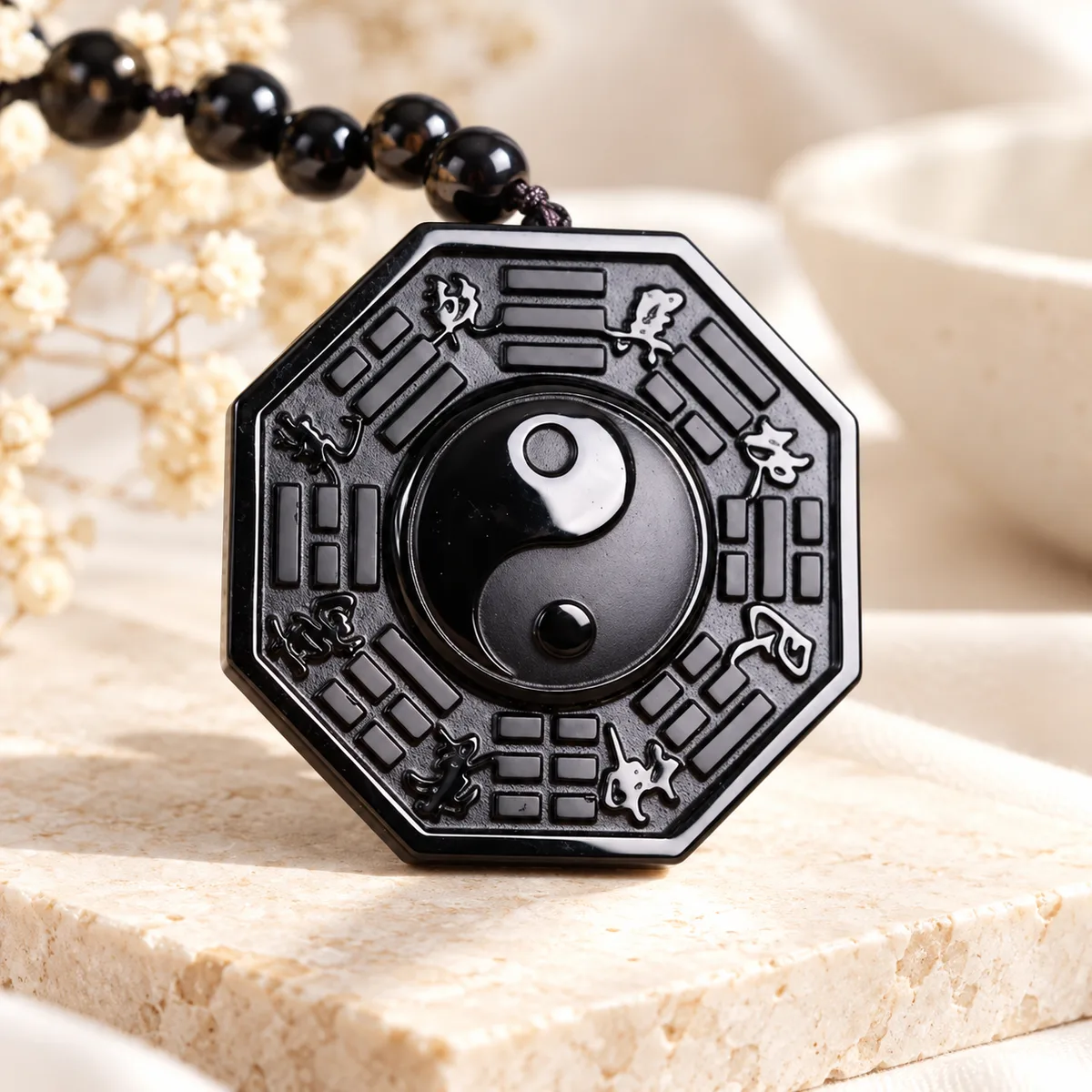
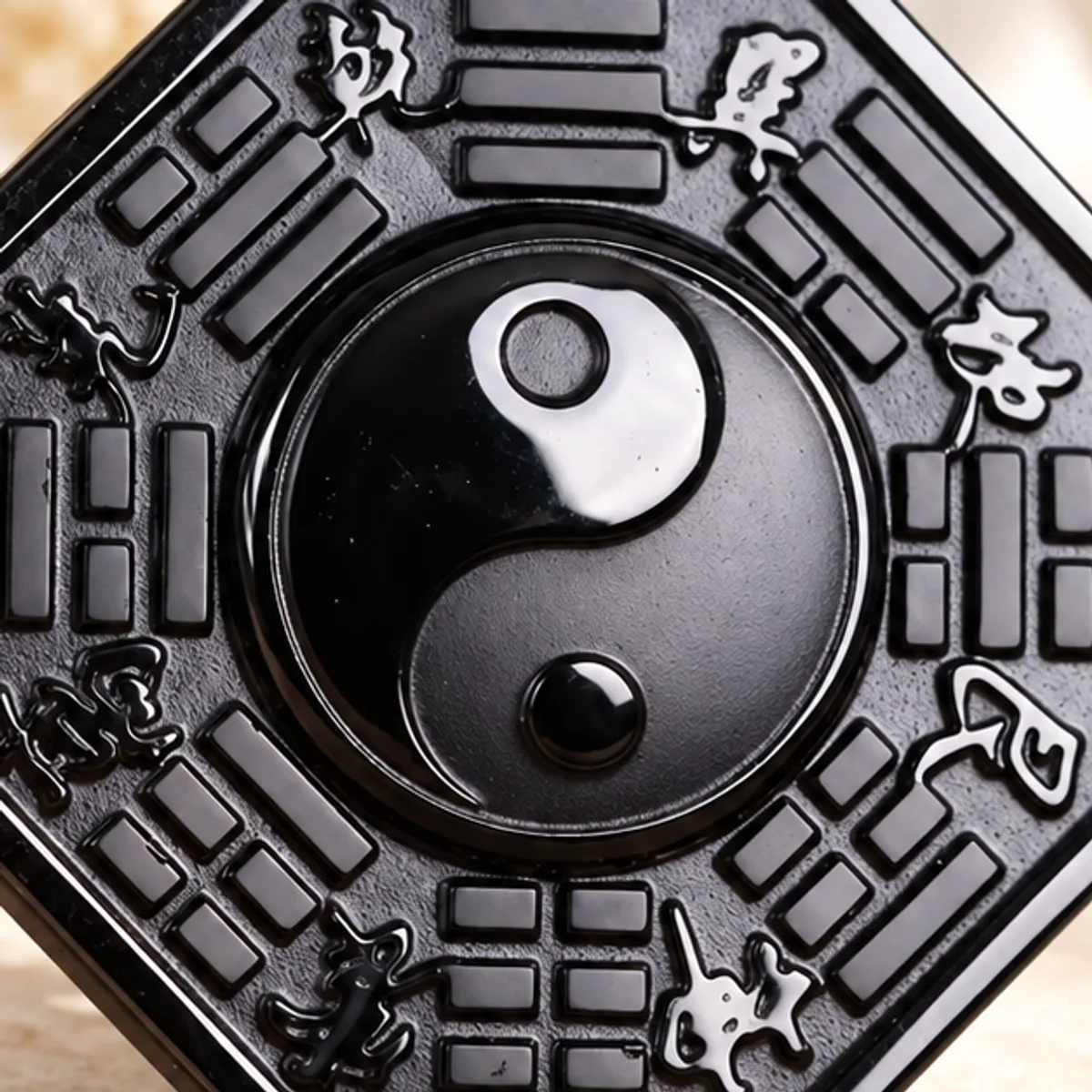
An obsidian octagon carrying the eight trigrams engraved in intaglio, one per side, around a central yin yang. The outer shape is not decorative: it follows the diagram, eight sides for eight trigrams.
The bagua is the diagram of the eight trigrams, each made of three lines, solid or broken, and it is traditionally shown within an octagon. Here the stone itself takes that shape, which is not always the case: many baguas are engraved on a round disc, and the relationship between the figure and its support is lost. I describe the figure, I do not interpret it: that belongs to a living tradition.
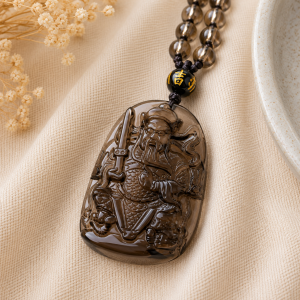
The catalogue also offers a round bagua, surrounded by a dragon and a phoenix carved in dense relief. This one is its opposite: nothing but geometry, lines cut in intaglio, flat surfaces, no figures. The first one gets noticed, this one gets read. If you are after the figure without the display, this is the one. Both are here.
The reservation lies in the eight corners. Every vertex of the octagon is a projecting point, and on a volcanic glass a projecting point is a breaking point: a knock against a belt buckle chips a corner, and on a regular shape a chipped corner shows immediately because the eye compares it with the other seven. The vertices are softened in the making, which protects them without rounding the shape.
Crystal lore ties obsidian to grounding. The bagua belongs, for its part, to Chinese cosmology and not to crystal lore. None of the above is proven, and no piece of jewellery heals anything. I have gathered separately what tradition attributes to obsidian, in the conditional.
- Genuine black obsidian, octagon with the eight trigrams engraved in intaglio.
- The shape follows the diagram: eight sides for eight trigrams.
- Vertices softened in the making: eight sharp corners would be eight breaking points.
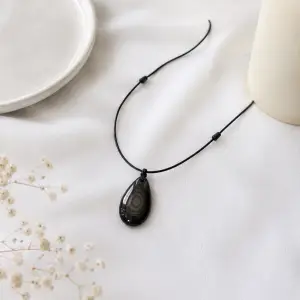
- A chain of obsidian beads, not a metal chain.
What to know before you wear it
 |  |  |
The specifications
- Stone
- Black obsidian, volcanic glass
- Shape
- Octagon, trigrams engraved in intaglio, central yin yang
- Dimensions
- About 42 mm / 1 5/8 in
- Setting
- None, stone drilled and knotted
- Chain
- Obsidian beads strung on cord
- Gender
- Unisex
- Brand
- Bijoux Obsidienne

Eight sides that must all be the same length
On an octagon, the flaw that jumps out is neither the engraving nor the polish, it is the length of the sides. Eight sides must be exactly the same length, and half a millimetre out on one of them distorts the whole figure: the eye reads the octagon as slightly squashed without being able to say where. The check is not done with a rule but with a compass, stepping the same opening eight times around the piece. If the compass does not land back on its starting point, the shape goes back to the wheel.
This piece exists because the catalogue’s carved bagua is busy, and many people are after the diagram alone. Reducing a figure to its geometry is not impoverishing it, it is making it legible. Both baguas are here and the obsidian guide explains the stone.
You step the same compass opening eight times. If it does not land back on its starting point, the shape goes back to the wheel.
Obsidian does not mind water, but the eight corners chip on impact. Take the pendant off before sport and do not wear it under a belt. The engraved lines hold dust: a soft brush under lukewarm water twice a year is enough. Never an ultrasonic bath. Cleaning an obsidian piece covers the rest.