How to Wear a Black Obsidian Necklace
My short answer: start by looking at what's actually at the ends of your fingers. The word "necklace" covers two very different pieces, a strand of obsidian beads, or a single stone hanging from a chain, and they're worn in completely different ways. Length, weight, necklines, cord care: everything changes. Here's how to wear a black obsidian necklace depending on which one you have.
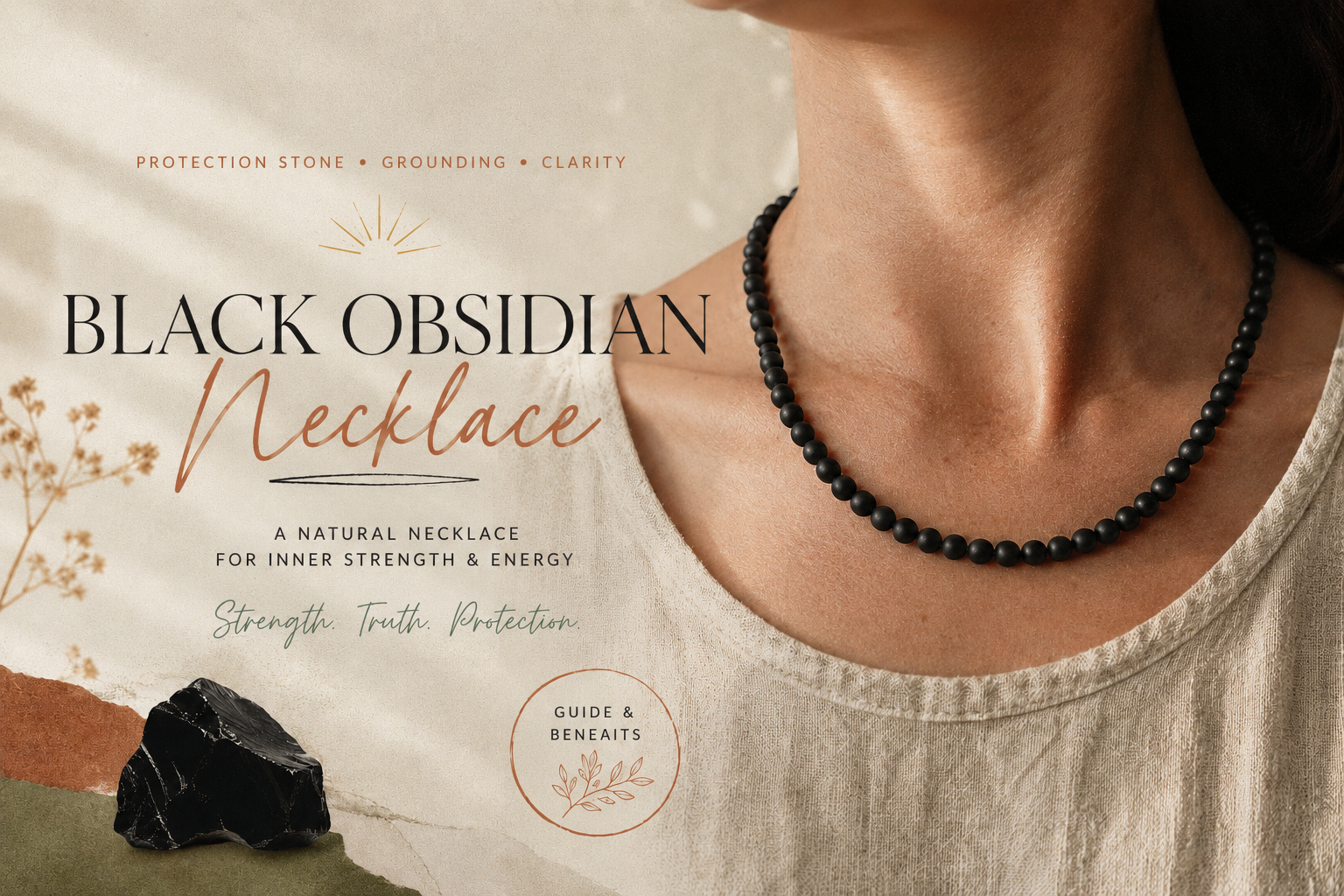
Two pieces under one word
This is the mix-up that ruins the most purchases, and nobody takes the time to clear it up. Search for "black obsidian necklace" and you'll indiscriminately find two pieces of jewelry that have almost nothing in common.
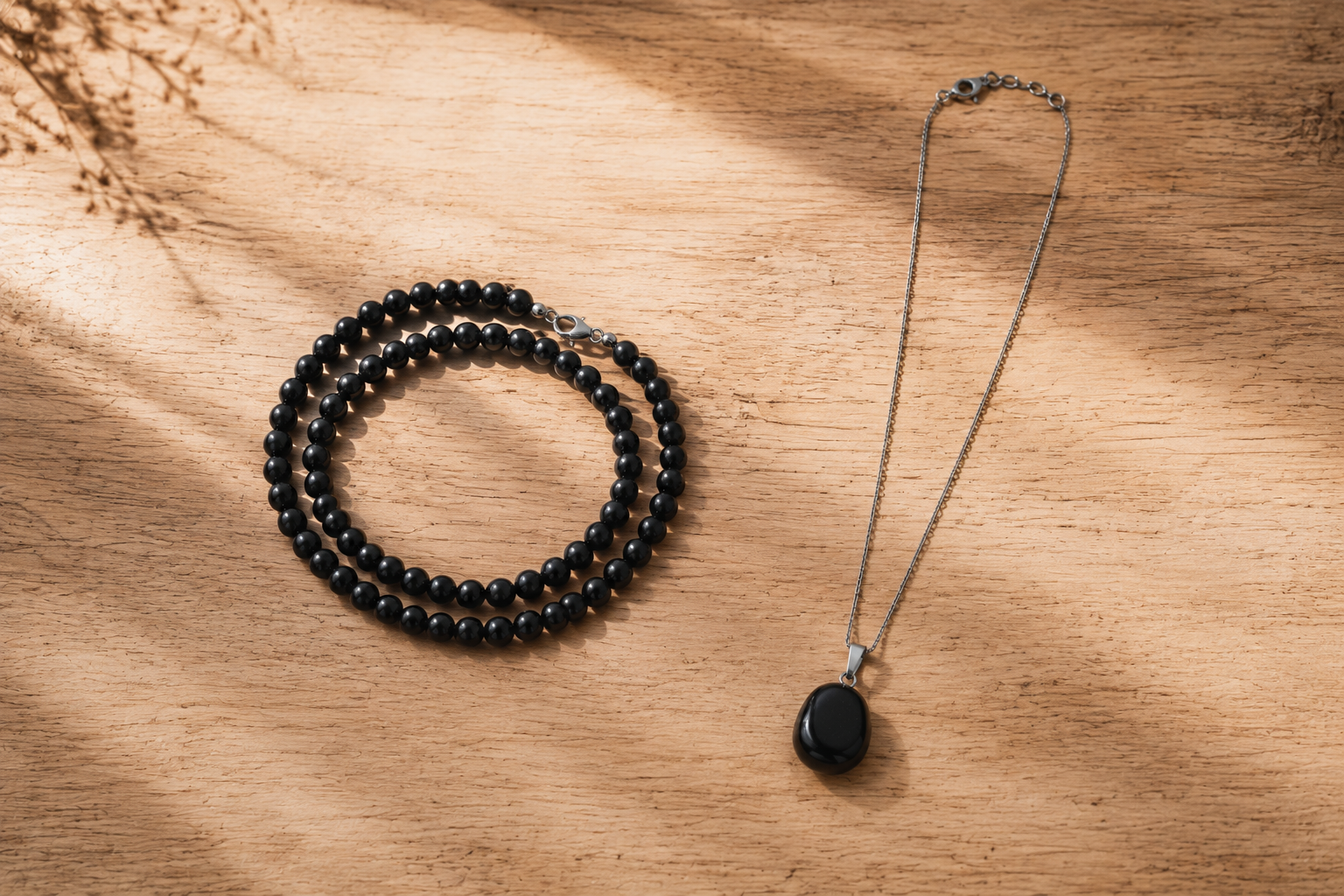
The beaded strand
Forty to sixty obsidian beads strung on a cord, with a clasp. A strong presence, continuous matte black around the neck. But: it's heavy, it's very visible, the cord wears, and the beads rub against each other.
The stone on a chain
A single piece of obsidian hanging from a steel or silver chain. Light, discreet, nearly indestructible, adjustable in length. It's really a pendant, even when the product listing calls it a necklace.
The rest of this article mainly covers the beaded strand, since that's the format that raises real questions about how to wear it. If your piece is a single stone on a chain, the key details live elsewhere: I've written a full guide, how to wear a black obsidian pendant.
A good half of the messages I get about necklaces come from exactly this: someone orders imagining a beaded strand and receives a stone on a chain, or the other way around. Before you click, look at the photo, not the title. The title rarely lies out of malice; it's just imprecise.
The beaded strand: weight and cord
Two physical realities decide everything here, and neither one is mystical.
Weight, first
Obsidian has a density around 2.4. In concrete terms, an 18 in strand of 10 mm beads holds about forty beads and weighs around 55 to 60 grams; the same strand in 8 mm beads runs around 35 grams. Compare that to a typical pendant, which rarely exceeds 15 grams. That's three to four times more weight, resting on your neck all day.
It's not unbearable, but you feel it by the end of the day, especially if you spend it hunched over a screen. If you're torn on bead diameter, go one size smaller: people rarely regret a lighter strand.
The cord, next
On an obsidian necklace, what fails is never the stone: it's the stringing. Three common setups:
- Elastic cord, convenient, but it stretches over time and eventually gives out, often without warning. Best avoided at the neck, where a break scatters fifty beads;
- Nylon or cable wire, with a clasp, the most common setup, and the most reliable for daily wear;
- Silk cord, knotted between each bead, the traditional setup, and by far the best: if the cord breaks, you lose one bead, not the whole necklace. The knots also keep the beads from touching each other.
That last point deserves attention, because it's specific to this stone: obsidian rates about 5 to 5.5 on the Mohs scale, and two obsidian beads can scratch each other since they share the exact same hardness. On an unknotted strand, the beads rub constantly and the polish dulls right where they touch. That's the technical reason for the knots, well before it's about aesthetics.
Careful, I don't make beaded strands for the neck, precisely because of this weight/durability trade-off: I prefer the stone-on-chain format. That's not a judgment on strands, which are gorgeous, it's a studio choice I'd rather stand behind than sell you something I don't believe in.
To understand why obsidian behaves like glass rather than a crystal, see my article on how obsidian is formed.
What length to choose
On a beaded strand, length doesn't work the same way as on a pendant chain: there's no "drop point," the necklace rests along its whole circumference. So the question isn't where the stone falls, but where the loop sits.
| Length | Where the strand sits | Necklines | My take |
|---|---|---|---|
| 16 to 17 in | Choker, at the base of the neck | Open collars, exposed necklines | Very graphic, but tightens the moment you lower your head |
| 18 in | Just below the collarbone | The most universal | The reference length, the one to default to |
| 20 to 22 in | Upper sternum | Sweaters, closed shirts, high collars | The most comfortable in 10 mm beads |
| 24 to 28 in | Plexus, long-line look | Chunky knits, layering | Beautiful, but 80 g at the neck all day |
| Double wrap | Two tight loops | Low necklines, bare backs | Reserve for 6 mm beads |
A useful benchmark: measure your neck circumference with a soft measuring tape, then add 2 in for a comfortable choker, 4 in for a below-the-collarbone fit. Other sizing benchmarks are in my size guide.
If you follow the logic of energy centers, keep in mind that tradition ties black obsidian to the root chakra, so to the lower body: no necklace length will get it there. So pick the length that suits you, not the one that checks a box. The full mapping is in my guide to obsidian and chakras, and if you're actually after a single stone at an adjustable height, everything is covered in the pendant guide.
What necklines to wear it with
Let's say it plainly: a strand of black obsidian isn't a subtle piece of jewelry. The continuous matte black catches the eye and structures the silhouette. It needs a bit of room around it to work.
- Round or boat neckline, plain and light-colored, the best setting. The contrast does all the work;
- V-neck, an 18 to 20 in strand follows the line of the V without fighting it;
- Open shirt collar, a short strand sits between the collar points, a very clean effect;
- Chunky sweaters and knits, go up to 22 in and beyond: a short strand disappears into the fabric;
- Busy prints or black on black, the two situations where the necklace cancels itself out. Save it for another day.
A word on gender, since it comes up often: black obsidian is one of the few genuinely unisex stones, understated and with no connotation. A short strand worn under an open collar is actually a classic of men's jewelry. And if plain matte black feels too severe, rainbow obsidian keeps the same depth with an added shimmer, see also the full range of obsidian varieties.
When to wear it, when to take it off
Crystal healing describes black obsidian as a blunt, sometimes abrupt stone, and treats it more as a daytime stone. Many people report restless nights when keeping it on overnight: these are personal accounts, not measurements, but common enough to take seriously. I've written a full article on this: sleeping with black obsidian.
For a beaded strand, the question settles itself: a heavy necklace worn at night twists, presses against your neck, and pulls on the cord. Take it off in the evening, without a second thought.
- Shower, bath, pool, ocean, water and soap seep into the drill holes of the beads and weaken the cord from the inside, where you can't see it;
- Exercise, the strand bounces against your sternum, and sweat attacks silk;
- At night, for the reasons above;
- Before perfume and lotion, alcohol dulls the polish and stiffens the cord. Get ready first, put the necklace on after;
- In the car, on long drives, the seatbelt rubs exactly where the strand sits.
The rest of the time, wear it without counting the hours. Ten to twelve hours is what most people wearing a protective black obsidian do.
What damages necklaces the most isn't wearing them, it's how they're put away: taken off and dropped in a pile on a dresser, the beads rub against each other all night. Lay it flat in a pouch instead. Three seconds, and the polish holds up for years longer.
What to pair it with
Three topics: the metal of the clasp, layering, and other stones.
The clasp
It's the piece people look at the least, and the one that causes the most trouble. Black obsidian pairs better with cool metals, sterling silver, stainless steel, than with warm gold, which makes it look gray. Above all, avoid cheap alloys: nickel is the leading cause of skin reactions from jewelry, and redness at the back of the neck almost always comes from the clasp, never the beads. A slightly larger lobster clasp is also much easier to work one-handed.
Layering
A strand of obsidian layers well, as long as you don't double up on mass. The rule that works: one strong element only. A short obsidian strand with a longer, thin chain, yes; two beaded strands, rarely. And leave some space between them: a metal chain rubbing against the beads scratches them, exactly as it does on a finger, a topic covered in the ring guide.
Other stones
Tradition commonly pairs black obsidian with:
- tiger eye, the most classic duo, described as protective and stabilizing, covered in a full guide;
- hematite, the same grounding logic, and a metallic gray that pairs well with black;
- rose quartz, to soften a set that obsidian alone would make feel austere.
Certain combinations, on the other hand, are advised against by tradition: details are in my guides to obsidian pairings and crystals not to pair with obsidian. These are symbolic correspondences: if a combination pleases your eye, nothing stops you.
Care, cord, and cleansing
A beaded necklace calls for slightly different care than a pendant: you need to think about the cord as much as the stone.
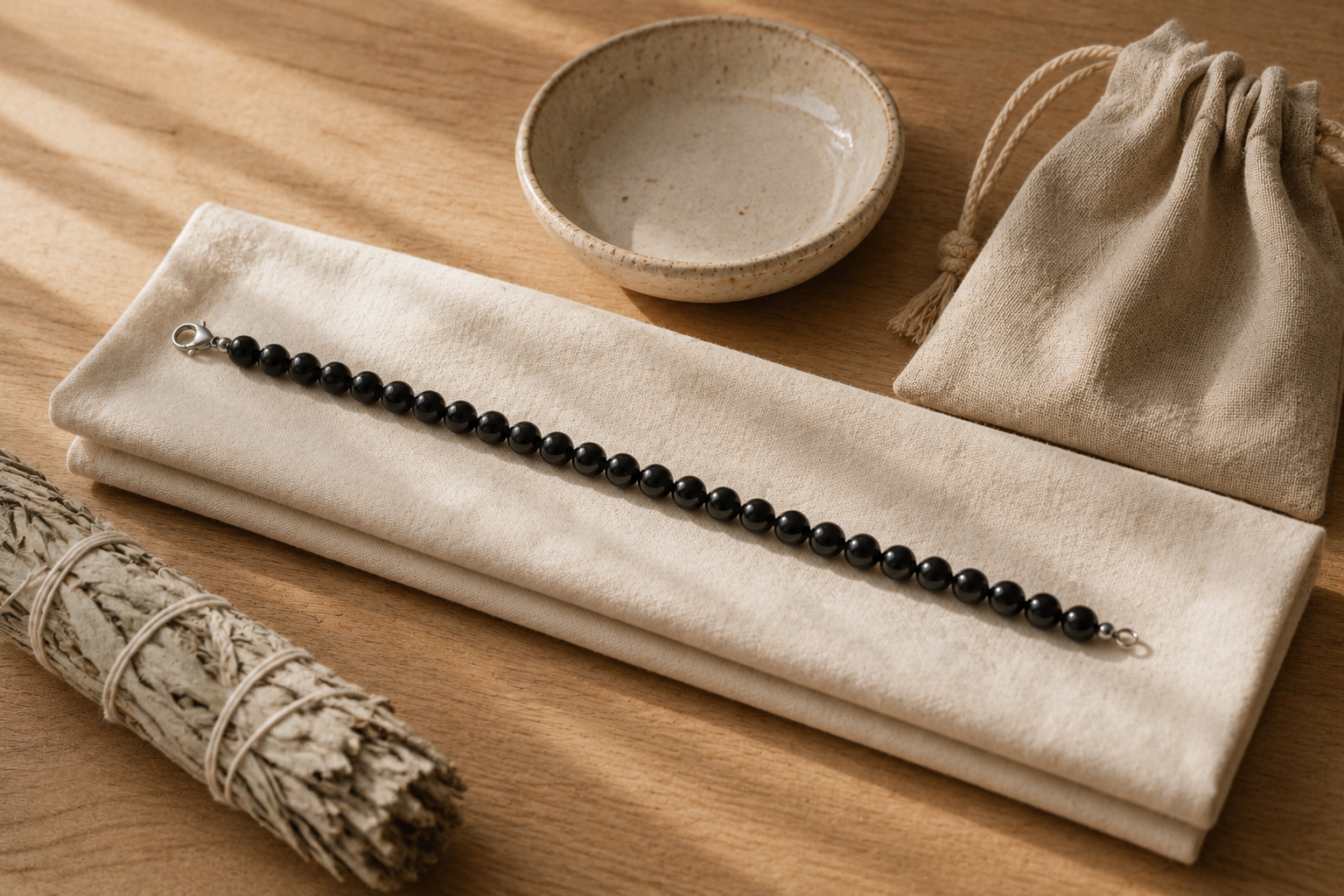
- Every evening, a wipe with a soft, dry cloth over the strand, laid flat. Skin oils build up mostly at the back, on the nape;
- Once a week, a barely damp cloth, never a soak: water that gets into the drill holes of the beads doesn't drain well and rots the cord from the inside;
- Never salt, dry or dissolved: it lodges in the micro-fractures and dulls the surface;
- Never an ultrasonic cleaner, the vibrations spread micro-fractures through volcanic glass and can loosen the knots;
- Re-stringing, for a strand worn daily, plan on re-stringing every two to three years. A cord graying between the beads, or a strand that's grown longer, are the two telltale signs;
- Storage, flat, in a pouch, never hanging: a heavy strand hung on a hook stretches along its full length.
For cleansing, sage or palo santo smudging works well; clear water too, but quickly and with thorough drying afterward. For recharging, moonlight or contact with the earth. Full details are in my guides to cleaning obsidian and cleansing and recharging obsidian.
One last word on what you're buying: black glass sold as obsidian is especially common on beaded necklaces, where the pieces are small and hard to examine closely. The tells to avoid it are covered in obsidian pricing and value. A genuine black obsidian has no reason to be expensive.
And if the beaded strand ends up feeling too heavy or too present for your daily life, the wrist and the hand take over without losing anything of the stone, it's also what I recommend most often in an obsidian bracelet.
Precautions & good practice
Three practical points before wearing a strand of stone at your neck.
- Chips and splinters, obsidian breaks into sharp edges. A cracked or chipped bead should be replaced, not kept on the strand;
- Children, never a beaded necklace on a young child, because of a strangulation and swallowing risk that has nothing to do with the stone;
- Skin, redness at the nape almost always comes from the clasp. Change the clasp before giving up on the necklace.
And a deeper point: if you're wearing black obsidian because you're going through anxiety, poor sleep, or lasting fatigue, the piece can accompany you, but it doesn't replace medical advice. Talking to your doctor is the single most useful step, and there's nothing excessive about it.
Worth knowing, the properties described here belong to spiritual traditions and crystal healing, a wellness practice grounded in beliefs. They are not a medical claim, do not treat any condition, and never replace the advice of a health professional. See also obsidian safety and precautions and the complete obsidian guide.
Frequently asked questions
What's the difference between a necklace and a pendant in black obsidian?
What length of black obsidian necklace should I choose?
Is a black obsidian necklace heavy?
Do the beads on an obsidian necklace scratch each other?
Does the cord on an obsidian necklace need replacing?
Can you sleep with a black obsidian necklace?
How do you clean a black obsidian necklace?
Black obsidian, handmade
Necklaces, pendants, bracelets, and rings in natural obsidian, shaped in my studio in France.