Black Tourmaline or Obsidian: How to Tell Them Apart
One glance is all it takes, and it costs nothing: black tourmaline is marked with parallel striations running lengthwise, and obsidian never is. Here is what genuinely sets these two stones apart, their constants, five checks you can do at home including a small static-electricity trick, and what crystal healing credits each of them with.
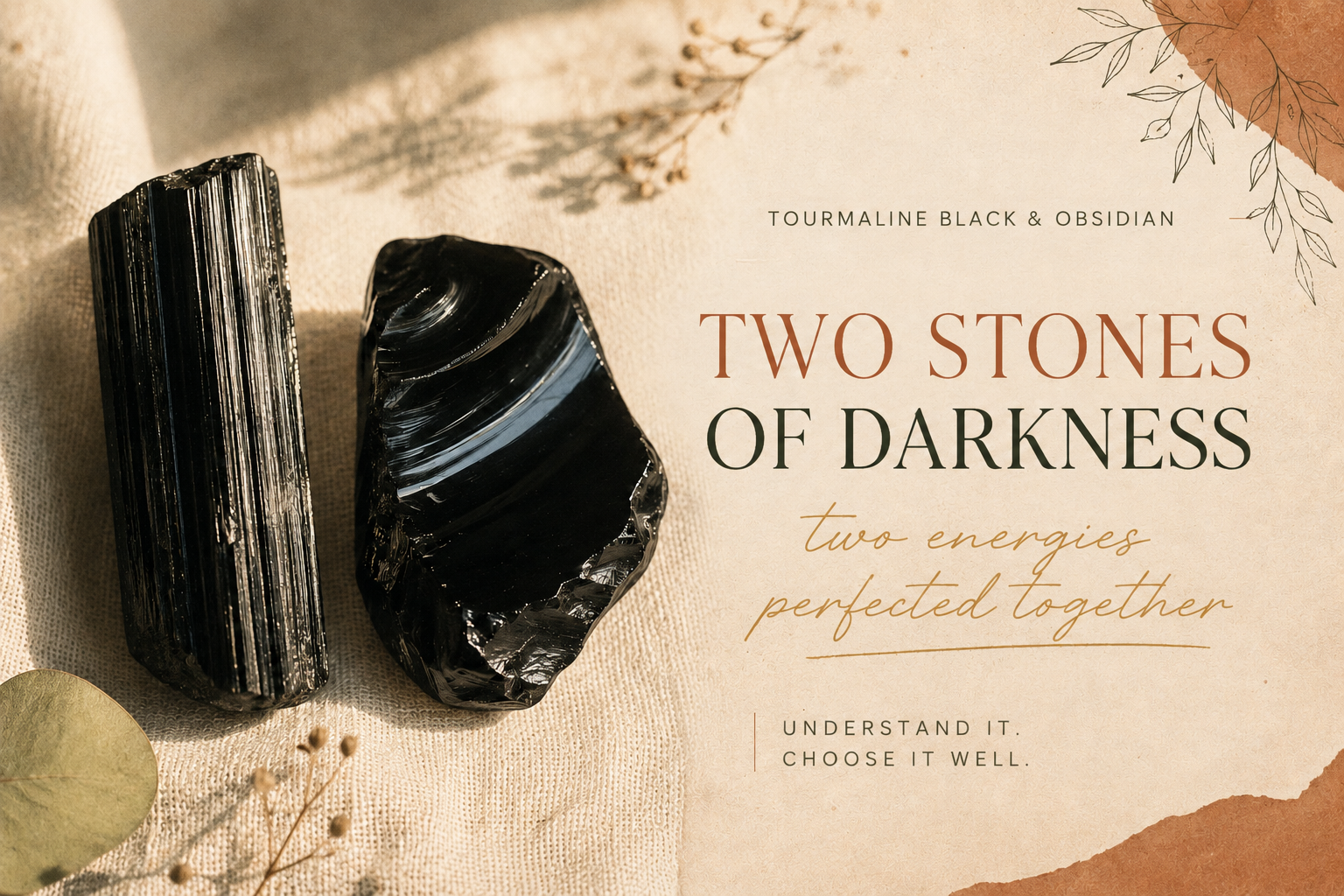
A glass and a crystal
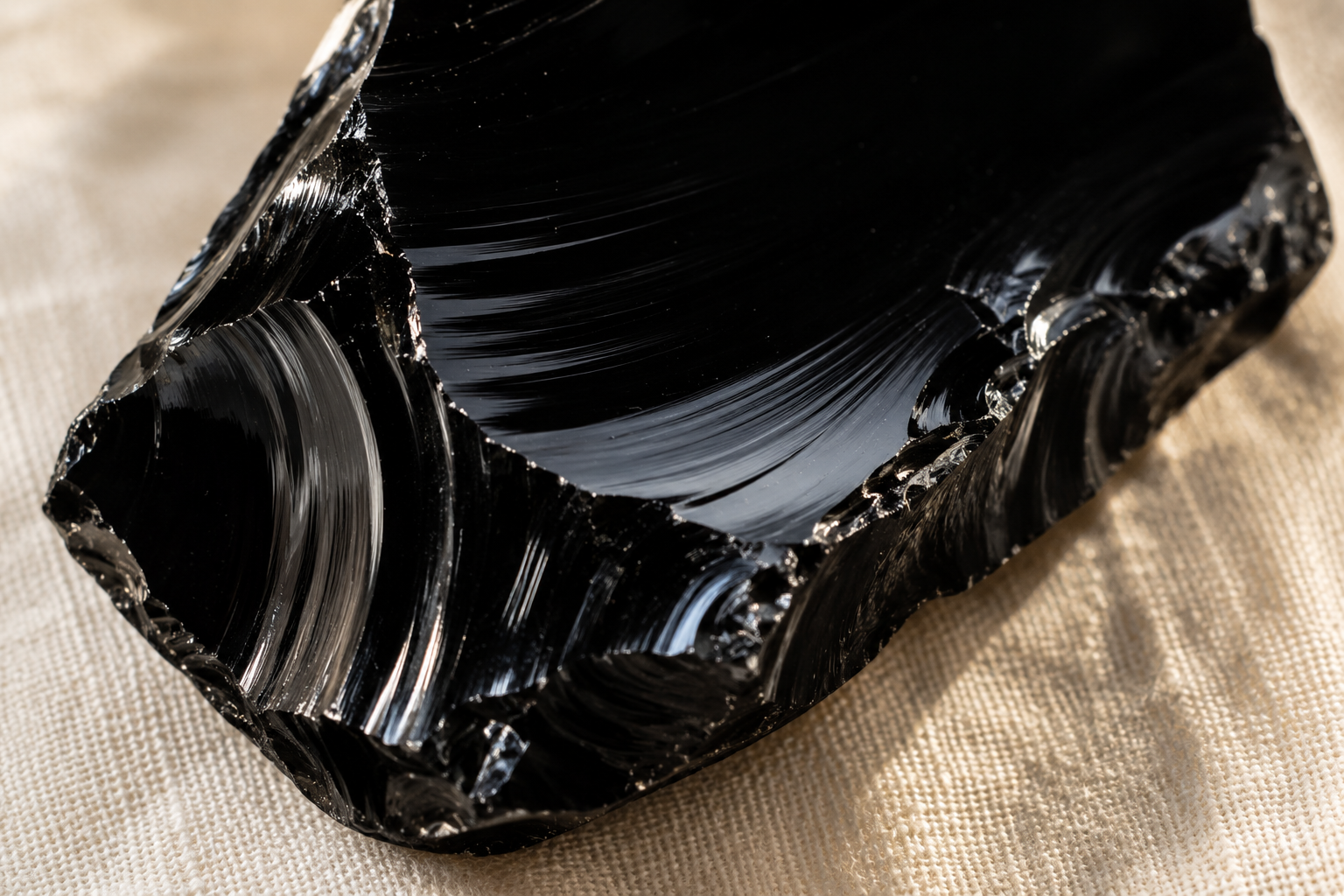
Obsidian is not a crystal. It is a natural volcanic glass: a silica-rich lava frozen before it could organise itself, its atoms left in disorder just as in a pane of glass. It is classed among the mineraloids. Its origin is told in detail in how obsidian is formed.
Black tourmaline, which mineralogists call schorl, is the opposite: a perfectly crystallised mineral, trigonal in system, belonging to the very complex borosilicate family. It owes its black colour to a high iron content and grows in elongated prisms, in pegmatites and metamorphic rocks from Brazil, Madagascar, Namibia and Pakistan.
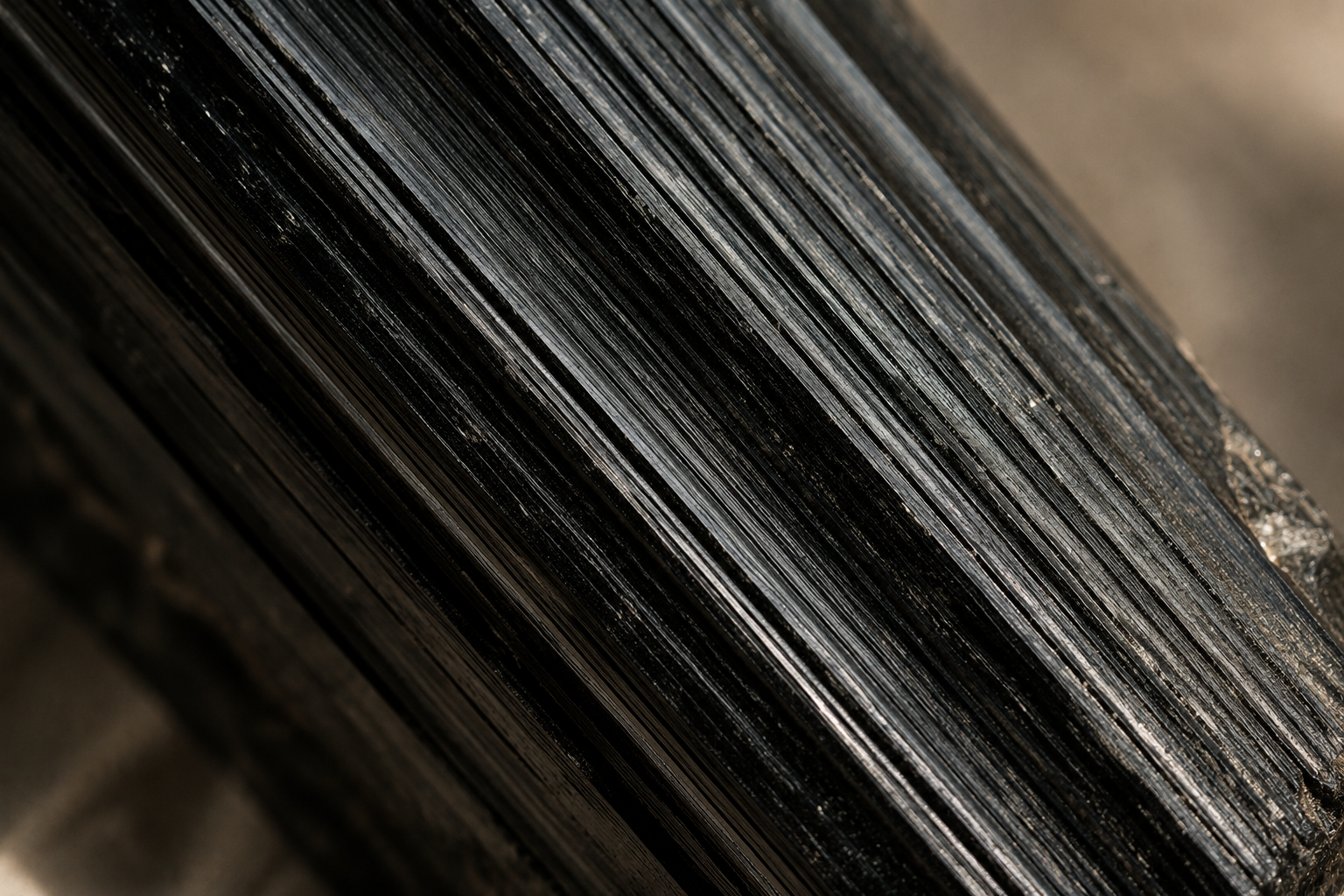
From that difference in nature comes the one thing worth remembering: a crystal grows along axes, and that growth leaves traces. On tourmaline, these are parallel grooves running the full length of the prism, deep, regular, impossible to mistake. A glass has no growth axis: obsidian is smooth, everywhere, always.
Obsidian and black tourmaline: the comparison table
| Criterion | Obsidian | Black tourmaline (schorl) |
|---|---|---|
| Nature | Volcanic glass, amorphous | Crystalline mineral, trigonal system |
| Composition | Silicate glass, over 70% SiO₂ | Complex borosilicate rich in iron |
| Hardness (Mohs) | 5 to 5.5 | 7 to 7.5 |
| Density | 2.35 to 2.60 | 3.02 to 3.26 |
| Refractive index | 1.48 to 1.51 | 1.62 to 1.65 |
| Birefringence | None (isotropic) | 0.014 to 0.024 |
| Surface | Smooth, deep vitreous lustre | Marked lengthwise striations |
| Fracture | Conchoidal, shell-like | Irregular, brittle |
| Raw form | Shards with no fixed shape | Elongated prisms, triangular cross-section |
| Electricity | None | Pyroelectric and piezoelectric |
| Origin | Mexico, USA, Iceland, Italy | Brazil, Madagascar, Namibia, Pakistan |
In plain terms, three lines do all the work. The striations are visible to the naked eye. The density (≈ 2.45 versus ≈ 3.15) is felt in the hand. And electricity is a property obsidian simply does not have, put to use further down.
Five tests you can do at home
From most reliable to least, and all non-destructive except the last, which I would steer you away from.
Look for the striations
The decisive test, free and instant. Tilt the stone towards a window: if parallel grooves appear running in one direction, it is tourmaline. They stay visible even on tumbled stones or beads, where they show up as fine, regular dark lines. Obsidian, by contrast, has nothing to show: just a smooth surface.
Weigh it in your hand
A bracelet of 22 beads at 8 mm weighs around 14.5 g in obsidian against 18.5 g in tourmaline, nearly 30% more. Less dramatic than with some very dense stones, but perfectly noticeable with one bracelet in each hand, and beyond doubt on a kitchen scale.
The static-electricity test
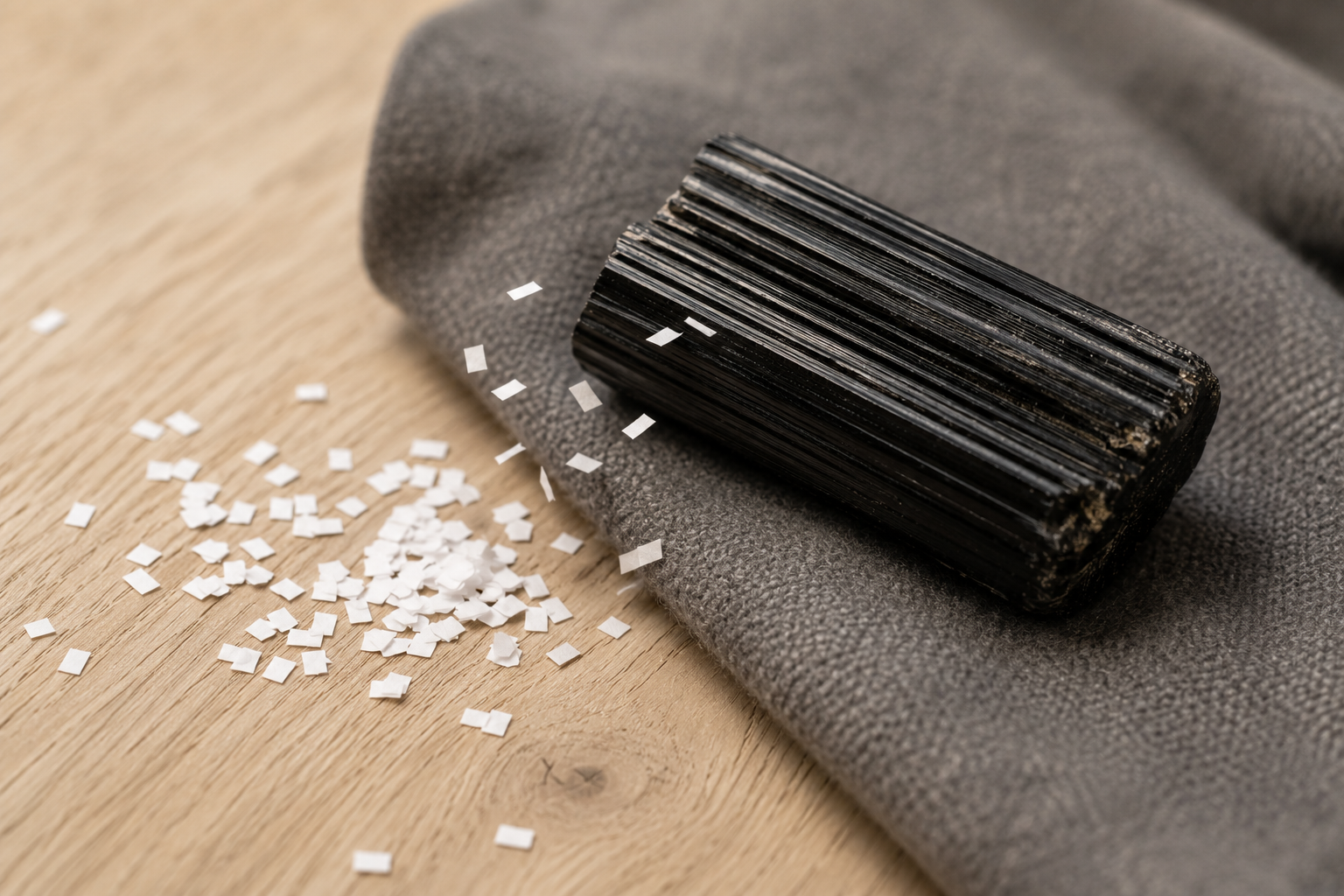
The most fun, and the least known. Tourmaline is pyroelectric: warmed, it builds an electric charge and attracts dust. Eighteenth-century Dutch traders called it aschentrekker, "ash-puller", because it picked up pipe ash. Rub the stone briskly in a woollen cloth, then bring it close to tiny paper confetti: tourmaline attracts them, obsidian does not. Never heat it with a flame, warmth from your hand or the sun is enough, and thermal shock damages both stones.
Check the fracture and the lustre
On a raw shard, obsidian shows a conchoidal fracture, curved, shell-like surfaces with sharp edges, and a deep, almost liquid vitreous lustre. Tourmaline breaks irregularly and looks more matt, more "mineral".
Scratch it, best avoided
A steel point (hardness ≈ 5.5) scratches obsidian but not tourmaline (7 to 7.5). The test works, and it permanently damages the piece. The four tests above are more than enough; if you really insist, work on a hidden area.
Careful, none of these tests replaces a gemmological examination. For a valuable piece, or in a dispute with a seller, only an independent laboratory can settle it: tourmaline's birefringence, absent in obsidian, is measured with a refractometer in a matter of minutes.
What crystal healing credits each with
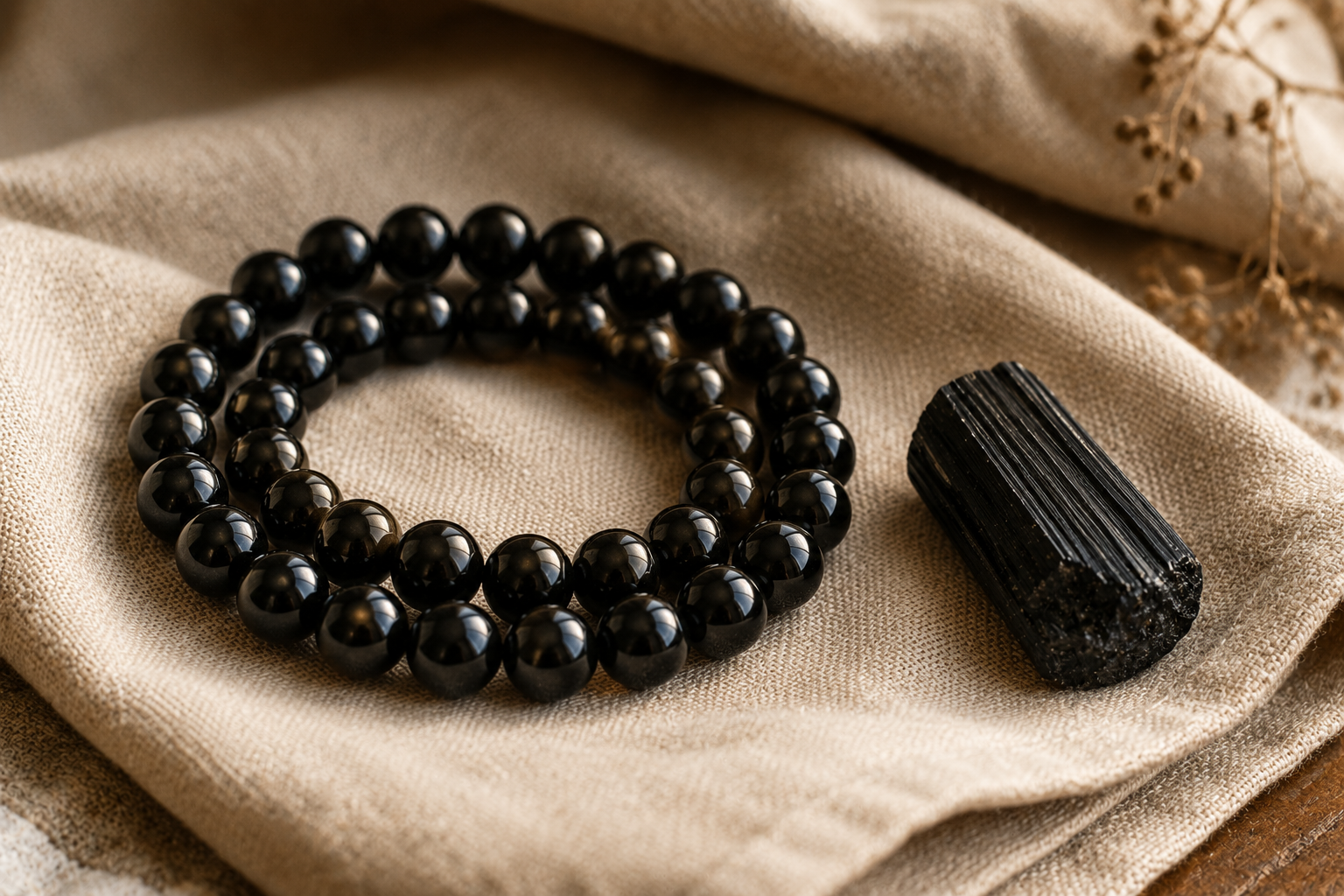
Both are sold as "protection stones", and that is exactly where the confusion sets in. In tradition, though, they are not said to play quite the same role.
Black tourmaline
Described as a shield facing outward. Tradition credits it with a defensive role: repelling, filtering, holding the line. The stone often suggested for heavy environments.
Black obsidian
Described as a mirror turned inward. Credited with less defence and more clarity: it reflects, confronts, brings things to the surface. It protects by revealing rather than by repelling.
I find this distinction useful: it explains why some people find obsidian too blunt where tourmaline suits them better. The subject is developed in obsidian, protection and grounding, and if obsidian feels too intense for you, dangers and precautions addresses it directly.
People often ask which one is "the more powerful". That is a question I cannot honestly answer, these properties belong to belief, not to measurement. What I can say is that plenty of people wear both together, and there is nothing inconsistent about that.
Obsidian also pairs very well with other dark stones: see my guide to crystal pairings with obsidian, including the obsidian and tiger eye duo.
Other black stones people confuse
Tourmaline is not the only candidate. Three other black materials circulate under loose labels:
- Black spinel, a very dense (≈ 3.60) and very hard (7.5 to 8) cubic mineral. Almost always cut with sharp, sparkling facets, which gives it away instantly: neither obsidian nor tourmaline is worked that way;
- Black onyx, a chalcedony at hardness 6.5 to 7, whose uniform commercial black is almost always achieved by dyeing. A matt, perfectly even look, without obsidian's glassy quality or tourmaline's striations;
- Manufactured black glass, the only genuine problem in the lot. Too perfect, no inclusions, often translucent at the edge and sometimes marked with a mould line. It warms up very quickly in the hand. This is what lies behind the "blue obsidians" sold in impossible colours.
Sorting them is quick: striated → tourmaline. Faceted and sparkling → spinel. Matt and perfectly uniform → dyed onyx. Too perfect and too light → glass. Obsidian, meanwhile, almost always keeps a small something, a bubble, a faint veil, a shift of tone within the black. Inflated prices and fanciful names are covered in obsidian price and value.
Which one should you choose?
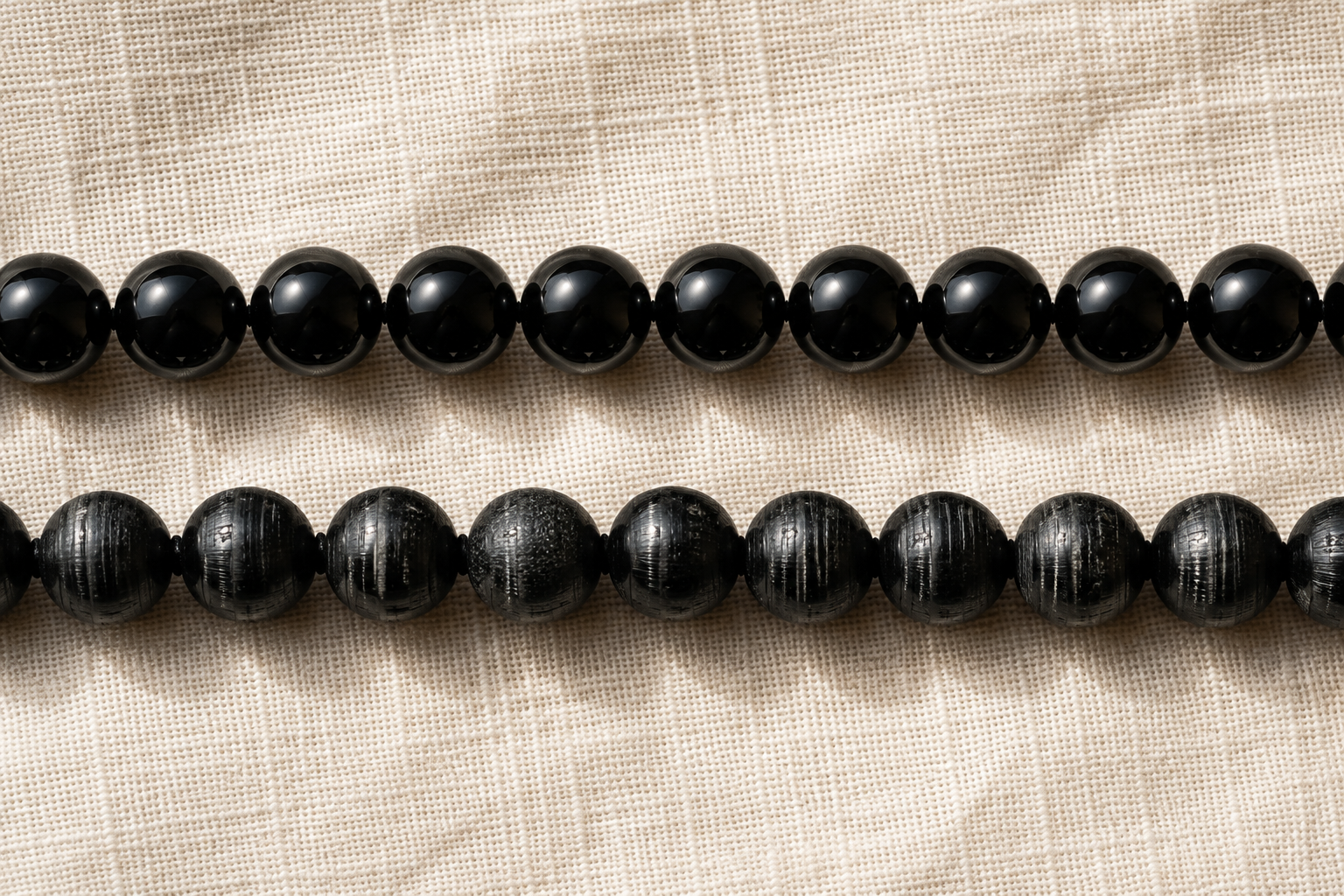
On technical grounds, best to say it plainly: tourmaline is more durable. At 7 to 7.5 on the Mohs scale against 5 to 5.5, it takes everyday knocks better. For a ring worn every day, that is a real argument.
What obsidian has in its favour is a different kind of thing. Its black is not matt but deep, almost liquid depending on the light, the shine of a glass, which tourmaline's more mineral finish does not give. It polishes to a level few stones reach, which is exactly why it was used for mirrors for centuries. And its material tells a story: frozen lava, a geological accident.
I don't work with tourmaline, and it is not a matter of principle: obsidian is simply enough for me. That black which shifts with the light, sometimes matt, sometimes almost liquid, I have never managed to tire of it. Tourmaline is a beautiful stone; it just isn't mine.
In practice: tourmaline if you want durability and a matt black; obsidian if you want depth and a story. If you are unsure about sizing, the size guide will help; and for the full picture, the complete obsidian guide gathers origin, types and care.
Precautions & care
The difference in hardness has one immediate consequence: do not store your two stones together. Tourmaline, at 7-7.5, scratches obsidian effortlessly. Each piece deserves its own fabric pouch or compartment.
For obsidian: a soft microfibre cloth, a brief rinse in lukewarm water if needed, never salt, never an abrasive product, never an ultrasonic cleaner or steam. Take your jewellery off before showering, exercise and bed, on a bracelet strung on elastic thread, it is the thread that wears out first. Everything is set out in cleaning your obsidian, and the energetic side in cleansing and charging.
Worth knowing, the gemmological constants cited here (hardness, density, refractive index, pyroelectricity) are measurable data. The properties credited to stones, by contrast, belong to spiritual traditions and to crystal healing, a wellbeing practice founded on belief. They are not a medical claim, they treat no illness, and they are never a substitute for the advice of a healthcare professional.
Frequently asked questions
How do you tell black tourmaline from obsidian?
What is schorl?
Is black tourmaline really electric?
Which one is harder?
Can you wear black tourmaline and obsidian together?
Which one is more expensive?
How can you recognise genuine obsidian?
Your obsidian, handmade
Bracelets, necklaces, pendants and rings in natural obsidian, handmade in France, every variety sold under its true name.