Spiderweb Obsidian and Its Network of Veins
A lattice of pale veins running across the black, branching, crossing over: spiderweb obsidian lives up to its name. Unlike the shimmer varieties, its pattern is a scar, the trace of old fractures the stone has healed. Here is how it forms, and how not to confuse it with its three look-alikes.
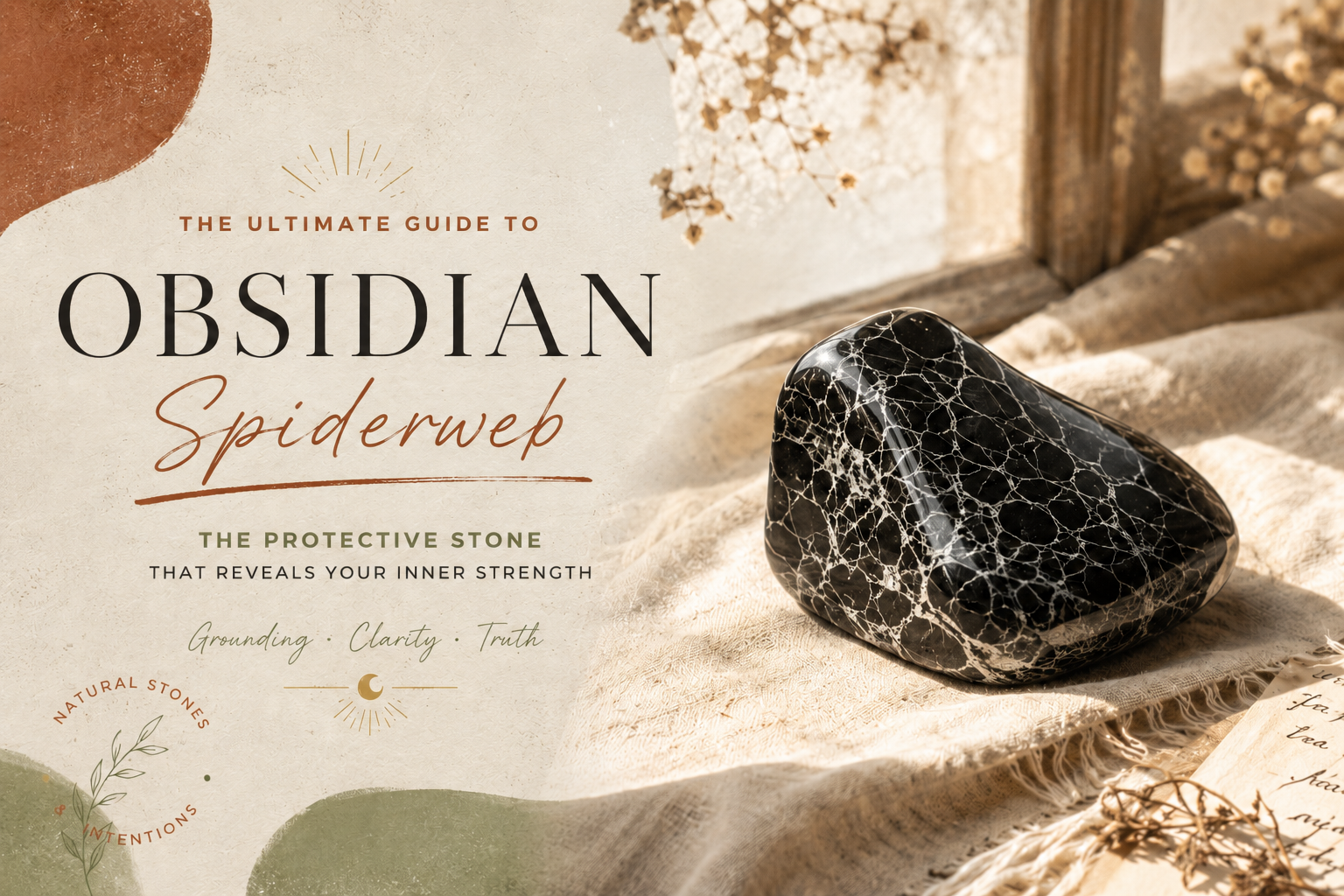
What is spiderweb obsidian?
Spiderweb obsidian is a variety of black obsidian crossed with a network of paler veins: white, grey, beige, sometimes red-brown. These veins branch and cross to form an irregular mesh reminiscent of a web.
Its big difference from the other patterned varieties is that it shows itself immediately, in plain light, with no need to orient it or hold it against a light source. It is a direct stone, one that reveals what it is at once.
Every piece is unique, the network never repeats, and that is exactly what collectors like about it. You will find it alongside the others in my guide to the types of obsidian.
Where does its network of veins come from?
Here is what makes this variety interesting: its pattern is neither an optical effect nor a deposit present from the start. It is a healed wound.
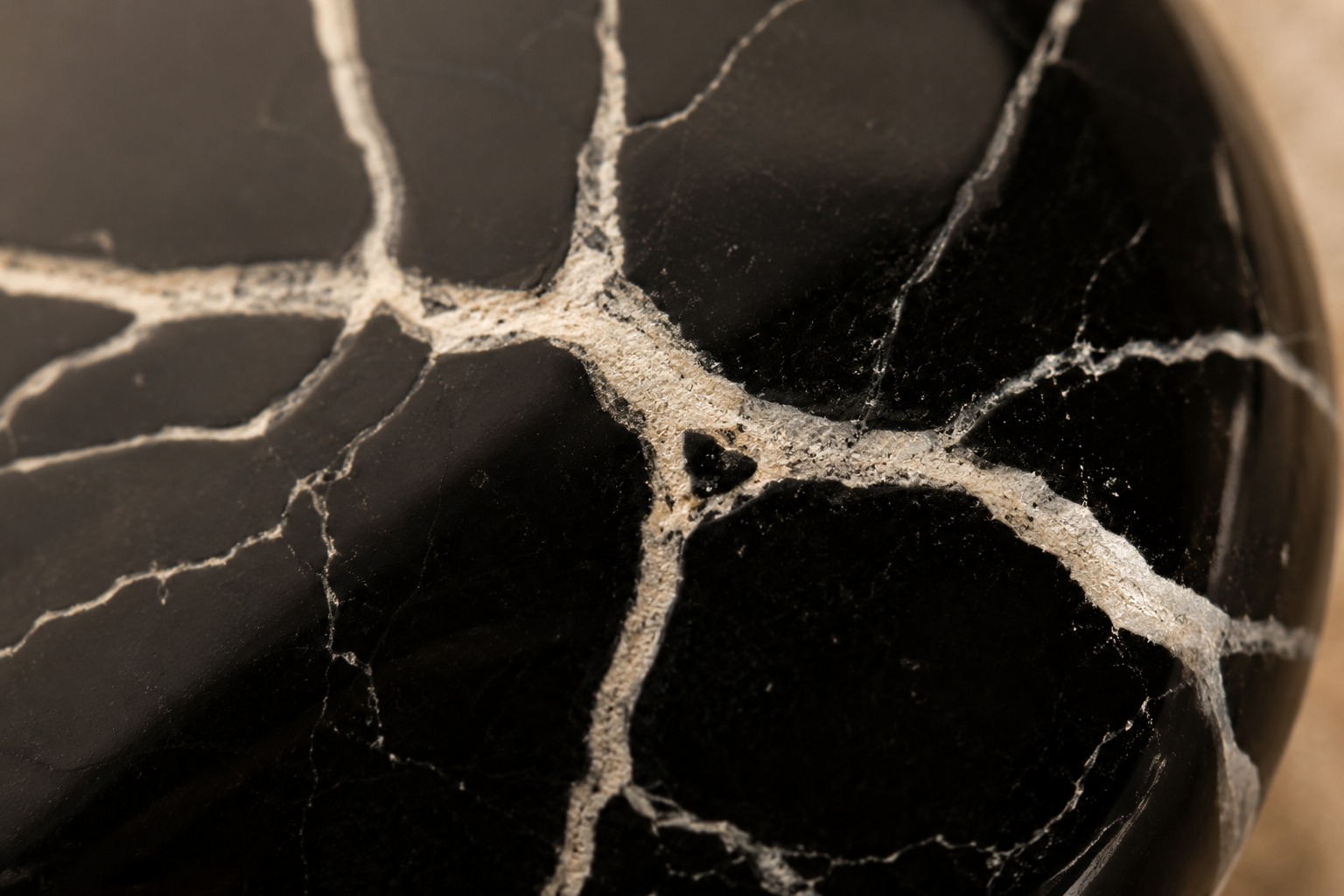
Obsidian is a glass, and like any glass it fractures. After it forms, a flow can crack for several reasons: stresses from cooling, ground movement, or the glass slowly absorbing water, which makes it swell slightly and crack from within.
These cracks do not stay empty. Water carrying dissolved minerals, silica, iron oxides, carbonates, circulates through them and deposits over time. The material filling the fracture is different from the original glass: paler, more opaque, often chalky in appearance. That is what you see.
In some pieces the process goes further: the rock has broken into fragments that were later re-cemented together. This is called a breccia, and the network becomes a genuine puzzle. These pieces are often the most striking.
I find this stone very expressive. What you admire inside it are its breaks, except they have been filled in, and the pattern has become more beautiful than the untouched surface. You can read whatever you like into that, but the image is there.
A name that covers more than one stone
Worth flagging, since few sites do: "spiderweb" is a descriptive commercial name, not a precise mineralogical category. It names a look, and that look can result from several distinct phenomena.
- Filled fractures, the most common case: cracks filled by a pale mineral deposit;
- Re-cemented breccia, the rock shattered into pieces, then was re-fused together;
- Perlitic cracking, the glass, as it absorbs water, cracks into concentric arcs that weather and pale;
- Devitrification along fractures, the glass began crystallising along the surface of the cracks, producing paler outlines.
All of these are genuine obsidians, and all are sold under the same name. So do not look for a single definition: none exists. What matters is that the pattern is natural, not the exact category.
In plain terms, if a seller tells you their spiderweb obsidian is "the real one" as opposed to others, that is a sales pitch. The term is descriptive, and several distinct formations earn it equally.
Its three look-alikes
Three stones share a similar look or name. Here is how to tell them apart.
Midnight lace
This is the most common mix-up between obsidian varieties. The distinction, though, is simple and rests on two criteria.
| Criterion | Spiderweb | Midnight lace |
|---|---|---|
| Nature of the pattern | Angular, branching network, no direction | Curved, parallel ribbons |
| Origin | Filled fractures | Flow banding |
| Observation | In direct light | Mainly backlit |
| Colour of the pattern | Veins paler than the background | Darker ribbons, seen by transparency |
The shortcut: if the pattern is visible set on a table, it is spiderweb obsidian. If you have to hold the stone up to the light, it is midnight lace obsidian.
Snowflake
Much easier to tell apart: snowflake obsidian shows round, isolated patches, cristobalite crystals formed in the glass, rather than lines. No branching, no network. Dots, not strokes.
Spiderweb jasper and spiderweb turquoise
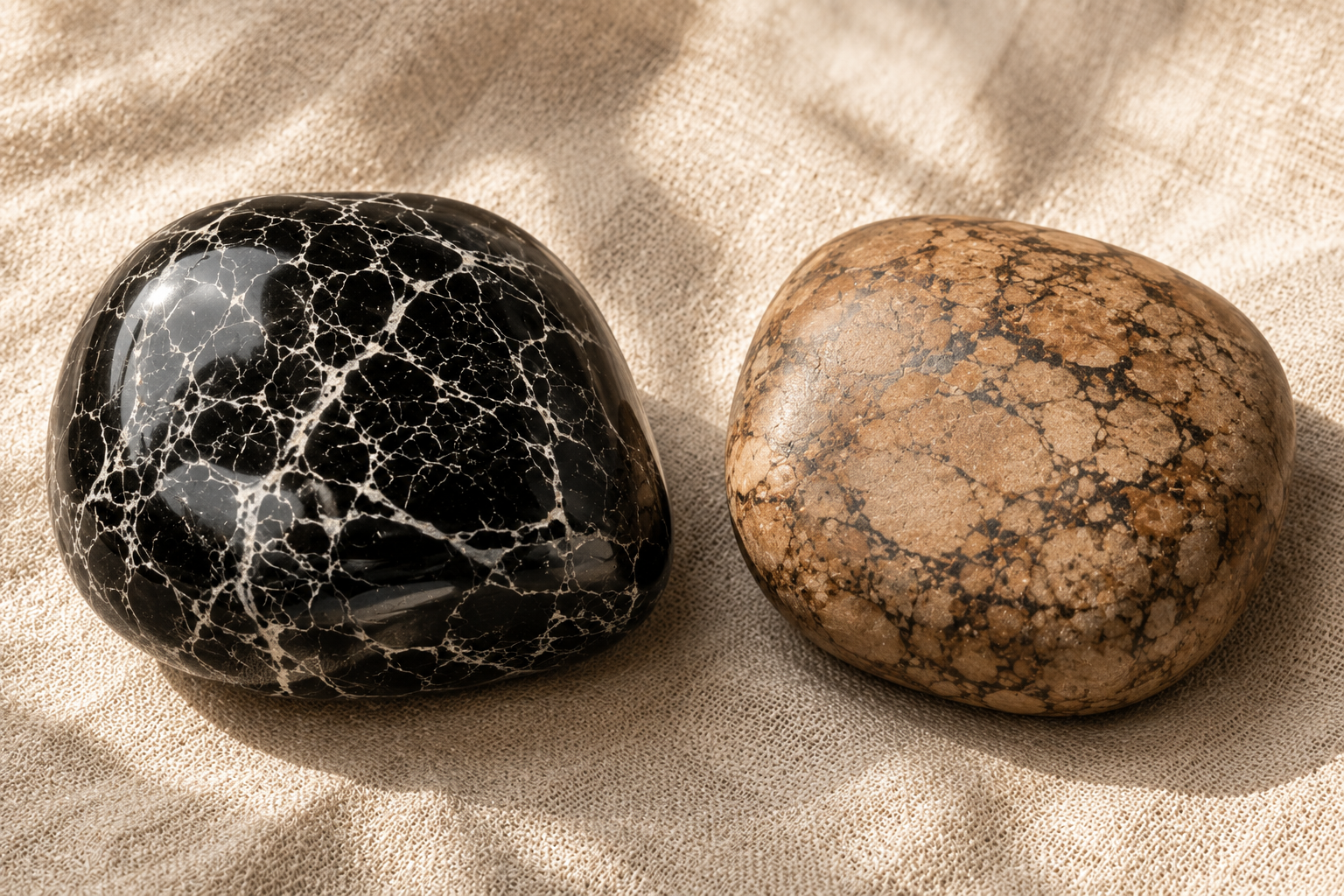
Watch out for this mix-up, which involves entirely different rocks. Spiderweb jasper and spiderweb turquoise share the same descriptive label, but:
- jasper is a microcrystalline quartz, matt, opaque, harder (6.5 to 7 on the Mohs scale);
- turquoise is blue-green, with a brown or black network, the exact reverse of obsidian;
- obsidian is a glass, vitreous lustre, almost mirror-like, moderate hardness at 5 to 5.5.
The decisive marker remains lustre. A polished obsidian shines like glass. A jasper, however well polished, keeps a waxy look.
The properties credited to spiderweb obsidian
As with the other rare varieties, this needs saying upfront: it is a modern commercial name, with no ancient tradition of its own. Today's correspondences were formulated within the last few decades, by analogy with its pattern.
That said, they hold together:
- repair and rebuilding: its dominant symbolism, and it follows directly from how it forms, a stone whose breaks have been healed;
- resilience: the idea that a fracture can become a strength rather than a weakness;
- seeing connections: by analogy with the network, it is linked to understanding tangled situations;
- protection and grounding, qualities common to all obsidians.
This is probably the variety whose symbolism sits most naturally alongside its actual geology. As for chakras, it is linked to the root chakra like any obsidian. The full picture is in my guide to obsidian and chakras.
Choosing and wearing it
Good news compared with midnight lace obsidian: since its pattern is visible in direct light, spiderweb obsidian works perfectly as jewellery. It is even one of the few rare varieties you can enjoy fully while wearing it.
A few markers for choosing well:
- Look for contrast, good pieces have crisp, pale veins on a deep black. A grey-on-grey pattern lacks character;
- Check the density of the network, too many veins and the stone looks messy, too few and the effect disappears;
- Check its strength, the veins are old fractures, so they are weak points. A very dense network weakens the stone. Avoid rings, which take more knocks;
- Be wary of patterns that are too regular, genuine fracturing is chaotic. A geometric network, with lines of constant thickness, may give away an engraved or dyed stone.
I don't work with this variety in the workshop, it remains hard to source with consistent quality. If you are after an obsidian to wear every day, classic black obsidian offers the same grounding energy, without the fragility of the veins.
Mineralogical fact sheet
- Nature
- Natural volcanic glass (mineraloid, amorphous)
- Other names
- Web obsidian, veined obsidian
- Colour
- Black crossed with white, grey, beige or red-brown veins
- Source of the pattern
- Filled fractures, re-cemented breccia or perlitic cracking
- Observation
- In direct light, no particular orientation needed
- Composition
- Silicon dioxide (SiO₂), silica and oxide infillings
- Hardness (Mohs)
- Around 5 to 5.5, lower along the veins
- Strength
- The veins are weak points: handle pieces with care
- Deposits
- Mexico, United States, Armenia, depending on the flow
- Chakras
- Root
- Age of the tradition
- Recent: modern commercial name
Care and cleansing
One extra precaution applies here, and it is structural: since the veins are old fractures filled with a softer, sometimes porous material, they are the stone's weak point.
- Avoid prolonged soaking, water can seep into the porous infillings;
- Cleaning, a soft, dry cloth is preferable. If needed, a quick rinse under clear water, then dry immediately;
- Cleansing, smoke is ideal here, since it avoids any contact with liquid. Avoid salt, which lodges in the veins;
- Charging, moonlight, without prolonged sun exposure;
- Knocks, a veined stone breaks along its old fracture lines. Store it alone, in a soft pouch.
The full run-through is in my guides to cleaning your obsidian and to cleansing and charging.
Worth knowing, the properties described here belong to crystal healing, a wellbeing practice founded on tradition and belief. They are not a medical claim, they treat no illness, and they are never a substitute for the advice of a healthcare professional. See also obsidian, dangers and precautions.
Frequently asked questions
What is spiderweb obsidian?
What is the difference from midnight lace obsidian?
Is spiderweb obsidian fragile?
How do you tell it from spiderweb jasper?
What are the properties of spiderweb obsidian?
How can you spot a fake pattern?
My obsidians, handmade
Bracelets, necklaces, pendants and rings in natural obsidian, shaped one by one in my workshop in France.