Midnight Lace Obsidian and Its Ribbons
Black and unremarkable in daylight, it reveals a lattice of fine, tightly curling ribbons when held to the light, like lace trapped in the glass. Midnight lace obsidian is one of the most discreet varieties, and one of the most fascinating once you know how to look at it.

What is midnight lace obsidian?
Midnight lace obsidian is a variety of black obsidian crossed with fine, tightly curling ribbons, darker or lighter than the background, that trace a lace-like pattern.
Its distinctiveness lies in the way it reveals itself. Set on a table, lit from above, it looks like any other black obsidian. Held up to a light source, it changes completely: the ribbons appear, cross, ripple. It is a variety that needs a deliberate gesture to exist at all.
It remains little seen in the UK market, where it turns up mainly among collectors and lapidaries. You will find it alongside the others in my guide to the types of obsidian.
This is the kind of stone you could own without ever really having seen it. And yet all it takes is holding it up to a lamp. I like the idea that a stone keeps something back for those who take the trouble to look differently.
Where do its ribbons come from?
Unlike rainbow obsidian or fire obsidian, whose colours arise from an optical phenomenon, midnight lace rests on a genuine physical structure. The ribbons exist within the material: they are not a reflection.
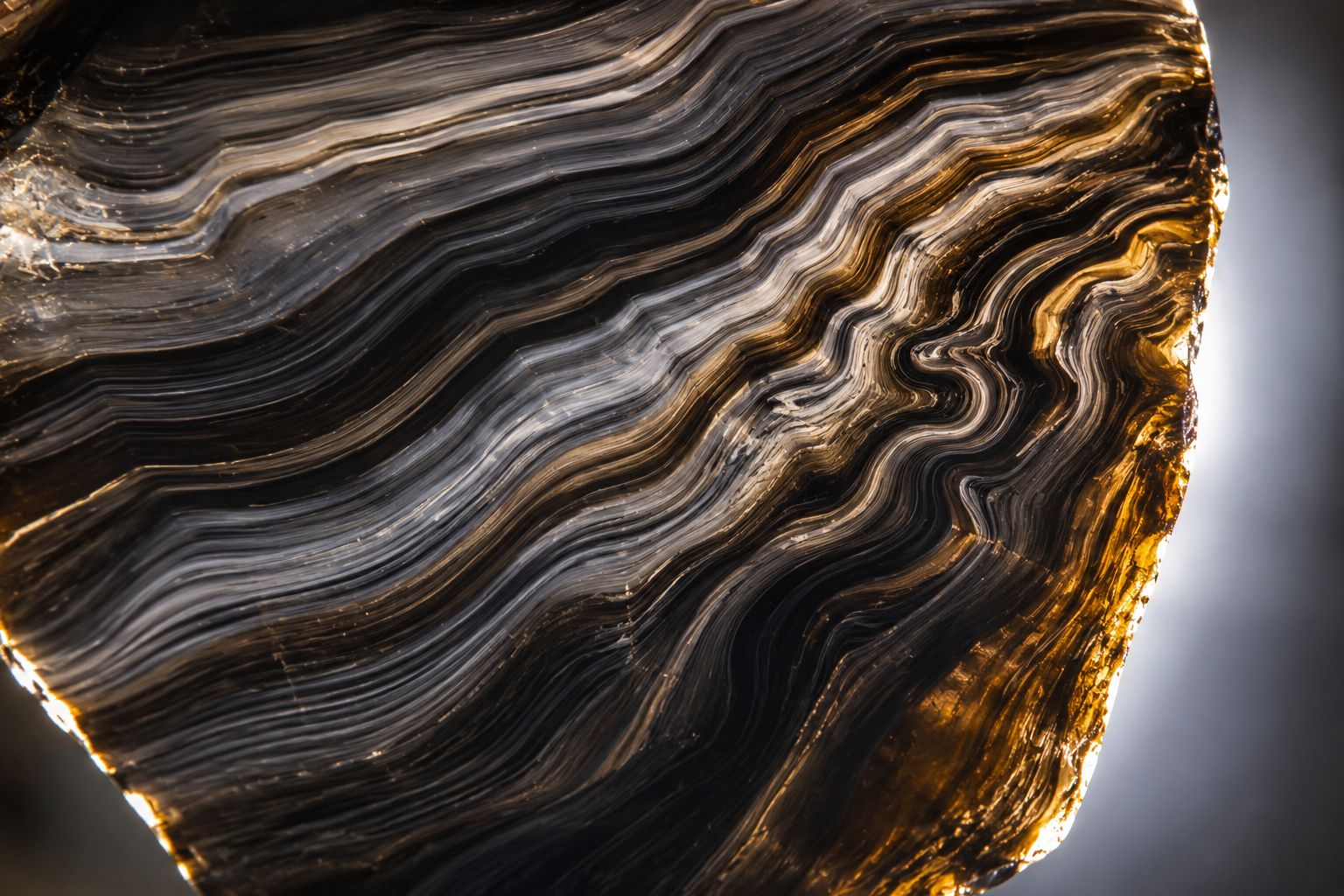
The phenomenon is called flow banding. When a silica-rich lava flows, it is extremely viscous, comparable to very cold honey. That viscosity means it does not mix: it flows in parallel layers sliding over one another, without blending. This is known as laminar flow.
Each layer has a slightly different composition, a few more microcrystals here, a few more gas bubbles there. These minute variations are enough to change the way light passes through the glass. When the flow freezes suddenly, the layers stay in place, and the folds that built up during the flow become these curling patterns.
In other words: you are looking at the motion of a lava flow, stopped dead. The lace's convolutions are the turbulence of the flow, frozen exactly as it was. To understand this process, see my article on how obsidian is formed.
The backlight test
Since the ribbons rest on differences in how light passes through the glass, there is only one correct way to observe them: from behind.
- Face a window or a lamp, and hold the stone between your eye and the light source;
- Favour thin areas, an edge, a corner, a thinly cut piece. The thicker the material, the less light gets through;
- Turn it slowly: the ribbons distort and change appearance with the angle;
- A torch pressed against the stone gives excellent results, it is the trick lapidaries use.
This is also why the best pieces are cut as thin slabs or cabochons, rather than thick beads. An 8 mm bead will let almost nothing through.
Before buying, ask for a photo or video of the stone backlit. A photo taken in front-on light shows nothing of the lace: it is the easiest way to sell an ordinary black obsidian under this name.
Midnight lace, spiderweb or snowflake?
Three patterned varieties, often confused, and yet very different in both origin and appearance.
| Variety | Pattern | Origin | Visible |
|---|---|---|---|
| Midnight lace | Fine, curling ribbons | Flow banding | Mainly backlit |
| Spiderweb | Network of pale veins | Re-cemented fractures | In direct light |
| Snowflake | Rounded white patches | Cristobalite crystals | In direct light |
The most useful distinction is how you observe it. If the pattern is visible at a glance, in plain light, it is not midnight lace, it is probably snowflake obsidian or spiderweb obsidian. Lace, by contrast, hides.
The second marker is the nature of the pattern. Lace gives curved, parallel lines that follow a single overall motion, like the strata of a folded cliff. Spiderweb gives an angular, disordered network with no common direction, because it is formed from fractures. Snowflake gives round patches, with no lines at all.
The properties credited to midnight lace
As with fire obsidian, a clarification is needed: this is a recent commercial name, coined within the English-speaking lapidary trade. This variety has no ancient tradition of its own, and the correspondences credited to it were formulated within the last few decades, often by analogy with its pattern.
That said, the qualities it is credited with today hold together:
- revealing what is hidden, a direct analogy with its pattern being invisible in plain light;
- patience and attention: it is a stone that demands a gesture in order to show itself;
- protection and grounding, qualities common to all obsidians;
- untangling complex situations, by analogy with its interwoven pattern.
As for chakras, it is linked to the root chakra like any obsidian, and sometimes to the third eye for its quality of seeing the unseen. The full picture is in my guide to obsidian and chakras.
Choosing and wearing it
Midnight lace poses a genuine practical problem: its pattern is not visible when worn. A stone set in a ring or strung on a bracelet stays black, since light cannot pass through it from behind.
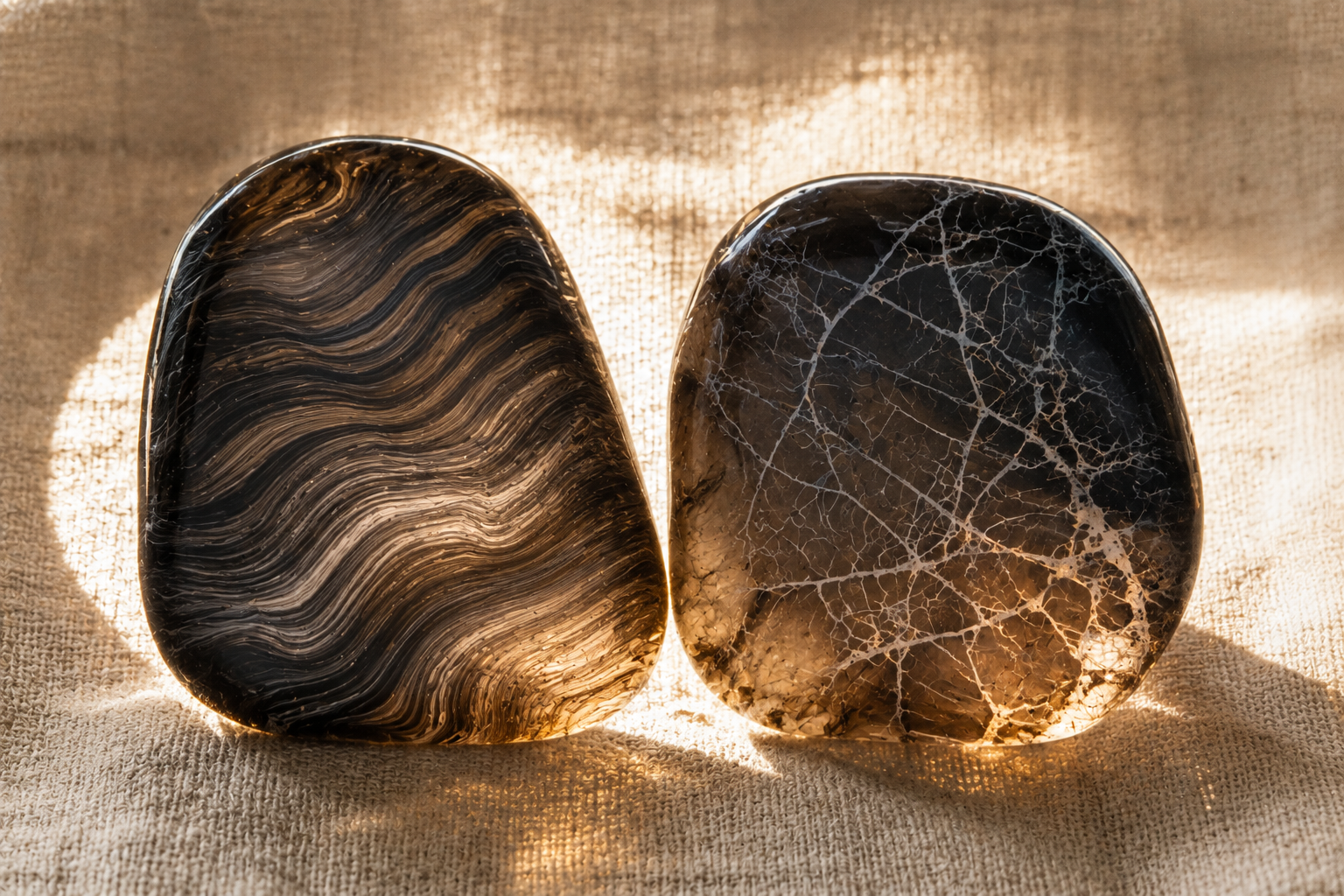
Two practical conclusions:
- Favour thin pieces, polished slabs, thin cabochons, flat pendants. The thinner the piece, the more easily the pattern shows itself;
- Think of it as an object to look at rather than jewellery to wear. Set near a window, it changes through the day.
If what you are after above all is an obsidian to wear day to day, classic black obsidian offers the same grounding energy with a permanent presence, and it is the one I work with in the workshop, unlike midnight lace.
Mineralogical fact sheet
- Nature
- Natural volcanic glass (mineraloid, amorphous)
- Other names
- Banded obsidian
- Colour
- Deep black, with lighter or darker ribbons
- Source of the pattern
- Laminar flow banding in the lava
- Observation
- By transparency, backlit
- Composition
- Silicon dioxide (SiO₂), microcrystals and gas bubbles
- Hardness (Mohs)
- Around 5 to 5.5
- Fracture
- Conchoidal, sharp-edged
- Deposits
- Oregon (USA), Mexico, depending on the flow
- Commercial form
- Thin slabs and cabochons, rarely beads
- Chakras
- Root, sometimes third eye
- Age of the tradition
- Recent: modern lapidary name
Care and cleansing
Care is the same as for any obsidian, with particular attention to the polish: a dulled surface lets less light through, and the pattern fades accordingly.
- Cleaning, soft, dry cloth. For fingerprints, which get in the way of viewing it backlit, a microfibre lens cloth works well;
- Cleansing, smoke, or a brief rinse under clear water. Avoid salt, which micro-scratches the surface;
- Charging, moonlight, without prolonged sun exposure;
- Fragility, thin pieces are brittle. Handle them flat and store them alone.
The full run-through is in my guides to cleaning your obsidian and to cleansing and charging.
Worth knowing, the properties described here belong to crystal healing, a wellbeing practice founded on tradition and belief. They are not a medical claim, they treat no illness, and they are never a substitute for the advice of a healthcare professional. See also obsidian, dangers and precautions.
Frequently asked questions
What is midnight lace obsidian?
Why can't I see the ribbons on my stone?
What is the difference from spiderweb obsidian?
What are the properties of midnight lace?
Can you wear midnight lace as jewellery?
How do you avoid being sold an ordinary obsidian instead?
My obsidians, handmade
Bracelets, necklaces, pendants and rings in natural obsidian, shaped one by one in my workshop in France.