Pumpkin Obsidian and Peanut Obsidian
Orange patches like a pumpkin's skin, beige clusters that look like peanut shells: pumpkin obsidian and peanut obsidian carry the most unexpected names in the family. And they hide a kinship few people suspect, one that links them directly to snowflake obsidian.
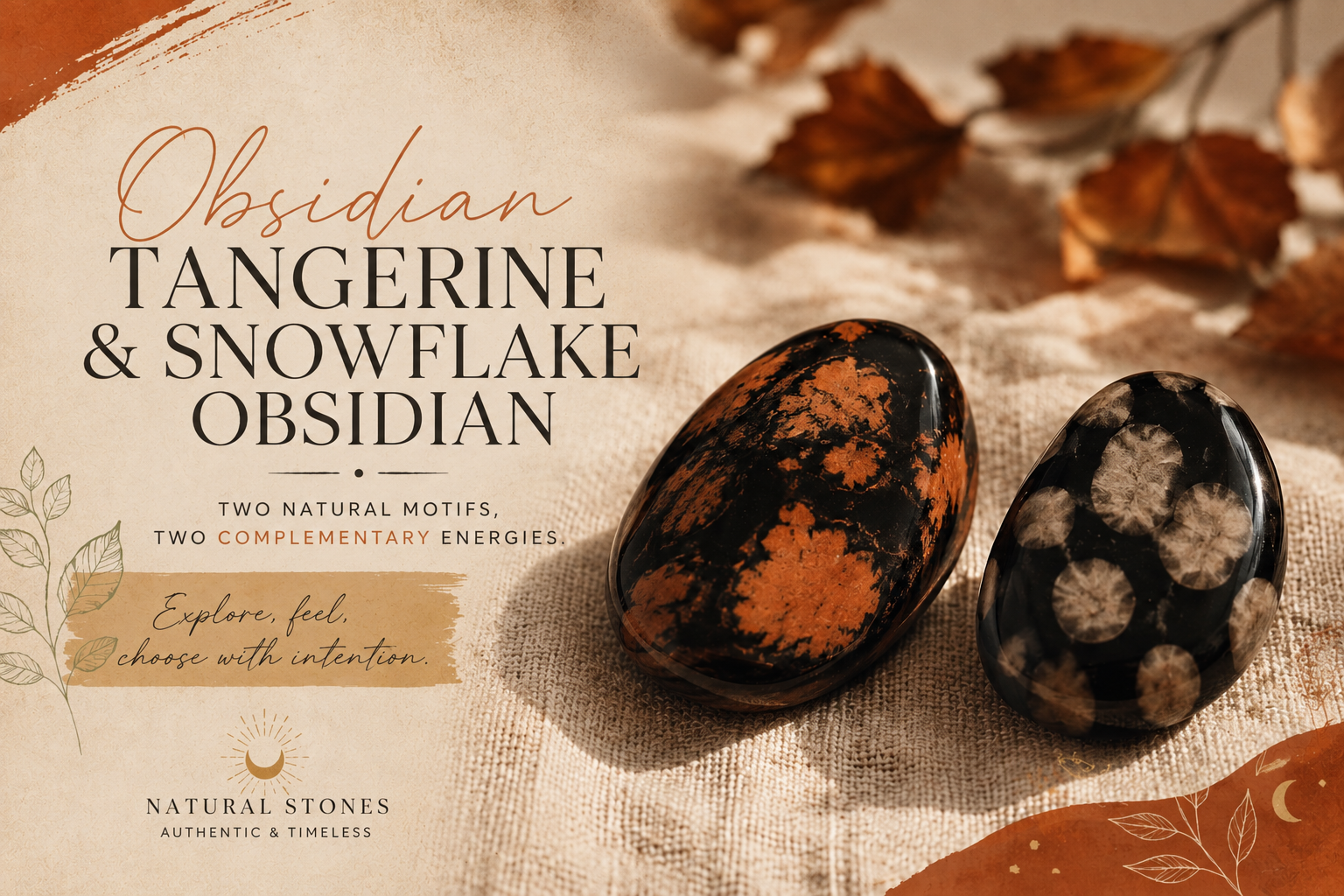
What are pumpkin obsidian and peanut obsidian?
These are two varieties of black obsidian characterised by rounded, pale-coloured clusters scattered through the volcanic glass.
Pumpkin obsidian shows orange to reddish-brown patches and speckling on a dark background. The comparison with a pumpkin's skin is immediate, hence the name.
Peanut obsidian shows beige, pale grey or light brown clusters, often grouped in twos or threes, whose shape and colour evoke peanut shells set against black.
Both names come from Mexican quarries and are not widely available in the UK. You will find them alongside the others in my guide to the types of obsidian.
I rather like these kitchen-table names sitting among the celestial eyes and peacock velvets. They say something true about the quarrymen who named them: you name what's in front of you, and that gives you a stone called pumpkin.
The shared secret: spherulites
Here is the piece of information almost no site gives, and it explains everything: the patches in these two varieties are spherulites.
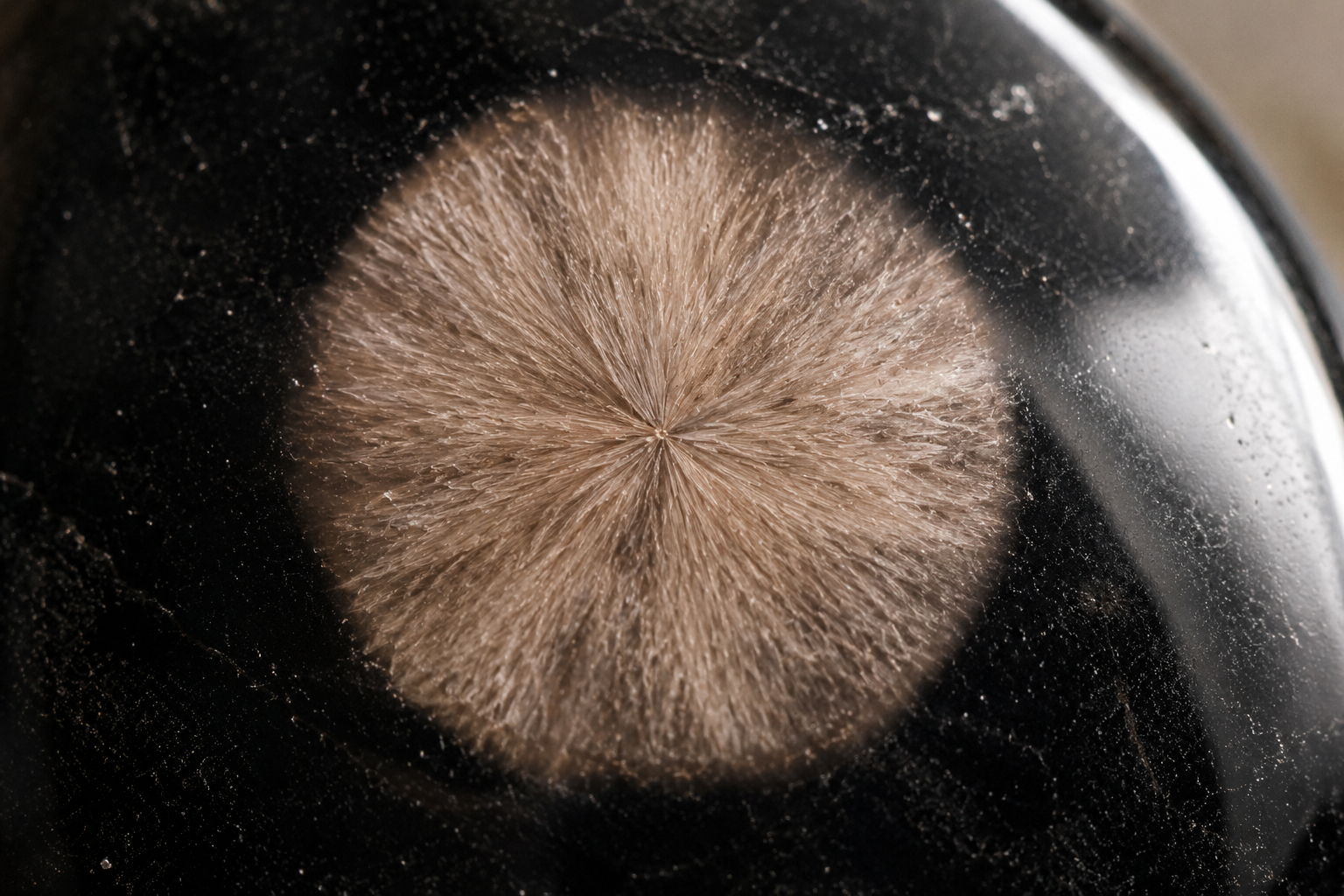
A spherulite is a cluster of fibrous crystals arranged in rays, grown outward from a single point, like a tiny ball of down. Here is how it happens.
Obsidian is a glass: the lava cooled so quickly that its atoms never had time to organise into crystals. But that glass sits in a metastable state, it "wants" to crystallise. If the temperature stays high enough for long enough, or if a flaw offers a starting point, crystallisation begins locally.
It then progresses radiating outward from that point, forming a sphere of mineral fibres, generally feldspar and cristobalite. These crystals, unlike the surrounding glass, are opaque and pale: they appear as light patches against the black.
This process is called devitrification: the glass locally turns back into a crystalline rock. To understand how obsidian forms, see how obsidian is formed.
The snowflake obsidian family
You already know this mechanism, even if you didn't realise it. It is exactly the same one behind snowflake obsidian, whose white flowers are also cristobalite spherulites.
Pumpkin, peanut and snowflake therefore form a single geological family: the spherulitic obsidians. What sets them apart is neither their nature nor how they form, but three parameters.
| Variety | Spherulite size | Colour | Distribution |
|---|---|---|---|
| Snowflake | Small, a few millimetres | White to pale grey | Evenly scattered |
| Peanut | Medium, often grouped | Beige, grey, pale brown | Clusters of two or three |
| Pumpkin | Large, sometimes merging | Orange to reddish-brown | Broad patches |
The colour depends on the composition of the crystals and any iron oxides present: white for pure cristobalite, beige to orange once iron gets involved. The size depends on how much time was available for growth: the slower the cooling, the more room the spherulites had to grow.
Worth remembering, if you like snowflake obsidian, peanut and pumpkin are its warm-toned variants. Same stone, same formation, only the palette changes. That is a good reason not to overpay for these varieties: they are not "rarer" in the geological sense.
Pumpkin or peanut: how to tell them apart?
Honestly, the line is blurry and depends a lot on the seller. Two markers hold up regardless.
Pumpkin
Orange to reddish dominant tone, in broad patches that can cover a good share of the stone. The overall impression is warm.
Peanut
Beige to grey dominant tone, in well-defined, spaced oval clusters. The overall impression stays dark, punctuated with pale.
The first marker is colour: warm for pumpkin, neutral for peanut. The second is surface coverage: pumpkin tends towards large patches, peanut towards isolated spots.
A single flow can yield both, and an in-between stone will be sold under one name or the other depending on the quarryman's mood. As with peacock velvet, these are commercial names, not mineralogical categories.
The properties credited to these varieties
As with the other recently named varieties, worth saying: there is no ancient tradition specific to pumpkin or peanut obsidian. Today's correspondences were formulated by analogy with their appearance.
They are generally credited with:
- grounding and protection, qualities common to all obsidians;
- warmth and comfort for pumpkin, by analogy with its autumnal tones;
- balance and patience for peanut, in line with snowflake obsidian, whose structure it shares;
- inner growth: a correspondence that follows nicely from the geology, since spherulites are literally crystals that grew within frozen matter.
As for chakras, they are linked to the root chakra like any obsidian, and pumpkin sometimes to the sacral chakra for its orange tones. The full picture is in my guide to obsidian and chakras.
If these warm tones appeal to you, mahogany obsidian offers a similar red-brown palette with far better availability, and it is the one I work with in the workshop.
Recognising and buying
Good news: these varieties are rarely faked, simply because demand and prices are both low. The main risk is not a fake stone, but a dyed stone or a fanciful name.
- Spherulites should have a texture, in raking light, you can feel a very slight difference in level between the polished glass and the crystallised zones, which are softer and so slightly recessed;
- The edges should be soft-focus, a spherulite blends gradually into the glass. A crisp, regular outline gives away a dye or a print;
- The distribution should be irregular, patches spaced too evenly are suspect;
- Be wary of fluorescent oranges, genuine pumpkin obsidian stays within earthy tones, never garish.
On price, these varieties sit among the most affordable obsidians, on a par with snowflake obsidian. A high price is not justified by rarity here. My benchmarks are in obsidian price and value.
One technical point worth knowing: since spherulites are softer than the surrounding glass, they polish less well. A stone with large spherulites often has a slightly uneven polish, that is not a manufacturing flaw, it is the nature of the material.
Mineralogical fact sheet
- Nature
- Spherulitic volcanic glass (partially devitrified mineraloid)
- Other names
- Pumpkin obsidian, peanut obsidian
- Colour
- Black with orange clusters (pumpkin) or beige clusters (peanut)
- Source of the pattern
- Spherulites: radiating fibrous crystals from devitrification
- Spherulite minerals
- Feldspar, cristobalite, iron oxides
- Family
- Spherulitic obsidians, like snowflake obsidian
- Hardness (Mohs)
- Around 5 to 5.5, lower at the spherulites
- Polish
- Slightly uneven: spherulites are softer than the glass
- Deposits
- Mexico, mainly
- Chakras
- Root, sacral for pumpkin
- Age of the tradition
- Recent: modern commercial names
Care and cleansing
One specific precaution applies here, tied to the structure: spherulites are softer and slightly more porous than the surrounding glass.
- Avoid soaking, water can penetrate the crystallised zones;
- Cleaning, a soft, dry cloth is preferable. If needed, a quick rinse under clear water then dry immediately;
- Cleansing, smoke works perfectly here, since it avoids any contact with liquid. Avoid salt, which lodges in the spherulites;
- Charging, moonlight, without prolonged sun exposure;
- Abrasion, never scrub with a sponge or a rough microfibre: you would wear down the spherulites faster than the glass, hollowing the polish.
The full run-through is in my guides to cleaning your obsidian and to cleansing and charging.
Worth knowing, the properties described here belong to crystal healing, a wellbeing practice founded on tradition and belief. They are not a medical claim, they treat no illness, and they are never a substitute for the advice of a healthcare professional. See also obsidian, dangers and precautions.
Frequently asked questions
What is pumpkin obsidian?
What is the difference between pumpkin and peanut obsidian?
What is the link with snowflake obsidian?
What is a spherulite?
Are these obsidians rare?
Why is my stone's polish uneven?
My obsidians, handmade
Bracelets, necklaces, pendants and rings in natural obsidian, shaped one by one in my workshop in France.