How to Wear a Black Obsidian Ring
My short answer: on the ring finger of your non-dominant hand, and not while working with your hands. I sell obsidian rings, and I'd rather tell you this before you buy: it's the most fragile format of all, because obsidian is volcanic glass and hands bump into everything. Here's how to wear a black obsidian ring so it lasts: the finger, the size, the moves to avoid, and the care routine.
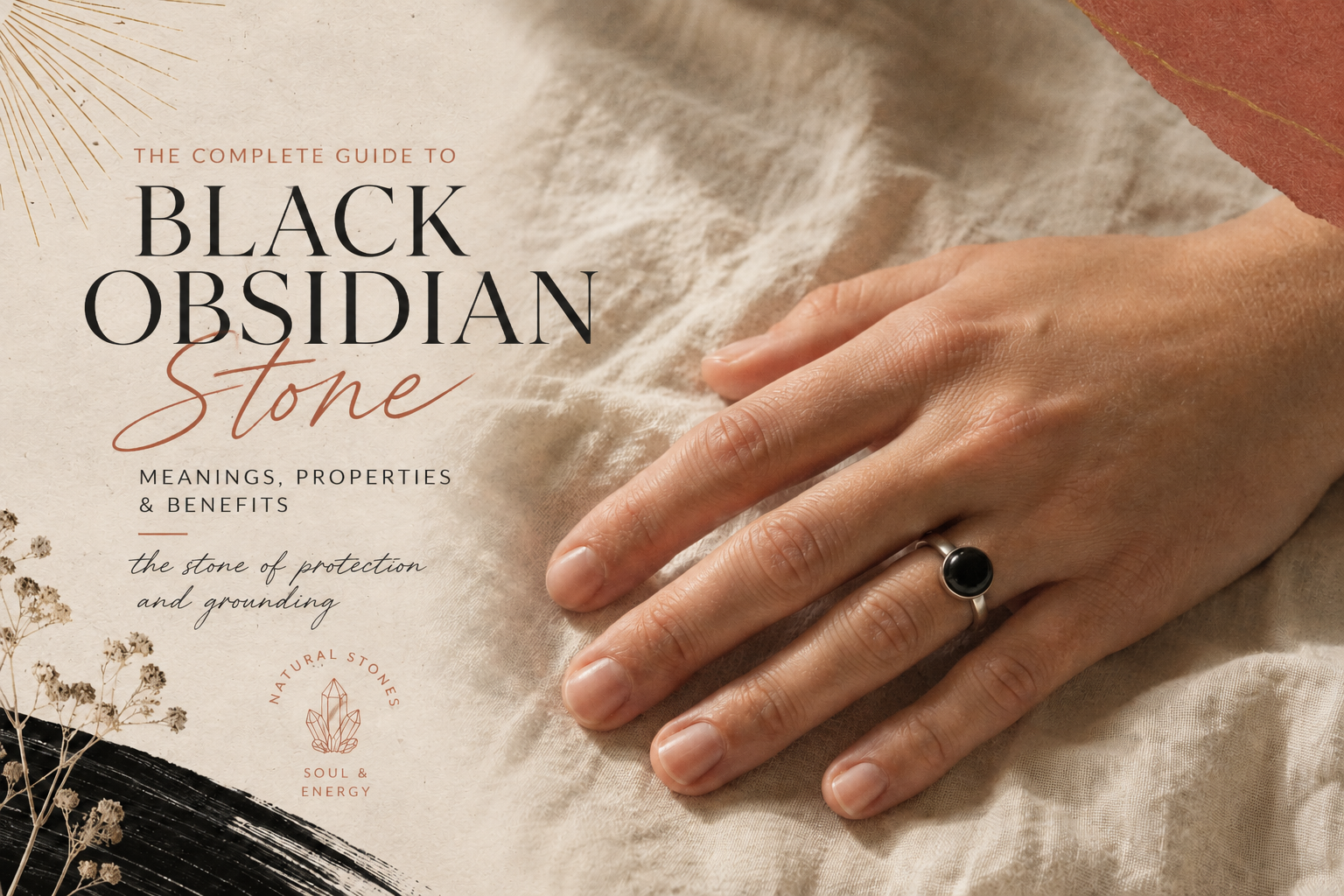
A ring cut from glass
Let's start with what nobody says on pages selling obsidian rings. Obsidian isn't a crystal: it's volcanic glass, lava that cooled too fast to crystallize. It rates about 5 to 5.5 on the Mohs scale, and crucially it has no cleavage plane: it breaks into sharp splinters, like a bottle. If the topic interests you, it's fully explained in my article on how obsidian is formed.
And the hand is, of the whole body, the part that runs into the most obstacles: doorknobs, keyboards, steering wheels, pots and pans, bags, car doors. A ring takes more knocks in a week than a pendant does in a year. This is the least durable format for this stone, and no precaution changes that reality, it can only delay it.
That said, a ring is still the most visible, most everyday piece of jewelry there is, and black obsidian looks stunning as one. You just need to know what you're getting into, and understand the two settings that exist:
Solid-stone ring
The whole band is cut from a single block of obsidian. Visually very pure, but fragile: a drop onto tile can crack it, and it can never be resized. This version is best reserved for occasional wear.
Stone set on a band
Obsidian set onto a sterling silver or steel band. Much sturdier: the metal absorbs the impact, and the stone stays protected by the setting. This is what I recommend for everyday wear.
I could sell you a solid-stone ring and tell you it'll last forever. It won't. I'd rather tell you to choose a silver setting if you plan to wear it daily, even if it means selling fewer solid-stone pieces, at least you won't be disappointed six months in.
Which finger, which hand
There's a tradition, inherited from Renaissance astrology, that assigns a planet and a quality to each finger. It's a lovely idea, and it has the merit of existing: it's a symbolic convention, passed down from hand to hand, not an established rule. No one has ever measured a ring behaving differently depending on the finger.
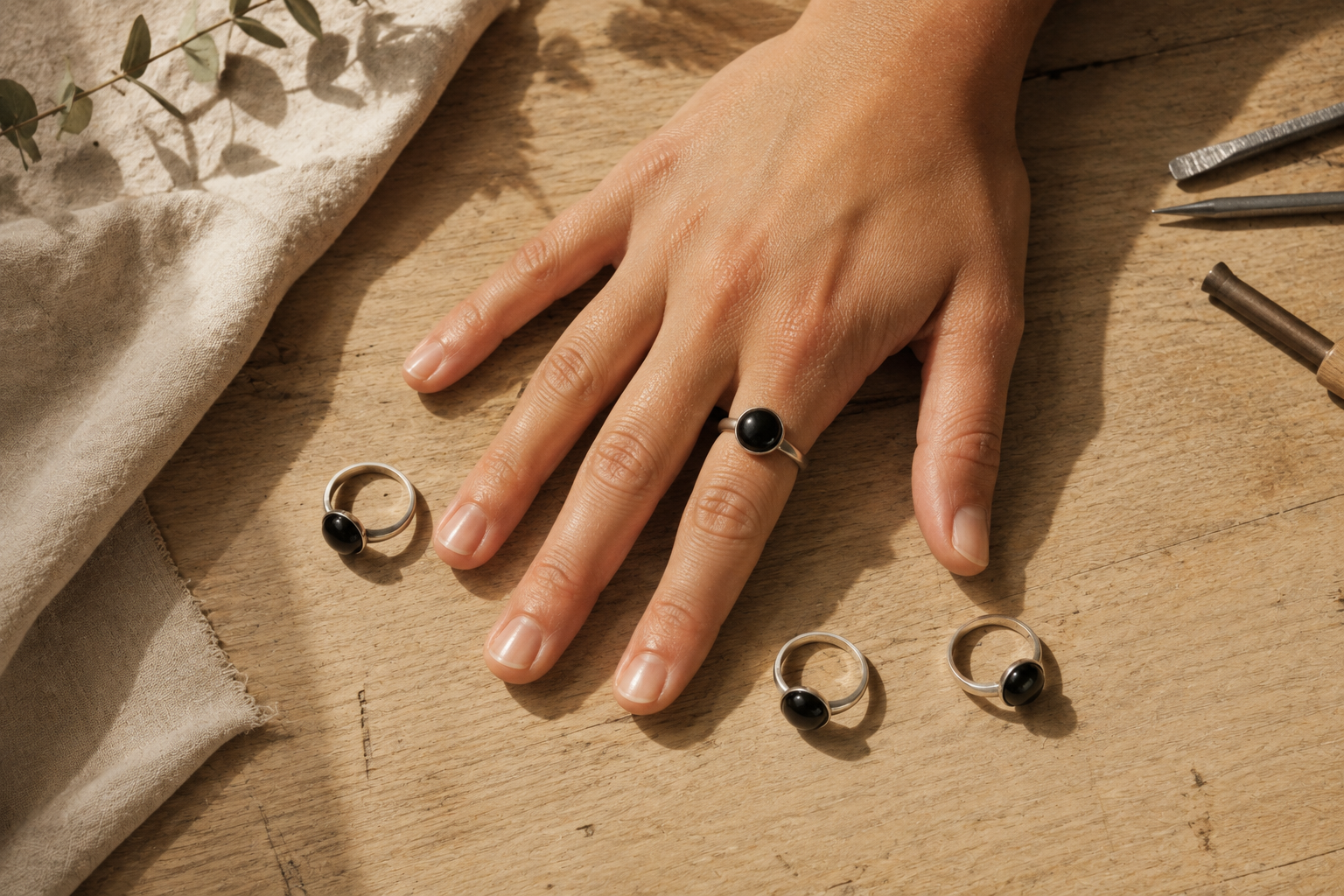
For obsidian, a much more down-to-earth criterion gives a clear answer: which finger takes the fewest knocks? The table below crosses both readings.
| Finger | What tradition attributes | In practice | My take |
|---|---|---|---|
| Thumb | Will, self-assertion | Wide band, very exposed, rubs against everything | Avoid for obsidian |
| Index | Authority, decision (Jupiter) | The pointing, pressing, tapping finger | Risky for daily wear |
| Middle | Structure, balance (Saturn) | The longest: takes every frontal impact | The worst choice for a soft stone |
| Ring finger | Emotion, commitment (Venus) | Rarely used, protected by both neighbors | My pick, without hesitation |
| Little finger | Communication, exchange (Mercury) | Few knocks, but slides off easily | Good second choice, if the fit is precise |
Left hand or right hand?
You'll read everywhere that the left hand "receives" and the right hand "gives." It's a common line in crystal healing, with nothing establishing its basis; it comes from a symbolic reading of the body, not an observation. Follow it if it speaks to you, it won't do any harm.
The criterion I recommend is simpler: wear it on your non-dominant hand. Left if you're right-handed, right if you're left-handed. Your dominant hand handles 80% of your movements, grabbing, twisting, writing, carrying, and that's what damages rings. This one habit alone can easily double the piece's lifespan.
Bottom line, ring finger, non-dominant hand. If you're set on finger symbolism, keep in mind that black obsidian is tied to the root chakra, so to the lower body: no finger will get it there. See the full mapping in my guide to obsidian and chakras.
Choosing the right size
With a metal ring, getting the size wrong by half a size is a minor setback: you have it resized. With an obsidian ring, it's final. A solid-stone ring can't be enlarged or tightened, and a set stone can only be resized by fully dismantling the setting. Sizing is therefore the single most important decision in this purchase.
Three precautions are worth more than a return:
- Measure at the end of the day, fingers swell over the course of the day and with heat. A size taken in the morning will feel too tight by evening;
- Measure the exact finger, the left and right ring fingers often differ by half a size on the same person;
- Check the knuckle fit, that's what decides, not the base of the finger. A ring that goes on with difficulty will come off badly if your finger swells.
If you're torn between two sizes, take the larger one: a slightly loose ring spins, a too-tight one becomes a real problem. All the sizing details are in my size guide.
Careful, this point is rarely mentioned and it matters: in a medical emergency, ring cutters used by first responders are designed for metal. A band cut from solid stone can't be cut off: it has to be broken. One more reason never to wear an obsidian ring too tight, especially if your fingers swell easily.
What damages it
Here's the list I'd love to slip into every package. None of this is mystical, it's just mechanics.
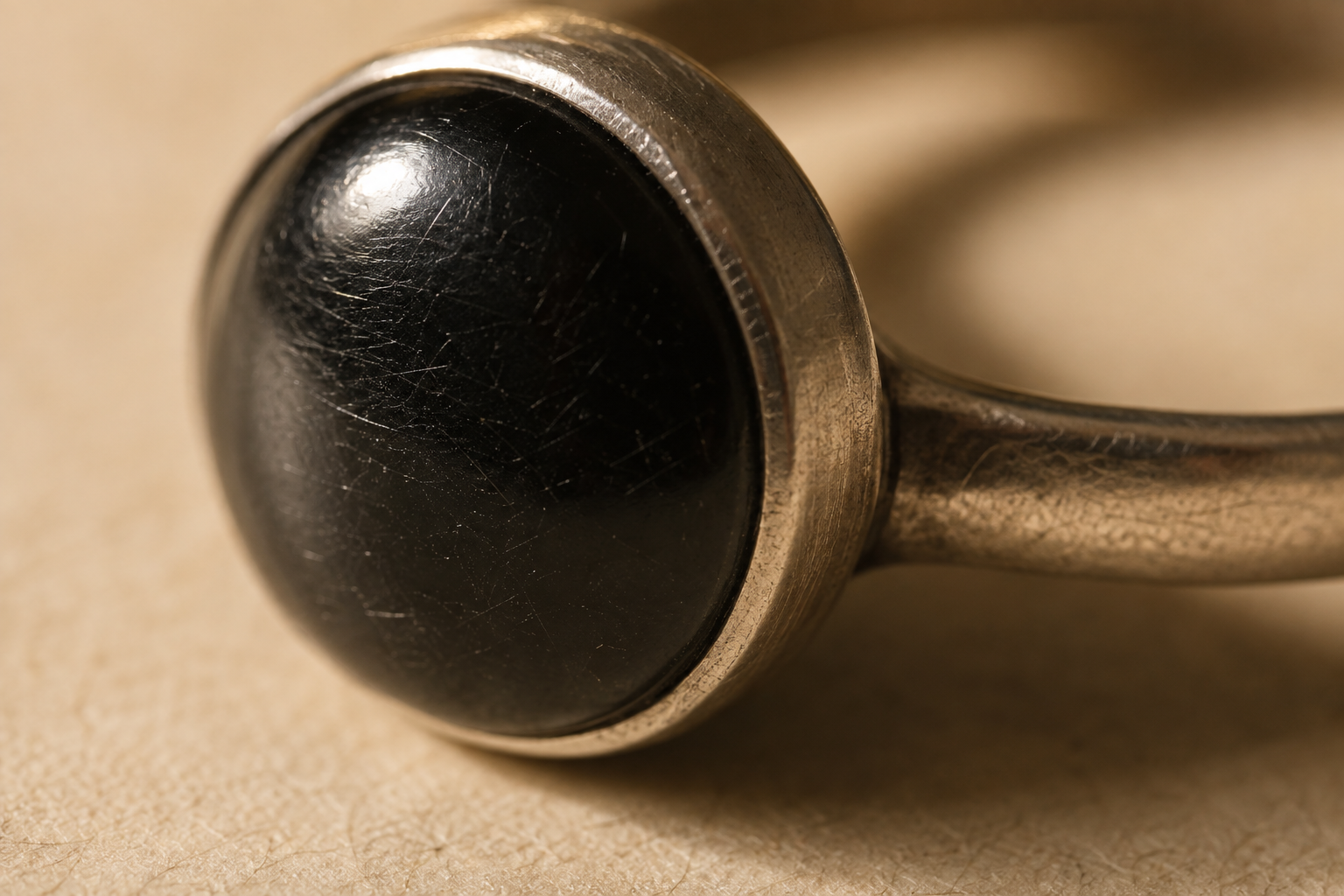
- Housework and gardening, cleaning products, gravel, soil. Sand is harder than obsidian: it will scratch it, guaranteed;
- Weightlifting and cycling, bars, handlebars, grips: this is where rings crack most often;
- Cooking, knocks against the sink and pots, oil and vinegar on the stone;
- Lotions and perfume, alcohol and oils dull the polish, especially inside the setting;
- Your pocket or bag, taking the ring off and tossing it loose into a pocket with keys is the fastest way to scratch it. A small pouch is all it takes;
- Other rings, a metal ring worn on the neighboring finger rubs against the stone all day.
None of this is dramatic. But black obsidian is matte and deep: it shows scratches far more than a light-colored stone, which is exactly why the disappointment stings when it happens.
When to wear it, when to take it off
Crystal healing describes black obsidian as a blunt, sometimes abrupt stone, and treats it more as a daytime stone. Many people report restless nights while keeping it on overnight; these are personal accounts, not measurements, but common enough to take into account. I've written a full article on this: sleeping with black obsidian.
For a ring, the sleep question actually settles itself: a ring worn at night catches on sheets, presses against the neighboring finger, and scratches against the headboard. Take it off in the evening, it's all upside.
- Shower, bath, pool, ocean, soap dulls the polish, chlorine attacks settings, salt lodges in the micro-fractures;
- Sports and DIY, without exception, this is where accidents happen;
- At night, for the reasons above;
- Before lotion and perfume, get ready first, put the ring on after.
The rest of the time, wear it without counting the hours. Ten to twelve hours a day is what most people wearing a protective black obsidian do, and that's perfectly fine.
A small dish by the kitchen sink and another on the nightstand: it's the only "method" I know that actually works. A ring taken off in a fixed spot goes back on the next day. A ring set down just anywhere ends up forgotten in a drawer.
What to pair it with
Two questions hide here: the metal of the setting, and how it coexists with other jewelry. The metal comes first, because it decides comfort.
The metal
Black obsidian is matte and absorbs light: it pairs better with cool, understated metals, sterling silver, stainless steel, than with warm gold, which makes it look gray by comparison. Above all, avoid cheap alloys: nickel is the leading cause of skin reactions from jewelry, and a finger turning red under a ring almost always points to the setting, never the stone. My rings are set in sterling silver or steel, precisely for this reason.
Other jewelry
When layering, leave a finger's gap between an obsidian ring and a metal one: constant metal-on-stone contact wears the surface. As for stones, tradition commonly pairs black obsidian with:
- tiger eye, the most classic duo, described as protective and stabilizing, covered in a full guide;
- hematite, the same grounding logic, and a metallic tone that pairs well;
- rose quartz, to soften a set that obsidian alone would make feel austere.
Certain combinations, on the other hand, are advised against by tradition: details are in my guides to obsidian pairings and crystals not to pair with obsidian. These are symbolic correspondences: if a combination pleases you, nothing stops you.
Finally, if the ring feels too exposed for your daily life, a black obsidian pendant offers the same presence with ten times fewer knocks. Black obsidian is also one of the few genuinely unisex stones, making it a classic of men's jewelry; and if plain matte black feels too severe, look at rainbow obsidian or the full range of obsidian varieties.
Care and cleansing
A ring worn every day gets dirty faster than any other piece of jewelry: hands spend their time in water, soap, and lotion.
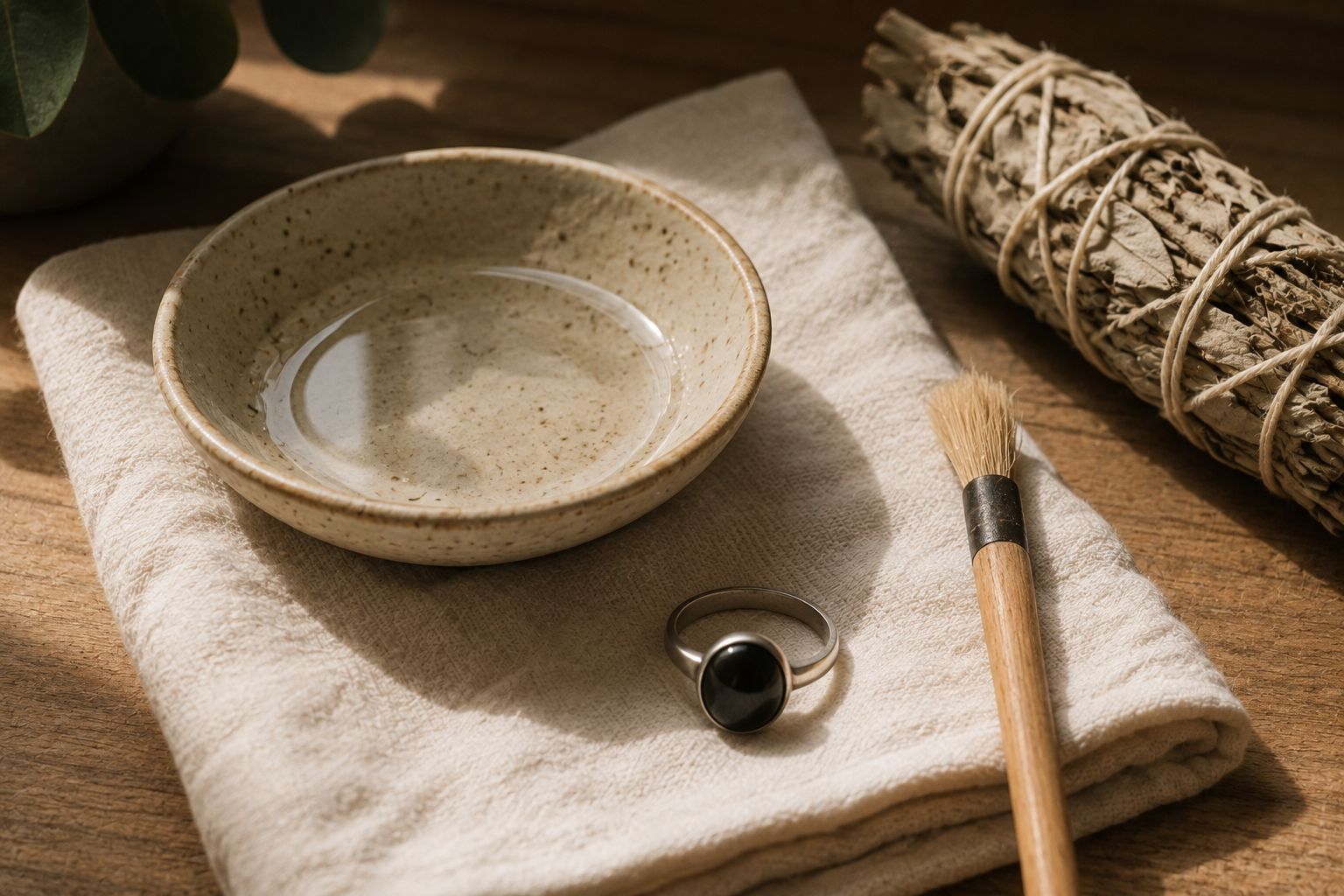
- Every evening, a wipe with a soft, dry cloth. This is what keeps the stone looking clean;
- Once a week, lukewarm clear water, a very soft brush for under the setting where soap builds up, dry immediately;
- Never salt, dry or dissolved: it lodges in the micro-fractures and dulls the surface. This is the most broken rule, and the most damaging;
- Never an ultrasonic cleaner, the vibrations can spread an invisible micro-fracture through volcanic glass;
- Cleansing, sage or palo santo smudging, or a quick rinse in clear water, depending on the tradition you follow;
- Recharging, moonlight, or contact with the earth. Avoid extended full sun.
Full details are in my guides to cleaning obsidian and cleansing and recharging obsidian. One last word on what you're buying: colored glass sold as obsidian is common, and the tells to avoid it are covered in obsidian pricing and value. A genuine black obsidian has no reason to be expensive.
And if the ring ends up feeling too exposed for your life, it happens, and it's not a failure, the wrist and the neck take over without losing anything of the stone.
Precautions & good practice
Three practical points before wearing a cut stone on your finger.
- Chips and splinters, obsidian breaks into sharp edges. A cracked or chipped ring should be removed immediately, not "worn a little longer";
- Tightness, never wear a stone ring that's too tight, for the reason explained above: it can't be cut off in an emergency;
- Skin, redness under the band almost always comes from the metal. Change the setting before giving up on the stone.
And a deeper point: if you're wearing black obsidian because you're going through anxiety, poor sleep, or lasting fatigue, the piece can accompany you, but it doesn't replace medical advice. Talking to your doctor is the single most useful step, and there's nothing excessive about it.
Worth knowing, the properties described here belong to spiritual traditions and crystal healing, a wellness practice grounded in beliefs. They are not a medical claim, do not treat any condition, and never replace the advice of a health professional. See also obsidian safety and precautions and the complete obsidian guide.
Frequently asked questions
Which finger should a black obsidian ring be worn on?
Left hand or right hand for an obsidian ring?
Does a black obsidian ring scratch easily?
Can you wear a black obsidian ring every day?
Can an obsidian ring be resized?
Can you sleep with a black obsidian ring?
How do you clean a black obsidian ring?
Black obsidian, handmade
Rings, bracelets, pendants, and necklaces in natural obsidian, shaped in my studio in France.