Mahogany Obsidian and Its Reddish-Brown Veins
Black and reddish-brown, veined like a fine timber, mahogany obsidian is the warmest stone in the family. Where black obsidian is blunt and at times confronting, this one is earthy and reassuring. Here's where its colour comes from, what crystal healing credits it with, and how to tell it apart from jasper.
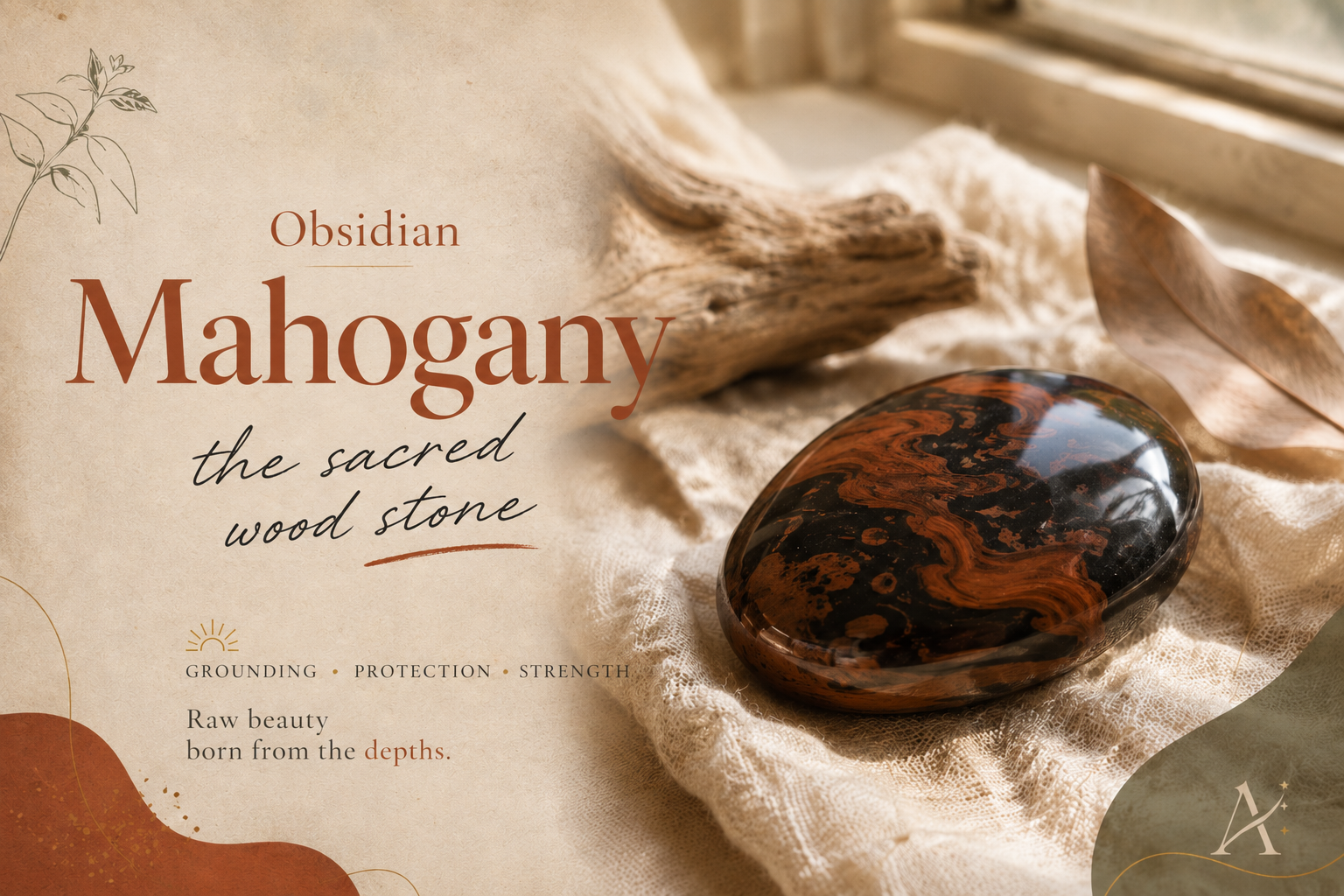
What is mahogany obsidian?
Mahogany obsidian is a variety of black obsidian, the volcanic glass born when silica-rich lava cools too quickly. Its distinctive trait is its reddish-brown zones, sometimes orange, blending with the black in broad patches, veins or cloud-like swirls.
The result is easily mistaken for polished mahogany timber, hence the name. Every stone shows a unique pattern: some are mostly black with a few rust-coloured streaks, others almost entirely reddish-brown with dark islands.
Unlike rainbow obsidian or its localised eye-sheen counterpart, whose effect depends on the angle of light, mahogany shows its colours constantly. It's a straightforward variety, with nothing hidden, which is also what makes it so easy to live with. You'll find it alongside the others in my guide to obsidian varieties.
This is the stone I recommend to people who find black obsidian a little severe. Same family, same grounding, but with something softer in its expression. It's as if it took on the colour of the earth as it cooled.
Where does its reddish-brown colour come from?
No dye here either: the colour is entirely natural and comes down to the chemistry of iron.
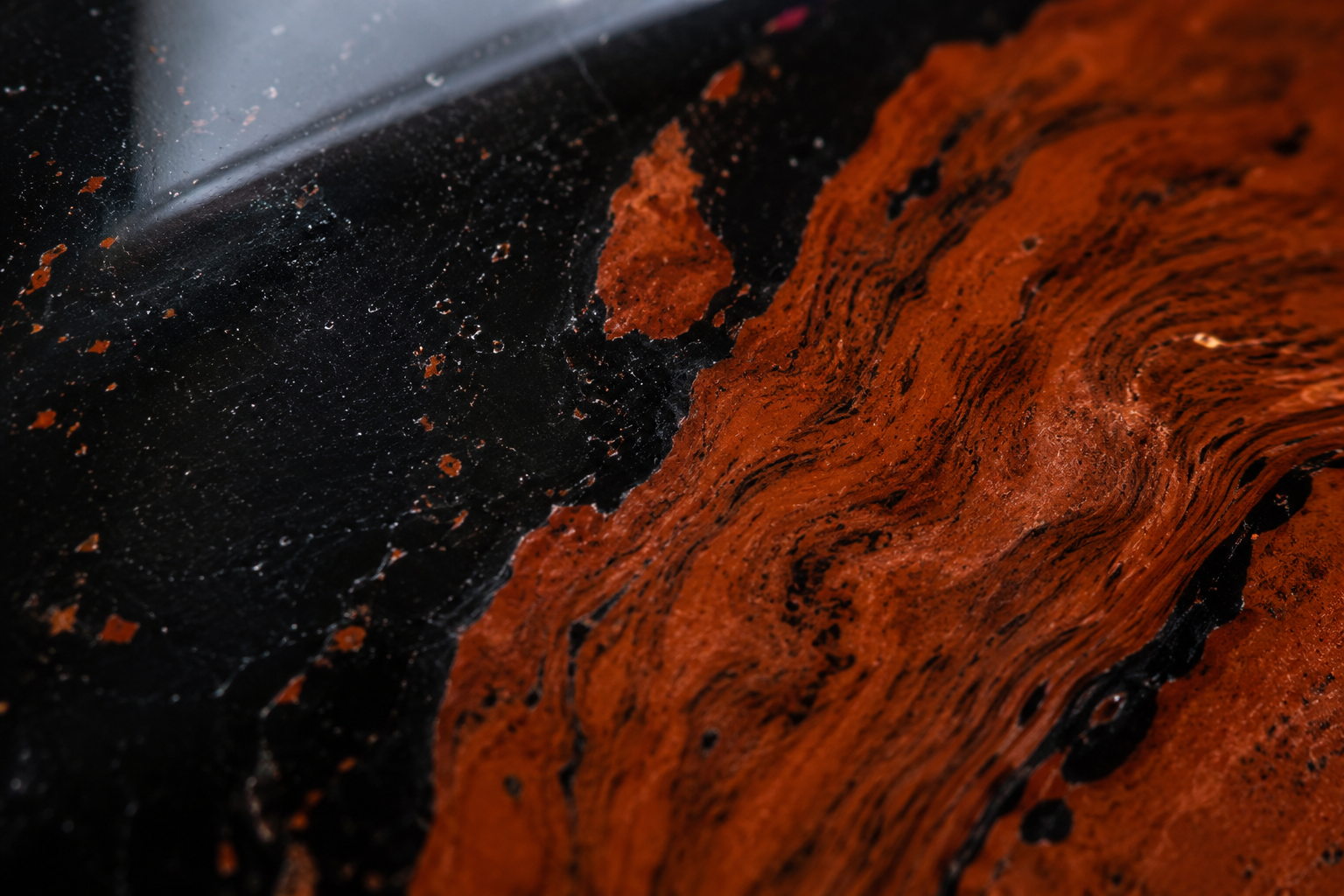
As the lava flow cooled, iron inclusions present in the glass oxidised and turned into hematite and related iron oxides. These compounds produce the rust, brick and reddish-brown tones seen in the stone.
The vein-and-cloud distribution comes from the movement of the lava itself: the still-viscous material stretched and folded before setting, trapping the oxidised zones within flow patterns. It's literally the movement of a lava flow stopped dead in its tracks.
On some stones, you'll also spot tiny spherulites, small clusters of crystals that formed around a nucleation point. For the full picture of the process, see my article on how obsidian is formed.
Mahogany or acajou: which is the right name?
Both, and they refer to exactly the same stone. Acajou is simply the French word for "mahogany", and the name mahogany obsidian is the one that dominates in the international mineral trade.
So you'll come across mahogany obsidian, obsidian mahogany, or occasionally brown obsidian, used interchangeably. None of these names points to a higher grade: it's the same variety.
Small tip, if a seller talks about "premium mahogany obsidian" or "AAA mahogany", be sceptical. There's no official grading system for obsidian. What matters is the beauty of the pattern and the quality of the polish, not a marketing label.
The properties of mahogany obsidian
In crystal healing, mahogany is described as the warm, vital version of obsidian. It keeps the family's protective and grounding qualities, but is credited with a more energising quality, geared toward action rather than introspection.
It's generally associated with:
- grounding and stability: like every obsidian, but in a version described as gentler;
- vitality and drive: its dominant reputation, tied to its earth and fire tones;
- confidence in one's own strength: recommended during moments of self-doubt;
- moving out of apathy: said to support getting back into motion after a period of fatigue or stagnation;
- healing old wounds: tied to self-worth or a sense of not belonging.
It's described as a stone that's gentle but persistent, less dramatic than black obsidian, more consistent over time. For the broader context, see my article on obsidian, protection and grounding.
I always associate it with the start of a new term, for whatever reason. Those moments when you have to get moving again without really wanting to. Mahogany carries something of that energy: not euphoric, just solid.
Chakras and energy
Mahogany obsidian is traditionally linked to two centres:
- the root chakra (Muladhara), like every obsidian, grounding, safety, connection to the body;
- the sacral chakra (Svadhisthana), below the navel, creativity, pleasure, life force. This is where its orange tones set it apart: it's one of the few obsidians credited with touching this centre.
This double association makes it a stone of getting back into motion: ground first, then move forward. I've mapped the full picture in my guide to obsidian and chakras, and for the practice itself, see meditating with obsidian.
Associated star signs
In crystal healing, mahogany obsidian is traditionally associated with:
- Taurus: for its connection to earth, matter and consistency;
- Capricorn: for its persistence and grounding;
- Aries: for its drive and its quality of getting things moving;
- Scorpio: for the link, shared by every obsidian, to deep transformation.
As always, these correspondences are indicative: the stone you're spontaneously drawn to is often the right choice.
How to wear mahogany obsidian
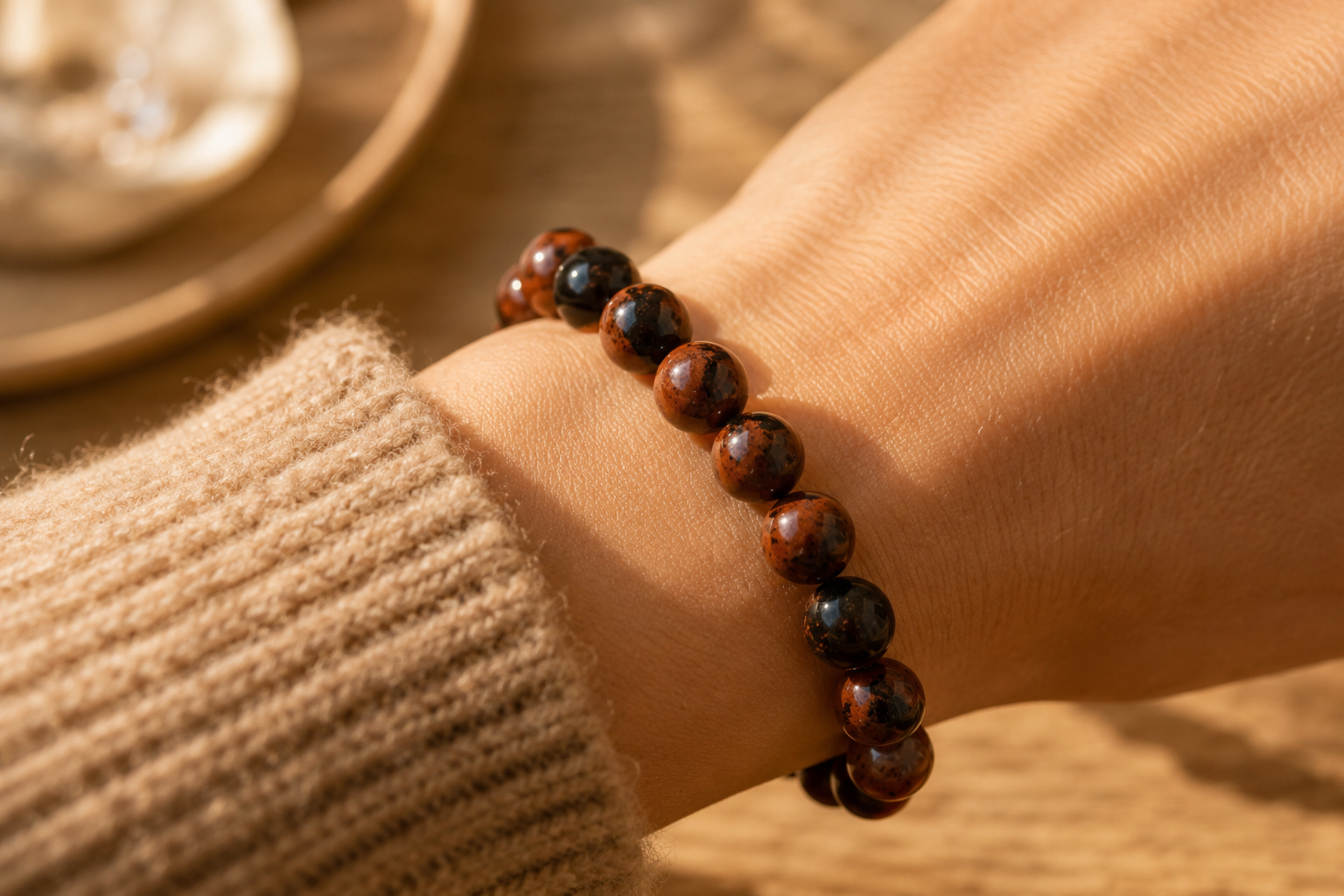
Mahogany has a practical edge over the optical-effect varieties: its colours show in any light, including indoors. No orientation to worry about.
- as a bracelet, the most common choice, and best suited to its everyday grounding energy;
- as a long pendant, to bring it down toward the sacral chakra and solar plexus;
- as a ring, its warm tones pair especially well with brass and gold;
- as a necklace, to keep the stone close to the heart.
It's also the easiest obsidian to style: its warm browns work with leather, wood, natural materials. It pairs well with tiger's eye, which shares its golden tones, as well as carnelian or red jasper to reinforce the sacral chakra. All the combinations are in my guide to crystal pairings, and check the jewellery size guide before ordering.
Not to be confused with jasper
This is the most common mix-up, and it isn't trivial, since the two are completely different rocks. Mahogany jasper shares a similar palette, but it isn't obsidian.
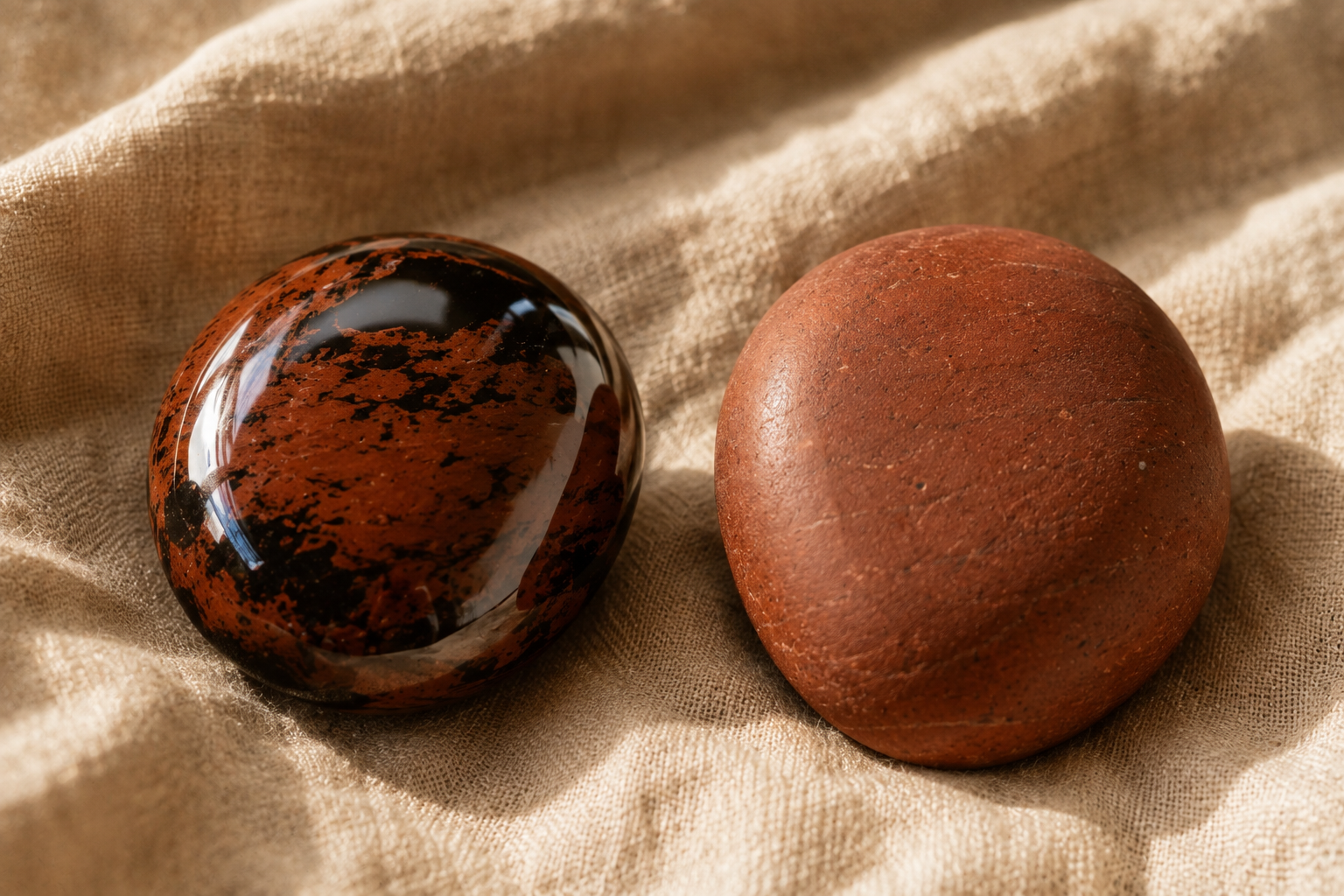
| Criterion | Mahogany obsidian | Mahogany jasper |
|---|---|---|
| Nature | Volcanic glass (amorphous) | Microcrystalline quartz |
| Lustre | Vitreous, almost mirror-like | Matte to waxy |
| Transparency | Slightly translucent on thin edges | Fully opaque |
| Fracture | Conchoidal, curved, sharp | Irregular, granular |
| Hardness (Mohs) | 5 to 5.5 | 6.5 to 7 |
| Feel | Cool, smooth like glass | Less cool, slightly grainy |
The simplest test: hold the stone up to the light against a thin edge. Obsidian lets a little reddish glow through; jasper stays completely opaque. The second marker is lustre: polished obsidian has the shine of glass, jasper has that of a matte pebble.
Also worth watching, some stones sold as "mahogany obsidian" are actually dyed black obsidian. A telltale sign: a perfectly uniform reddish-brown colour, with no veins or variation. Genuine mahogany is always irregular, never monochrome. For pricing, my guide to obsidian price and value will give you useful benchmarks.
Mineral data sheet
- Nature
- Natural volcanic glass (mineraloid, amorphous)
- Other names
- Acajou obsidian, brown obsidian
- Colour
- Black mixed with reddish-brown, rust and orange, in veins and clouds
- Source of colour
- Iron oxidising into hematite during cooling
- Composition
- Silicon dioxide (SiO₂), iron oxides, magnesium
- Hardness (Mohs)
- Around 5 to 5.5
- Structure
- Amorphous (no crystal lattice)
- Fracture
- Conchoidal, sharp-edged
- Main sources
- Mexico, United States (Oregon, California)
- Chakras
- Root, sacral
- Star signs
- Taurus, Capricorn, Aries, Scorpio
Care and cleansing
Mahogany is cared for like other obsidians, with one extra point of attention: its red zones, richer in iron oxides, are slightly more sensitive to acids. Avoid vinegar, lemon and household cleaning products.
- Cleaning, a soft, dry cloth, or lightly damp if needed, dried immediately;
- Cleansing, smoke from sage or palo santo, or a brief rinse in clear water. Avoid salt;
- Charging, moonlight suits it well. Some also rest it in direct contact with the earth, which fits its energy nicely;
- Precaution, medium hardness: store it away from harder stones that would scratch it.
The full run-down is in my guide to cleansing and charging obsidian.
Good to know, the properties described here come from crystal healing, a wellbeing practice based on tradition and belief. They are not a medical claim, do not treat any condition, and never replace advice from a health professional. See also obsidian, dangers and precautions.
Frequently asked questions
What's the difference between mahogany and acajou obsidian?
Where does mahogany obsidian's reddish-brown colour come from?
How do you tell mahogany obsidian from mahogany jasper?
What are the properties of mahogany obsidian?
Which chakra does mahogany obsidian correspond to?
Is mahogany obsidian suitable for beginners?
How can you recognise dyed mahogany obsidian?
Find your mahogany obsidian
Bracelets, necklaces, pendants and rings in natural obsidian, handmade in my studio in France.