Myths and Legends of Obsidian
A goddess with blade-edged wings, tears turned to stone, a god who wears a mirror in place of a foot: obsidian trails a long procession of stories behind it. But not all of them are the same age, or carry the same weight. Here are the myths and legends of obsidian, distinguishing those attested for centuries from those invented a hundred years ago, or yesterday.
Two families of legends
Before telling any of these stories, one distinction changes everything. The tales attached to obsidian fall into two groups that are constantly blurred together:
Attested traditions
Documented by ancient sources, codices, texts. We know who told them, when, and in what context. Almost all of them come from Mesoamerica.
Recent legends
Emerging in the 19th or 20th century, often within collector literature or the crystal trade, then presented as timeless.
This distinction takes nothing away from the beauty of the second group. A hundred-year-old legend is still a legend, and it tells us something true about the people who invented it. But presenting it as ancestral knowledge is a different matter, and it's exactly what most pages on the subject do.
I sell stones, so it's very much in my interest for their stories to be ancient and mysterious. That's exactly why I'd rather say when they're not, otherwise nothing else I claim carries any weight.
The birthplace: Mesoamerica
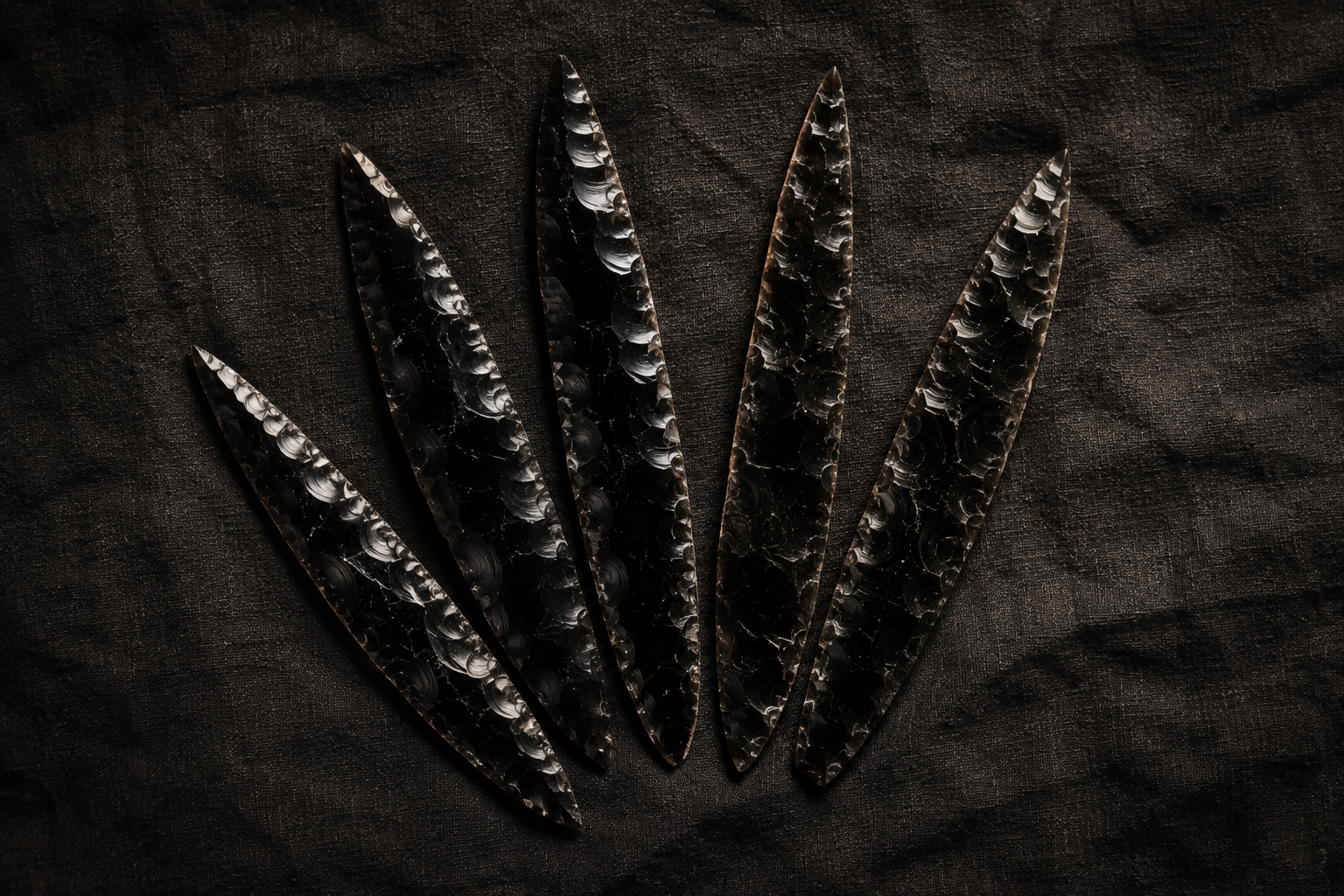
This is where the only genuinely documented traditions are found. For the Aztecs, obsidian, itztli in Nahuatl, wasn't a curiosity: it was a central material, yielding blades of formidable sharpness and mirrors. It naturally had its own deities.
Tezcatlipoca, the Smoking Mirror
The most famous. God of night, fate and sorcery, Tezcatlipoca carries an obsidian mirror, sometimes at his chest, sometimes in place of a foot, in which he's said to read all things. His name literally means "Smoking Mirror". I've written a full article on this divinatory practice and what people genuinely see in it: the black obsidian scrying mirror.
Itzpapalotl, the Obsidian Butterfly
Far less known, and strikingly different. Itzpapalotl is a skeletal warrior goddess, queen of the Tzitzimimeh, who rules over Tamoanchan, a paradise associated with children who died in infancy and the place where humans were created. Her name translates as "Obsidian Butterfly", and her wings are edged with blades.
A nuance that crystal-healing sites always leave out: scholars debate the translation. Itzpapalotl can equally mean "clawed butterfly", and the blades on her wings are described sometimes as obsidian, sometimes as flint. The goddess is real; her exact reading is less certain.
In short, what these figures have in common isn't protection or gentleness, but sharpness and sight. Mesoamerican obsidian isn't a comforting stone: it's a blade and a mirror. The soothing properties credited to it today have nothing to do with these traditions.
Apache tears
This is the most moving legend attached to obsidian, and probably the most widely told. Here it is, in its common version.
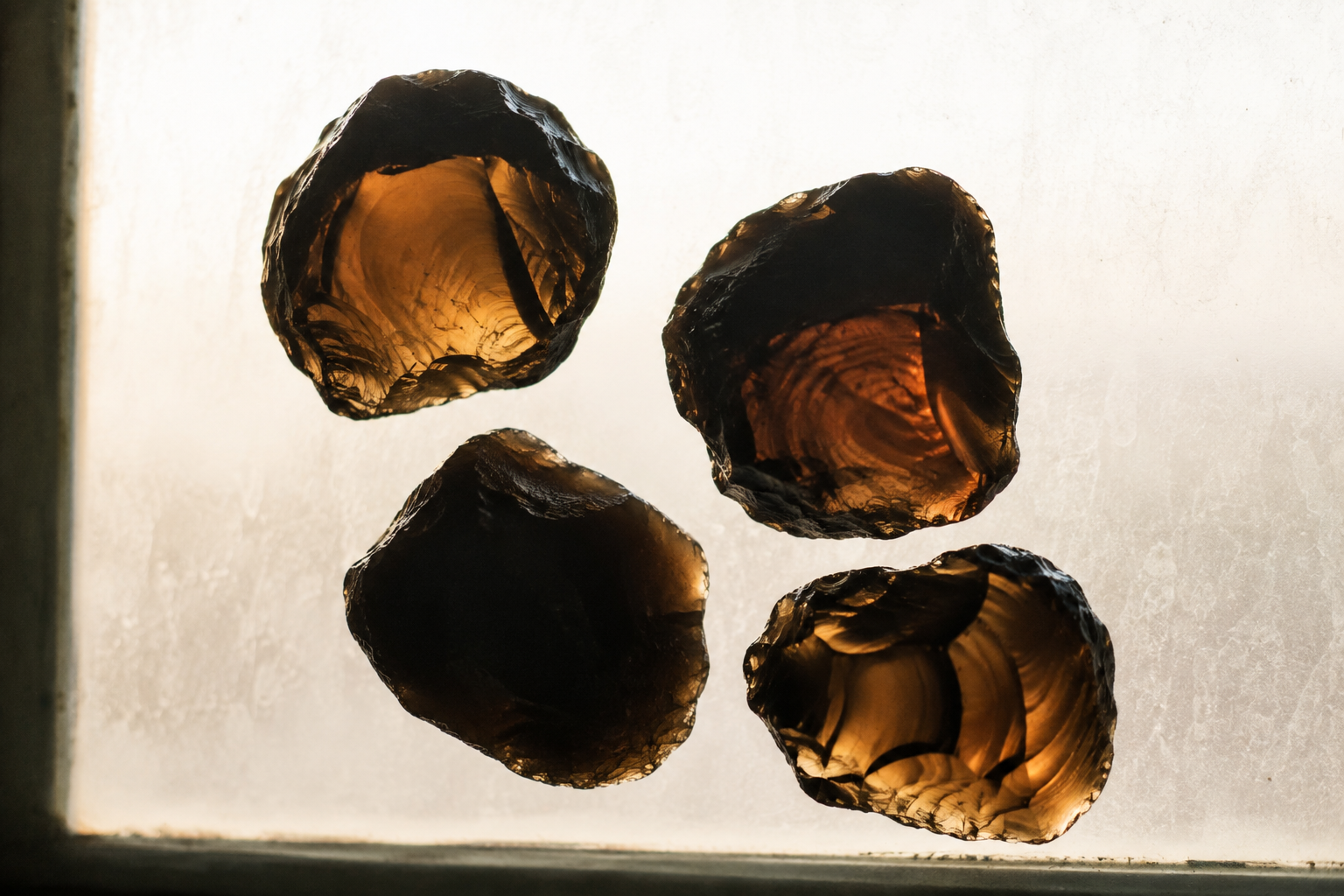
In the early 1870s, in Arizona, a group of Apache warriors is surrounded by the US cavalry atop a cliff near what is now the town of Superior. Rather than surrender, the survivors leap to their deaths, the place has since been named Apache Leap. The grief of their loved ones is said to have been so great that their tears, touching the ground, froze into black stones. These are the rounded obsidian nodules still found in the area today, known as Apache tears.
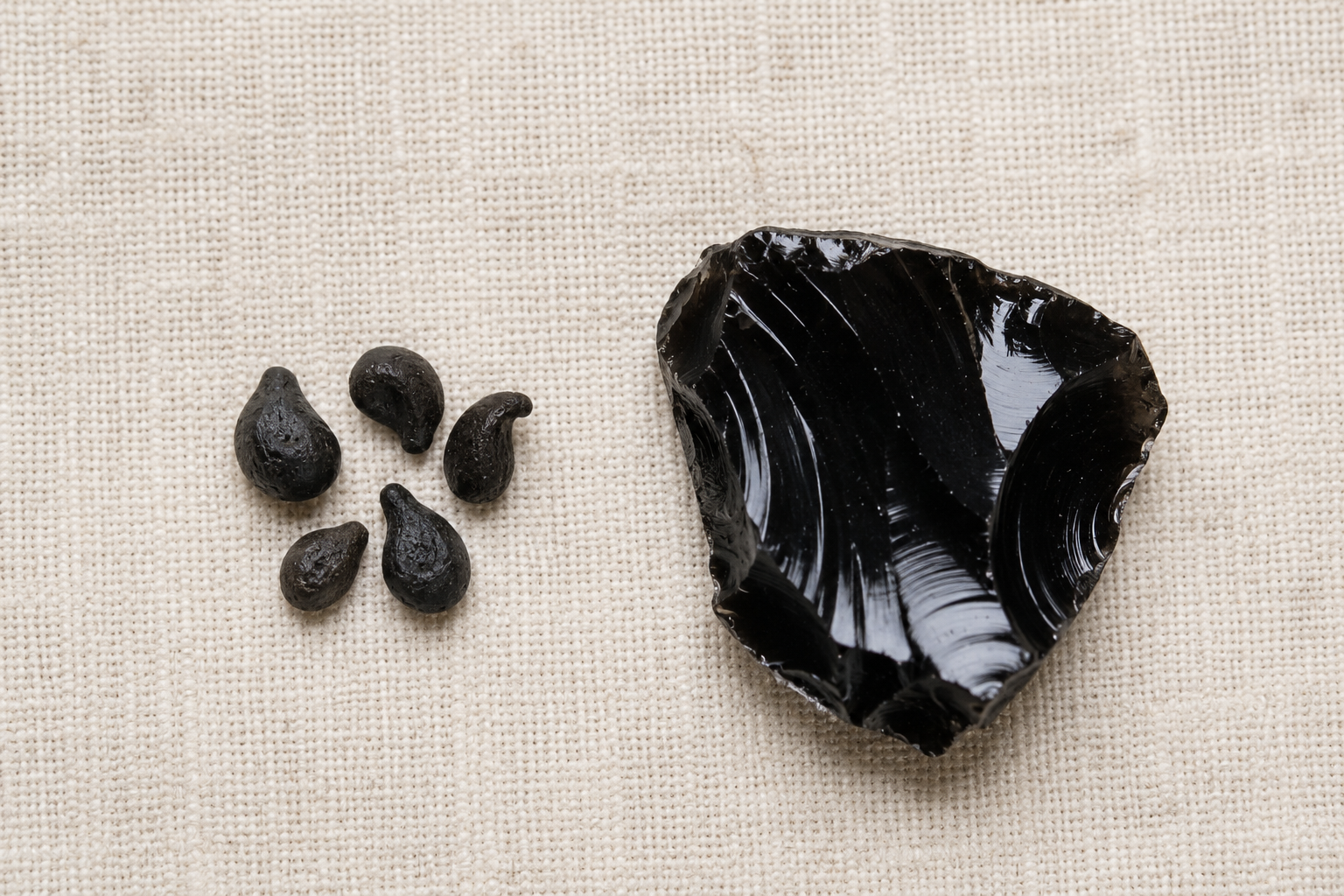
The detail that makes the story so striking is genuinely true: held up to a lamp, these stones are translucent, a deep brown. The "tear" really does show within the material.
Here's the question worth asking, though. This story has circulated in written form since the 20th century, mainly within mineral-collector literature and the crystal trade. Its roots in an authentic Apache tradition aren't established, and folklorists tend to see it as a modern narrative built around a real episode of the Apache Wars. That doesn't disqualify it, it just places it.
Worth noting, behind the legend lies a period of real violence against Apache peoples. Telling this story as a pretty sales pitch would be out of place. It deserves to be told with the weight it carries.
Europe and the stone from elsewhere
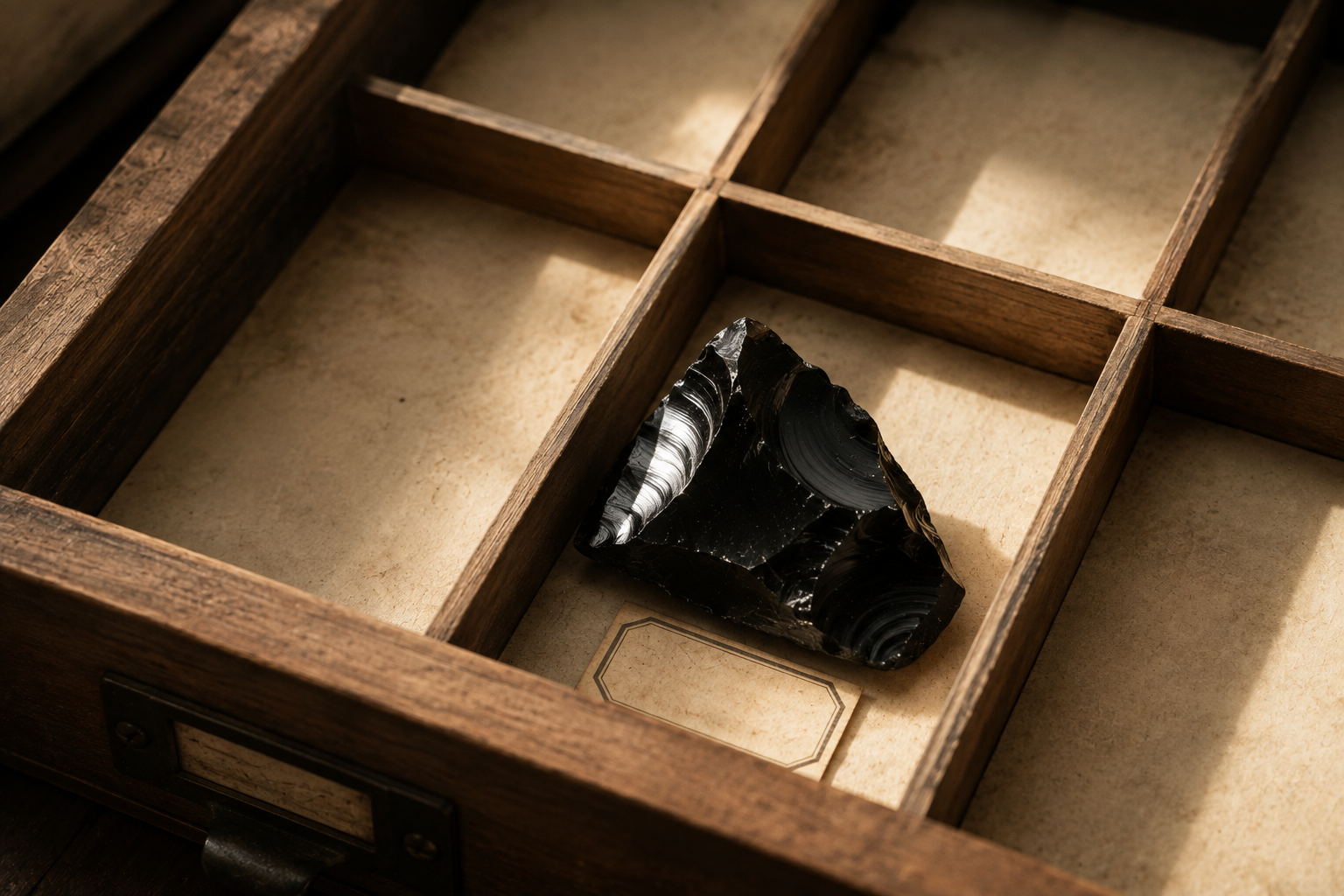
Europe never developed its own obsidian mythology, for a simple reason: it barely had any. The notable deposits lie elsewhere, Mexico, Iceland, Lipari. What it produced instead were stories of curiosity.
The first comes from Pliny the Elder, who in the 1st century credited the discovery of the stone to a certain Obsius, in Ethiopia. That's where our word comes from, and the story of how it travelled holds a surprise I tell in what does "obsidian" mean.
The second dates to the Renaissance. After the Spanish conquest, Mesoamerican obsidian mirrors reached Europe as exotic objects and became highly sought after. One of them ended up in the hands of John Dee, astrologer to Elizabeth I, who used it for his "conversations with angels". It's now held at the British Museum, and a recent analysis confirmed its Mexican origin.
What's striking is the shift: a stone from Mesoamerican daily life becomes, in crossing the Atlantic, a magical object. The magic wasn't in the stone; it was in the distance.
What gets mistaken for legend
Three mix-ups come up so often they're worth untangling.
Pele's tears are not obsidian
Constantly lumped in with Apache tears. These Hawaiian volcanic glass droplets, named after the goddess Pele, are basaltic in composition, from lava poor in silica. Obsidian, by contrast, comes from lava rich in silica. Distant family, different materials.
Dragonglass is a literary invention
In the world of Game of Thrones, dragonglass, obsidian, is one of the few materials able to kill White Walkers. It's a novelist's invention from the 1990s, and it genuinely revived interest in the stone. No connection to any ancient tradition.
The "obsidians" that aren't
Electric-blue "obsidians", sold with tales of Atlantean stones, are almost always manufactured glass. Here the legend serves directly as a sales pitch: see obsidian price and value.
The legends being born right now
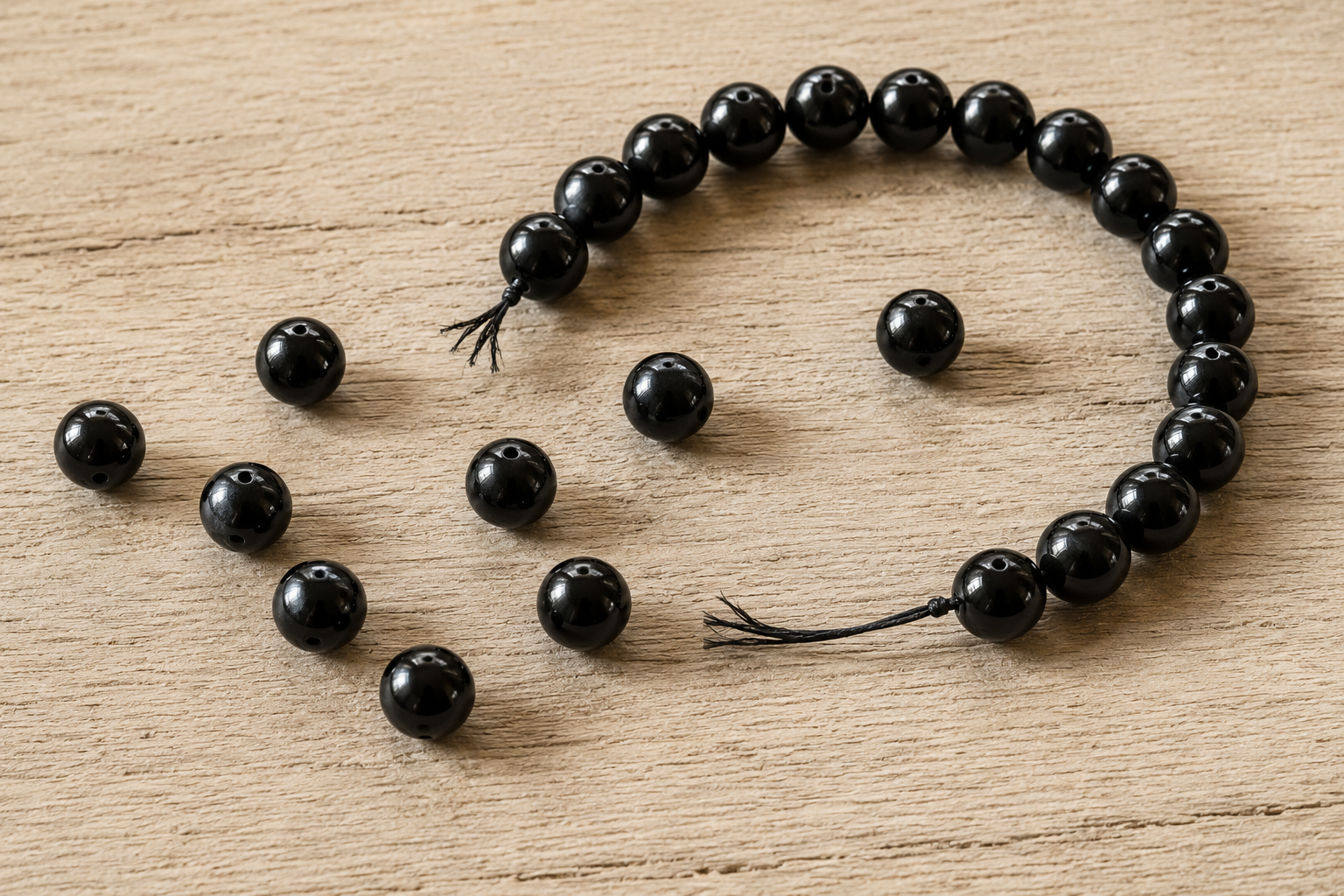
What's most interesting is that you can actually watch a legend take shape. Here's one that appeared with social media: "if your obsidian breaks, it's because it absorbed too much negativity and protected you".
The story is perfect: it comforts, it gives meaning to an accident, and it encourages a repurchase. It has all the makings of a functional myth, and it's less than twenty years old.
What actually happens is more mundane. Obsidian is a glass rated 5-5.5 on the Mohs scale, with a conchoidal fracture: it snaps cleanly under impact, like a window pane. And on a bracelet, it's most often not the stone that fails but the elastic cord, worn down by water, soap and perspiration. I see it every week in the studio.
When a customer tells me "my bracelet broke, it protected me", I never contradict them: if the story helps, it's theirs to keep. But when they ask me why, I give the honest answer, it's the cord, and I can restring it.
The fix is straightforward: take your bracelet off before showering and exercising, and have it restrung when it loosens. It's all in my guide to cleaning and caring for obsidian.
Precautions & good practice
One rule, and it holds well beyond obsidian: always ask where a story comes from. A documented tradition ties back to a culture, an era, a source. A recent legend has no genealogy, which is exactly why it's presented as "ancestral", a word that means nothing and commits no one.
This doesn't mean rejecting everything. A story can be beautiful and useful without being old, and the stories we tell ourselves serve a purpose. It's simply about knowing what you're actually holding. If the topic of properties interests you, it's covered in protection and grounding and in the complete obsidian guide.
Good to know, the myths and properties described here come from spiritual traditions, folklore and crystal healing, a wellbeing practice based on belief. They are not a medical claim, do not treat any condition, and never replace advice from a health professional.
Frequently asked questions
What is the legend of obsidian?
Where does the Apache tears legend come from?
Who is Itzpapalotl?
Are Pele's tears obsidian?
Does Game of Thrones' dragonglass exist?
What does it mean when obsidian breaks?
How do you tell if a legend is genuinely old?
Obsidian, no added legend
Bracelets, necklaces, pendants and rings in natural obsidian, handcrafted in France, and described for what they are.