Tri-Flow Obsidian, Three Stones in One
Deep black, a reddish-brown patch, a golden sheen, all within a single pebble. Tri-flow obsidian is the least documented variety in the family, and the hardest to pin down. Here's what this name actually covers, why a single lava flow can produce three different-looking stones, and what to check before buying one.
What is tri-flow obsidian?
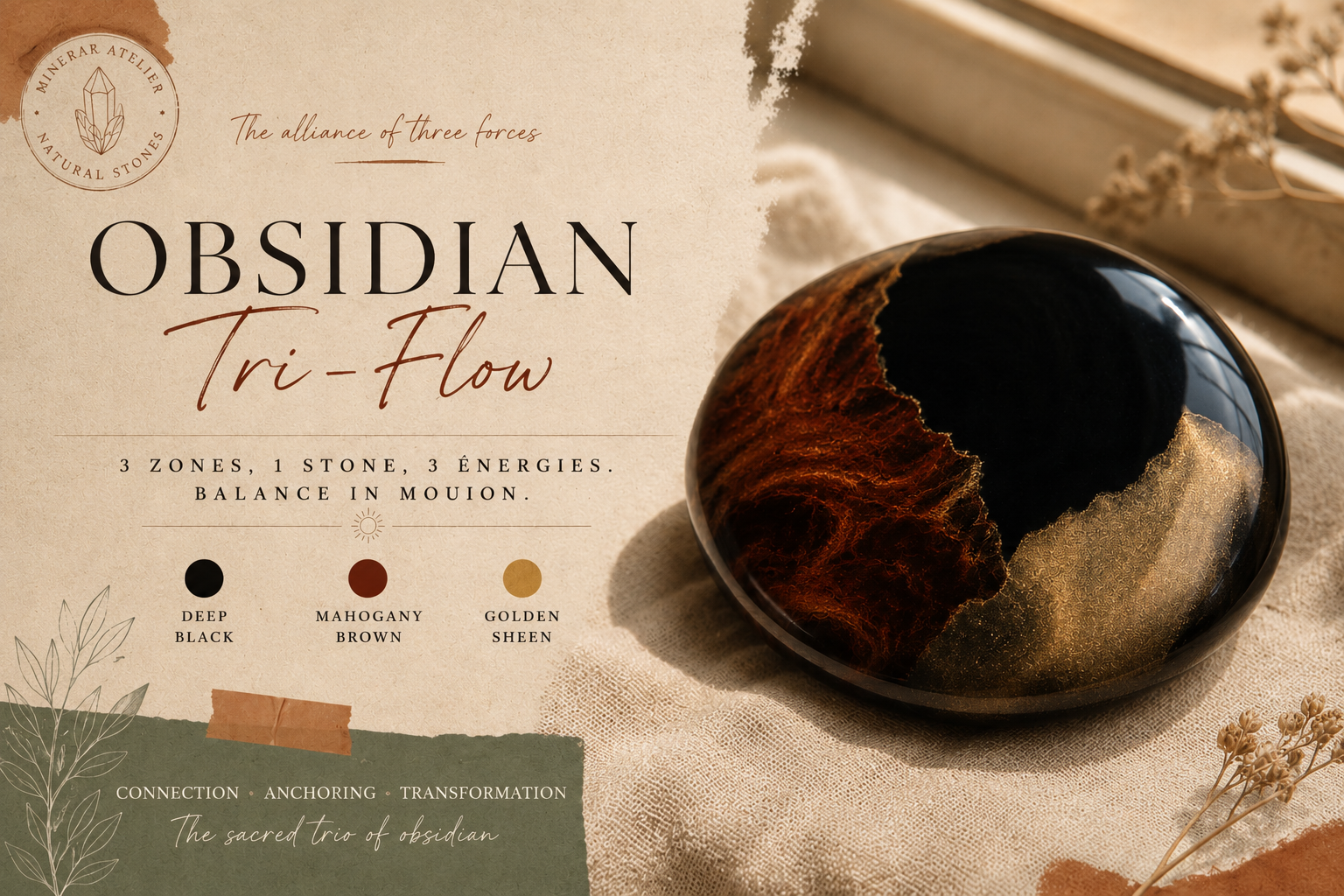
Tri-flow obsidian refers to a stone showing three clearly distinct zones within a single piece, most often a black patch, a reddish-brown, mahogany-type patch, and a third zone that varies: a gold sheen, pale speckling, or more translucent glass.
The term comes from "flow", referring to a lava flow. It signals that the stone comes from a spot where several domains of the same flow, or several overlapping flows, meet. You're not looking at a single variety, but at a boundary.
It's the rarest name I cover in my guide to obsidian varieties, and by far the least documented.
I've only ever seen two or three in my life, all with collectors. What strikes you is how sharp the zones are: it looks like three different stones glued back together. Except they were never separate.
A name with no fixed definition
Best to be upfront, since it's the most useful thing to know here: "tri-flow" has no established definition. It isn't a mineralogical term, nor even a settled trade name the way mahogany or snowflake are.
Depending on the seller, you'll find this name applied to:
- black + mahogany + gold sheen;
- black + mahogany + snowflake-type speckling;
- black + mahogany + translucent brown glass;
- sometimes simply a highly contrasted mahogany, resold under a more marketable name.
The only real common thread is the coexistence of three distinct looks within one piece. Even the number three is loose: some stones show two, others four.
Practical takeaway, don't try to work out whether your stone is "really" a tri-flow. There's no answer to that question. Instead, look at whether the three zones are clearly defined, well contrasted and pleasingly arranged: that's what gives a piece its value, not the label.
Why a lava flow isn't uniform
Here's the substance of the matter, and it's more interesting than the name. An obsidian flow is never uniform. Several factors vary from one spot to the next, sometimes over just a few centimetres.
- Cooling speed, the edge of a flow sets within hours, the core takes weeks. Where cooling drags on, crystals form;
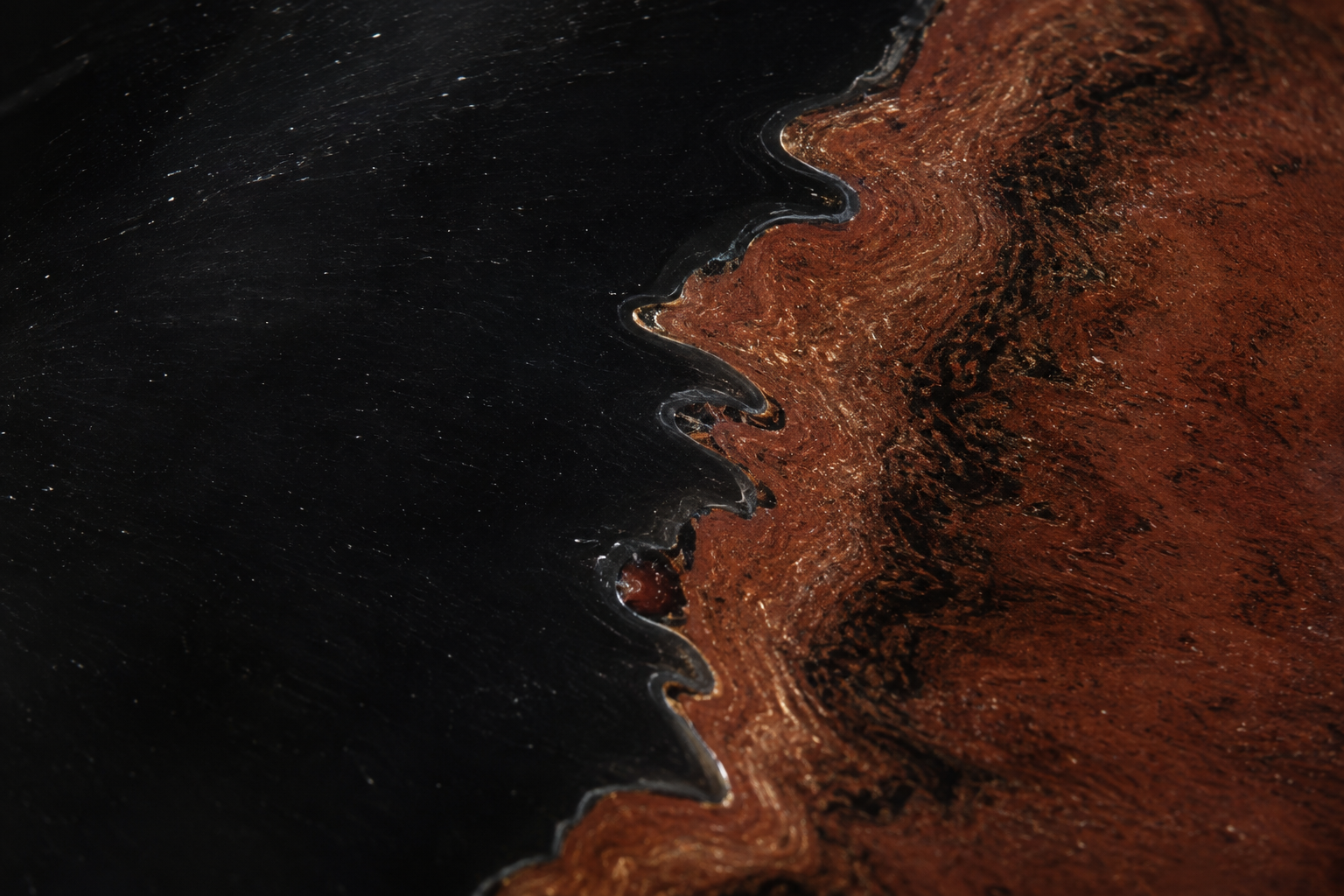
- Iron oxidation, in contact with air or water, iron oxidises into hematite and colours the glass reddish-brown. This is what produces mahogany obsidian;
- Gas bubble content, its distribution depends on local pressure. Aligned, it produces the sheen seen in gold sheen obsidian;
- Lava mixing, a viscous flow folds and refolds material from slightly different origins without ever fully blending it.
A tri-flow stone is therefore a cross-section through these boundaries. You're holding several local histories in one hand: here the lava cooled fast, there it oxidised, elsewhere bubbles lined up. To understand the whole process, see how obsidian is formed.
The three families of effects, combined
There's something satisfying about this variety: it brings together, in a single object, the three mechanisms that explain every obsidian variety.
Optical
Layers of magnetite or aligned bubbles diffract light. The effect depends on the angle.
Gold sheen · rainbow · localised "eye" sheen · fire · peacock velvet
Crystalline
The glass crystallises locally into spherulites. The opaque crystals form pale patches.
Snowflake · pumpkin · peanut
Structural
Flow, fractures or oxidation imprint a pattern into the material itself.
Mahogany · midnight lace · spiderweb
A fine tri-flow stone can show all three at once: an oxidised reddish-brown zone (structural), a zone with a gold sheen (optical), and sometimes pale spherulites (crystalline). Three distinct mechanisms, one stone.
That's what makes it, to my mind, the best teaching piece in the whole family. If you want to understand at a glance why obsidians can look so different while all being the same glass, hold a tri-flow up to a window.
The properties credited to tri-flow
As with every recently named variety, there's no ancient tradition specific to tri-flow. The correspondences circulating today were formulated by analogy with the idea of bringing together.
It's generally credited with:
- integration: bringing together parts of oneself that are kept separate, its dominant symbolism;
- balance between different forces, by analogy with its zones that coexist without blending;
- versatility: some present it as combining the qualities of the varieties that make it up;
- protection and grounding, shared by every obsidian.
An honest caveat, the idea that a tri-flow "combines the properties" of three varieties is appealing, but it comes from analogical reasoning, not an established tradition. If a specific correspondence matters to you, it's better to choose that variety directly.
As for chakras, it's linked to the root chakra like every obsidian, with extensions depending on which zones are present, sacral for the mahogany portion, solar plexus for the gold sheen. The full picture is in my guide to obsidian and chakras.
Recognising and buying
The main risk isn't counterfeiting, nobody fakes a tri-flow, demand is too low. It's more the opportunistic label: an ordinary mahogany stone resold at a higher price under a rarer-sounding name.
The markers that matter:
- The zones should be clearly defined, three genuinely distinct domains, not a continuous gradient. A classic mahogany fades gradually from black to brown; a tri-flow shows readable boundaries;
- Boundaries are never straight lines, they ripple, following the movement of the lava. A perfectly straight, sharp edge points to an assembled or glued doublet;
- All three zones should share the same polish quality, a marked contrast in shine can signal a bonded join;
- Ask for a cross-section view, the zones should carry through the thickness of the stone, not just sit on the surface.
On price, there's no established benchmark: the market is too narrow. Treat it like a fine-quality mahogany stone, with a reasonable premium for the rarity of the pattern, and be wary of prices pitched at fire obsidian levels, which is nowhere near as rare in comparison. My benchmarks are in obsidian price and value.
Mineral data sheet
- Nature
- Natural volcanic glass (mineraloid, amorphous)
- Colour
- Black, reddish-brown, and a third variable zone (gold sheen, pale or translucent)
- Source of pattern
- A cross-section through several domains of the same flow
- Status
- A name with no fixed definition, the loosest in the family
- Composition
- Silicon dioxide (SiO₂), iron oxides, variable inclusions
- Hardness (Mohs)
- Around 5 to 5.5, varying by zone
- Sources
- Mexico and the United States, depending on the flow
- Typical form
- Individually cut pebbles and cabochons
- Chakras
- Root, with extensions depending on the zones present
- Tradition
- Recent: a modern lapidary trade name
Care and cleansing
One particularity here: since the three zones don't share exactly the same composition, they don't react identically. So follow the care routine for the most fragile zone.
- Cleaning, a soft, dry cloth. If the stone has crystallised zones, they're softer and scratch faster;
- Cleansing, smoke cleansing is preferable. Oxidised zones, richer in iron, don't handle acids well: no vinegar or lemon. Avoid salt;
- Charging, moonlight, without prolonged sun exposure;
- Knocks, the boundaries between domains can be lines of weakness. Handle the stone carefully and store it alone.
The full run-down is in my guides to cleansing and charging obsidian.
Good to know, the properties described here come from crystal healing, a wellbeing practice based on tradition and belief. They are not a medical claim, do not treat any condition, and never replace advice from a health professional. See also obsidian, dangers and precautions.
Frequently asked questions
What is tri-flow obsidian?
Is tri-flow an official variety?
Why does one flow produce several different-looking stones?
Does tri-flow combine the properties of three varieties?
How do you spot a glued assembly?
How much does tri-flow obsidian cost?
My handmade obsidian pieces
Bracelets, necklaces, pendants and rings in natural obsidian, shaped one by one in my studio in France.