
Description
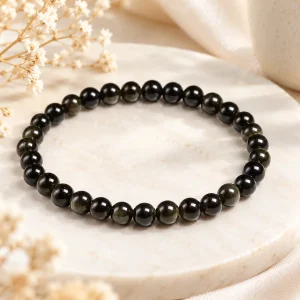
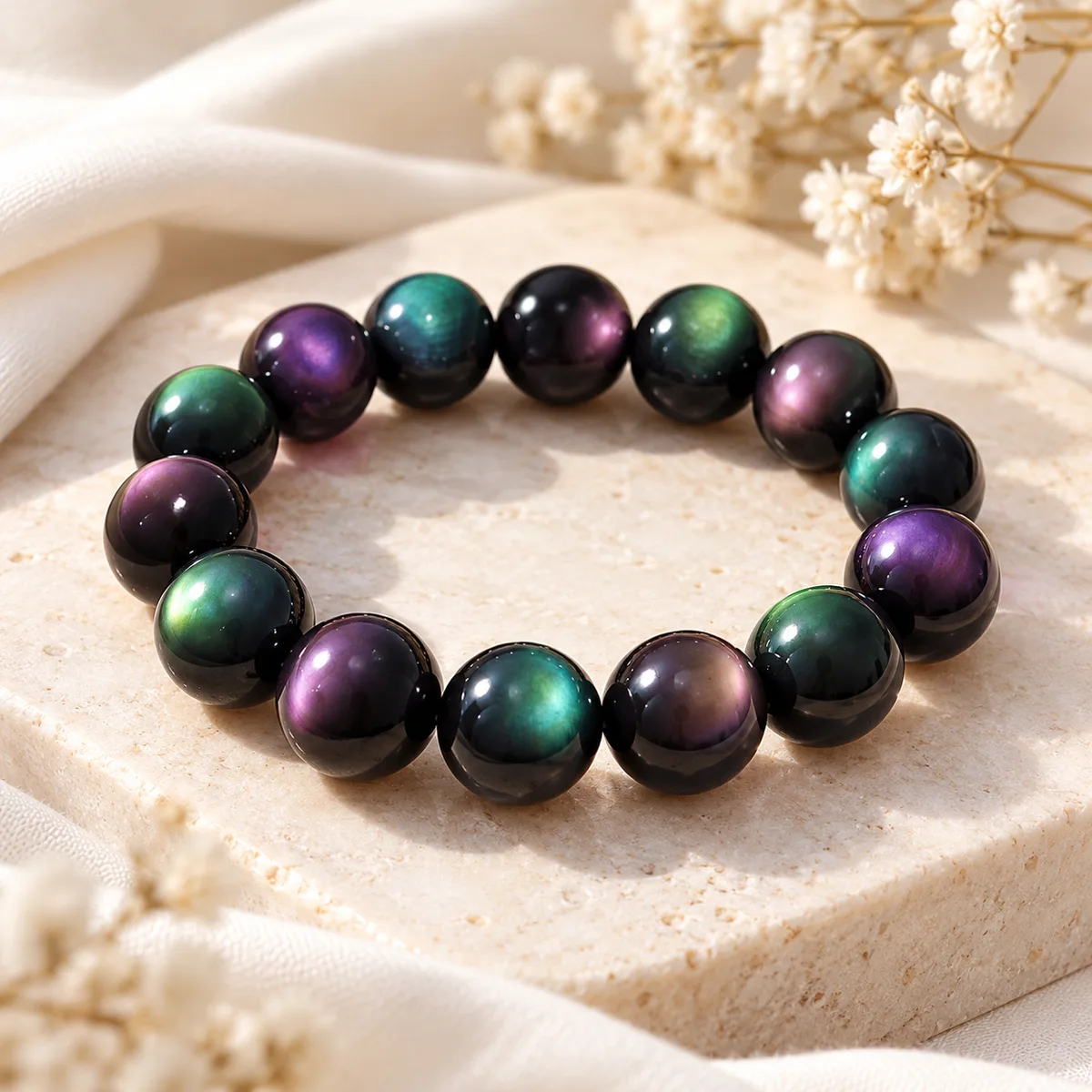
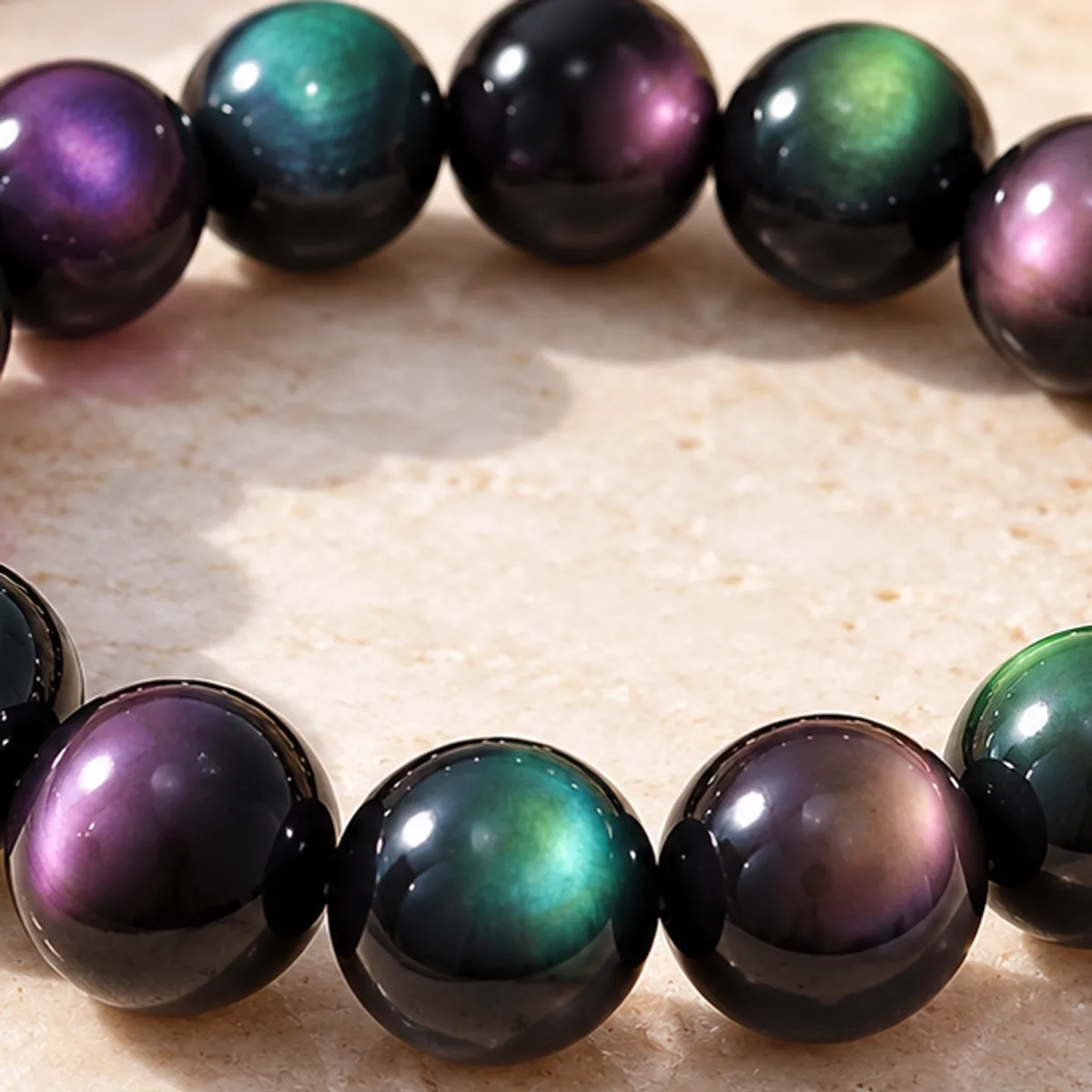
About fifteen rainbow obsidian beads of 12 millimetres. Under raking light each dome opens onto green, violet and bronze rings. Head on and under a ceiling light they go black again. It is the most capricious stone in the catalogue, and the most spectacular when it agrees.
The iridescence comes from magnetite inclusions arranged in very thin layers inside the glass. Light reflects off several layers at once and the waves recombine: it is the same phenomenon as on a film of oil or a soap bubble, not a colored deposit. The colours depend on the thickness of the layers, and so change from one bead to the next. The obsidian varieties set out that family.
Diameter is not a matter of looks here, it is a matter of legibility. The colored rings form concentric circles whose spacing is set by the stone, not by the size of the bead. On an 8 mm bead you see only a portion of a ring and the effect looks like a vague green reflection; at 12 mm the bead holds the whole circle and the figure reads. That is what separates this strand from the finer rainbow bracelet already in the catalogue. Both are here.
The reservation is blunt: this stone disappoints indoors. It needs a direct source and an angle, and under diffuse office lighting it stays a slightly grey black strand. Every photograph of a rainbow obsidian product is taken with a light placed on purpose, mine included. If you work under fluorescent light all day, take a golden obsidian instead, which holds up better in flat light.
Crystal lore makes rainbow obsidian a stone of harmony, by analogy with its colours. None of that is proven, and no piece of jewellery heals anything. I have gathered separately what tradition attributes to obsidian, in the conditional from start to finish.
- Real rainbow obsidian, about fifteen round 12 mm beads.
- The large diameter holds the whole colored ring: that is what makes the figure readable.
- It needs direct light and an angle: under diffuse lighting the strand looks black.
- Hand-strung in France on braided elastic cord, no clasp.
What to know before you wear it
 |  |  |
The specifications
- Stone
- Rainbow obsidian, volcanic glass with magnetite inclusions
- Bead diameter
- 12 mm
- Number of beads
- About 15
- Wrist size
- 17 to 19 cm, elastic
- Stringing
- Braided elastic cord, no clasp
- Weight
- About 45 g
- Stone origin
- Mexico
- Gender
- Unisex
- Brand
- Bijoux Obsidienne

Why rainbow obsidian needs large beads
Sorting rainbow obsidian is not done under the workshop lamp but at the window, and it takes two hands: one to hold the bead, one to turn it slowly. A bead gives its ring along a single axis, and if the drilling falls crooked the ring ends up on the edge, invisible on the wrist. Out of a hundred beads, about thirty are drilled the wrong way. They are not bad, they are unusable here.
The catalogue already holds a rainbow bracelet, in finer beads and cheaper. This one does not replace it, it answers a complaint I kept getting about the other: you cannot see the colours. That was true, and it was a question of diameter. Both are here, and the obsidian guide explains the material.
Out of thirty drilled rainbow beads, about ten carry their ring on the edge. Invisible on the wrist.
Obsidian does not mind water, but it chips on impact and scratches against hard metal. On 12 mm beads one knock on the corner of a table is enough. Take the bracelet off before exercising, a soft cloth is enough, never an ultrasonic bath. Cleaning an obsidian piece covers the rest.